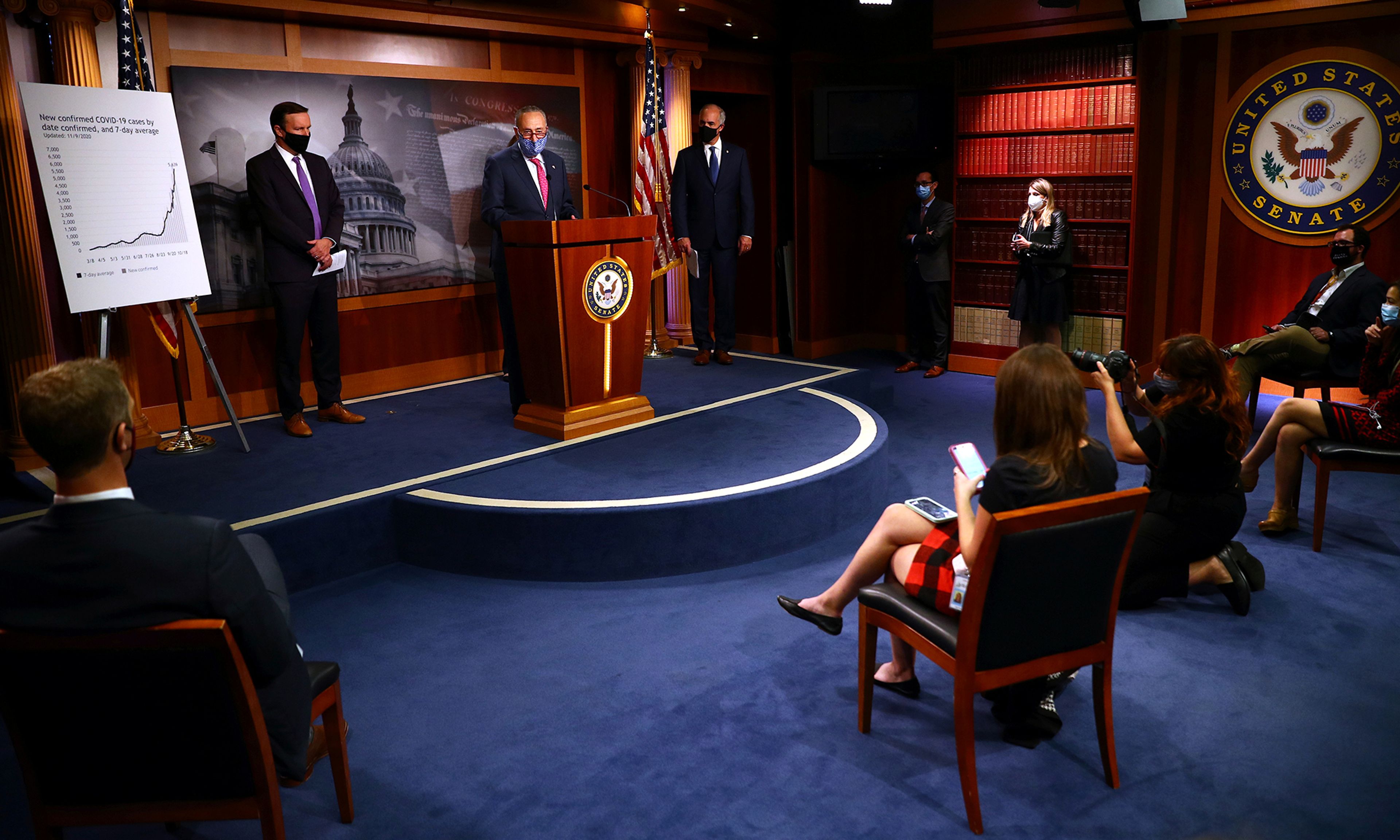
Hours before the polls closed on Election Day, former Senate majority leader Harry Reid made a bold prediction: Democrats would take control of the Senate by defeating at least seven sitting Republican senators.
“I think we’re going to win in Colorado, we’re going to win in Montana, we’re going to win in Maine, we’re going to win in North Carolina,” Reid said on MSNBC. “We’re going to win in Arizona, we’re going to win in Iowa, and we’re going to win in Alaska.”
Reid was almost entirely wrong. As expected, Republicans easily picked up a seat in Alabama and Democrats easily picked up a seat in Colorado. Arizona Republican Martha McSally outperformed her poll numbers but still lost to Democrat Mark Kelly by 2.5 points. But Senate Democratic candidates came up empty everywhere else. When the dust settled, Republicans had secured 50 Senate seats heading into 2021 — with control of the Senate to be decided by two runoff elections in Georgia on January 5.
A good deal is riding on the outcome of the runoff elections. “Now we take Georgia, then we change America!” Chuck Schumer, the Senate Democratic leader, exclaimed as he celebrated the projection of Biden’s victory in New York on November 7. But the results so far — with Democrats held to at best a 50–50 Senate with Kamala Harris as the tiebreaker — are likely to keep progressives from fulfilling some of their wildest legislative dreams over the next two years.
What went wrong for Democrats? The most surprising Senate result was Republican Susan Collins’s big win in Maine. With 90 percent of the vote reported, Trump was losing Maine to Biden by ten points; Collins was winning by eight points. Not a single public poll showed Collins with a lead all year. Collins was down only a couple of points in a couple of preelection polls, and she still had decent odds of winning — a two-in-five shot, according to FiveThirtyEight — but no one predicted a blowout.
Vastly outperforming a Republican presidential candidate is something Collins has done before. In 2008, when John McCain lost Maine by 17 points, Collins won reelection by 23 points. But in 2020, Democrats believed that Collins’s votes for the confirmation of Supreme Court nominee Brett Kavanaugh and against the conviction of President Trump in his impeachment trial would doom the moderate Republican. Collins was able to honestly maintain her reputation for independence, however, by breaking with the party on other key votes. She helped kill a bill to partially repeal Obamacare in 2017, but she also voted for the Trump tax cuts. She voted against the confirmation of Amy Coney Barrett to the Supreme Court because Republicans had blocked Obama nominee Merrick Garland in 2016. But Collins also sliced and diced her Democratic opponent Sara Gideon at their final debate when Gideon refused to state her position on packing the Supreme Court.
In 2016, several Republican senators ran far ahead of Trump in many states, including Arizona, Georgia, Ohio, and Iowa. But in 2020, the only state besides Maine that had a lot of ticket-splitting was Nebraska, where Trump won by 19 points and Republican senator Ben Sasse won by 40 points. Sasse benefited from running against a scandal-plagued opponent (the state Democratic Party rescinded its endorsement of Sasse’s opponent after reports that he had made an extremely lewd and disparaging comment about a female campaign staffer). Still, Sasse’s outperforming Trump was notable, given that so many Republicans fear getting on Trump’s bad side and Trump was all but telling Nebraska Republicans in the closing weeks of the campaign not to vote for Sasse because the Republican senator had criticized Trump.
Republican Senate candidates in most other states ran less than a few points ahead of or behind President Trump.
While Trump appeared likely to lose Georgia by 0.2 points, David Perdue ran 1.8 points ahead of Democrat Jon Ossoff as the race advanced to a runoff. The key Republican victory, in addition to Maine, that put control of the Senate within reach for Republicans was North Carolina. While some absentee ballots had not been counted as we went to press, Republican Thom Tillis was leading Cal Cunningham by 1.8 points. (Trump led Biden by 1.4 points in the state.) Cunningham may very well have lost the race because of a scandal of his own making. Before news broke that Cunningham had had an affair with a veteran’s wife, private GOP polling showed Tillis running well behind Trump. Cunningham faced allegations of more than one affair, and the Washington Post reported that Trump (who is something of an expert on the subject) told donors at a private fundraiser in late October: “I think Tillis is getting back in this one, because his opponent ended up having more affairs than you’re allowed to have at one time.”
In some states, Trump did much better than polling suggested. The average of polls underestimated Republicans in Iowa for the fourth consecutive election. Trump carried the state by eight points; Republican senator Joni Ernst won by seven points. Republican Senate candidates won by double digits in red states — South Carolina, Texas, Kansas, and Montana — where public polls showed competitive races this year.
Were any of the blowout elections ever close to begin with? It’s a big question as the polling industry draws scrutiny over its 2020 errors.
Private GOP polling consistently showed Collins with a lead this summer when public polls showed her trailing, but one GOP internal poll just before the election showed the race tied. Senate Republicans dropped in polls across the country after the first presidential debate and President Trump’s COVID diagnosis, but their numbers rebounded shortly thereafter. The stellar performance of Amy Coney Barrett at her Senate confirmation hearing likely helped Republicans across the country, as did the final Trump–Biden debate.
The Senate outcome is drawing more attention, but the election results were more of a surprise to House Democrats, who greeted news of Donald Trump’s defeat with recriminations rather than celebrations.
“We need to not ever use the words ‘socialism’ or ‘socialist’ ever again,” Virginia Democrat Abigail Spanberger told her colleagues in a conference call that was leaked to the press. “If we run this race again we will get f***ing torn apart again in 2022.”
Professional prognosticators expected House Republicans to lose seats on November 3, but the GOP ended up gaining seats. At press time, with mail-in ballots still being counted in California and New York, it wasn’t clear just how many seats the party had won, but House Republicans thought they’d most likely end up with anywhere from 208 to 212 — not far from the 218 needed for a majority.
“This is going to be the most narrow majority in [at least] 20 years,” Minnesota congressman Tom Emmer, chairman of the National Republican Congressional Committee, tells National Review. “If we don’t have it this time, we will have the majority in two years.”
Emmer attributes the GOP gains to several factors, including the Democrats’ leftward lurch, Nancy Pelosi’s intransigence on another COVID-relief bill, and the diverse field of GOP candidates.
A lot of attention has been given by the press to one kook who will join the ranks of the House GOP caucus: Marjorie Taylor Greene, who promoted deranged conspiracy theories in the past, defeated a neurosurgeon in a GOP primary in deep-red northwest Georgia this summer.
But the GOP candidates who took over Democratic seats are impressive individuals — all of whom happen to belong to racial minorities, be veterans, or be women (sometimes representing more than one of those demographics).
Outside of Charleston, S.C., Republican Nancy Mace, the first woman to graduate from the Citadel, took back a seat from incumbent Democrat Joe Cunningham.
In Oklahoma City, Republican state senator Stephanie Bice became the first Iranian American elected to Congress, defeating Democrat Kendra Horn.
In New York City, assemblywoman Nicole Malliotakis, the daughter of Greek and Cuban immigrants, won the Staten Island district represented by Democrat Max Rose.
In Southern California, Orange County Board of Supervisors chairwoman Michelle Steel, who is Korean American, flipped a district from blue to red. Young Kim, the first Korean-American Republican elected to the state legislature, also appeared on track to win a Democratic district that straddles Los Angeles and Orange Counties.
While it wasn’t enough for a House majority, the GOP gains in the suburbs — where the party suffered a bloodbath in 2018 — were enough to spook Democrats such as Virginia’s Spanberger, who represents a district outside of Richmond and narrowly hung on.
Republicans also picked up a few seats in the Midwest: Former newscaster and state representative Ashley Hinson won in northeast Iowa, Iraq War veteran Peter Meijer won in central Michigan, and former state senator Michelle Fischbach won in western Minnesota. “The Democratic Party that my grandfather loved is dead,” says Minnesota’s Emmer.
And there were signs of a new Republican Party coming to life. Both Trump and down-ballot Republicans improved their performance among Hispanic voters in several districts.
In South Florida, Republicans Maria Elvira Salazar and Carlos Gimenez ousted, respectively, incumbent Democrats Donna Shalala and Debbie Mucarsel-Powell.
In New Mexico, Republican Yvette Herrell, a former member of the state house who is also a member of the Cherokee Nation, defeated an incumbent Democrat by seven points.
In Texas, Republican Tony Gonzalez kept a district along the Rio Grande in the GOP column. The district, represented by retiring GOP congressman Will Hurd, has seen close races decided by roughly a point or less in 2016 and 2018. Gonzales won it by three points, as Trump made some of his biggest gains relative to 2016 among working-class Hispanic voters in that district.
Some races were still too close to call as we went to press. In California, Congressman Mike Garcia, a former Navy fighter pilot who flew combat missions over Iraq, was fighting to hold on to a seat north of Los Angeles that he had flipped from blue to red in a special election earlier this spring. In Utah, it wasn’t clear whether former NFL player Burgess Owens took back the Salt Lake City seat once held by Mia Love. (If elected, Owens would join Florida’s Byron Donalds, who won a competitive GOP primary in August, as one of two African Americans in the House GOP caucus next year.)
Republicans insist these results should be surprising only to those relying on polls conducted by Democrats or media outlets. “Our polling was sound throughout the cycle — it’s reflected in the seats that we won,” says Michael McAdams of the National Republican Congressional Committee. “We told [the press] time and again that these seats are going to flip, and they didn’t want to believe us. They bought the Democrats’ spin, hook, line, and sinker.”
For now, with control of the Senate uncertain, all eyes turn back to Georgia. It’s a matter of debate how much Democrats could achieve in the next two years with a divided Senate. To pass some transformative legislation, they’d need West Virginia moderate Joe Manchin to break his promise to vote to keep the filibuster. And then they’d need the vote of Manchin, or Collins if Manchin defects on a bill. Given that Obamacare was passed in 2009 with the help of supposedly moderate Senate Democrats, the risks involved in a 51–50 Democratic Senate would be real.
The outcome in Georgia matters also because Republicans have a more difficult Senate map in 2022. They’ll be trying to hold seats in six battleground states — Pennsylvania, North Carolina, Wisconsin, Georgia, Florida, and Iowa. Democrats are playing defense in only three battlegrounds: Arizona, Nevada, and New Hampshire.
It’s hard to know what American politics will look like, and which party will have the advantage, in two years. But you can be sure that for the next two months Republicans and Democrats across the country will have Georgia on their mind.












Comments