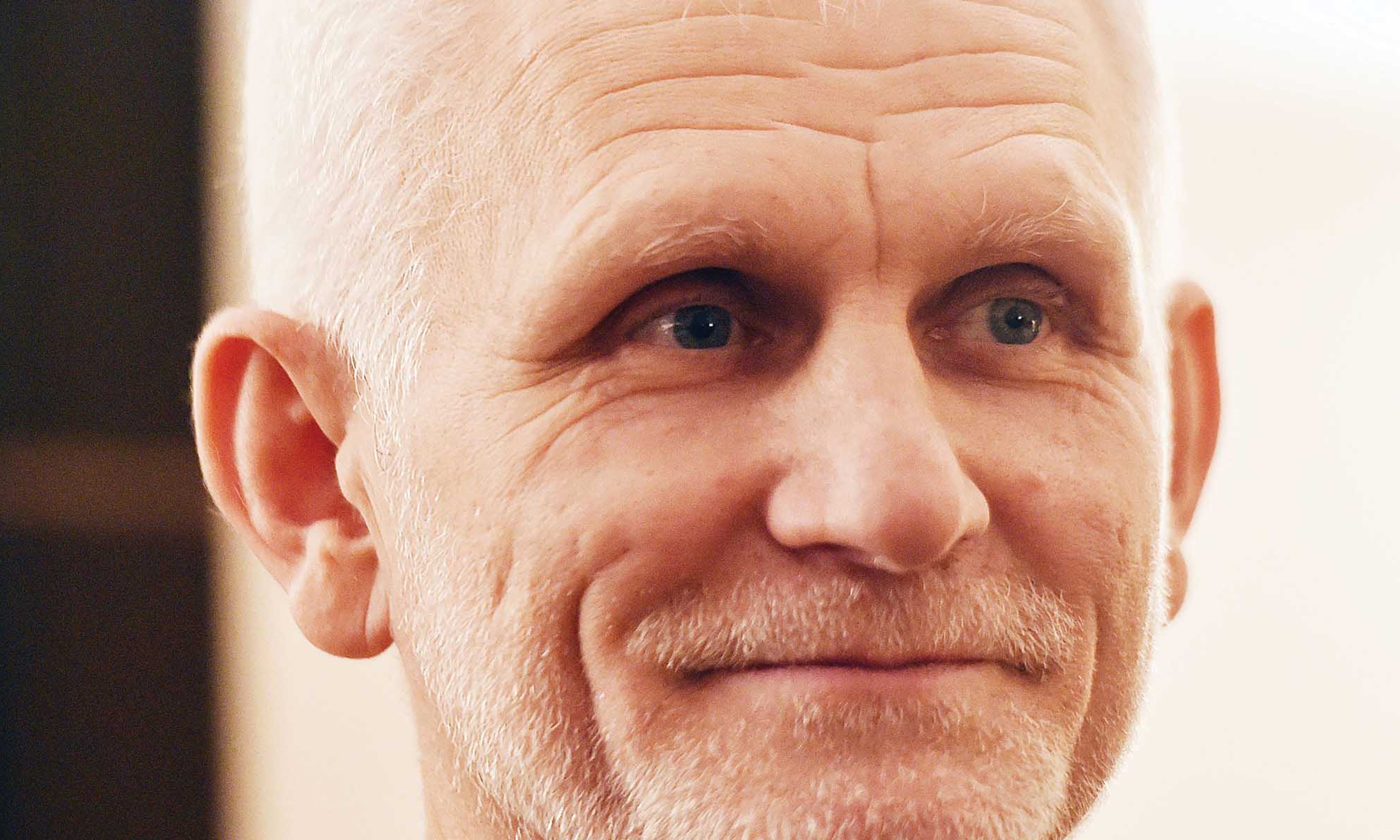
The 2022 Nobel Peace Prize has the character of a freedom prize. Often, peace and freedom blend. What is peace, anyway? It is more than the absence of war. It is not war either. The Norwegian Nobel Committee has explored this tricky question of peace since 1901, when the Nobel prizes began.
Last year’s peace prize, too, had the character of a freedom prize. It was given to honor a specific freedom: press freedom. Its recipients were Maria Ressa, of the Philippines, and Dmitry Muratov, of Russia. Both of them work under the gun. Muratov is the editor-in-chief of Novaya Gazeta, an independent newspaper. Over the years, six of his colleagues at the paper have been murdered.
Novaya Gazeta is effectively banned in Russia, like all other independent media. But Muratov and a remnant are doing all they can to keep reporting and publishing, whenever and however feasible. They are not leaving Russia either. In a recent interview with Reuters, Muratov said, “We will work here until the cold gun barrel touches our hot foreheads.”
There are three recipients of this year’s peace prize — one individual and two organizations. The individual is Ales Bialiatski, a Belarusian democracy activist and political prisoner. (In Belarus, democracy activists tend to be political prisoners.) One of the organizations is Memorial, which is the largest civil-society and human-rights group in Russia. Is “is” the right word? Like civil society in general, Memorial has been abolished, officially. But, like Novaya Gazeta, it is operating in whatever ways it can. The second organization to win this year’s prize is from Ukraine: the Center for Civil Liberties.
In its press release, the Nobel committee said,
The Peace Prize laureates represent civil society in their home countries. They have for many years promoted the right to criticise power and protect the fundamental rights of citizens. They have made an outstanding effort to document war crimes, human right abuses and the abuse of power. Together they demonstrate the significance of civil society for peace and democracy.
Since 1994, Belarus has been ruled by Alexander Lukashenko, a dictator in the Putin mold. Actually, you might say that Vladimir Putin is a dictator in the Lukashenko mold, because Lukashenko came first. In any event, they are both from a familiar mold. The Belarusian is a junior partner of the Russian in the Ukraine war.
Last year, they played hockey together. The game was in St. Petersburg, and Lukashenko’s son, age 17, was also on their team. On the other team were retired Russian hockey stars. The Putin-Lukashenko team won 18 to 7. Putin scored seven goals, Lukashenko scored two, and young Lukashenko scored four. The other team was careful not to put up too much of a defense.
Putin and Lukashenko would encounter a sterner defense from the Ukrainians.
Ales Bialiatski, the imprisoned laureate, was born in 1962. He was already a democracy activist in the early 1980s, when the Soviet Union had about a decade to go. In 1996, he founded the Viasna Human Rights Center. (“Viasna” means “spring.”) He was imprisoned from 2011 to 2014. He was put into prison once more last year.
The Nobel committee has given its award to political prisoners before. The award for 1935 went to Carl von Ossietzky, a prisoner of the Nazis. Goering demanded that Ossietzky decline the prize. He said that, if Ossietzky did not, he would be casting himself outside “the community of the German people.” Ossietzky said he would not decline, adding that he was a better German than the Nazis. He died, still a prisoner, in 1938.
By the way, when Andrei Sakharov, the great Russian scientist and dissident, won the peace prize in 1975, the Kremlin denounced him as an “anti-patriot.” Others thought that he represented the noblest, and best, Russia.
In 2010, the Nobel committee gave its prize to a Chinese political prisoner, Liu Xiaobo. Like Ossietzky, he died a prisoner, in 2017.
Memorial was founded in the late 1980s, at the instigation of Sakharov, who served as its first chairman. Its purpose was twofold: to investigate and tell the truth about the past, and to promote democracy in the present. Memorial has long been known as “the conscience of Russia.”
The first public event of the organization concerned another country — China. In the summer of 1989, after the Tiananmen Square massacre, members of Memorial protested outside the Chinese embassy in Moscow.
Liu Xiaobo was a protest leader at Tiananmen Square, and was imprisoned, for the first time, thereafter.
Natalia Estemirova once worked for Memorial, and for Novaya Gazeta. She was murdered in 2009. Yuri Dmitriev dedicated himself to uncovering mass graves from the Stalin period. He has been a political prisoner since 2016.
Putin and his cohort have steadily re-Sovietized Russian society. As Memorial has documented, there are more political prisoners in Russia today than in the late Soviet period. When the Kremlin was outlawing Memorial in December 2021, the chief prosecutor, Alexei Zhafyarov, said, “Memorial creates a false image of the Soviet Union as a terrorist state.” He further said that Memorial “makes us repent of the Soviet past, instead of remembering glorious history.”
Shortly before the organization was banned, Dmitry Muratov was giving his Nobel lecture in Oslo. He said, “Memorial is not an ‘enemy of the people.’ Memorial is a friend of the people.”
In exile, members of Memorial are putting out a newsletter. Its latest letter said that the organization had won the Nobel Peace Prize; that the Kremlin had seized Memorial property; and that Yuri Dmitriev, age 66, was enduring solitary confinement.
The Nobel committee made its announcement about the 2022 prize on October 7. Four days earlier, Oleksandra Matviichuk had been in New York, for a session of the Oslo Freedom Forum. Born in 1983, she is a Ukrainian human-rights lawyer, and she is the executive director of the Center for Civil Liberties — the third recipient of the 2022 prize. I spoke with her on that day, in New York.
About the war in her country, she said, “This war is not a war between two states but between two systems: authoritarianism and democracy. Putin started this war not because he was afraid of NATO. Putin is afraid of the idea of freedom.” She also said, “It is becoming obvious to more and more people that if we do not stop Putin in Ukraine, he will go farther.”
Repeatedly, Matviichuk has stressed that Ukrainians are not fighting for mere territories — though those territories are Ukrainian, and rightfully theirs. They are fighting for the people in those territories.
“This war started not in February 2022 but in February 2014,” she said in our interview. It was in 2014 that Russia invaded, occupying parts of eastern Ukraine. It was on February 24 of this year that Russia launched its all-out assault. “I had been documenting war crimes for eight years already,” Matviichuk continued. “I am very aware of what Russians did to people in the occupied territories. I have interviewed hundreds of people.”
And? “They have told me how they were beaten, how they were raped, how their fingers were cut off, how they were crammed into wooden boxes, how they were tortured with electricity. One lady reported that her eyes were dug out with a spoon.”
So, “we will never leave our people alone in these occupied territories. I know what I’m talking about. It would be inhuman to leave them in this gray zone without any protection.”
Matviichuk has done onerous work, documenting unspeakable crimes, though she speaks of them anyway. I asked her how she holds on to her sanity. She said, “I will be honest: In August, I went through a very difficult period of exhaustion. For the first time, I had no energy to get up. But I overcame it.” She then said, “We are faced with challenges that require superhuman efforts of us.”
Ukrainians, she said, “are fighting for freedom in all senses: the freedom to be an independent state, not a colony of Russia; the freedom to be Ukrainians, to have our own language and culture, as other nations of the world do; the freedom to have a democratic choice — a chance to build a country where the judiciary is independent, human rights are protected, the government is accountable, and the police serve the people.”
I asked her, “How important is the support of the United States?” She barely had the words to express the importance of American support. “It’s extremely important, tremendously important,” she said. She explained that, in a 20-year career, she had worked in various systems of international law. “And there is no mechanism, no legal instrument, that can liberate even one person from Russian captivity. The Russians kill us, and the United States provides us weapons.”
It may be “weird,” she said, to hear this kind of talk from a human-rights lawyer. “But I want our people to survive, and that’s why we are grateful for the United States, and why we ask for long-range weapons in sufficient amounts, because now we have a window of opportunity to liberate more Ukrainian territories, as we have been doing since September of this year.”
If it is weird to hear this kind of talk from a human-rights lawyer, is it weird — weirder still — to hear it from a peace laureate? Or the executive director of one? What kind of peace laureate cries for weapons of war? One who wants to repel an invader, and to see her country spared subjugation.
“There was never a good war or a bad peace,” Benjamin Franklin said. In 1938, Clive Bell, the Bloomsbury figure, said, “A Nazi Europe would be, to my mind, heaven on earth compared with Europe at war.” That is a point of view. There are others.
“They make a desert and call it peace,” an unknown Roman said. In the 18th century, Beilby Porteus, the English churchman and abolitionist, said, “War its thousands slays, peace its ten thousands.” In the next century, Lajos Kossuth, the Hungarian hero, said, “I am a man of peace — God knows how I love peace. But I hope I shall never be such a coward as to mistake oppression for peace.”
One more quotation, this one from an American president. “We seek peace,” said Eisenhower, “knowing that peace is the climate of freedom.”
The European Parliament awards a Sakharov Prize for Freedom of Thought. Unusually, but understandably, the parliament gave its 2022 award to an entire people: the Ukrainian people. “They are standing up for what they believe in,” said the parliamentary president, Roberta Metsola. “Fighting for our values. Protecting democracy, freedom, and the rule of law. Risking their lives for us.”
When Sakharov won the Nobel Peace Prize, back in 1975, he said, “Even if what I am doing will not produce change in my lifetime, it is not useless, because it is a moral act. It is being true to what I believe in and must do.” We can be sure that Ales Bialiatski, and the Memorial people, and Oleksandra Matviichuk and her colleagues feel just the same.









Comments