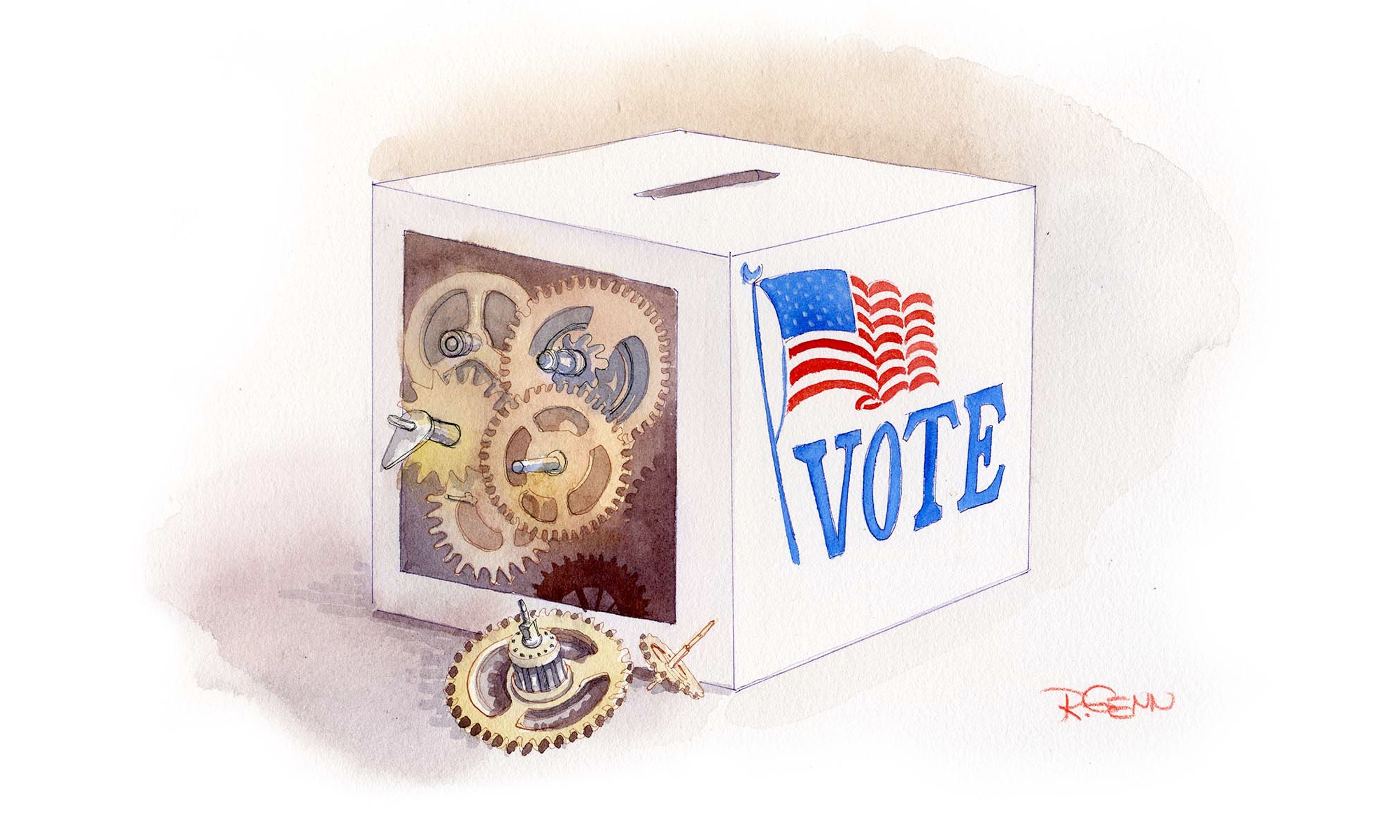
Conservative and Republican voters are mightily tired by now of being lectured about whom they shouldn’t vote for. We are all well aware that these conversations don’t even happen on the blue side of the aisle. But, then, we’re supposed to be the grown-ups. And there is one particular set of elections in 2022 in which voters who value the American system really do need to think long and hard about whether they should vote for their state’s Republican candidate — or even consider voting Democratic. I speak of the 27 statewide elections for secretary of state.
In most states, the secretary of state runs the election system. In 35 states, this is an elected office; in most others, it is appointed by the governor. The bulk of the elected secretaries of state are up for reelection this year. In some states, Republicans are running excellent candidates, such as Georgia’s incumbent, Brad Raffensperger, or Colorado challenger Pam Anderson. But the party is also running some novices who frankly have no business being entrusted with the authority to oversee elections. If you see conservatism as being grounded in a Burkean respect for rules, traditions, order, and established institutions, and therefore want powerful public offices to be held by responsible adults, what are you to do?
Two years after the 2020 presidential race, there are many reasonable complaints that the campaign and the election were conducted in ways that were unprecedented, unfair, and in some cases illegal. The once-in-a-century pandemic that frightened many voters away from in-person polling places was partly a justification for these methods and partly an excuse. Voting procedures were changed, sometimes without the consent of state legislatures; private money distorted how public resources were deployed by election administrators. Grievances over these changes were exacerbated by the conduct of private actors, such as when social media barred the New York Post from sharing important and truthful journalism.
Trump was able to harness grassroots energy for his “stop the steal” movement from voters who saw the abrupt shift in election procedures as evidence of a conspiracy to steal the election.
Yet the most scrutinized election in American history, resulting in more than five dozen lawsuits and monthslong postelection audits, has failed to yield plausible evidence that any illegality changed the outcome. If one counts every legal vote, and only every legal vote under the proper standards, Joe Biden won and Donald Trump lost. It is impossible by now to honestly dispute this. We were treated to a nearly endless procession of crackpot theories to the contrary that failed to withstand scrutiny, but sober elected Republicans, including Raffensperger and other secretaries of state, as well as governors, played crucial roles in upholding the results in the face of the storm. The system held because good people did their jobs. This likely won’t be the last time good people are needed to do so.
But the conspiracy theories were fed in part by decisions made by Republicans in office. Chief among those was the misbegotten decision by the Republican legislatures of Pennsylvania, Wisconsin, and Michigan to prevent pre-canvassing of mail-in ballots, a process used in other states (such as Florida) to expedite their counting on Election Day. The result was a backlog of Democratic-leaning mail-in ballots, whose tabulation at the end produced what looked like “late-night vote dumps” swinging those states to Biden. Better administration of the count would have spawned fewer conspiracy theories.
That is only one way in which the people who run elections matter. Secretaries of state issue election guidance on many details that are too granular to be covered in legislation. They sometimes defend election laws from challenges in court and in public. And they can gum up the works if they refuse to certify results, as happened in one New Mexico county during primary season earlier this year, requiring a court to step in. While secretaries of state have limited power to simply block the certification of elections, a rogue election official could create a lot of havoc in a contested race for president, the Senate, or governor. Nobody should want that.
Some Republican candidates, such as Jim Marchant in Nevada, have floated tearing up the state’s entire list of registered voters and starting over, a terrible idea that would multiply public expense and disruption while purging many legal voters from the electorate. Wes Allen in Alabama wants to withdraw the state from the interstate database for keeping voter rolls updated, a move that would enable more voter fraud.
Many of the willing believers and participants in Trump’s conspiracy theories, which fed the flames that led to the January 6 riot at the Capitol, remain undeterred. A number of “stop the steal” devotees responded to 2020 by deciding to run for the job of secretary of state themselves, aiming to replace the very people who saved the system from a graver crisis. This might be an inspiring story of civic engagement, featuring a diverse cast of characters, if the cause were not such a bad one. Marchant was a state legislator and failed congressional candidate who claimed that his own race was stolen. Kristina Karamo in Michigan was a poll watcher in the Detroit suburb of Oak Park who claimed to have seen election supervisors direct the counting of late-night fraudulent ballots; courts did not credit her charges.
Mark Finchem in Arizona was a member of the Oath Keepers militia who attended the January 6 rally. As a state legislator, Finchem led the fight for an audit of the vote in massive Maricopa County, which contains Phoenix and Mesa and is home to 4.4 million people. That audit produced nothing resembling sufficient evidence to overturn Biden’s victory in Arizona; millions of dollars of taxpayer money were spent in order to conclude that Biden won Maricopa County by a larger margin than the official tallies indicated.
Marchant, together with a figure from the QAnon conspiracy culture of the Internet, decided to launch a movement to capture secretary-of-state offices and other key state executive positions. “When my coalition of secretary-of-state candidates around the country get elected,” Marchant vowed at a Trump rally, “we’re going to fix the whole country, and President Trump is going to be president again in 2024.” They branded this the “America First” candidate slate and attracted donors such as MyPillow founder Mike Lindell.
Besides Marchant, the America First slate’s 17 candidates include Karamo, Finchem, Audrey Trujillo in New Mexico, Diego Morales in Indiana, Pennsylvania gubernatorial nominee Doug Mastriano (who if elected would appoint the Pennsylvania secretary of state), and Arizona gubernatorial nominee Kari Lake. Trujillo says that American elections are “no better than any other communist country like Venezuela or any of these other states where our elections are being manipulated.” Fellow travelers include Allen in Alabama, Chuck Gray in Wyoming, Kim Crockett in Minnesota, Monae Johnson in South Dakota, longer-shot candidates in Massachusetts, Connecticut, and Vermont, and a third-party challenger to the Republican incumbent in Ohio. Additional candidates lost Republican primaries in Georgia, Idaho, Kansas, Colorado, Arkansas, Nebraska, North Dakota, South Carolina, Wisconsin, and California.
So, what to do if one of these people is on your ballot? In elections for Congress or governorships, there is a fair argument that conservatives should not be asked to sacrifice their priorities on a vast menu of vital issues simply to register disdain for Republican candidates’ pandering to the conspiratorial fringe. But several of the Republican secretary-of-state candidates are that fringe, and they are running for offices where the subjects of their election crackpottery would be the entire focus of their job.
A number of the rogues may win. Democrats have been massively outspending them, pouring over $25 million and counting into competitive states, but voters furious at Democratic misgovernance may not be in the mood to split tickets. The Republican State Leadership Committee, the GOP campaign arm for a battery of state offices (including state legislatures and elected state courts), has proceeded gingerly. It says that it “cannot match what Democrats are spending on these races” and needs to “prioritize protecting our incumbents.” Thus far, it has gone on the air for only two secretary-of-state candidates: Raffensperger in Georgia and Anderson in Colorado. That leaves Marchant and his slate to fend for themselves.
In Wyoming, where Gray is running unopposed, the legislature is considering options to strip his office of some responsibilities in order to limit the damage he can do. Changing the rules to thwart the choices of the voters, however, has its own perils for faith in democracy.
Even voters pulling the lever for the rest of the Republican ticket could stand for good government by declining to support Marchant and similar candidates. Doing so would reduce the risks of a major constitutional crisis if Trump is on the ballot again in 2024. That would send a message that voters have a limit: They will not stand for handing over the running of elections to people who traffic in election conspiracy theories.
There are two counterarguments against helping Democrats win these elections, aside from the purely partisan case against giving any Democrat any space in which to build a farm team for statewide office.
The first is that electing Democrats is also not harmless. Even in the field of election administration, leaving Democrats in charge for the next four years invites mischief of its own, some of it lasting. It was Democratic rule-bending that helped feed so much of the mistrust in 2020 that Trump capitalized on in the first place. Most of the current Democratic candidates support a radical federal takeover of elections. Democrats may refuse to enforce election laws or may enter into consent decrees hobbling the state. And electing Democrats who won’t contest a Democratic victory does nothing to stop meritless contests of a Republican victory.
That said, in a number of these states, a Democratic secretary of state would have to deal with a Republican governor, legislature, and perhaps attorney general. In Arizona, a Democratic secretary of state would provide some check on Lake, who now leads in the governor’s race for reasons having little to do with election administration. Divided government may be the way to go.
The second counterargument against opposing these Republicans is that co-opting extremists can sometimes be more effective than squelching them. Putting the conspiracy theorists in charge of the boring work of running elections could force some of them to become more responsible and accept how the system really works. It could also lead some of their supporters to accept losing outcomes because they have faith in the people running the election. That may well be how some of this plays out. But, then, electing these people would do just as much to inflame conspiracy theories on the Democratic side of the aisle, and it’s a risk to bank on the hope that irresponsible people will grow while in office.
Every vote may count, and perhaps none more than a vote for the person who decides how the votes are counted. Conservatives should think long and hard before giving a vote to someone they can’t trust to do that with integrity.










Comments