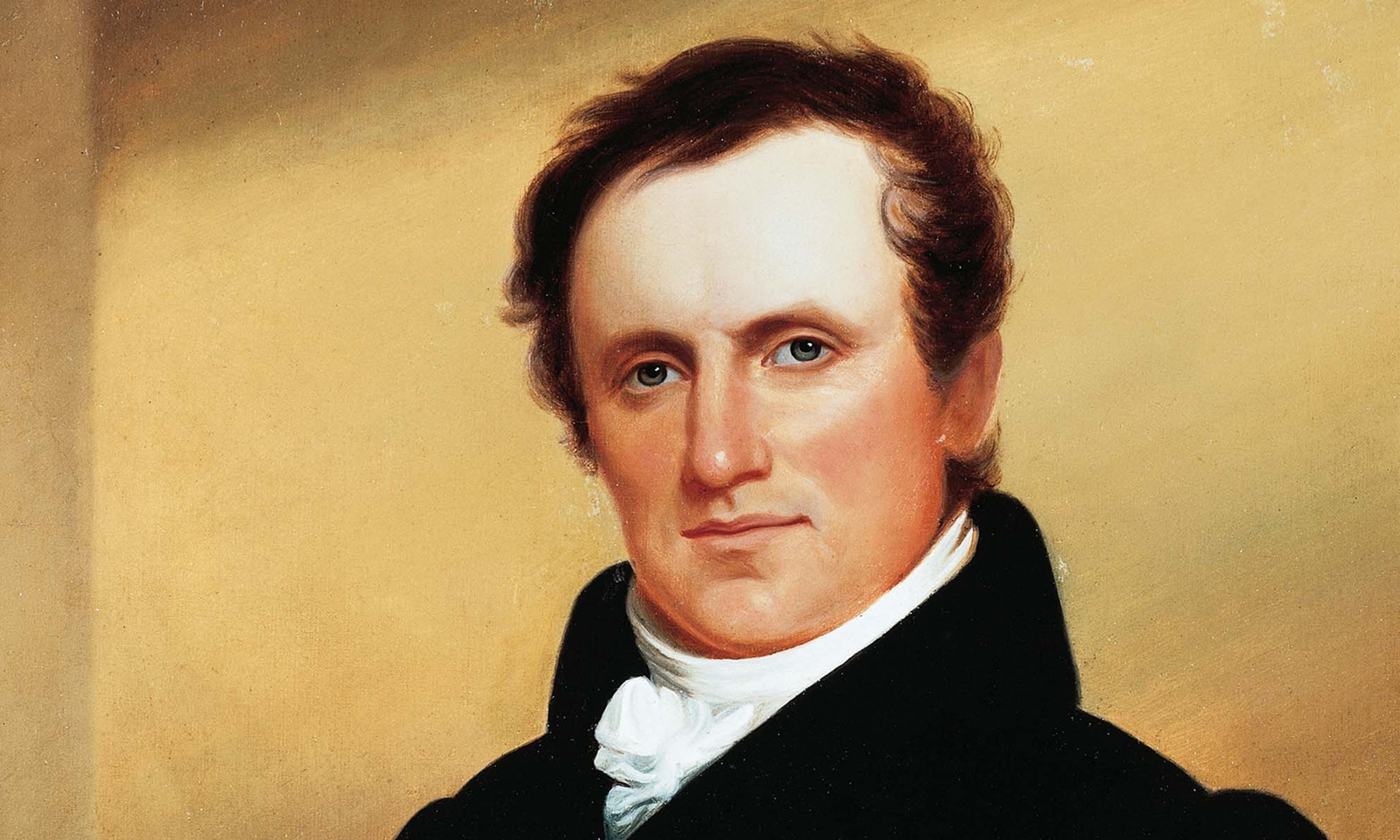
For many generations, James Fenimore Cooper was a household name. And his books were household books, so to speak. Everyone read the Leatherstocking Tales — a series of five novels, including The Last of the Mohicans. The title of that book has entered our language: “There won’t be any more like him, before long. He’s the last of the Mohicans.”
My impression is, Cooper has faded from public consciousness. Some people know Mark Twain’s mockery of his novels, rather than the novels themselves. Not everyone mocked the novels, far from it. Victor Hugo regarded Cooper as great. D. H. Lawrence called The Deerslayer — which belongs to the Leatherstocking Tales — “one of the most beautiful and perfect books in the world: flawless as a jewel and of gem-like concentration.”
I am touched by the thought of Schubert, on his deathbed, reading Cooper’s novels. (They were translated into many languages.) In his final days, Schubert did two things, mainly: correct the proofs of Winterreise (one of his great song-cycles) and read Cooper. The last letter he wrote was to his friend Franz von Schober, a poet and librettist. He asked whether Schober could find him more Cooper.
He wrote more than novels, Cooper did. He was a writer, and thinker, of parts. More on that in a moment.
Cooper was born the same year as the United States, as some people measure our national beginning: 1789. He grew up in Cooperstown, N.Y., founded by his father, who, among other things, served in Congress. Cooperstown today is known as the site of the Baseball Hall of Fame.
The “Fenimore” in “James Fenimore Cooper” comes from the writer’s mother, whose maiden name it was.
Cooper entered Yale College at the age of 13. After three years, he was kicked out, for assorted mischief. He joined the crew of a merchant vessel; he then joined the U.S. Navy. He would write frontier novels, yes, but many sea novels as well.
And in 1839, he wrote a history of the U.S. Navy — which by that point was about 40 years old.
A few years before that, he had written another nonfiction book: The American Democrat. The title does not refer to a particular person or to a member of a party. It refers to a type: What is an American democrat, or what ought such a person to be?
Cooper had spent about seven years in Europe: from 1826 to 1833. He and his family lived chiefly in Paris. When he returned, he surveyed the American landscape with a cold and troubled eye. He says, in his preface to The American Democrat,
A long absence from home has, in a certain degree, put the writer in the situation of a foreigner in his own country; a situation probably much better for noting peculiarities than that of one who never left it.
I read parts of The American Democrat in college. (I did not matriculate at 13.) I have rediscovered it in recent weeks. This book is periodically rediscovered, especially in times of worry — and America is never without worry for long. What are the fundamentals of our government and society? Ben Franklin said that we had a republic if we could keep it. Can we?
Cooper’s book has always been overshadowed by another book about American democracy, written at about the same time — a masterpiece by a French traveler. But I recommend cocking an ear to Cooper, as well as Tocqueville.
The American Democrat is an odd book, in addition to a worthy one. It’s like a textbook or primer — an America 101. It is not entertaining at all. There is nothing remotely novelistic about it. This is interesting, from a man who entertained countless readers with stories.
Cooper divides his book into 46 little chapters, or sections. Almost all of them have headings that begin with “on”: “On Republics,” “On Equality,” “On Representation,” etc. Virtually every topic is political — but, toward the end of his book, Cooper allows himself some words about “lifestyle,” as we would say today. The contemporary reader may smile at this:
The Americans are the grossest feeders of any civilized nation known. As a nation, their food is heavy, coarse, ill prepared, and indigestible. . . . The predominance of grease in the American kitchen, coupled with the habits of hasty eating . . .
To borrow a line from Marx (Groucho): I resemble that remark.
Like any author, Cooper appreciated sales, but this book was not designed to sell. It won him few friends, and lost him many. Fans of the novels were not fans of this. A villain of the book is the flatterer of the public (whoever he may be). Cooper is an anti-flatterer, if you will. He sees himself as a true friend of the public, in that he writes the truth (as he conceives it).
People pride themselves on “speaking truth to power” — leaders, big shots. In a democracy, this is very easy to do. Usually, you get nothing but applause for it. What is hard is speaking truth to “the people” — for, in a democracy, that’s where power lies.
Cooper writes,
The constant appeals to public opinion in a democracy . . . induce private hypocrisy, causing men to conceal their own convictions when opposed to those of the mass. . . . A want of national manliness is a vice to be guarded against, for the man who would dare to resist a monarch shrinks from opposing an entire community.
Pretty much everyone in my business knows politicians who say one thing in private — their true beliefs — and another when before a crowd. Moreover, the same applies to not a few media personalities.
About The American Democrat, you and I could talk and argue for hours. There is something to praise, or condemn, or question, or quote, on every page. Here and now, maybe we could have tastes of Cooper, on a few subjects — beginning with the responsibility of the voter, or the “elector,” as Cooper calls him.
That responsibility is grave. On the character of the officeholders, says Cooper, the character of the institutions depends. Thus, it is the “duty of every elector to take care and employ none but the honest and intelligent in situations of high trust.”
Every system of government has its dangers — some more than others, of course. “The peculiar danger of a democracy,” writes Cooper, “arises from the arts of demagogues.” So, again, “it is a safe rule, and safest of all, to confide only in those men for public trusts in whom the citizen can best confide in private life.”
Cooper sketches out demagogues. He gives us their characteristics. He does the same for anti-demagogues. But there is also a third group: “a large class of political men” who are not quite demagogues, but who dip into demagoguery or ride its wave, telling themselves that they are doing so for the “public good,” not their “private advancement.” Such men “lend themselves to the side of error.”
Not a little, Cooper worries about “the disgraceful desire to govern by means of mobs, which has lately become so prevalent.” Feeling aggrieved, and impatient of process — “all forms of law” — people try to get their way by force. “No civilized society,” says Cooper, “can long exist with an active power in its bosom that is stronger than the law.”
I think of John Adams and his famous warning: “Avarice, ambition,” and the like “would break the strongest cords of our Constitution as a whale goes through a net.” (Adams was a New Englander, and that simile must have come naturally to him.)
Cooper was often at odds with the press, and he has pointed things to say about the press. Here is a fetching phrase: “The press, like fire, is an excellent servant but a terrible master.” He further says,
Editors praise their personal friends and abuse their enemies in print, as private individuals praise their friends and abuse their enemies with their tongues. Their position increases the number of each, and the consequence is that the readers obtain inflated views of the first and unjust notions of the last.
This leads us to another subject — parties and partisanship:
Party is known to encourage prejudice, and to lead men astray in the judgment of character. Thus it is we see one half the nation extolling those that the other half condemns, and condemning those that the other half extols. Both cannot be right.
An additional statement to absorb: “No freeman, who really loves liberty, and who has a just perception of its dignity, character, action, and objects, will ever become a mere party man.” But that “mere” is important. Cooper goes on to say,
He may have his preferences as to measures and men, may act in concert with those who think with himself, on occasions that require concert, but it will be his earnest endeavour to hold himself a free agent, and most of all to keep his mind untrammeled by the prejudices, frauds, and tyranny of factions.
If people quote from The American Democrat at all, they tend to quote this: “Whenever the government of the United States shall break up, it will probably be in consequence of a false direction having been given to public opinion.” Bad actors fan popular passions. They prey on ignorance and resentment.
This is the weak point of our defences. . . . Opinion can be so perverted as to cause the false to seem the true; the enemy, a friend, and the friend, an enemy; the best interests of the nation to appear insignificant, and trifles of the moment; in a word, the right the wrong, and the wrong the right.
Cooper died in 1851, a decade before “the war came” (in Lincoln’s simple words). The problems of the 1860s make those of the 2020s seem a lovely picnic. And yet, listen to Spencer Cox, the governor of Utah, speaking at a press conference in September. He was talking about threats of violence to Mitt Romney and other politicians.
“Look, guys,” said Cox, “I’m not usually prone to hyperbole.” But the United States is “headed down a very dark path, and we’re further down that path than I think most people realize.”
Holding nothing back, Cox said, “There is a very real chance over the next couple of decades of a complete failure of our democratic institutions, of our republic. . . . If we don’t wake up as a society and if we don’t stop playing with fire, . . . we could end up in a very dark place.”
Even those who think this is too strong, or nonsensical, would probably agree with the following: America is still an experiment, all these years on — something relatively new and risky in the affairs of men.












Comments