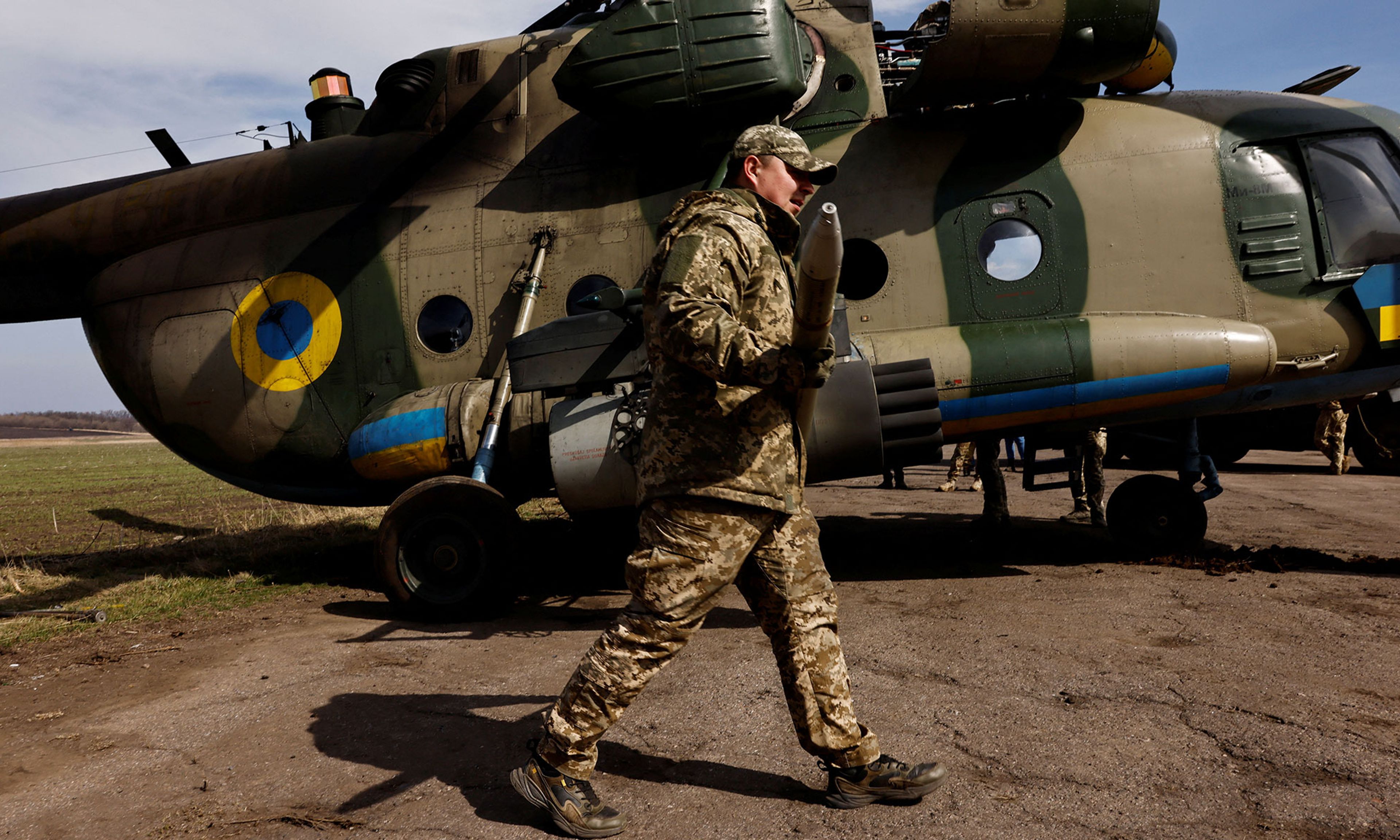
Addressing the United Nations General Assembly on September 19, President Joe Biden warned against accepting Russia’s land grabs in Ukraine and admonished member states that the very existence of the rules-based order was at stake. “If we allow Ukraine to be carved up, is the independence of any nation secure? The answer is no,” Biden said. “We must stand up to this naked aggression today to deter other would-be aggressors tomorrow. That is why the United States together with our allies and partners around the world will continue to stand with the brave people of Ukraine as they defend their sovereignty and territorial integrity — and their freedom.” Biden has taken this tone since Russia launched its full invasion in February 2022.
But some within and without the U.S. government who support the Ukrainian cause think the help that Biden and his administration have given Ukraine, though certainly better than nothing, has been too little, too late. Various prominent members of both the Democratic and the Republican Party appear to agree. And indeed, despite the president’s strong rhetoric and stated commitment to seeing Ukraine’s defense through to the finish, a look at U.S. aid to Kyiv shows hesitancy often followed by reversal.
At the outset of the war, the U.S. government, concerned to avoid escalation and the possibility of a direct conflict between NATO states and Russia, nixed the idea of offering High Mobility Artillery Rocket Systems (HIMARS) to Ukraine. But Biden walked that position back only a day later, telling reporters he would ship the rockets after all.
The president initially refused to send Patriot air-defense missiles that would have stymied Russian aerial bombardments, with his administration arguing that United States service members would have to enter Ukraine to operate the interceptors. By December 2022, Biden had again relented, agreeing to send the Patriots.
The White House said last December that it was not considering Ukrainian president Volodymyr Zelensky’s request for cluster bombs. The reason was “concerns about the use of those kinds of munitions,” as John Kirby, strategic-communications coordinator for the National Security Council, explained at the time. This July, Biden said he had changed his mind, and Ukraine now has the controversial munitions (which can remain in the ground undetonated and harm civilians years after hostilities have ceased).
In January of this year, the administration held fast against German efforts to persuade the U.S. to ship Abrams tanks to Ukraine. The reasoning then, according to Defense Secretary Lloyd Austin and Chairman of the Joint Chiefs of Staff General Mark Milley, was that the time needed to train Ukrainians to operate the tanks and the maintenance they would require were prohibitive. But Biden’s advisers have now abandoned that argument, and the U.S. is delivering M1A1 Abrams tanks to Kyiv.
The latest pieces of military hardware caught in this loop are Army Tactical Missile Systems (ATACMS), long-range missiles that could strike territory within Russia’s borders. News stories during August and September suggested that the White House was on the verge of agreeing to transfer the weapons, but the day before Zelensky’s visit to Washington it was reported that Biden would in fact not be doing so. Then, on September 22, individuals within the administration said Biden had offered Zelensky a small number of ATACMS during a meeting.
For several U.S. senators, that was just another turn in a vicious cycle that has hamstrung the Ukrainian war effort from the beginning. Several tell National Review they are disappointed by the White House’s posture toward the conflict.
“Ukraine needs the weapons to defend themselves, and that includes defending themselves against missiles and supply depots in Russian-held Ukraine or in Russian territory,” Senator Tom Cotton (R., Ark.) tells NR. “Biden is prolonging the war by refusing to provide Ukraine with this aid in a timely manner.”


Ukrainian servicemen of the Tenth Separate Mountain Assault Brigade “Edelveis” of the Armed Forces of Ukraine fire a 2S1 Gvozdika self propelled howitzer towards Russian troops at a position in Donetsk Region, Ukraine, September 26, 2023.
Oleksandr Ratushniak/Reuters
Senators Roger Wicker (R., Miss.) and Lindsey Graham (R., S.C.) say that American hesitation only emboldens Putin and that the war would be in a much different place had the Biden administration armed Kyiv sooner. Senator John Cornyn (R., Texas) agrees, saying that the White House “always seems to be a day late.”
Senator Mitt Romney (R., Utah) takes an even harsher tone. He says that the excuses the president has given are “ringing hollow at this point” and that the “administration, by virtue of its actions, is demonstrating that it has been wrong from the beginning.”
Some Democrats are concerned too. One of them is Senator Richard Blumenthal (Conn.). He says that he has tried to push the president toward greater, faster action “from Day One”: “I came back from my first trip to Ukraine and said to the president, ‘We have to do more, and we have to do more quickly.’” Blumenthal appreciates the assistance Biden has given, but he notes that he and his fellow Ukraine-supporting senators have consistently asked the White House to do more.
Luke Coffey, a senior fellow at the Hudson Institute and a former British defense official, agrees with these senators. Coffey says that had the U.S. fully committed to arming Ukraine at the beginning of the war rather than engaging in this pattern of hesitation and reversal, “advances and Ukraine’s counteroffensive would have gone a lot faster.” He elaborates: “Russia’s ability to safely harbor its Black Sea fleet in occupied Crimea would be diminished, and you would have Russia using a lot of energy and focus trying to consolidate its position in occupied Crimea instead of focusing on maintaining the front lines of southern Ukraine.”
As is evident above, the Biden administration has offered a variety of reasons for not arming the Ukrainian defense more assertively. But part of the problem may be that it has simply struggled to make up its mind.
“There are plenty of interesting indicators of a split within the administration as to how far we should go on supporting Ukraine,” says a former senior State Department official who wished to remain anonymous. “There are senior officials at the Pentagon and the White House and National Security Council who are really concerned over Putin overreacting — using nuclear weapons if we give Ukraine the wherewithal to strike inside Russia — and have held up what they really need, which are long-range weapons.”
The laggardly pace of U.S. arms deliveries “illustrates the hypocrisy of the Biden administration when it comes to arming Ukraine, and the ATACMS specifically,” Coffey says. The “excuse was that it’s escalatory and would be overly provocative to Russia.” But “a couple months later, after Ukraine has already been using Storm Shadow cruise missiles provided by the British” — missiles quite similar to ATACMS — “they then come out and say one of the reasons for not providing ATACMS is because Ukraine already now has a similar capability from the French and the British.” Given the Biden administration’s about-face on the long-range missiles and other systems, it’s worth wondering how seriously to take Russian threats of retaliation.
Of course, the fact that Putin has not reached for his nuclear weapons does not prove that fears of nuclear war have been irrational. Hindsight is 20/20, and there has been a great deal of uncertainty as to how far Putin would go. Coffey acknowledges the threat: “Of course we can’t completely rule out the use of a nuclear weapon.” But he thinks such a development unlikely and notes that Putin and his confidants have a track record of empty threats. Each step of the way, Russian officials have insisted that additional lethal aid would prompt harsh retaliation from Moscow, but Putin has yet to bring such a consequence to bear. So far, it appears his red lines mean about as much as Obama’s did in Syria.
“We should be arming Ukraine to win,” Coffey says. “Not just to survive.” Given the history of the war to date, it is hard to disagree.












Comments