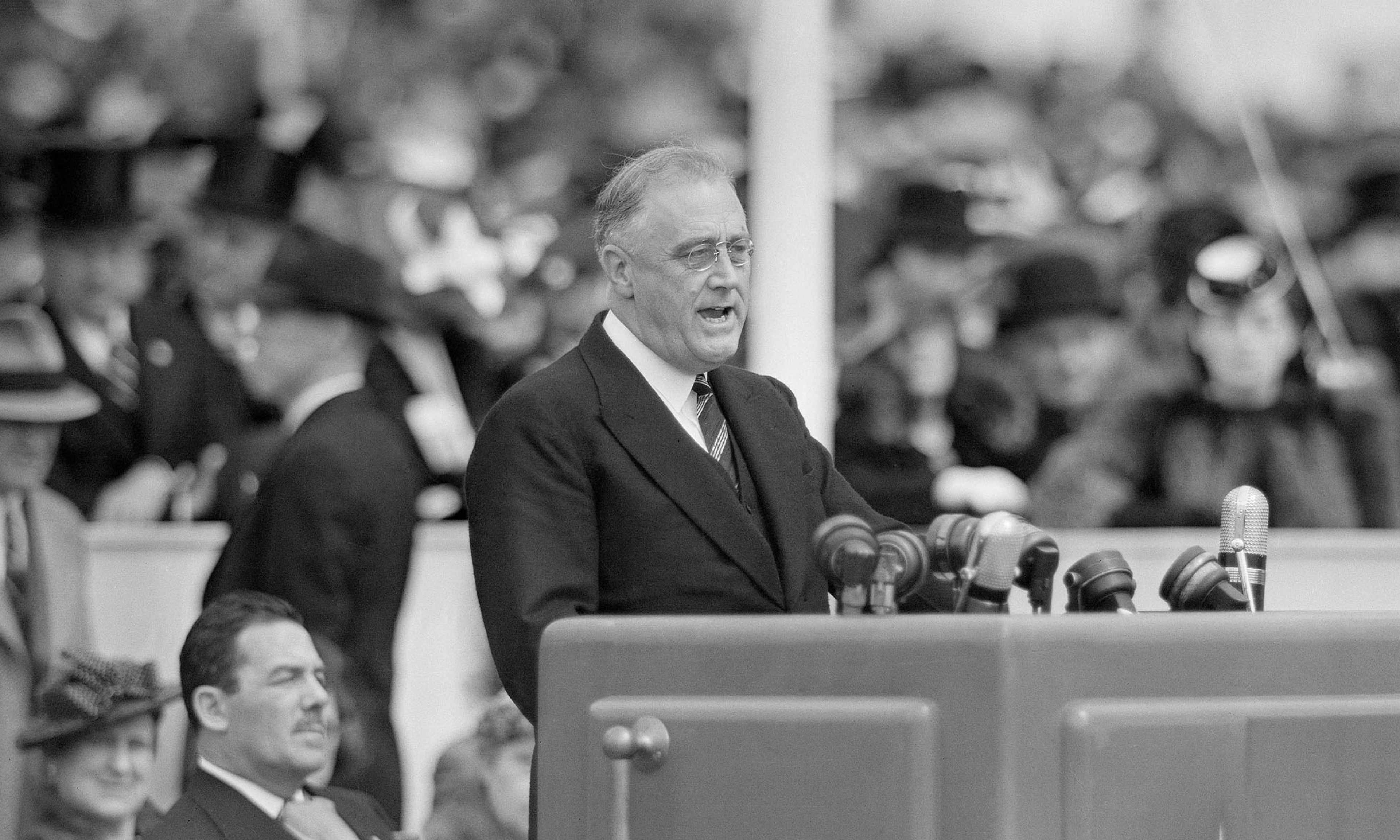
For decades, economists have generally agreed that whatever else Franklin Roosevelt accomplished, he didn’t end the Great Depression. On the contrary, he worsened it through his vacillations — changing policies so rapidly that businesses were afraid to invest — and his economic illiteracy. His first-term achievements, the National Industrial Recovery Act and the Agricultural Adjustment Act, sought to organize the economy into a system of legal cartels while, absurdly enough, outlawing price cuts as incomes were falling. The agriculture law limited planting in order to raise farmers’ incomes, even as the Resettlement Administration tried to increase harvests to produce more food.
FDR’s second term ushered in crippling taxation and limits on employment that triggered the “Roosevelt Recession” — a depression within a depression — which the president blamed on a shadowy conspiracy of industrial saboteurs.
In reality, the Depression ended only in 1946, when Congress — over President Harry Truman’s objections — slashed taxes, repealed regulations, and eliminated bureaucracies that were delaying post-war recovery.
But while economists have acknowledged these facts, mainstream historians remain wedded to the Roosevelt myth. With laudable exceptions — notably Wolfgang Schivelbusch, Amity Shlaes, Ira Katznelson, and Burton Folsom — most continue to portray Roosevelt as the savior of the American economy who, in the words of one mainstream writer (Michael Hiltzik), “exposed the economic orthodoxy” of free markets as “antique superstitions.”
Even more glaring is how historians typically ignore Roosevelt’s horrendous record on civil liberties. Pick at random any book about the New Deal, and it will contain no mention of his policies of censorship, mass surveillance, and intimidation and persecution of political opponents. It likely will concede that his decision to imprison 100,000 Japanese Americans in internment camps was wrong but excuse his refusal to act against Jim Crow as if it were an unfortunate reality forced upon a benevolent patriarch who wished he could heal the nation.
David Beito’s The New Deal’s War on the Bill of Rights is a welcome break with such rosy nostalgia. In nine succinct and deeply researched chapters, he explores how Roosevelt and his allies masterminded “mass surveillance of private telegrams, crackdowns on free speech, inquisitorial investigations, sedition prosecutions,” and other abuses — while blithely facilitating segregation and violence in the South.
Partly this was the spirit of the age. After all, dictatorship was fashionable in the Thirties. Four years of Depression at home and the mirage of economic renewal in Mussolini’s Italy convinced many Americans that democracy was unworkable and that only a strongman could cut through the muddle. Just weeks after his inauguration, a New York Times reporter wrote that Americans had given Roosevelt “the authority of a dictator” as “a free gift, a sort of unanimous power of attorney.”
But, knowing that Americans wanted their president to be a folksy charmer rather than a shrieking visionary, the new president chose to delegate to underlings the unsavory task of destroying his enemies. Among those who happily undertook it were Senators Hugo Black and Sherman Minton, who used their Special Committee to Investigate Lobbying to terrorize and humiliate the New Deal’s opponents. They illegally subpoenaed telegrams and other private correspondence from conservative magazine editors and political activists, which the committee used to falsely accuse the senders of conspiring against the public welfare. On one occasion, Black subpoenaed every telegram going into or out of Washington, D.C., during a seven-month period. Another time, he sent over 1,000 subpoenas to the Chicago Tribune, a leading anti–New Deal newspaper.
Black and Minton then dragged conservative magazine publishers before the committee to lambaste them as members of a cabal seeking to wreck the New Deal and impoverish American workers. Black and Minton’s primary goal, Beito notes, “was to help Roosevelt’s campaign by scaring away potential donors fearful of being hauled before a congressional committee” for supporting the conservative opposition. They were so successful at intimidating their ideological opponents that their efforts set the pattern for inquisitions by the House Un-American Activities Committee 15 years later — although the New Deal witch hunts were worse than the McCarthy-era dragnets in some ways. That’s because courts halted Black and Minton’s campaign in the end, setting legal precedents that deprived subsequent committees of the surveillance powers Roosevelt’s deputies enjoyed.
One reason courts began to intervene was that other politicians had begun imitating Roosevelt’s tactics. For example, Jersey City’s infamously corrupt mayor Frank Hague — a strong New Dealer — began cracking down on political opponents in a similar vein: secretly reading their mail and banning public speeches by journalists who criticized him. His abuses became so bad that some Republicans and Democrats formed what Beito calls a “Bill of Rights Coalition” to defend free speech. Republican presidential contender Alf Landon, for example, joined Socialist Party nominee Norman Thomas in denouncing Hague for having Thomas arrested and expelled from Jersey City.
This bipartisan “coalition” eventually established a broader culture of free speech that took root in the legal profession after World War II. But Roosevelt was no part of it. The closest he came to condemning Hague was a radio address that included a sentence vaguely criticizing “outspoken reactionaries.” This was interpreted as a reference to the mayor, but Roosevelt took no further action. He even refused to remove Hague from his position as vice chairman of the Democratic National Committee — a position Hague retained until after Roosevelt’s death.
The “Bill of Rights Coalition” also did not include the American Civil Liberties Union. Although it joined in a successful lawsuit against Hague, the ACLU remained silent about the actions of Black, Minton, and others, owing to what Beito calls the “coziness between ACLU officials” and the New Deal. Many of its members were Roosevelt partisans, or even cabinet members, and were unwilling to criticize their allies.
This accounts for the ACLU’s cravenness in the face of one of Roosevelt’s most shocking acts: Japanese-American internment. Its board commanded members not to participate in lawsuits against the roundups, and when one member, a San Francisco lawyer named Wayne Collins, defied that order to represent one internee and file a brief supporting another, the ACLU formally disavowed him. The chairman of the ACLU’s San Francisco branch got that decision reversed, but the board still refused to compensate Collins for the $10,000 of his own money he spent bringing the cases. It did, however, send a letter to General John DeWitt, organizer of the internment, congratulating him on his success at “so difficult a job.”
The ACLU was also MIA on Roosevelt’s sedition trials. Once the country entered World War II, the president was keen to exploit the 1917 Espionage Act and the Smith Act of 1940 to crack down on citizens who had opposed American involvement. In 1944, he ordered that charges be brought against 33 defendants in what became the largest sedition trial in American history. Accused were a miscellany of Nazi sympathizers, antisemites, and ordinary newspapermen such as William Griffin, who had editorialized before 1941 against participation in the war. Griffin changed his mind after the Japanese attack on Pearl Harbor, but that didn’t shield him from prosecution by administration lawyers bent on making a lesson out of him.
Again paralyzed by loyalty to Roosevelt, the ACLU “never took an official position” on the trial, Beito writes. But the president took an exceptionally active role — instructing subordinates that the case “must be won at all costs” and repeatedly chiding cabinet members who grew reluctant to bring additional cases.
After seven months of testimony, the judge died and a mistrial was declared. (Only after Roosevelt’s own death was the case against the 33 defendants dismissed.) Disappointed, the president resorted to a more effective technique: mobilizing the IRS against his enemies. Years earlier, he had given confidential tax information to Black and Minton, who used it to denounce administration opponents as tax cheats.
In 1944, he used the same tactic against a conservative group called the Committee for Constitutional Government (CCG). It had done nothing more than sell books criticizing the New Deal, but the White House’s congressional supporters, characterizing it as a front for millionaire manipulators, hounded the CCG’s leadership well into the Truman administration. Truman’s congressional allies even jailed the CCG’s leader for contempt of Congress when he refused to turn over the names of the people who bought the books. In 1953, the Supreme Court freed him on First Amendment grounds.
Roosevelt’s record on segregation is equally bad. Many historians contend that he was too dependent on southern Democrats to risk opposing Jim Crow, but, as Beito shows, he wasn’t just reluctantly acquiescent to it but a willing participant. He risked intraparty strife when his pride was at stake — even campaigning against fellow Democrats who opposed his 1936 court-packing plan — but he never considered reining in Memphis’s racist “boss” Edward Crump, who maintained Democratic Party loyalty in his county with cruel campaigns of harassment against black opponents. When, during the war, black newspaper editors complained about racism in the American military and the hypocrisy of fighting Nazism abroad while facilitating segregation at home, Roosevelt told his attorney general “to personally admonish black editors to cease ‘their subversive language.’” Those who refused were banned from the mail.
The Roosevelt myth persists because he symbolizes the “social justice” politics most history professors today endorse. David Beito’s book reveals that such politics inevitably involve a degree of authoritarianism incompatible with the Bill of Rights.








Comments