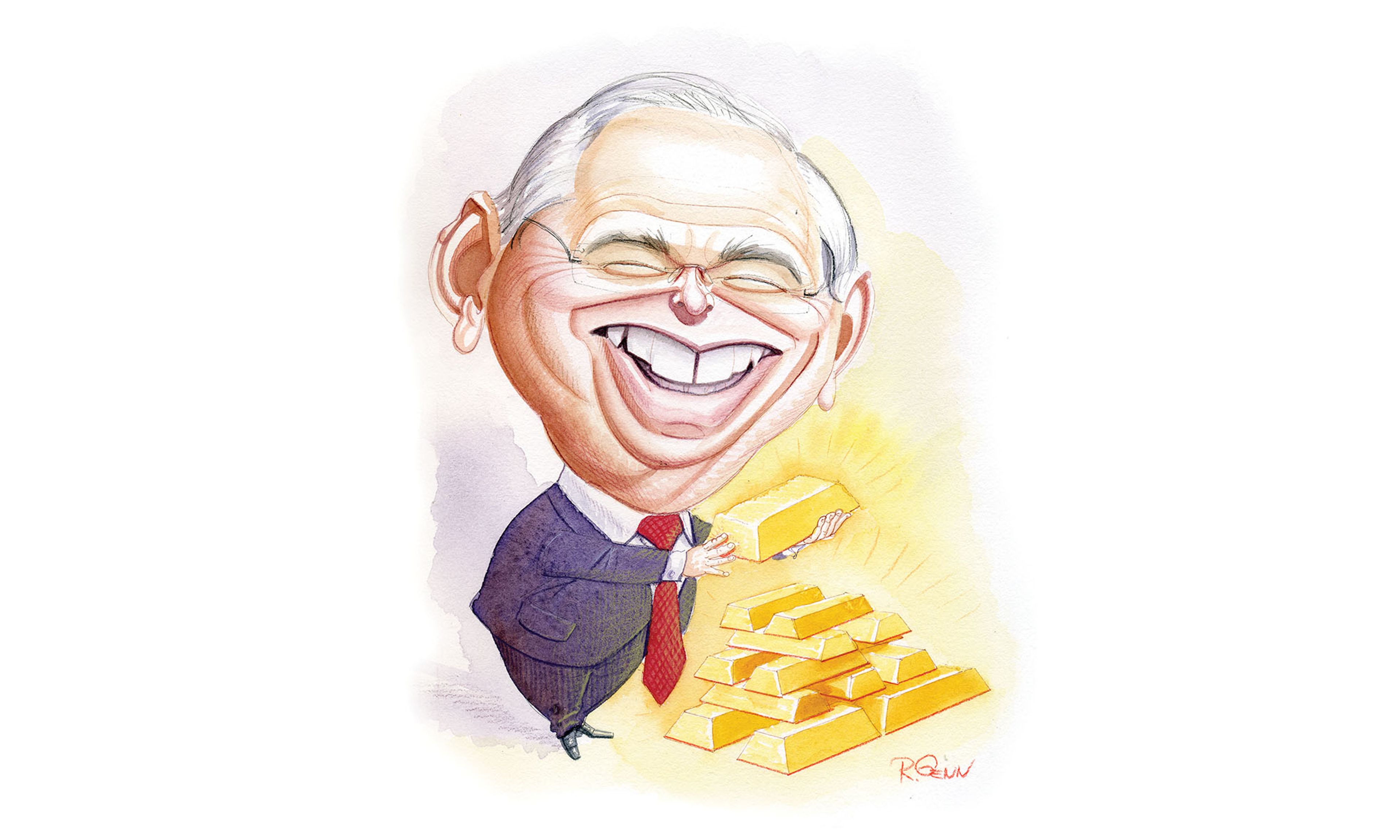
• Looks like Ron Paul wasn’t the last goldbug in Congress.
• Here we go again. A Republican speaker of the House is having trouble corralling backbenchers in a spending showdown with a Democratic president, while any ensuing shutdown will almost certainly be blamed on the GOP. We’ve seen versions of this movie multiple times, and the sequels usually don’t get better. The obvious GOP play, the one that enabled Republicans to beat expectations in the debt-ceiling fight, is to pass their preferred version and negotiate from there. But GOP firebrands are making that impossible. They seem to welcome the prospect of Kevin McCarthy’s being forced to get nothing and pass a bill with Democratic support so that he can be excoriated as a sellout who doesn’t deserve to be speaker. We gave up on this franchise years ago with the release of Dumb and Dumber To.
• The House commenced an impeachment inquiry against President Biden, focused for now on his family’s influence-peddling business. Speaker McCarthy decreed an impeachment inquiry rather than seeking a House resolution approving it — a tactic he condemned when then-speaker Nancy Pelosi used it (in the 2019 impeachment of Trump over Ukraine). With just a four-vote majority, some Republicans in revolt over the budget, and others against an impeachment, McCarthy was in an impossible spot. The pity of it is that the House committees were already making headway with the public, much of which now believes the president is not just incompetent but corrupt, too.
• Special counsel Jack Smith is urging Judge Tanya Chutkan, the Obama appointee presiding over the January 6 case against Trump, to place severe limits on what Trump may say about the case — even though his opponents, including President Biden, are uninhibited. Chutkan has a history, in sternly sentencing January 6 defendants, of grousing about DOJ’s then-failure to prosecute Trump. Trump, of course, has a right to seek her recusal and inveigh publicly against what he alleges is a selective, politicized prosecution. No matter what accommodations are made, the tension between the regular rules of a court trial and the regular rules of a political campaign is intractable.
• The Biden administration announced that it was granting temporary legal status to potentially more than 700,000 Venezuelans, protecting them from deportation orders. The administration is also working to grant most of them work permits that Secretary of Homeland Security Alejandro Mayorkas indicated would be good for up to five years. Normally, such work permits are limited to just two years. New York City mayor Eric Adams has praised the move. Most migrants who have come to New York City this year are Venezuelan, and Adams believes that giving them work permits will relieve the economic strain on the city. But the law created “temporary protected status” for aliens whose home country was subject to a hurricane, earthquake, or famine. The key word was “temporary.” It was not supposed to be a backdoor amnesty. Venezuela’s government has made it a basket case for a decade; it has not suddenly gotten worse in a way that would justify immediately granting relief and work permits to a population of a size somewhere between Sacramento’s and Boston’s.
• Eagle Pass is the latest Texas town to be overwhelmed by our border crisis. It has 28,000 residents, two hospitals, and a police force of 100 people. Thousands of migrants are arriving in the town every day. Mayor Rolando Salinas issued a disaster declaration. Over just three days of this crisis, three migrants died near the crossing, including a three-year-old. Migrants are overwhelming the border because the Biden administration dismantled the web of executive orders and the remain-in-Mexico policy that successfully stopped the crisis under the last administration. The new amnesty for Venezuelans will not improve matters. This humanitarian disaster is a choice Biden made.
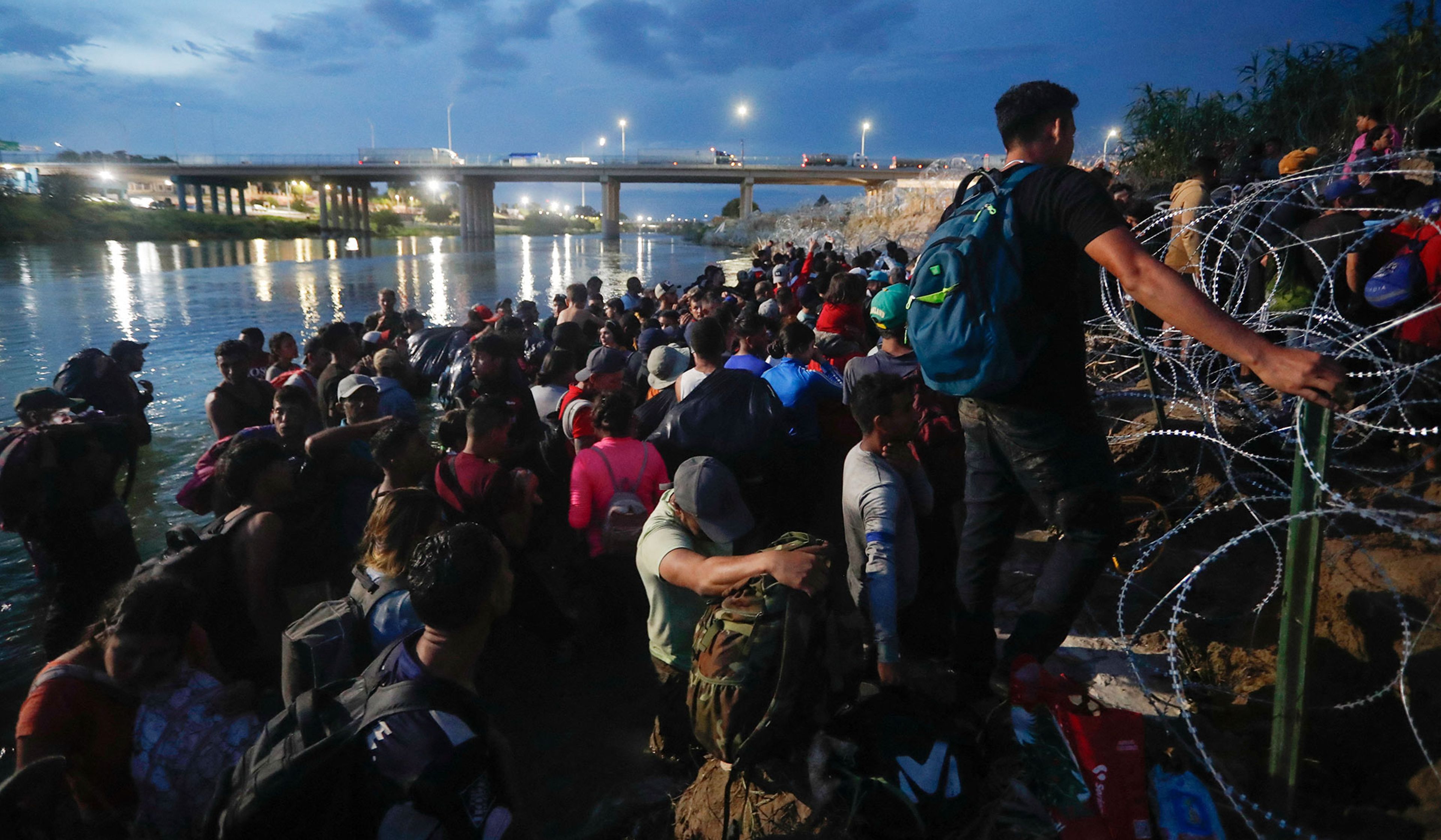
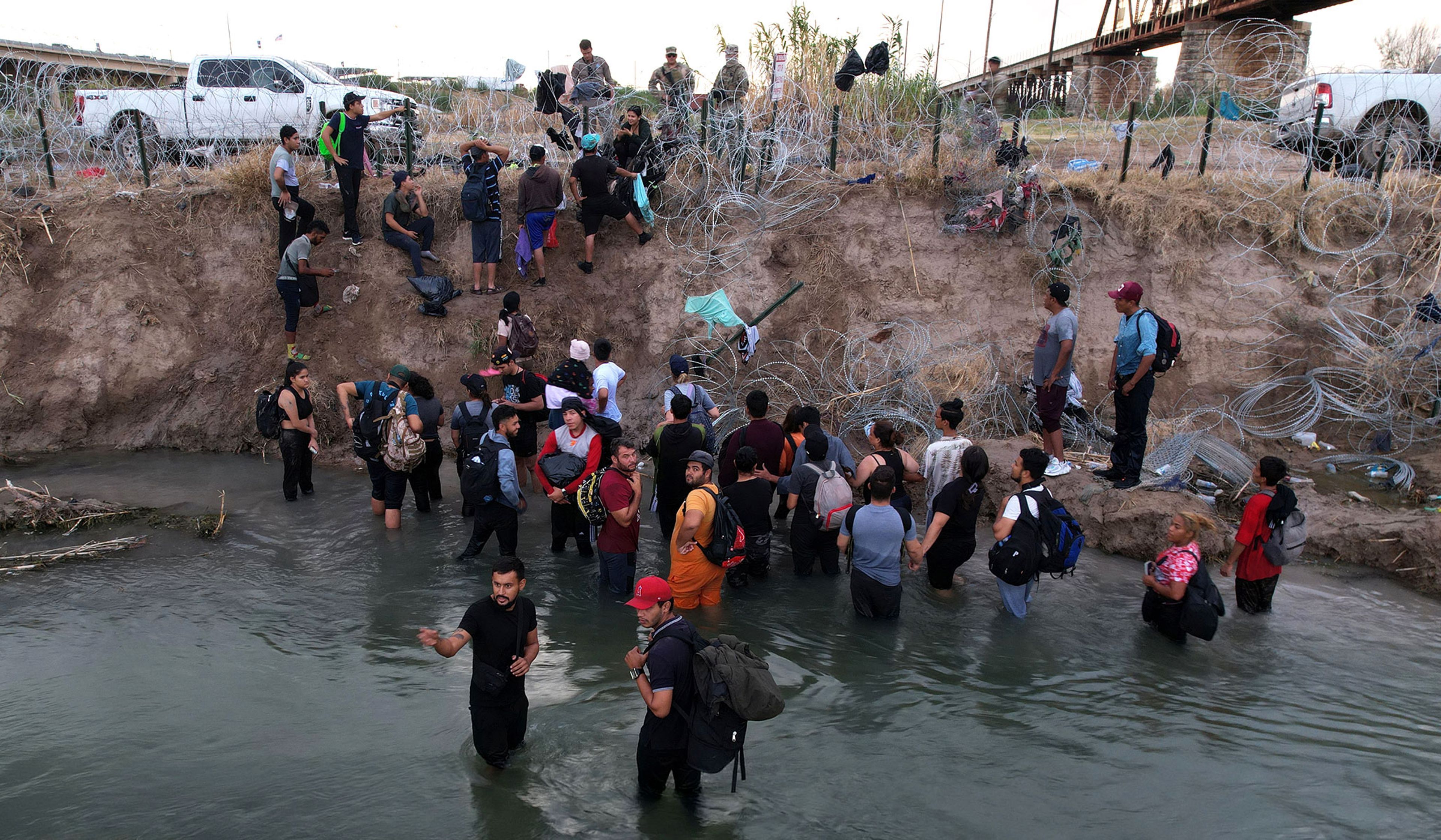
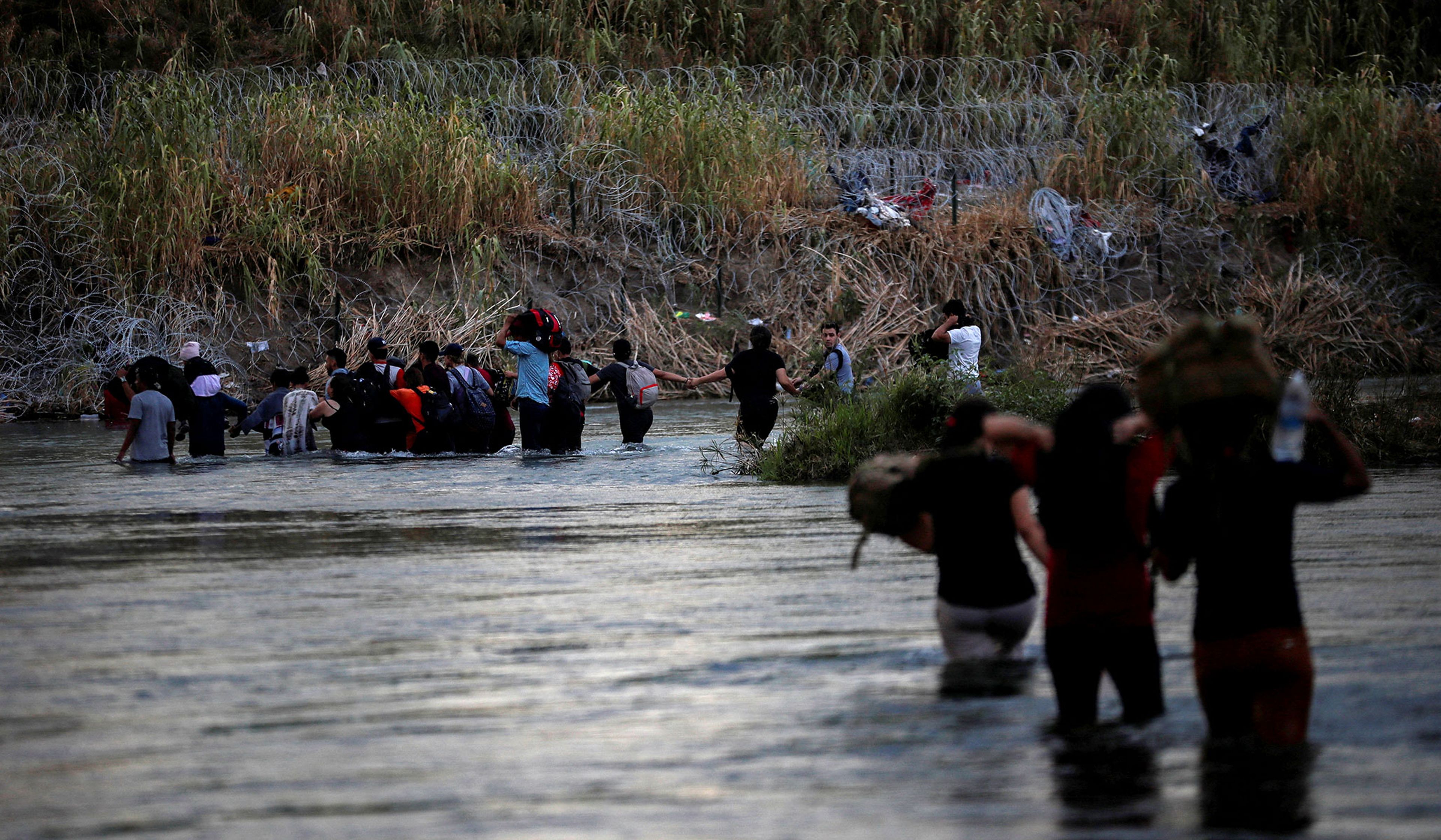
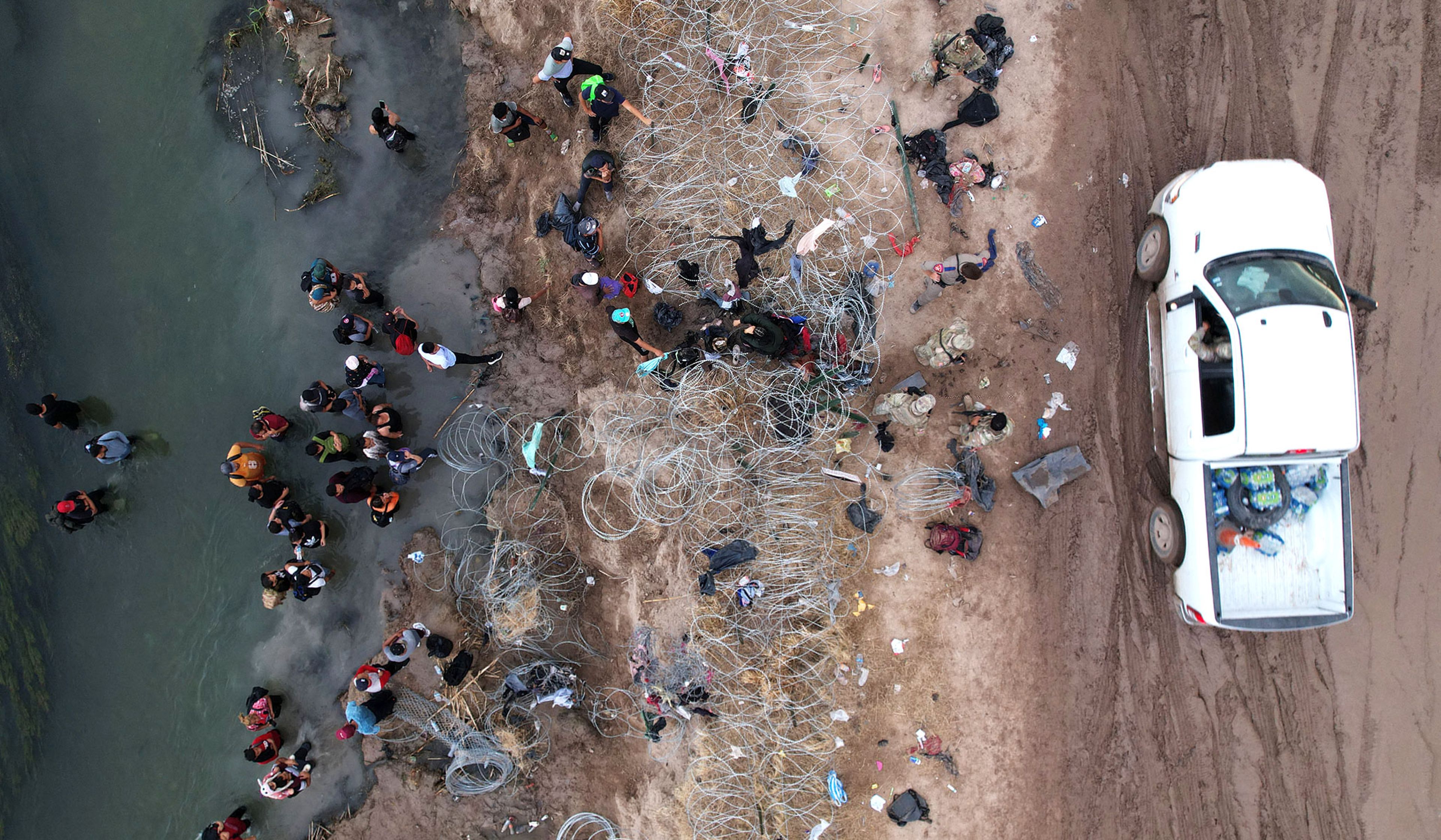
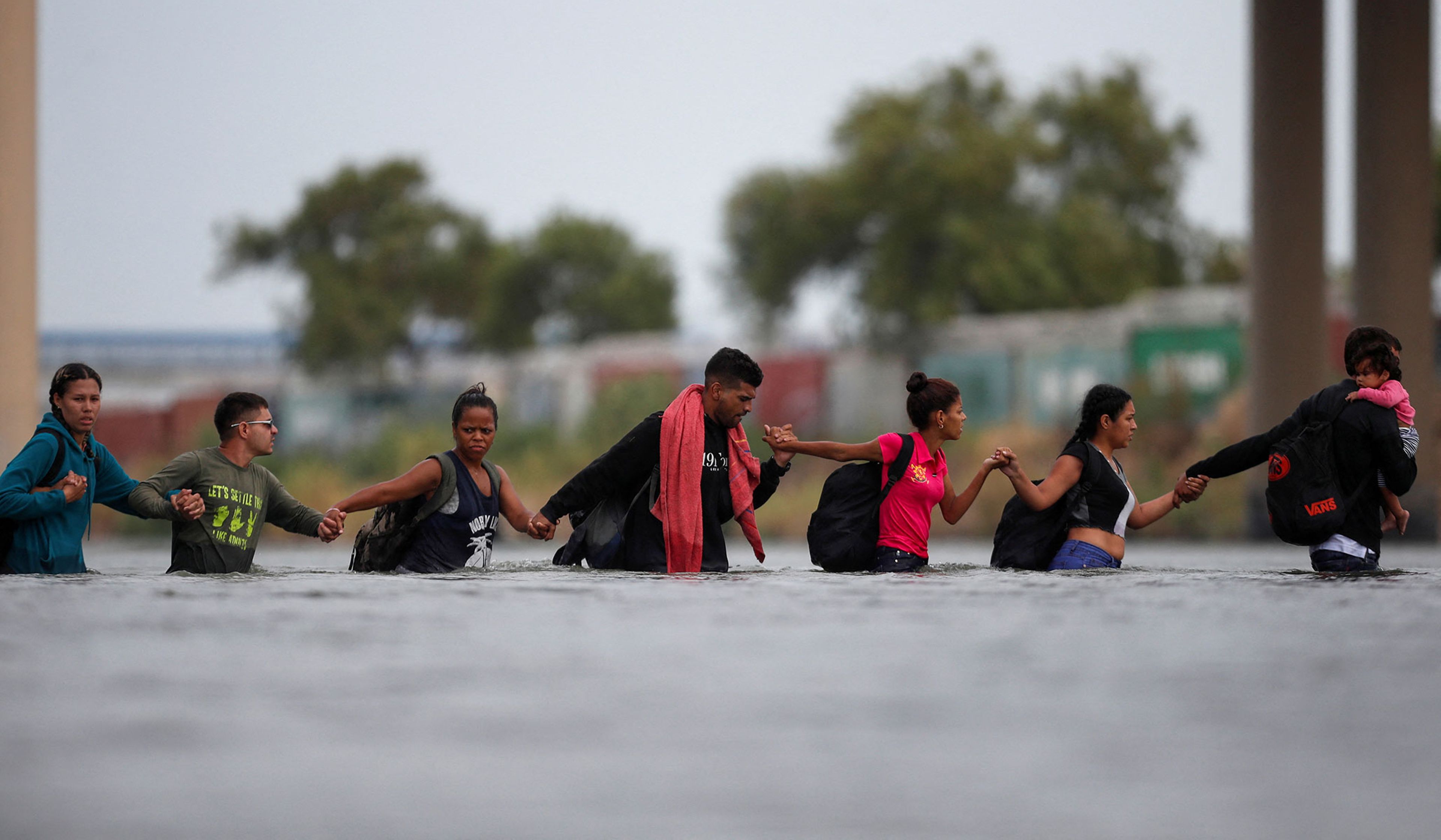

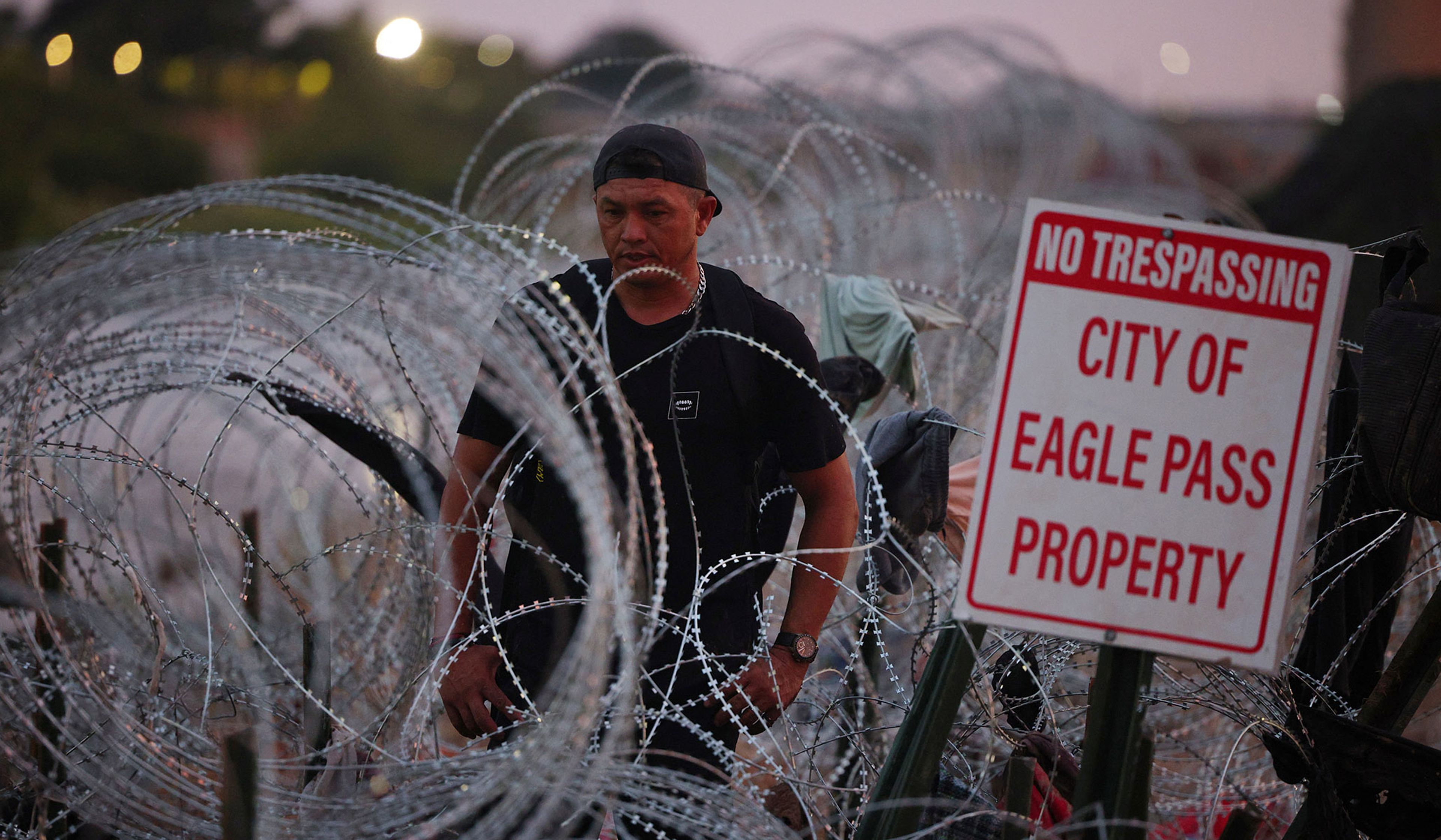
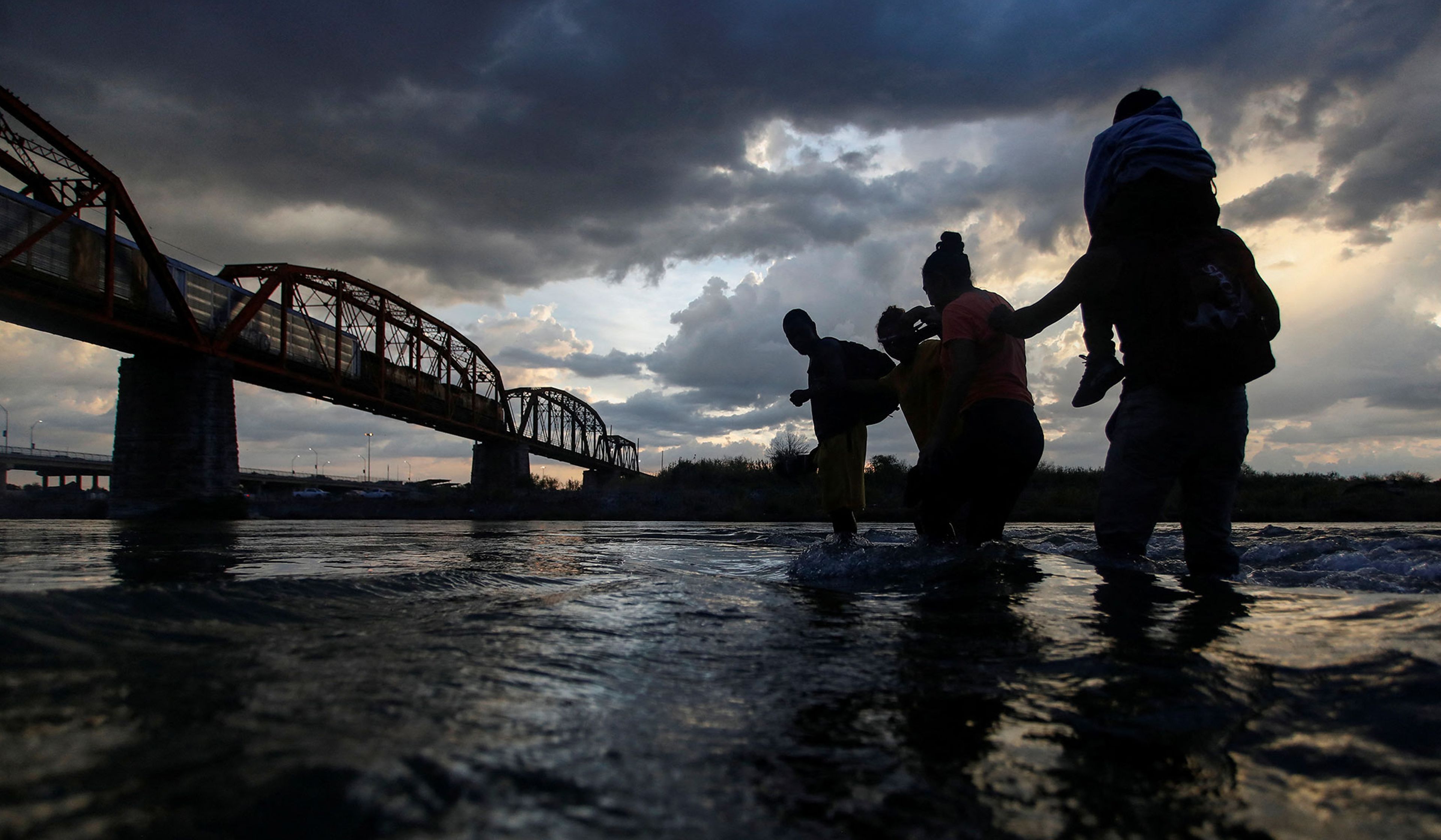
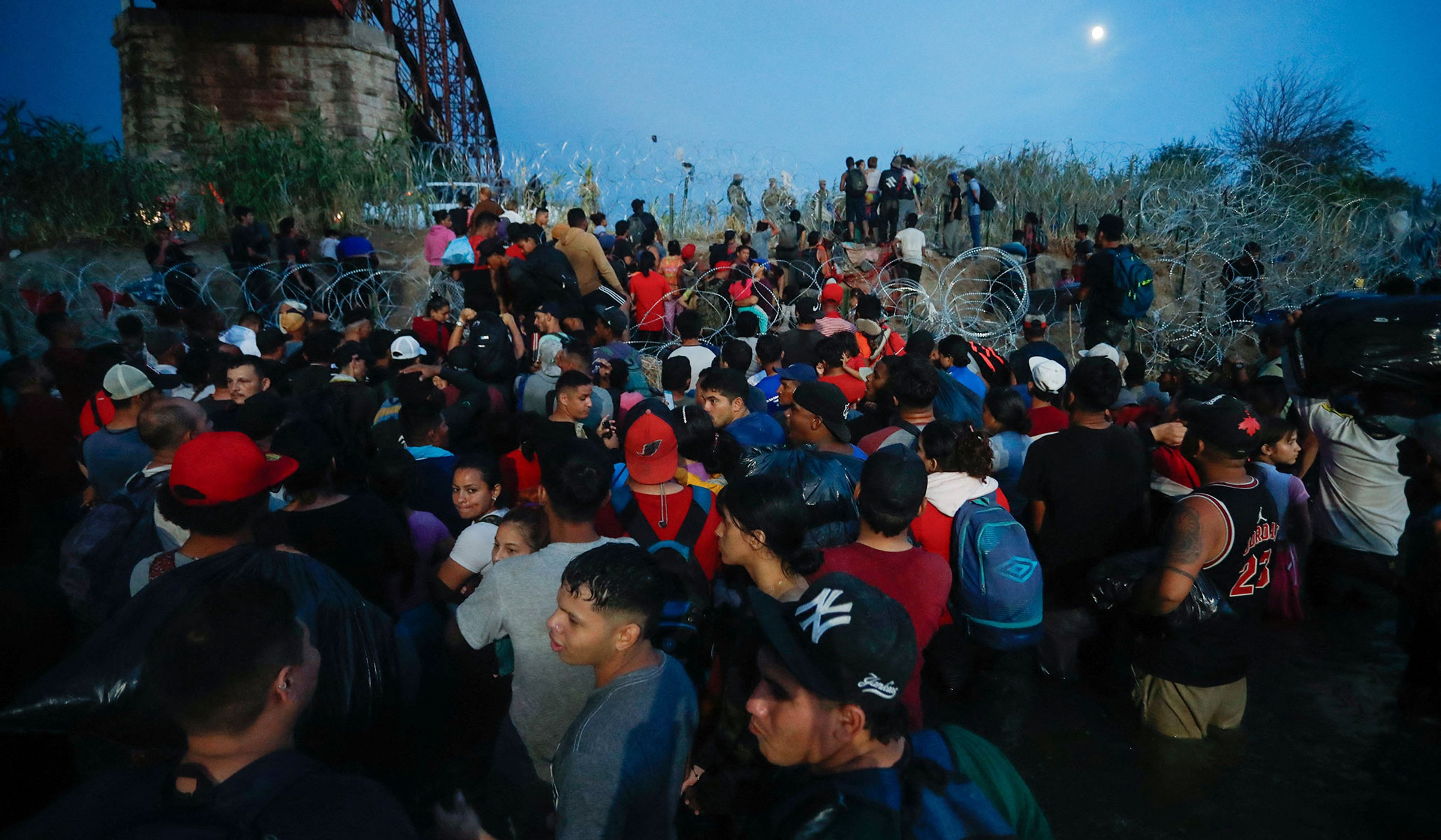

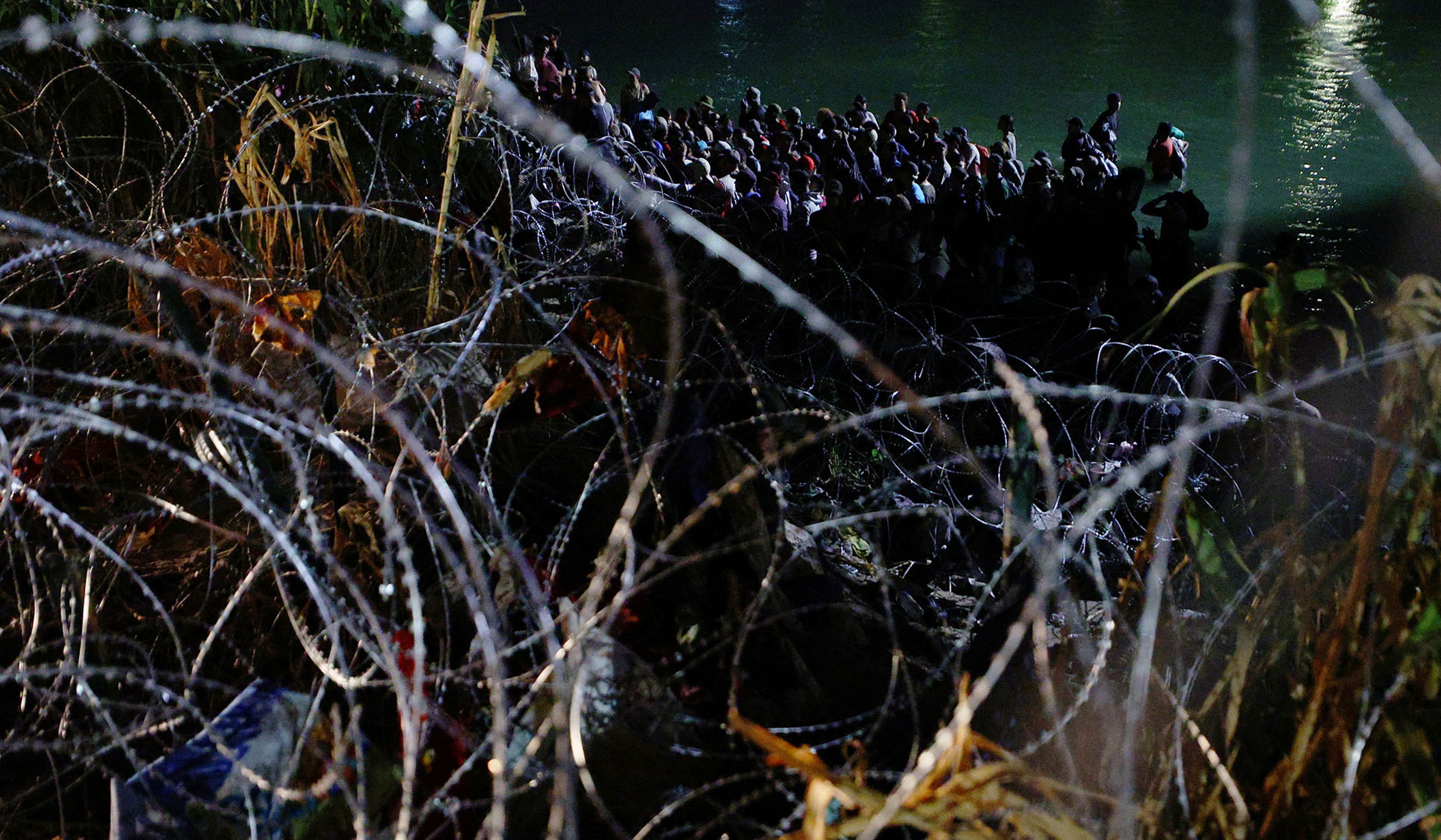
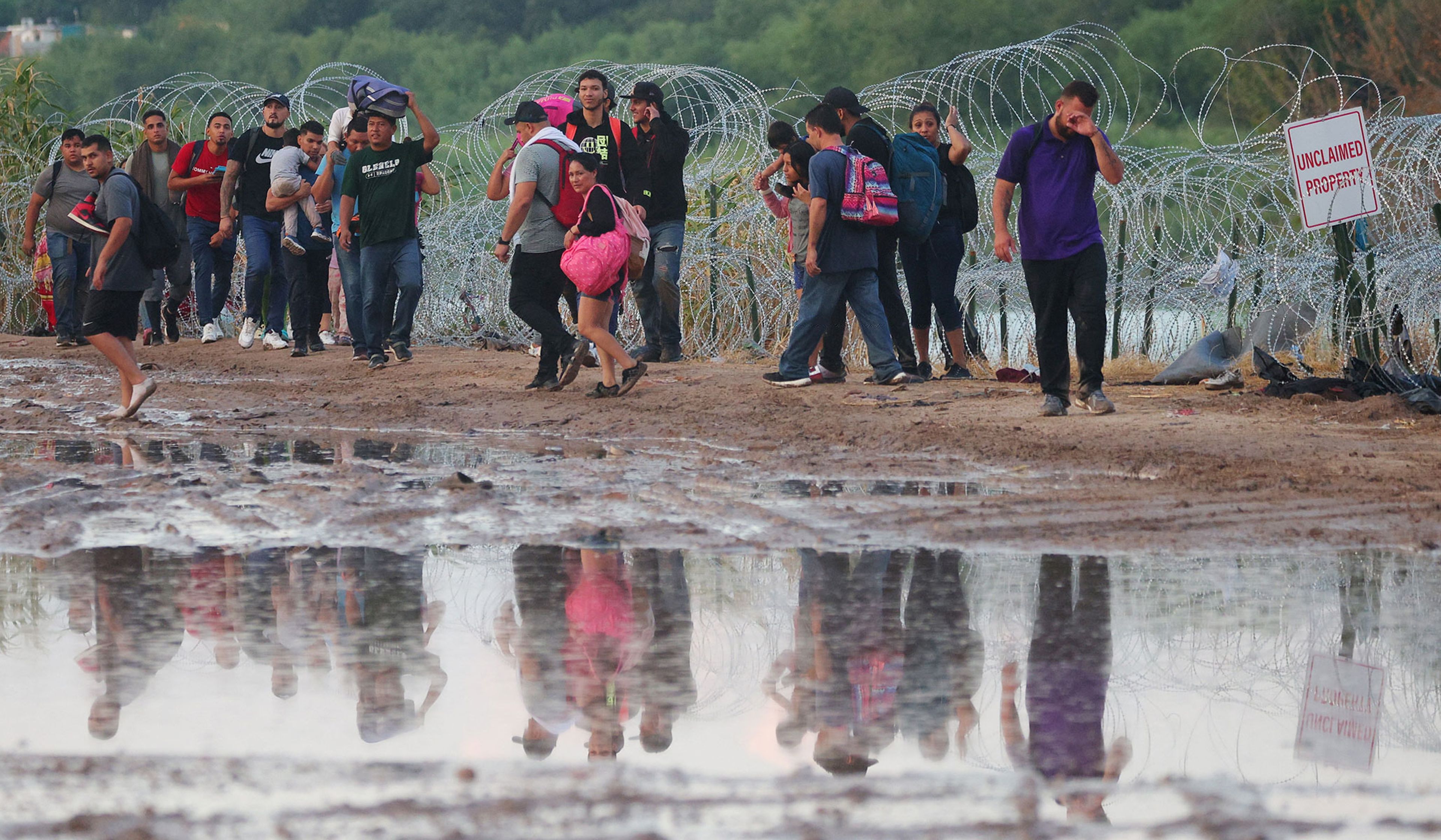
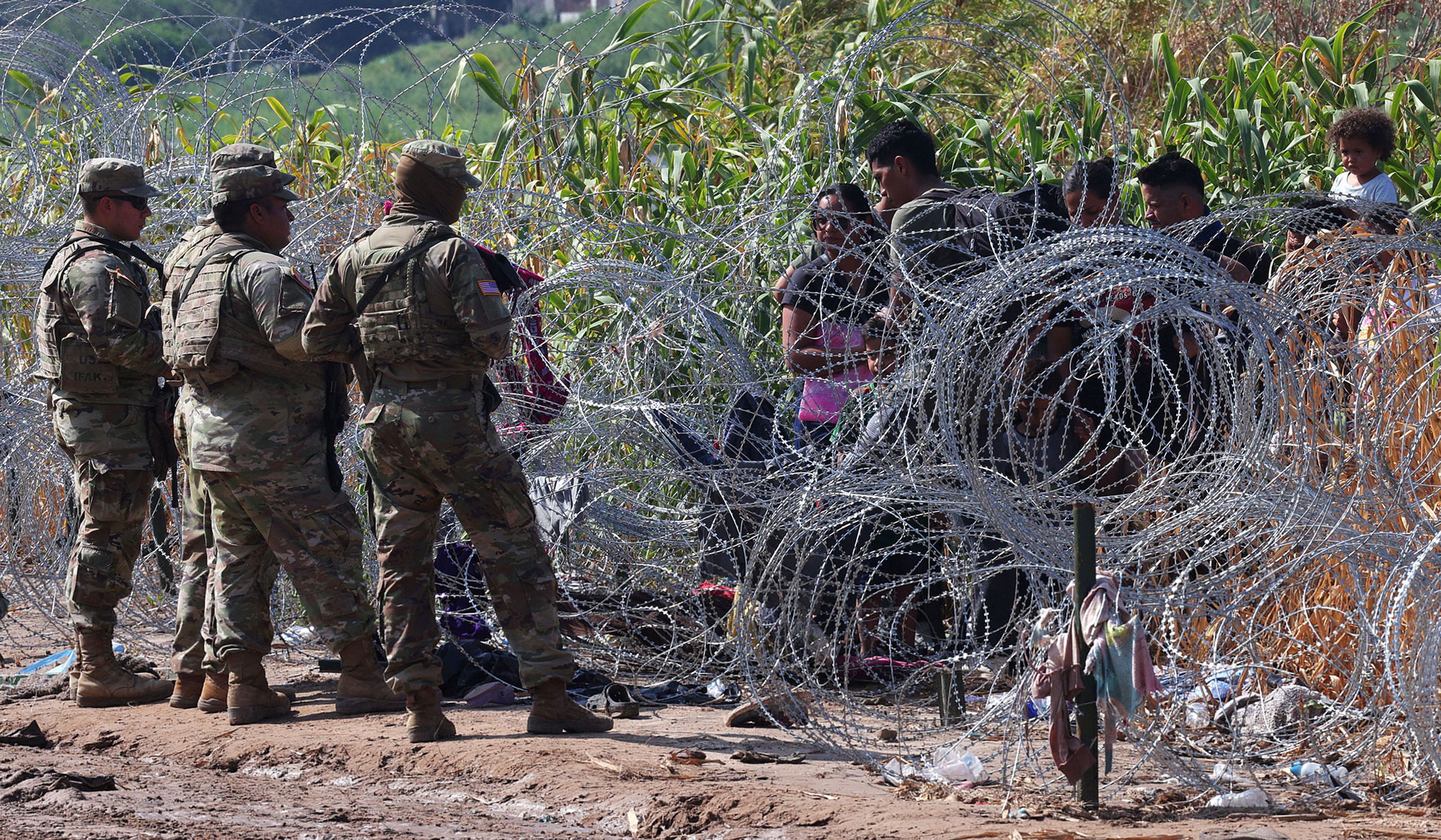


Asylum seekers wait on the banks of the Rio Bravo after crossing during their journey through Mexico to Eagle Pass, Texas, in Piedras Negras, Mexico September 26, 2023.
Daniel Becerril/Reuters
• Senate Majority Leader Chuck Schumer (D., N.Y.) announced that the sergeant at arms would no longer require members to wear jackets and ties or the female equivalent before going to the Senate floor. Schumer did not say for whom the rules were changed, but it was obviously for John Fetterman (D., Pa.), who has declared that “we should all want to be more comfortable.” Comfort has nothing to do with it. Fetterman’s uniform — hoodie atop gym shorts — is political shtick, designed to lend him the populist cred that he as a child of wealth would otherwise lack. Schumer evidently deferred to Fetterman’s wishes out of sympathy for his mind-impairing stroke and subsequent depression. This only compounds the offense. Daniel Inouye (D., Hawaii) lost an arm in World War II, yet he dressed. Bob Dole (R., Kan.) lost the use of an arm in World War II, yet he dressed. Tammy Duckworth (D., Ill.) lost both legs and the partial use of an arm in the Iraq War, and yet she dresses. Decent dress shows respect for the institution, for the constituents who sent one there, and for oneself. The Senate should call its cosplaying sloven to order.
• “New Jersey politician indicted for corruption” may seem like the ultimate dog-bites-man story, but Senator Bob Menendez (D.) has managed to plumb new depths. Having survived a 2015 corruption indictment thanks to a hung jury and a forgiving electorate, he is now the first senator in history to be indicted in two different scandals. Menendez is alleged to have sold sensitive information to Egypt and taken payoffs for helping the country get American military aid, interfered in criminal prosecutions in exchange for a Mercedes-Benz convertible, and helped a crony get a monopoly on certifying U.S. food exports to Egypt as halal. A June 2022 federal search of his home turned up $100,000 in gold bars, the Mercedes, and half a million in cash, some of it stuffed into pockets of jackets with Menendez’s name emblazoned on them. The indictment recites all manner of stupidly incriminating evidence: gold bars with traceable serial numbers, envelopes of cash with the fingerprints or DNA of people alleged to have bribed him, and “a web search for ‘how much is one kilo of gold worth,’” performed by Menendez fresh from an Egyptian trip. In response, Menendez has dug in, played the race card, and preposterously claimed that jackets full of Benjamins is some sort of Cuban family tradition. The tradition in question is clearly closer to home.
• Mitt Romney announced he would not run for reelection as senator from Utah next year. He has old-fashioned-movie-star looks and a political bug inherited from his father, George, a one-time presidential hopeful. After making a fortune as an entrepreneur, Mitt ran unsuccessfully for the Senate from Massachusetts (incumbent Ted Kennedy ran a whisper campaign against his Mormonism), then successfully for governor. In those days he was liberalish, pro-choice, and touting a dry run for Obamacare. He then ran twice for the GOP presidential nomination. Now he called himself “severely conservative.” He won the party’s nod in 2012, but lost the election. Ideological consistency was not in his makeup: He was an executive by temperament, a doer, not a pathfinder. Yet defeat seemed to liberate him. As Utah senator he became the first member of that chamber to vote to convict a president from his own party; the second time, he noted that colleagues had told him they would have voted to impeach and convict as well if they did not fear violence from the president’s supporters. In an era when so many Republicans proclaim themselves “fighters,” Romney, in twilight, showed real courage.
• When the Department of Defense announced it would use taxpayer money — contrary to federal law — to fund tourism for Pentagon employees seeking abortions throughout pregnancy, Alabama senator Tommy Tuberville warned that he would refuse to confirm senior Pentagon officials en masse through unanimous consent. When the Biden administration followed through on its illegal abortion-funding plan, Tuberville made good on his promise. Though the Biden administration denounced the resulting backlog of nominations as a national-security crisis, it was largely a crisis of Democrats’ making (to the extent that one may call it a crisis that acting officials are doing jobs rather than Biden’s nominees). Tuberville’s protest did not mean the Senate could not confirm these nominees; it meant simply that Majority Leader Schumer would need to chew up Senate floor time or require the upper chamber to work more than three days a week, perhaps even in the month of August. In September, Schumer proved he has the ability to confirm these nominees when he allowed votes on three key positions. If the Biden administration wants a speedier process, it could simply agree to follow the law.
• General Mark Milley’s retirement as chairman of the Joint Chiefs of Staff was noted by former president Donald Trump with a post on Truth Social. Trump’s opinion of Milley has been low since the general apologized, rightly, for being cast in the president’s Bible-thumping appearance in Lafayette Square during the George Floyd riots. Trump subsequently called him a “dumba**” and a “f***ing idiot.” His farewell post spanks Milley for the disastrous withdrawal from Kabul (surely Biden’s fault, and his own, as well). Trump continued: “If the Fake News reporting is correct,” he “was actually dealing with China to give them a heads up on [my] thinking.” Milley called the Chinese after January 6 to assure them that things were normal enough in the United States, fear no surprise attacks. “This,” Trump went on, was “an act so egregious that, in times gone by, the punishment would have been DEATH!” He finished by calling Milley’s call “a treasonous act.” Trump’s frenzies suggest that he is losing control of his mind, even as Biden has lost control of his speech.
• The United Auto Workers union has never been a friend of conservatives. One of the top issues in the early days of National Review was supporting Wisconsin bath-fixtures manufacturer Kohler in its struggle against the UAW. In each election cycle from 1990 through 2022, more than 98 percent of the UAW’s campaign contributions have gone to Democrats. Over a quarter of the union’s membership is now composed of hyper-progressive higher-education workers, and it has been far more successful convincing graduate students to unionize than convincing nonunion autoworkers to join. In December 2020, the UAW reached a settlement with the Department of Justice after a yearslong fraud and corruption investigation. More than a dozen top union officials, including two former presidents, were convicted of crimes for embezzlement of workers’ dues. Some Republicans seem to be under the illusion that there’s political gain to be had by siding with the United Auto Workers in its ongoing strike against the Big Three carmakers. Left out of the dispute between the union and the employers is a much larger constituency: people who buy cars. If the strike goes on for too much longer, they’re going to be upset by higher prices and reduced supply. It will be just another sign of the rising cost of living brought about by the Biden administration — and clearly illustrated by the president’s picketing alongside the union. Republicans would be wise to be on the other side of the issue, not playing footsie with a corrupt left-wing organization.
• Presidential candidate Nikki Haley gave a speech in New Hampshire calling freedom “America’s secret weapon.” It’s too bad that it really seems like a secret these days. Most of her fire was trained on Democrats, who have taken big government as their guiding principle during the Biden administration. But she also went after Republicans, some of whom have spoken positively of government-directed economic policies to support specific industries or advocated variants of “stakeholder capitalism” for supposedly conservative ends. She made sure to note that Donald Trump — like Barack Obama and Joe Biden — was guilty of running up the debt. The problem with the “political-subsidy economy,” as Haley describes it, is not that it was designed by Democrats; Republicans aren’t significantly better at designing subsidies. Haley understands that people know how to run their own lives, thank you very much, and don’t trust politicians or bureaucrats to make decisions for them. It would be a relief for America’s secret weapon to be out in the open again.
• An armed man allegedly impersonating a U.S. marshal was arrested at a Robert F. Kennedy Jr. campaign event in Los Angeles. The man reportedly claimed he was part of Kennedy’s security detail and told staff that he had to see the candidate “immediately.” Kennedy’s real security detail held him until the police arrived. How many more armed strangers do we want near a presidential candidate named “Robert F. Kennedy” at a campaign event in Los Angeles? Two seems plenty. In July, Kennedy and his campaign requested U.S. Secret Service protection and were turned down. Yes, under the law, Secret Service protection is usually granted only to “major presidential and vice-presidential candidates and, within 120 days of the general presidential election, the spouses of such candidates.” But the law allows exceptions for circumstances that warrant them, including “explicit threats of bodily harm to the candidate or indications of inappropriate behavior towards the candidate suggesting potential bodily harm.” Barack Obama, Herman Cain, Ben Carson, and Donald Trump all received Secret Service protection early. The consequences if a presidential candidate were shot or killed after being turned down for U.S. Secret Service protection would be dire. Get Kennedy his protection.
• Leonard Leo is hated on the left because he is effective — and worse, he fights back with tools the Left has long wielded alone. Now he’s under investigation by his own competition. Judicial nominations long featured asymmetrical information wars waged by “dark money” networks on the left, led by Arabella Advisors. They dispensed funds for advertisements, sign-holding protesters, and even public-relations firms to represent accusatory witnesses. To respond, Leo built a parallel network of organizations within the byzantine legal structure of the nonprofit-advocacy world. Leo is currently being targeted by a group styling itself the “Campaign for Accountability” and launched from . . . the Arabella network. It alleges that consulting fees paid by Leo’s nonprofits to other for-profit groups he operates are improper. Enter D.C. attorney general Brian Schwalb, previously a leader of a law firm that represented Arabella organizations. Schwalb’s chief deputy was formerly legal director of the Arabella-linked Alliance for Justice. Schwalb has launched an investigation that seeks information about Leo’s network — information valuable to the left-leaning activist journalists who have produced reams of judicial hit pieces in the past few months. Democrats on the Senate Judiciary Committee are pursuing a separate investigation of Leo. In each case, the aims are to impose the costs of the process, to blacken Leo’s reputation, and to gain intelligence on his activities. Evidently it’s easier than fighting violent crime.
• Ken Paxton, Republican attorney general of Texas, has been acquitted in his impeachment trial in the Texas senate. Paxton has a list of scandals — criminal, ethical, personal — dating back to his first felony indictment in 2015. In some obvious ways the fix was already in: For one thing, Paxton’s wife, as a state senator, sat among the jurors even though she was unable to vote. But the varying vote totals on the charges suggested that the senate Republicans, whose political priorities (particularly on the critical and complex issue of school choice in rural Texas) are already bitterly out of sync with those of Republicans in the Texas house, were rejecting the impeachment as a political power move in a greater game. Lone Star politics is its own small universe, and since Republicans have ruled the roost for decades, the game is mostly played by insiders. With Paxton now returning to office (backed by Trump and Lieutenant Governor Dan Patrick, among others), expect internal bloodletting and a probable shrinking of the party’s statewide fortunes.
• California governor Gavin Newsom is not usually shy in his support of transgender rights. But he surprised everyone by vetoing a bill requiring courts to “consider a parent’s affirmation of the child’s gender identity or gender expression” when deliberating custody and visitation rights. The Democratic governor gave two reasons for his decision. First, the precedent: Other states might use similar tactics toward opposite ends. Second, its redundancy: Existing California law already requires courts to consider a child’s health, safety, and welfare, which judges may (and sometimes do) interpret to include “the parent’s affirmation of the child’s gender identity.” Whether the veto was a political calculation (Newsom is thought to have presidential ambitions, though he denies it) or the governor truly thought the bill was a step too far, the outcome is welcome, and the decision commendable.
• North Carolina’s legislature passed a new budget granting universal school choice. The legislation will eliminate the income cap currently required for eligibility in the state’s education-voucher program. Governor Roy Cooper (D.) has expressed his intention not to veto the bill, which includes a Medicaid expansion he had sought and which was passed by a veto-proof majority in any case. Although the vote tally was split mainly along partisan lines, four Democratic state representatives ultimately supported the bill. North Carolina is the tenth state to grant universal vouchers, in a promising trend that ought to continue.
• Because New York City is a mayor-run town, the city council is populated by neighborhood loudmouths who lack the energy or cunning to win offices that might be politically effectual. So they spend their time debating measures that compensate for their lack of importance. Most recent is a plan to remove all public statues of slave-owners or affix explanatory plaques to them detailing the sins of their subjects. This would mean canceling or scolding images not only of hard-handed, peg-legged Peter Stuyvesant, last director of New Netherlands, but of George Washington and Thomas Jefferson as well. To which one can only say that it is thanks to those revolutionary heroes that the seats on the city council are held by their current occupants rather than the illegitimate sons of viscounts.
• The Democratic mayor of Dallas, Eric Johnson, announced he was changing his registration to Republican. This is notable because Johnson is both scandal-free and well liked enough that, after winning a close race in his first term, he ran unopposed for reelection mere months ago. Many were surprised, but they should not have been. What always distinguished Johnson from his big-city peers such as Chicago’s Brandon Johnson or New York’s Bill de Blasio was his commitment to law and order. For such a figure, the Republican Party is the more natural home.
• The Federal Reserve paused its interest-rate increases, holding the federal funds rate at 5.5 percent. Chairman Jerome Powell reiterated that the Fed remains committed to its 2 percent long-run inflation target, which is right. Going forward the Fed will likely face more pressure to cut interest rates than to raise them. It should tread very carefully and make sure its actions back up its words about its steadfast commitment to restoring price stability. Still missing from the Federal Open Market Committee statement is any warning about the negative effects of deficit spending, which is making the fight against inflation much harder.
• Ukrainian president Volodymyr Zelensky addressed the United Nations General Assembly and met with officials in Washington, including President Joe Biden. There, Zelensky reportedly received verbal assurances from the president that Kyiv’s request for long-range Army Tactical Missile Systems will be granted . . . eventually. Only a “small number” of those systems will be on offer, according to the Wall Street Journal. Hopefully, the turnaround will be faster than the time it took for Biden to provide Ukraine with M1 Abrams tanks, the first of which arrived in Ukraine in September after Biden finally consented to handing them over back in January.
• Zelensky received a warmer welcome from Biden than from some congressional Republicans. Kevin McCarthy declined the Ukrainian president’s request to meet with House members during his Washington sojourn, though the speaker insisted scheduling conflicts were to blame and met privately with Zelensky. The snub came amid a public effort by 29 members of the GOP congressional delegation to shame their fellow Republicans into abandoning Ukraine’s cause in the name of fiscal discipline. The size of the anti-Ukrainian caucus mirrors the strength of its arguments. Donald Trump, meanwhile, maintains that he has a secret plan to end Russia’s war in Europe. In a CNN interview last week, Zelensky asked the former president to stop playing coy and divulge the details of his plan. As of this writing, Trump has not been forthcoming with any particulars.
• The House Select Committee on the Chinese Communist Party recently traveled to New York for a series of meetings to get the financial industry to kick its addiction to Chinese cash. As Mike Gallagher (R., Wis.) and Raja Krishnamoorthi (D., Ill.) describe it, there are systemic risks to the industry’s significant entanglements in China, including the funneling of U.S. capital to firms involved in Beijing’s military buildup and human-rights abuses, Chinese firms’ unwillingness to open their books to foreign auditors, and the possibility that China’s dire economic straits will destabilize the U.S. economy. The committee, which has operated in a remarkably bipartisan way, is pushing a broader agenda that would expand on President Biden’s recent executive order prohibiting U.S. private-equity and venture-capital investment in certain Chinese sectors linked to the military. The agenda would, for example, restrict pension funds’ investments in China. If Wall Street doesn’t get the committee’s message, the rest of Congress should.
• The more we learn about President Biden’s latest agreement with the Iranian regime, the worse it looks. The good news is that five detained Americans have returned home. The bad news is that the administration moved to unfreeze $6 billion in assets held by South Korean banks, which Iran will now be able to use to support its terrorism and military operations in the Middle East and beyond. The White House also agreed to release five Iranian nationals who have been indicted for, or convicted on, a range of charges, including evading U.S. export controls, transferring dual-use technology to Iran, and acting as unregistered foreign agents for the regime. The administration is jacking up the price that enemies of the United States can demand for the return of seized American citizens. The Trump administration was able to secure the release of a hostage held by Iran without providing a cash infusion to the regime. This White House is an easy mark.
• In Russia, the state has aired another military-recruitment ad. Two soldiers are in a trench, talking about the future. One says, “Do you know where Pechersk Hills is, in Kyiv?” The other says, “It’s downtown. My aunt lives there. It’s a cool area.” The first soldier responds, “I have a dream. I want to buy an apartment there. When the war is over and we recapture Kyiv, I will move my family there.” A graphic on the screen says, “Choose the city of your dreams.” The second soldier says that he would prefer to live in Odesa, because “I love the sea.” Remember: Putin is assaulting Ukraine, and trying to re-subjugate it, because he fears “NATO encroachment.” People say so.
• Twice, the Kremlin tried to kill Vladimir Kara-Murza with poison: in May 2015 and in February 2017. Each time, the target survived. Kara-Murza is a Russian democracy leader and a conscience of that country. For speaking out against the assault on Ukraine, he drew a sentence of 25 years in prison. In Russia, everyone knows that the real sentence is “for as long as Putin rules.” Kara-Murza has now been transferred from Moscow to a maximum-security penal colony in Siberia. His health is precarious. Immediately after he arrived, they put him into a punishment cell. It looks like they are again trying to kill this great and brave man, this time more slowly, perhaps. His wife and children, exiled in America, are pleading for his life. The fate of Vladimir Kara-Murza ought to be a priority for free-world governments and decent people everywhere.
• Nicaragua declared independence from Spain in 1821, on September 15, a date observed annually as a national holiday. This year it arrived in the midst of escalating attacks by the government on civil society, particularly the Catholic Church, whose local leaders have acted and spoken boldly in defense of Nicaraguans who suffer under the dictatorship of Daniel Ortega. The U.S. State Department issued a terse statement from Secretary Antony Blinken that included these words: “We share the Nicaraguan people’s profound concerns about restrictions to their freedom of expression, association, and religious practice. The United States looks forward to the day when they may fully enjoy their rights to liberty, respect for the dignity of the human person, and political freedom.” Loosely translated: Happy the day when Nicaraguans remove Ortega from power and declare their independence from the iron fist of the Sandinista regime.
• Western politicians made promises to achieve net-zero greenhouse-gas emissions when their more visible painful consequences would not be apparent for a while. In 2019, under Prime Minister Theresa May, Britain became the first G-7 country (the EU has since followed suit) to legally bind itself to reach net-zero greenhouse-gas emissions by a specific year, 2050. The commitment was poorly thought through and pointless, given that the U.K. accounts for about 1 percent of global emissions. In 2020, May’s successor, Boris Johnson, no less thoughtlessly advanced the year when the sale of almost all new gas-powered cars would be banned, from 2035 to 2030, a deadline that has now come too close to be ignored. British car-buyers are unenthusiastic, and Britain’s infrastructure is not ready. Current prime minister Rishi Sunak, facing a difficult general election no later than January 2025, is now pushing the mandatory transition date back to 2035 (in line with the EU) and taking other steps that should ease Brits’ immediate net-zero burden. Al Gore has, predictably, been among the critics of this move, a sign that Sunak has done the right thing.
• The Khalistan movement is a Sikh-separatist cause in the Indian state of Punjab that if successful would in all likelihood disrupt India. Its leader, Hardeep Nijjar, operated in Canada. His murder there has created a major drama. Canada’s prime minister, Justin Trudeau, is known to support Khalistan in principle, that is to say he seems to be approving the goal of an organization with terrorist instincts. Trudeau claims that Indian agents killed Nijjar. He did not wish to “provoke or cause problems,” but the Anglosphere intelligence source known as the “Five Eyes” had evidence that Indian agents were responsible for the murder and he had informed the Indian government about this weeks ago. Few diplomatic rows have been so unexpected.
• President Ilham Aliyev inherited the presidency of Azerbaijan from his father. Now in true dictator style he has invaded Nagorno-Karabakh, an enclave within Azerbaijan of about 120,000 Armenians. Inherited from the Soviet Union in its Stalinist mode, it has served to maintain a 30-year-old ethnic and religious conflict that has only grown stronger since the fall of communism. The current Azeri invasion looks like a leaf from Putin’s book. By the latest count, more than 6,650 Armenians have fled the defeated enclave, prompting a political crisis in Yerevan, the capital of Armenia. Nikol Pashinyan, president of Armenia, points a finger at Russia for its failure to respond to the invasion of Nagorno-Karabakh. Observers fear that these events could well spark a renewed military conflict between Armenia and Azerbaijan, perhaps drawing in regional powers. One Armenian think-tank researcher has said that “there is a high probability of war on a large scale by the end of 2023.”
• The celebrated author and founder of Boston University’s Center for Antiracist Research, Ibram X. Kendi, is at the center of a controversy over the scholarly works his center is producing — or, rather, the lack thereof. A Washington Free Beacon review of the contributions the center has published under Kendi found that the center’s scholars have primarily produced op-eds or commentary, most of which appeared on the center’s own website. It has generated only two academic papers since its June 2020 founding, funded by tens of millions of donated dollars. The discovery follows the news that Kendi’s center is hemorrhaging staff, some of whom have since complained about the “exploitative” experience they endured under his leadership. Kendi should be commended for providing such a vivid preview of the federal Department of Antiracism he wishes to create.
• WFB, surveying the media world in 1959, wrote, “The New Republic is liberal; so is the Washington Post, the St. Louis Post-Dispatch, the Minneapolis Tribune; much of the New York Times; all of the New York Post, save that oasis which publishes my dispatches.” As the years passed, liberalism colonized outlet after outlet — until the arrival, on the American scene, of Australian press lord Rupert Murdoch. He transformed the New York Post, bought numerous other properties, and in the mid Eighties broke into television with the Fox network. He had a similarly electrifying effect in Britain. There followed huge success, real creativity (The Simpsons), one near-bankruptcy, and gale-force lawsuits. Through it all ran politics: Murdoch’s niche, in the words of sometime employee Roger Ailes, was half the public: the right-leaning half, served by often good reporting (on Fox News as well as in the Weekly Standard) and less often good commentary. The acid test was Trump — a fellow rich man Murdoch always disdained but was willing to tout so long as he was a winner; willing to fight once he lost and tried to overturn his loss. Will the last-act reversal succeed? Can it, with a base suckled on Bill O’Reilly and Tucker Carlson? Murdoch, 92, has stepped down as CEO of News Corp and Fox Corporation, his holding companies, handing the reins to eldest son Lachlan, though he remains chairman emeritus. To be continued.
• The Jesuit priest Father Marko Rupnik continues to get sponsorship from the highest places in the Catholic Church for his mosaics of the Holy Family and other saintly figures. They decorate much of the Vatican’s literature promoting the Synod on Synodality. This is strange, because Rupnik has recently been kicked out of the Jesuit order after an investigation proved to it that he had abused the members of a religious sisterhood for years and committed some of the most serious canonical crimes in the process. Rupnik reportedly gave absolution to nuns for sexual sins he had committed with them. In recent years, Rupnik continued to live at the Centro Aletti in Rome, a center of art and theology where he serves as director. An inquiry carried out by the Diocese of Rome issued a statement effectively rehabilitating Rupnik and clearing his associates of wrongdoing. Rupnik’s victims were appalled that the report seemed to congratulate members of the Centro Aletti because they “chose to maintain silence — despite the vehemence of the media — to guard their hearts and not claim any irreproachability with which to stand as judges of others.” In other words, good job keeping quiet and not being judgmental about sexual abuse.
• Looking for picture frames at an antique shop in Manchester, N.H., a woman picked up a small dark-hued painting — it was only four dollars, why not? — of two women having a conversation and looking vaguely worried, aristocratic, and Old World, a statue of a downcast female saint lurking in the background. The buyer hung the painting on her wall and after a few years posted it on Facebook, asking whether anyone knew what it was about. Word spread fast. An art curator drove down from Maine to take a look. The curator of the Brandywine Museum of Art, outside Philadelphia, confirmed that the artist was N. C. Wyeth, the legendary illustrator (and father of Andrew). Wyeth had sent it to Little, Brown to serve as the frontispiece for the novel Ramona, by Helen Hunt Jackson. How it made it from the publisher to the New England antique shop remains a mystery. It recently sold at auction for $191,000, as lucrative as a winning lottery ticket but more interesting.
Trump’s Turn against Pro-Lifers
For months, Donald Trump has been blaming the pro-life movement for the GOP’s underwhelming performance in the 2022 midterm elections because he needed a scapegoat. His kooky hand-picked candidates cost the GOP the Senate because they performed worse than pro-life GOP governors and pro-life GOP House candidates in battleground states, but many in the mainstream media were more than happy to join Trump in portraying abortion as the top factor hindering Republican gains in 2022.
In a September 17 appearance on Meet the Press, Trump escalated. He attacked Florida governor Ron DeSantis for signing a law that protects the lives of unborn children with detectable heartbeats: “a terrible thing and a terrible mistake.” With those words, Trump went from attacking the pro-life movement to attacking the pro-life cause itself.
Trump was not trashing the Florida Heartbeat Act because it lacks exceptions. The law includes protections for the life and physical health of the mother throughout pregnancy; it includes an exception until 15 weeks when the pregnancy is the result of rape, incest, or human-trafficking; and it includes an exception for fatal fetal-health abnormalities until the third trimester of pregnancy.
Trump expressed some willingness to support pro-life protections late in pregnancy but would not identify a specific time limit. “It could be state, or it could be federal,” Trump said. “I don’t, frankly, care.”
Solely as a matter of electoral politics, it’s not necessary for Trump to attack heartbeat laws. His nearest competition in the GOP primary is trailing by 45 points. It is true that the pro-life side has lost referendum after referendum since the Dobbs decision, but that trend does not at all apply to normal pro-life Republican candidates in general elections. Governors Brian Kemp of Georgia, Greg Abbott of Texas, and Mike DeWine of Ohio each signed heartbeat bills into law. Kemp won by eight points, Abbott by eleven, and DeWine by 25.
Trump may desire only to hurt his GOP rival in distant second place, but his words could have deadly consequences. The Florida Heartbeat Act will likely take effect later this year after a ruling from the Florida supreme court, but in 2024 Florida voters will probably be presented with the opportunity to pass an amendment to the state constitution enshrining abortion on demand. If Trump’s attacks on Florida’s pro-life law boost the pro-abortion side by even a small amount, it could push the amendment past the 60 percent threshold needed for passage.
The reaction from pro-life leaders to Trump’s “terrible” abortion comments ran the gamut from strong denunciations — Kim Reynolds, the governor of Iowa, was notably in this camp — to mild criticism. Those who offered mild criticism may have done so because they hoped to cajole Trump, the overwhelming favorite in the primary, into supporting a federal limit on abortions later than 15 weeks of pregnancy. Ending the barbarism of abortions late in pregnancy is an important goal, but seeking an endorsement of that policy from presidential candidates should not involve soft-pedaling the truth about what it means to be pro-life.











Comments