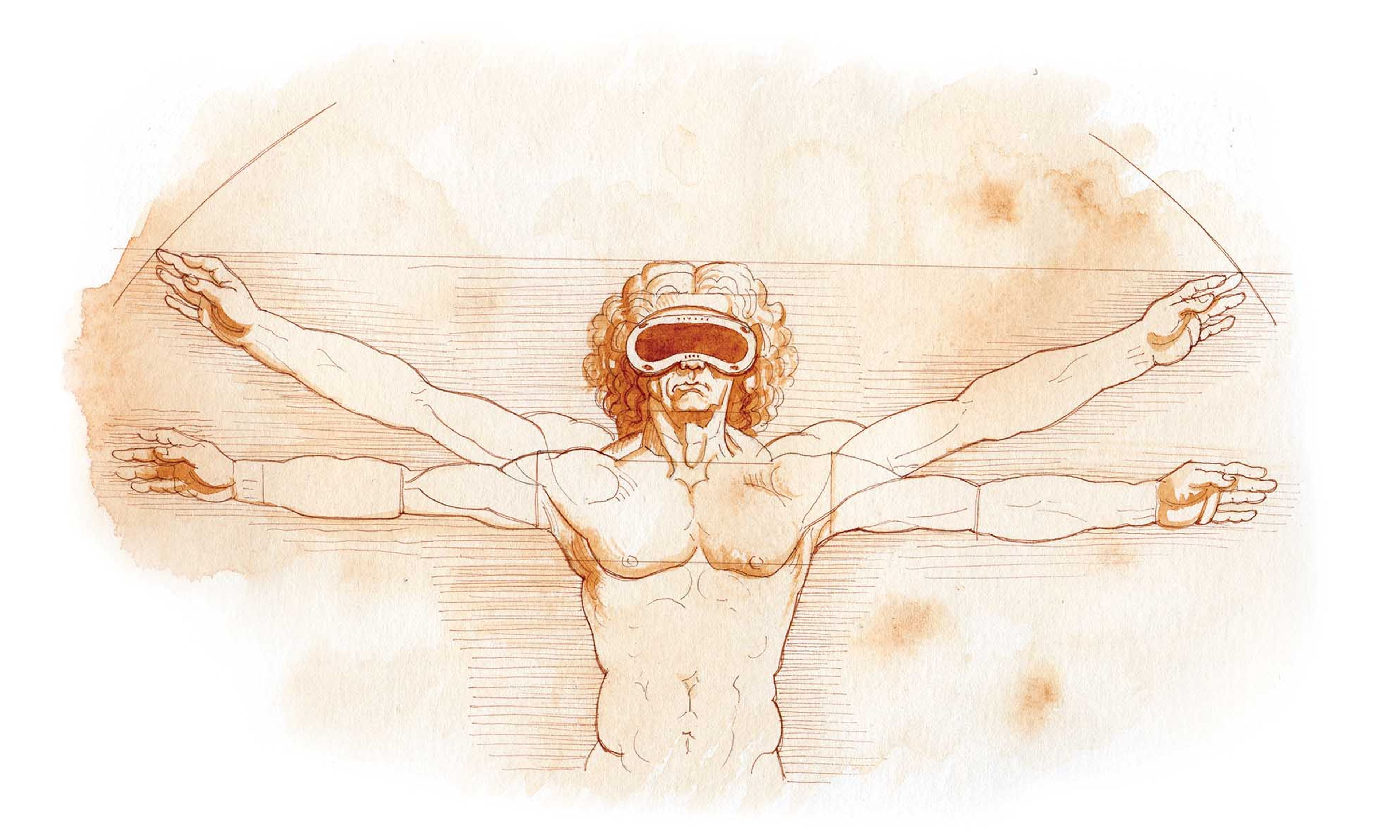
In the early phases of the Gutenberg revolution, when the mass production of books was transforming brains quite as rapidly as the smartphone is remodeling them today, William Shakespeare had doubts.
His most thoughtful character, Hamlet, the “prince of philosophical speculators,” is a bookworm. Only a severely literary person, making the case dad is a great bloke, invokes Hyperion.
Yet Hamlet rebukes his best friend, Horatio, precisely for being too narrow in the bookish knowing of the age. (Horatio has recently returned to Elsinore from Wittenberg, a center of the printed technology of that day much as Palo Alto is a citadel of the electronic know-how of ours.) “There are more things in heaven and earth,” Hamlet assures his friend, “than are dreamt of in your philosophy.”
Gutenberg’s is the gift of the democratization of knowledge through the mechanical reproduction of information. Even when allowance is made for the vast amount of nonsense that has been set up in type, the overall effect, during half a millennium, has been to keep poverty, tyranny, and disease on the run.
Then, too, Gutenberg’s revolution liberates the mind from provincialities of time and place. No longer “rooted to a single spot,” the reader of printed matter, Edward Gibbon saw, “multiplies his own experience, and lives in distant ages and remote countries.”
Today’s electronic reproduction of knowledge carries on that benign upheaval, exposing morbidity to sunlight and transporting us as efficiently as King Solomon’s carpet to whatever times and places appeal to our curiosity or our fancy.
Yet technologies that broaden horizons also narrow them, diminish ways of knowing and being that enhance the life of the unvirtual places in which we pass our days. The books Shakespeare devoured — scholars wear themselves out tracing his allusions — fed his poetry. But his poetry is, among other things, a plea for a face-to-face culture that Gutenberg’s revolution was eroding.
Today’s information revolution, as liberating as Gutenberg’s, is no less narrowing. The Silicon Valley moguls who oversee it feel it themselves. Much as Henry Ford tried to turn Greenfield Village, Mich., and Sudbury, Mass., into “a world the way it used to be” before cars, today’s tech titans regularly flee the globalized information technopolis and its virtual culture to seek out places, from Marrakesh to Mathura, Malia to the Maldives, where a living culture still performs its archaic magic.
A century ago a reclusive scholar, Oswald Spengler, published The Decline of the West, a prose poem in which he purported to argue that the life cycle of cultures — Chinese, Hindu, Magian (Near Eastern), Apollonian (Hellenic), Faustian (Western) — corresponds to the life cycle of plants. There are preordained springs (the Vedic flowering in India, medieval monasticism in the West), fruitful summers (Greek Orphism, North Atlantic Calvinism), decaying autumns (Islamic Sufism, English empirical rationalism), and frigid winters (Buddhism, Western ethical socialism).
Yet with all this voluptuous scholarship, Spengler was less a historian concerned with the past than a prophet who despaired of the present. The two great figures in his book are the artist (or “culture-man”) and the technician (or “civilization-man”). Spengler ravaged the State Library in Munich and indeed the whole of history to show that civilization-man’s technopolises, in thrall to the machine, destroy culture-man’s artistic habitats, which speak “the language of the soul.”
In Spengler’s vegetable mysticism, culture-man’s spare but charmingly poetic towns (Athens, Florence, Ctesiphon, Jerusalem, etc.) are growths of culture’s spring and summer. Come the autumn, however, they give way to civilization-man’s prosperous but mechanical “world-cities” (Victorian London, Gilded Age New York) as inevitably as the rose withers under the fall’s first frosts.
But the mask of the cultural botanist is constantly slipping in The Decline of the West. In Spengler’s theory civilization-man is no more to be blamed for the ugliness of 19th-century Liverpool than culture-man is to be praised for the beauty of 14th-century Bruges: We are ruled by our seasons. But in practice Spengler the vegetable fatalist is constantly at odds with Spengler the old-fashioned moralist. He loves the “Orphic springtime” that “contemplates the Gods,” and he is melancholy in the “soulless” winter of the world-city, estranged from the “cosmic beat” of nature and the human heart.
Only gradually do you see that Spengler’s pseudo-biological mummery is an elaborate ruse, one that gives him cover to make the case for a moral and artistic culture that was passé in an age of mechanical determinisms (Marxist political economy, Freudian psychology, the never-ending parade of cultural Darwinisms). His heart desired what his theory forbade: a balancing of art and technics, a synthesis of culture and the machine, the sort of dream Victorian moralists like John Ruskin and Matthew Arnold dreamt.
But Victorianism was dead, or so Lytton Strachey announced in Eminent Victorians, which appeared in 1918, the year the first volume of The Decline of the West was published. Spengler reached a similar conclusion. Modernity’s cultural incoherence, its “formless masses,” could never be made good by sermons like those in Ruskin’s The Stones of Venice or Arnold’s Culture and Anarchy. Any overt attempt to stand up for the cohesive poetry that created places like Athens and Jerusalem, Varanasi and Kyoto, was, he saw, doomed to fail in a century blind to all virtues but those of the ultramodern and the ultra-primitive. Between the savage and the skyscraper there was nothing.
Only by parodying Darwin — by pretending that history is horticulture in another key — could the sage of Munich open his contemporaries’ eyes to the value of the unfashionable wisdoms to which he himself was pledged. The ingenious effect of The Decline of the West is that it makes the reader sympathize with the dissident Spengler who subverts his own determinist system, the moralist who believes that a technical civilization which monopolizes the “whole life of broad regions” while the deeper culture “dries up” might actually be — modified, in a way that preserves both the culture and the technics.
Today’s tech magnifico is the image of Spengler’s civilization-man: deeply visionary and blind as Oedipus, the primal technocrat. Acute in all technical perceptions, he never sees the kid in Dunkin’ Donuts in the syringe-littered town ordering Sunday breakfast a few feet away from his spaced-out parents.
Blind to the cultural causes of the present discontents — at least as powerful as the socioeconomic ones — the tech magnifico relies on modern political arrangements to avert the fate that befell his unseeing predecessor in Thebes. Accustomed to constitutional paper guarantees (that for now protect him more effectually than the Swiss Guards did Louis XVI), he grows careless of provincial sentiment, contemptuous of life beyond Palo Alto and Belgravia, Seattle and the 16th arrondissement. As though he would prove Disraeli right in his Two Nations theory of elite cynicism.
Thus the tech magnifico thinks little of flyover country, but piques himself on his world-city, not least its morgue-museum vanity art (largely plundered from the culture of dying provinces). He emulates English Whigs who, growing fat on the information technology of 18th-century London, undertook grand tours of the European continent to pillage pre-Gutenberg art; he follows in the footsteps of Gilded Age tycoons, who — wallowing in even gaudier pools — fell happily to the same work of expropriation. From the Athenian marbles of Phidias to the Florentine tempera-on-wood panels of Giotto, the technocratic Vandal makes away with as much of the old stuff as he can.
Steal culture — they don’t make it anymore.
But a looted creativity proves no substitute for the living thing, and so by extravagant jet or overstuffed yacht the information mandarins make their way to places innocent of their technology. Some, it is said, retire to remote islands, to live as people did in the days before Instagram.
They can’t have it both ways. If the techno-metaverse they preach is sufficient for human flourishing, they shouldn’t themselves be chasing premodern idylls in places where life is still (as Clifford Geertz found pre-tourist Bali to be) “radically aesthetic.” On the other hand, if their technical millennium isn’t all it’s cracked up to be . . . they have some soul-searching to do.
‘Sir, we fear these things,” says the chorus to Oedipus. Political structures that insulate the tech magnifico from the unhappy consequences of his technics are today at the mercy of those technics. In erasing un-virtual spaces created by culture (in which citizens work out their beefs face to face) the magnifico subverts the very constitutional edifice that keeps him in business.
America’s republican experiment was never meant to reengineer the soul after the fashion of Maoist or Robespierrist regimes; the experimenters presupposed a foundation of culture on which their novel political edifice was to rest. Their chief innovation lay in the insight that smaller communities, however culturally splendid, were rarely politically stable. To overcome the factional strife that plagued the premodern city-state, James Madison envisioned a free self-governing space on a scale never before seen. Size, supplemented by checks and balances, would conciliate factional differences rather than exacerbate them. “Extend the sphere,” Madison says,
and you take in a greater variety of parties and interests; you make it less probable that a majority of the whole will have a common motive to invade the rights of other citizens; or if such a common motive exists, it will be more difficult for all who feel it to discover their own strength, and to act in unison with each other.
Today’s information technology, cynically pushed as so much digital opium, undermines Madison’s architecture by eroding its cultural basis. The new virtual culture makes it easy for the factional hatreds Madison dreaded to “discover their own strength,” even as its technology abstracts us from the vestigial salves of a flesh-and-blood common life, the cultural infrastructure that occasionally allows us to recognize, in the political adversary, a human friend.
Yet rather than try to balance culture and technics, our techno-pashas press all the more fiercely for their cyber technopolis; and as they await its advent, they look not to cultural renewal but to censorship and pharmaceutical palliatives to shore up the Madisonian regime it is ultimately to replace. Drugged into a state of happy insensibility, fed on a steady diet of manufactured opinion, the discontented plebs will come to resemble, under the mandarin scepter, the tractable bovines Alexandre Kojève, the philosopher of the European Union, foresaw inheriting a post-human earth, a world where the “‘healthy’ automata are ‘satisfied’ (sports, art, eroticism, etc.), and the ‘sick’ ones get locked up.”
And Oedipus thought he could manage the Theban plague. For in spite of so many infusions of Zoloft, so many dropped URLs, so many prophecies of the happy meta-utopia to come, the sad angry citizen of technocracy refuses to be pacified, and spites the master class by seeking relief in electronic group hatreds.
Eleanor Rigby is now on Facebook.
Hamlet turns on the renewal the prince experiences as he coaches a troupe of theatrical players, “the tragedians of the city,” who have come to Elsinore to stage a play in the castle.
The tragedians’ performance brings Hamlet face to face with real people in a living art, one that puts him on a path to serenity. The play is Shakespeare’s swan song for the sort of placeful culture today’s technicians (in theory if not in practice) disdain. The bookish prince who in Act I shrinks from a “weary, stale, flat, and unprofitable” world is, after his encounter with the players, hardly less carried away than a modern citizen on Adderall, speculating in Act V that there is a grace “that shapes our ends, rough-hew them how we will.”
Shakespeare was, to be sure, pleading for his own face-to-face cathartic magic in the midst of the Gutenberg revolution. He was sticking up for the premodern notion of poetry as psychic hygiene: the belief that culture works through art and music intervening in everyday life, a theory the ageing Plato, amending his youthful suspicion of poetry, took up in the Laws.
Even so Hamlet is not a rejection of technology. It is a brief for the synthesis of art and technics that Spengler (in his vegetable moods) dismissed as impossible in an “autumnal” age like ours. Shakespeare’s prince anticipates and dismisses this Spenglerian vegetable determinism: As beings who can “defy augury,” we have the power to escape our “unweeded gardens.”
Hamlet has some history on his side. Athenian poets reconciled a new social technology (democracy) with an older mythopoeic culture of place. Roman elites (pace Spengler) invested lavishly in local artistry. From the Atlantic coast to the Arabian desert, from the Forum Julii in Fréjus to a restored Palmyra in Syria, from the theater of Mérida in Extremadura to the Maison Carrée in Nîmes, they worked with provincials to create forums that even now speak to the complexity of the soul and the soul’s need for an artistically wrought complexity of place. (See Hemingway’s account of the cultural virtues of Pompey’s Pompaelo.)
Until the day before yesterday, Homo sapiens lived in smallish, highly cultured places to which few of us would willingly return. Food was a problem (hard to come by), as was shit (hard to get rid of). New technical knowings liberated us from all that, but they can’t replace old cultural knowings gained through arts that attach us to particular places: the knowing of Odysseus in his longing for Ithaca, of Dante when he mourned the fair sheepfold of Florence.
Such knowings, far from threatening our technical globalisms and information economies, would make them more secure, if only because information and technology can never be substitutes for culture. As conservatives should be the first to insist: A philistinism that fails to recognize the place of art and beauty in the regulation of the daily round is not — conservative.
But it is the tech magnifico, not the cultural conservative, who holds the cards today. And cyber magicians have no interest in art or poetry, save in ornamental forms. They wager that the creativity that makes for a culture vital enough to reach the psychic subsoil will eventually succumb to technology, as well as to pluralist fears that “thick” culture inevitably privileges a particular dogmatic music and so undermines pluralism.
The tech magnifico thus finds an ally in the oversensitive pluralist who, George Santayana saw, distrusts any creativity that intervenes in life because some of the creativity may possess a spiritual dimension. When Santayana argues that poetry “is called religion” when “it intervenes in life,” he is calling out those who would prevent art from intervening in life because some of the art may be experienced dogmatically, as sacred. Such purists are creating a civilization which, being out of touch with needs of the soul, will not long endure.












Comments