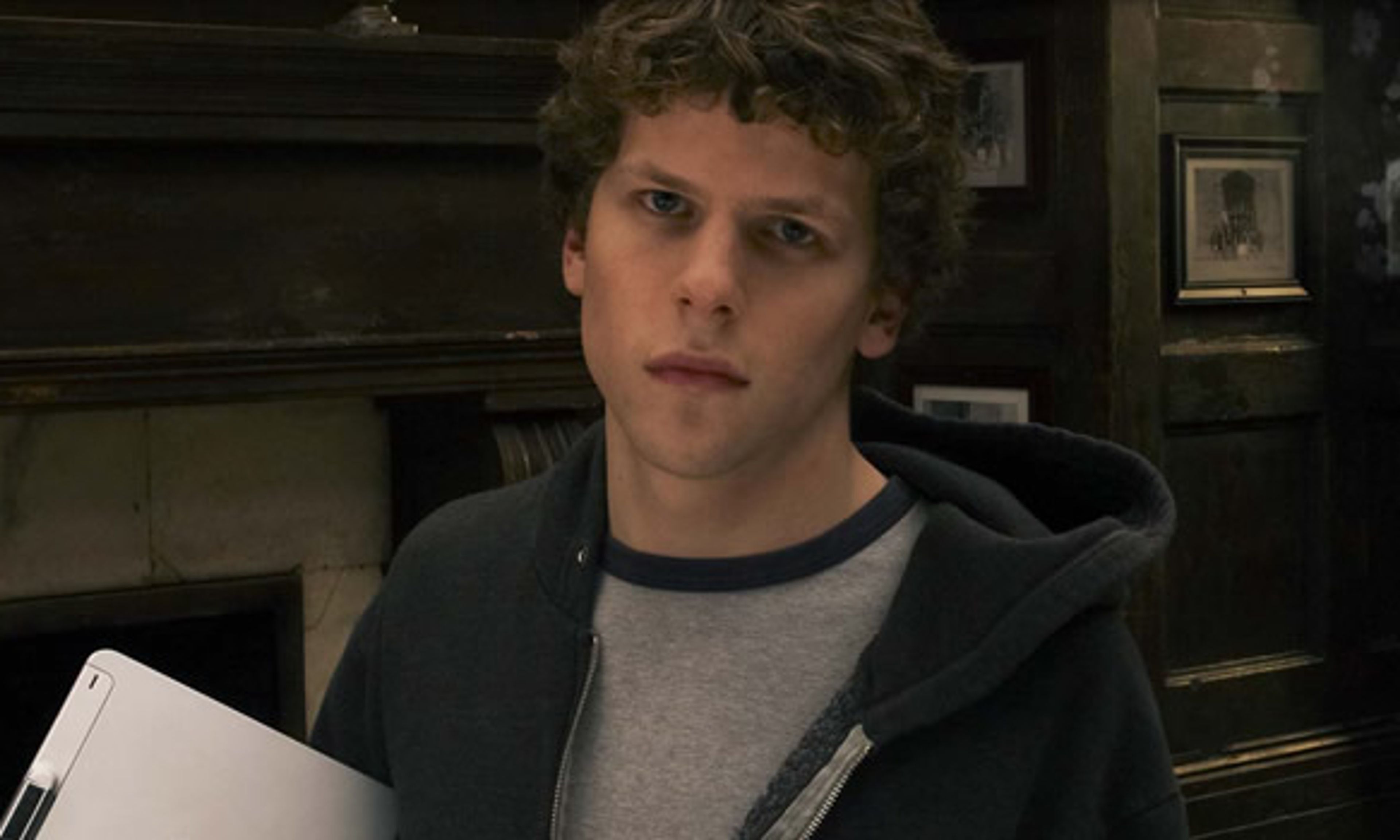
The Social Network, David Fincher’s darkly comic vision of how the online colossus Facebook came to be founded, and then how its founder came to be sued by enemies and friends alike, is the best movie I’ve ever seen about the modern meritocracy. Anyone who’s had the dubious privilege of spending his college years in the peculiar pressure cooker of an elite university will find its story deeply resonant, and perhaps horribly so. And anyone who’s ever dated, worked with, competed with, or otherwise encountered someone from that world will find it an illuminating guide to why we sometimes (often?) can seem like such awful creeps.
The movie’s antihero is Mark Zuckerberg (Jesse Eisenberg), who’s currently worth $25 billion or so, but who makes his first appearance in Fincher’s story as an awkward, tightly wound, fast-talking Harvard sophomore, drinking with his Boston University girlfriend (Rooney Mara) in the fall of 2003. They’re discussing the great Ivy League dilemma: How do you distinguish yourself on a campus where getting a perfect score on your SAT makes you only slightly above average? Or rather, Zuckerberg is discussing it, along with the more particular dilemma of how he might attract the attention of Harvard’s “final clubs,” the all-male centers of the school’s social life. His girlfriend, bright and pert and lovely, is stuck playing second fiddle to his self-involvement, and she’s clearly growing tired of it. Tired enough, in fact, to seize on a disparaging remark he makes about BU academics as the perfect excuse to dump him.
The way the movie tells it, this was the breakup that launched an online revolution. Zuckerberg retreats to his dorm, his computer-science problem set, and a beer-stocked fridge, where — once soused — he decides to have his revenge on the female sex. This involves setting up a website called Facemash.com, whose users are invited to rate the relative hotness of Harvard’s female undergraduates in a tournament-style format, and whose popularity swiftly crashes the university’s servers and brings the school’s disciplinary office down on Zuckerberg’s head.
But it also brings him to the attention of Cameron and Tyler Winklevoss, identical-twin rowers (they’re played by a single actor, Armie Hammer) and members of the eliter-than-elite Porcellian Club, who have an idea for a Harvard-centric dating site and want his help in building it. Zuckerberg initially says yes, and then decides — well, what exactly he decides is open to differing interpretations. Suffice to say that he strings the Winklevosses along for a few months, even as he persuades his entrepeneurial, deep-pocketed best friend, Eduardo Saverin (Andrew Garfield), to put up the seed money for a different sort of Harvard-centric site: a social network called The Facebook.
This leads to instant fame, if not necessarily to fortune. As with most successful Internet properties, the big question once The Facebook starts sweeping college campuses is how and when and whether to start monetizing it. Saverin, doggedly but somewhat unimaginatively ambitious, wants to sell ads based on the site’s initial traffic. But Zuckerberg, from somewhere deep in his own uncoolness, recognizes that the site’s appeal rests entirely on its cool, and that marring the site with ads too early in its genesis would spoil his chance to become something more than simply rich.
He’s prodded along in this understanding by Sean Parker (a surprisingly effective Justin Timberlake), the sybaritic co-founder of the music-sharing — or, if you believe the record industry, music-stealing — website Napster, who recognizes The Facebook’s potential from afar and swiftly attaches himself to Zuckerberg. It’s Parker who insists that they rename it Facebook, Parker who persuades Zuckerberg to abandon Harvard for Silicon Valley, and Parker who drives a wedge between the nerd king and his posher, less visionary best friend. Meanwhile, the Winklevosses and their high-priced lawyers start to circle, claiming that Facebook was originally their idea . . .
It is all true? Well, perhaps not. The lawsuits are real enough, but the actual Zuckerberg is still dating his sophomore-year girlfriend, and he recently told The New Yorker that he never cared about the final clubs. The quick, often hilarious script, penned by Aaron Sorkin of West Wing fame, is based on a sensationalized quickie-book by Ben Mezrich, an author who’s mastered the art of taking the straw of fact (interviews with the bitter Saverin, in this case) and spinning it into the gold of semi-fictionalized bestsellers.
But if the facts have been massaged a little bit, the story is still intensely true-to-life. In Eisenberg’s characteristically canny performance, Zuckerberg emerges as the classic outsider-insider: a Westchester-born, prep-school-educated high achiever who nonetheless carries a huge chip on his shoulder, and who takes every slight and setback as a spur to ever greater ambition. And Fincher’s portrait of the billionaire as a young man captures the way the American meritocracy takes a class of people who are almost all extraordinarily privileged by any reasonable standard, and then uses minute-seeming status anxieties — Boston University versus Harvard, the geeks versus the jocks, the upper class versus the upper-upper class, the final-club boys versus the guys who don’t get in — as a spur to frantic, constant, dehumanizing competition.
This isn’t really a story about the Internet, ultimately. It’s about the soul of man under meritocracy. And it isn’t a pretty sight.












Comments