What qualifies an election as “the most important election”? Even in the days when politics was considered by some to be a mundane and boring profession, there was never an unimportant presidential election. But let’s face it: Some are more important than others. Think about the elections that did matter, such as in 1800, between John Adams and Thomas Jefferson. These men agreed on nothing, especially the role and scope of the national government. It was so vicious, a supporter of Jefferson’s called Adams “a hideous hermaphroditical character which has neither the force and firmness of a man, nor the gentleness and sensibility of a woman.” These two great men reconciled only years later, when each was on his deathbed.
How about 1860, which forced the matter of slavery to the forefront and left in its wake over 600,000 young Americans dead? After the Civil War, British newspapers went from writing “the United States are” to the “United States is.” We truly became united. Arguably, as of 2020, one of the most important elections in American history was 1860. Everything, including the future of the United States, was at stake. The victory of Abraham Lincoln, who appealed to the “better angels of our nature,” backed by the newly formed, anti-slavery Republican Party, was a blaring klaxon to the South — a shift in power that would, in their minds, assure the end of the institution of slavery. This election, more than any other political calculation, directly led to the South’s seceding, a national war, the preservation of the nation, and the end of slavery in America. Had the North lost, the idea and actuality of America would have vanished, just another failed republic for children to read about in history books.
Historically, the most important American presidential elections have always revolved around fundamental transformations in national policy or the specter of a war to come — or a war to close out.
The election of 1932 certainly ranks as one of our most important, since it portended a fundamental shift in activism-government and its relationship to the average citizen. It changed both parties, and they both eventually embraced a bigger, more solicitous government. Of course, the election of 1940 must also be considered important, because the European war was at our doorstep. Though both candidates, Franklin Roosevelt and Wendell Willkie, pledged that “your boys are not going to be sent into any foreign war,” as FDR said in the fall of 1940, that pledge did not last, and America was plunged into a world that changed it in every way imaginable. FDR was probably more temperamentally suited to unite America and alter the course of American history than Willkie and, for that victory over fascism, he must be considered one of our greatest presidents.
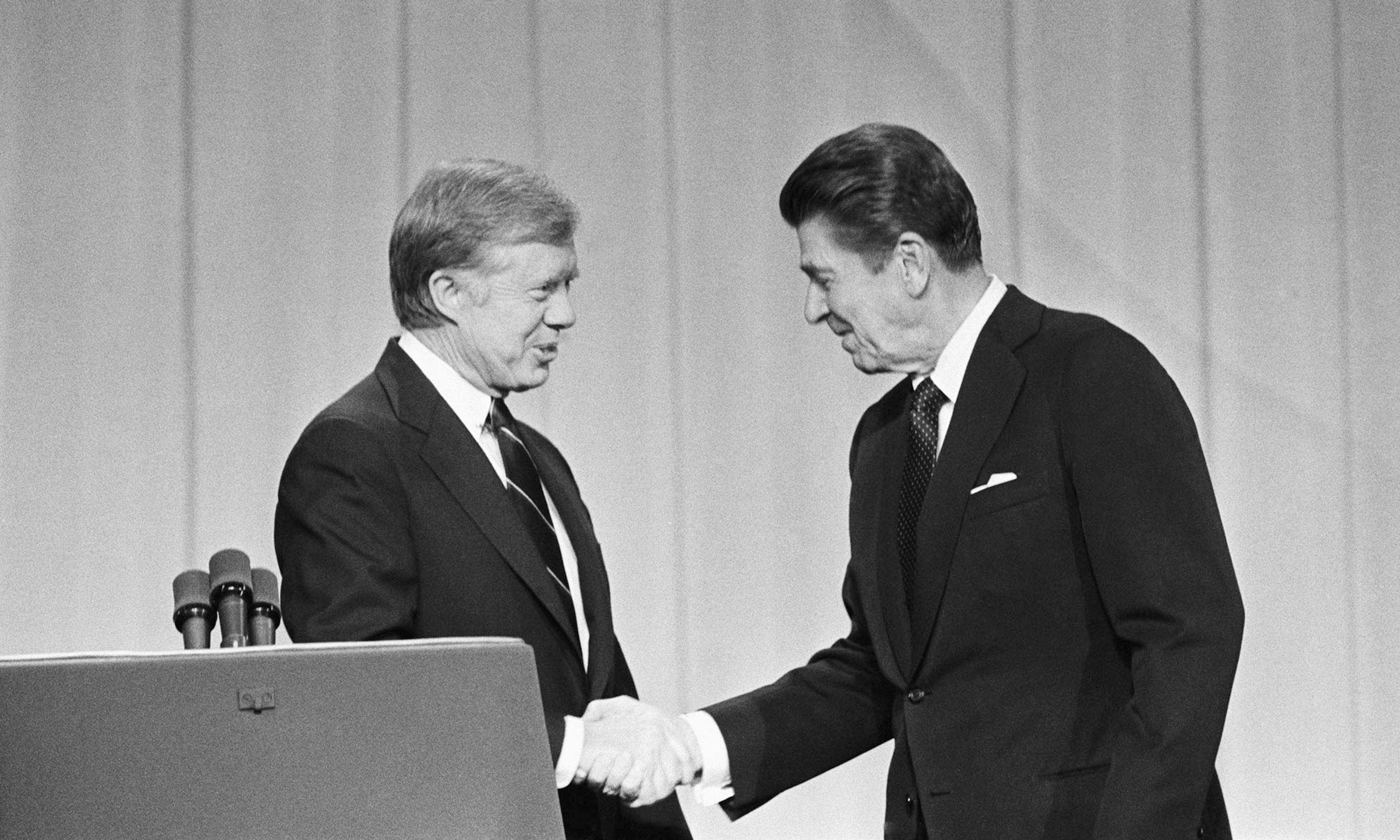
The election of 1980 was also about war — the Cold War — and a fundamental change in national policy. Ronald Reagan and Jimmy Carter came to rhetorical blows over everything. They were diametrically opposed on every point of policy. They agreed on nothing. They really did not like each other. Reagan thought Carter was in over his head, and Carter thought Reagan was a lightweight. During the campaign, Reagan confided to a reporter that it’s not enough for a candidate simply to want to be president: “There is more of a feeling that one should be president.” In 1980, by any metric, the Soviet Union was winning the Cold War and the West was losing. The USSR had invaded Afghanistan one year earlier; Southeast Asia had fallen to communism; Angola had fallen to communism; Nicaragua had fallen to communism; Fidel Castro was running amok; Soviet subs were in Cuba; but all Carter cared about was his precious SALT II treaty. He said as much. The invasion of Afghanistan be damned, he wanted a signed treaty with the Soviets. Suffice it to say, the Soviets played Carter for four years like he was holding a busted flush.
In the 1980 campaign, Carter said Reagan would divide the country and that “Americans might be separated, black from white, Jew from Christian, North from South, rural from urban.” Reagan told his convention in Detroit in July, “Never before in our history have Americans been called upon to face three grave threats to our very existence, any one of which could destroy us. We face a disintegrating economy, a weakened defense, and an energy policy based on the sharing of scarcity. . . . You know, there may be a sailor at the helm of the ship of state, but the ship has no rudder.” Reagan’s longtime aide and friend Stu Spencer once told me that he thought Reagan regarded Carter as “a little sh**.” Reagan really had no use or respect for the Georgian peanut farmer.
When President Donald Trump says, loud and long, that the 2020 election is the most “important” in history, is he right? It’s undoubtedly the most expensive election and, clearly, the most ubiquitous election, but the most important? To be the most important, surely former vice president Joe Biden and President Trump must have diametrically opposed political philosophies, right? But based on the expansion of government at all levels, the unchecked growth of entitlement programs, and the ever-growing national debt, there is little difference between the two. Which is why this election is very similar to the 1968 contest between Vice President Hubert Humphrey and former vice president Richard Nixon. Looked at through the lens of history, they disagreed on little. Nixon said he had a “secret plan” to end the war in Vietnam, but in fact he expanded the scope of the war once he became president. Nixon denounced the rioters. Humphrey denounced the rioters. Nixon favored activist government. Humphrey favored activist government. From a policy standpoint, there really wasn’t a dime’s worth of difference between the two.
This 2020 contest is really a race between two personalities and two cultures. The brash and bold Trump vs. the softer-spoken Biden. The liberal argument is that a softer and clearer voice in the White House will ripple across the country and ameliorate America. The counter is that, without the power of Trump’s personality, the fringe elements of society will take over the country. While this is far from an important election in terms of policy or war, it might be more important in terms of us, the American people and our culture. Perhaps we will finally realize that surrendering so much of our society to the man, any man, in the Oval Office is a mistake. That maybe the substance of what a president says is more important than how calmly or forcefully he says it.
Biden wants to rebuild infrastructure in America; so does Trump. Biden wants to avoid future military entanglements; so does Trump. Biden is appealing to the everyman, forgotten by coastal elites. So is Trump. Where do they differ? Social issues, taxes, and immigration; all important, but hardly the makings of another civil war or a grand undertaking. The difference is much simpler. The difference is our makeup as a people. Law and order may be the most important issue of all. With mayhem, nothing is possible.
The election of 1980 didn’t lead to civil war, but it did free millions from Soviet bondage. Four years of Jimmy Carter, thought by some to be a good man who was sadly unequal to the presidency, had crippled the nation in more ways than one. The great George F. Will once told me he regarded the 1980 election as a “national emergency.” The economy was in a shambles, national pride was at an all-time low, and, most important, the Cold War was considered not a fight to be won but a fact of life to be tolerated. Presidential candidate Ronald Reagan’s constant assertion that the nation was at war was incomprehensible to the D.C. establishment. Carter believed that the great days of America were behind it and that the sooner the nation accepted this, the better off it would be. Reagan, conversely, promoted a vision of America emerging from victory in the Cold War into a second golden age. And he united the country. When he left office in January 1989, his overall approval rating was 68 percent, the highest of any president leaving office since World War II. His approval rating among African Americans was an astonishing 43 percent, and he had high ratings among Democrats in general. His approval rating among voters under 30 was a skyscraping 77 percent.
As the magnificent Jeane Kirkpatrick once observed, “Ronald Reagan believed, as I see it, that the individual is the creative principal in history and in society and economics, . . . and in foreign affairs.” A quintessential man of the Enlightenment, Reagan believed happiness should be part of our national policy — and who was to argue with the results? He set out to raise the nation’s morale after the 17-year malaise of JFK’s assassination, Vietnam, gas lines, and the failed presidencies of Lyndon Johnson, Richard Nixon, Gerald Ford, and Carter. Reagan knew that a happy people are a productive people, and a productive people produce the weapons of peace to raise the national economy and the weapons of war to bring an evil empire to its knees. He understood that a state of happiness was an important political issue and a potent political weapon — just as his personal favorite president, FDR, did; just as the oft-quoted JFK did.
Reagan also unleashed an intellectual revolution in 1980, something even the Washington Post acknowledged at the time. From 1932 to 1980, both parties more or less agreed on a large role for government. Reagan was the first candidate — after Barry Goldwater’s failed candidacy in 1964 — to articulate the case against government and for freedom. He said, rather brilliantly, “If no one among us is capable of governing himself, then who among us is capable of governing someone else?” Speaking at his alma mater, Eureka College, Reagan said, “For most of my adult life, the intelligentsia has been entranced and enamored with the idea of state power, the notion that enough centralized authority concentrated in the hands of the right-minded people can reform mankind and usher in a brave new world. . . . The romance of the intellectual with state power is over. Indeed, the excitement and energy of the intellectual world is focused these days on the concerns of human freedom, on the importance of transcendence and enduring values.” He quoted men of letters often, such as Aristotle, Thomas Paine (a personal favorite), Aleksandr Solzhenitsyn (another favorite), Franklin, Washington, Disraeli, and Madison.
Reagan was once asked whether there was anything he had learned from his Hollywood days that helped him be a better president, and the wise old man said, “I don’t know how you can do this job and not be an actor.” Reagan, like Shakespeare, knew that “the play’s the thing.” All good leadership is based in presentation, and the better, such as Napoleon, Washington, MacArthur, and Patton, knew that all the world was indeed a stage.
The 1980 campaign introduced to the world the memorable quote “I am paying for this microphone, Mr. Green!” and the more timeless “Are you better off than you were four years ago?” which is now offered by every presidential candidate. The campaign was the first in many a year to offer voters a real choice between the power of the “nanny state” and the power of the individual, a hard choice about alternative futures.
But most of all — for those of us who were soldiers and captains and generals in the Reagan revolution and part of that time — what made the 1980 campaign important, and what has it still lingering in our minds after 40 years, is how it left Americans feeling hopeful. It made us excited for the future, and it made people believe that, finally, we had reached the light at the end of the long proverbial tunnel. It gave people across the political spectrum a sense of optimism that seems foreign in today’s elections. By comparison, neither Republicans nor Democrats today are all that excited about Donald Trump or Joe Biden. No one is ecstatic. No one is eagerly anticipating the next four years under either candidate. Reagan brought new energy to the American idea, and for that, his election 40 years ago still stands out above the competition.












Comments