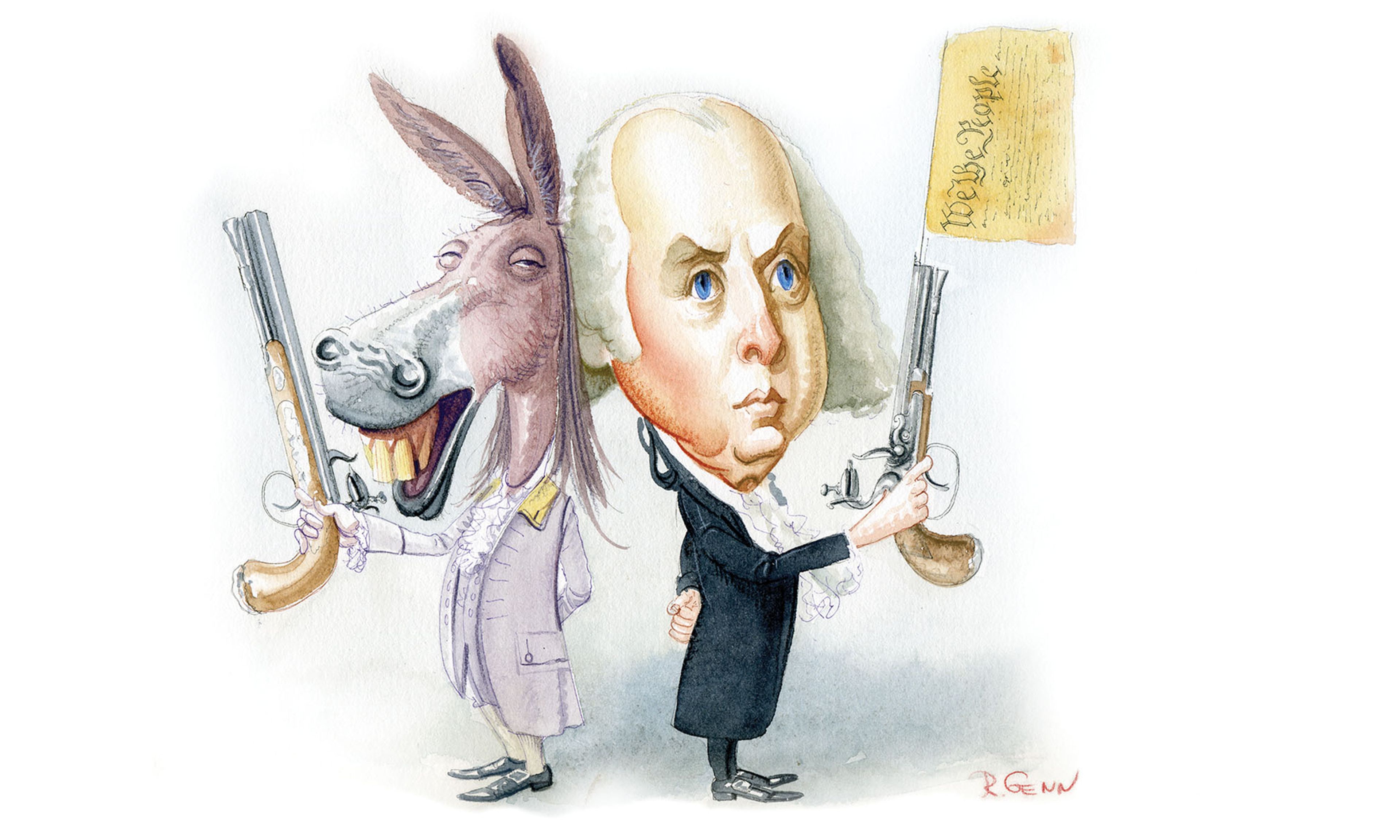
Democrats have lately revived their campaign to make the District of Columbia the 51st state — or 52nd, if they get their way on Puerto Rican statehood. Besides being politically and legally infeasible, D.C. statehood would be bad for the health of the American republic. While some aspects of the argument in favor of it have improved in recent years, events this year have thrown into sharp relief why the Founders wanted the federal district to be forever separate from any state.
The Constitution defines a unique status for the seat of the federal government. A constitutional amendment is required to change that. Article I, Section 8 of the Constitution gave Congress plenary local lawmaking power to “exercise exclusive Legislation in all Cases whatsoever, over such District” — the broadest power Congress exercises anywhere. The 23rd Amendment, passed by Congress at the urging of President Dwight Eisenhower and then-senator John F. Kennedy in 1960, and ratified the following year, gave D.C. residents the right to vote in presidential elections as they would if D.C. were a state. But it defines D.C. as a permanent constitutional entity of its own, outside of statehood. The Justice Department has repeatedly concluded, under administrations of both parties, that D.C. statehood requires amending the Constitution. That isn’t going to happen. The last time such an amendment was tried, in the 1970s, only 16 states signed on.
The District of Columbia is overwhelmingly Democratic, which is inseparable from why Democrats are so eager to give it representation in the Senate. Indeed, some Democrats have argued for D.C. statehood as partisan retaliation for Republicans’ filling the Ruth Bader Ginsburg vacancy on the Supreme Court so close to the 2020 election. Republicans make up only 6 percent of the District’s registered voters. No Republican has been elected mayor of D.C. since the start of home rule in 1975. There are no Republicans on the D.C. city council, and there have been none for over a decade. Richard Nixon’s 21.6 percent of the vote in 1972 is the only time a Republican presidential candidate cracked a fifth of the vote; George H. W. Bush in 1988 was the last Republican to crack a tenth of the vote. Given Democrats’ naked and obvious partisan motives in pushing for statehood, there is no prospect that the required 38 states could be persuaded to amend the Constitution even if a Democrat-controlled Congress mustered the required two-thirds vote in both houses to pass an amendment.
It is theoretically possible to make an end run around this obstacle by creating a new, separate state out of parts of D.C. without amending the Constitution. That, however, would create a new set of problems. Carving a state out of the existing District might avoid the constitutional issue, at least if Maryland consents. D.C. consisted originally of land ceded to the federal government by Maryland and Virginia, but the Virginia sections were returned (retroceded) in 1846. Article IV, Section 3 of the Constitution provides that “no new State shall be formed or erected within the Jurisdiction of any other State; nor any State be formed by the Junction of two or more States, or Parts of States, without the Consent of the Legislatures of the States concerned as well as of the Congress.” There is some question whether the land ceded by Maryland was ceded irrevocably or only for purposes of being part of the federal District. Legal expert opinions collected by the Congressional Research Service lean toward the view that the grant was irrevocable. Maryland is, in any event, a Democrat-dominated state, despite having a Republican governor, so it would likely consent eventually.
What then? If a new state is to be based on appeals to the democratic rights of the people, most of its residents will want to be included. While it was limited by Article I, Section 8 of the Constitution to a maximum size of “ten miles square,” the Constitution specifies no minimum size. In theory, the District to remain under federal control could be shrunk to the areas immediately around the White House, Capitol, and Supreme Court. This is essentially what happened to the Vatican in 1870 when it lost control of the rest of Rome.
But what would happen to that rump District? Some of the proposals for a new state of “Douglass Commonwealth” (after Frederick Douglass, a worthy namesake) would leave the federal District with nearly no residents outside of the White House. But the 23rd Amendment would still guarantee the rump District three electoral votes. Proponents appear to believe that once statehood seems like a fait accompli — or shortly thereafter — that would create a bipartisan incentive to amend the Constitution. But in the interim, a presidential election could easily turn on a “rotten borough” of nearly no voters and with power in the Electoral College far exceeding its population. The old British practice of rotten boroughs, in which a tiny handful of aristocratic voters would control a seat in Parliament equivalent to the representation of entire cities, was such a notoriously corrupt abuse that the British abolished them in 1832. We should not aim to revive one now.
Would the residents be limited to the president’s family, thus giving the incumbent party a leg up? Or would there be a small enclave of permanent residents? Consider a hypothetical situation: A politically motivated billionaire buys up all the residential housing left in the federal District and ensures that its residents are all partisan political operatives and staffers. It is not hard to find a few dozen or a few hundred such people in D.C. Voilà! Three locked-in electoral votes — maybe for Republicans, maybe for Democrats. Even without such drastic steps, the new District, once captured, would create its own perverse incentives for one party to cling to the status quo.
Even getting past the problem of the rotten borough, statehood for the District would create two related problems: accretion of too much wealth and federal power in the capital, and the danger of making the physical security of the federal government dependent on the favor of a local government that could prove hostile or extortionate.
The Founders foresaw the risk that creating a national capital would give too much power to the state of its location and its residents. Madison wrote in Federalist No. 43 that “the gradual accumulation of public improvements at the stationary residence of the government would be both too great a public pledge to be left in the hands of a single State, and would create so many obstacles to a removal of the government, as still further to abridge its necessary independence.” Yet even Madison never conceived of a time when the federal government would spend $4.5 trillion a year and employ more people in D.C. alone than the entire population of Syracuse or Dayton.
Between 1990 and 2007, D.C.’s median household income varied from 95.6 to 107 percent of the national average. Today, according to the Census Bureau’s American Community Survey, it is 140 percent, higher than in any state, with neighboring Maryland second. There is nearly one federal job for every four residents in D.C., and much of the District’s private employment is in satellites of federal power. The D.C. suburbs are now the wealthiest places in the nation, and uniquely recession-proof. This is hardly a picture of an oppressed community needing a further voice in a national government run by its own residents.
In the 1980s and 1990s, it was argued that the largely poor, black residents of D.C. — it was more than 70 percent African-American in 1980 — were unduly disenfranchised. The flip side of that argument was that D.C. was a fiscal basket case, wholly unsuited to be a state of its own without huge federal subsidies. In the past decade, however, while D.C. has attained a measure of fiscal buoyancy with the flood of federal jobs, it has ceased to be majority-black. Its claim for statehood should be evaluated on a basis less focused on race.
Madison and the other Founders worried, as well, that the federal government’s independence of action in the national interest would be imperiled by subjecting its physical security to state and local authorities. This was not a hypothetical problem. In June 1783 a drunken mob of unpaid Continental Army soldiers surrounded the Continental Congress in Philadelphia. State and local authorities in Pennsylvania refused Alexander Hamilton’s desperate pleas to defend the Congress. Led by Hamilton and Oliver Ellsworth of Connecticut, its members fled across the Delaware River into New Jersey and took up temporary housing in Princeton. Hamilton spent the time in New Jersey exile drafting a resolution calling for a constitutional convention. The Framers of the Constitution that was drafted at that convention (conducted in secrecy from the Philadelphia crowd) understood that a government with more permanent quarters could not so easily pack its bags.
With the events of 1783 fresh in mind, Madison warned that, without federal control of the capital, “the public authority might be insulted and its proceedings interrupted with impunity. . . . A dependence of the members of the general government on the State comprehending the seat of the government, for protection in the exercise of their duty, might bring on the national councils an imputation of awe or influence” to the detriment of other states. In 1812, as president, Madison saw the capital burned by an invader when the Maryland militia could not protect it. His insight proved prophetic in 1861, when Maryland teetered on the verge of joining Virginia in seceding. Federal authorities needed to subdue angry mobs in Baltimore and send a young Andrew Carnegie at the head of a military and technical crew to keep the District connected by rail and telegraph to the North. The next four years of war centered heavily on the physical defense of the capital, and of the Confederate capital in Richmond.
Today, that threat is back out in the open. In June, after President Trump deployed federal authority to protect the White House and federal property against unruly mobs in Lafayette Square, Washington mayor Muriel Bowser lobbied for statehood precisely because it would expand her authority at federal expense: “I think what we saw from this president is something that we haven’t seen in our city, and that was federal troops on the ready, federal police, policing a local city, National Guard troops hauled in from all over the country. So I decided, when we saw those federal police out on D.C. streets, that we had to push back.”
Whatever mistakes Trump made in handling disorder in the District and clearing a space for his own photo op outside St. John’s Church, the answer is not to make presidential or congressional power permanently dependent on a single local official. We have seen efforts in New York and California to use state power over the president’s tax returns (recently leaked, perhaps illegally by those state officials) as a lever of control over the chief executive. The holding of every future Republican presidency hostage to a hostile D.C. mayor’s control of the streets is once again not a far-fetched possibility.
The United States should not aspire to be revolutionary France, with the nation’s government subject to the whim of the capital’s mobs. That way lies madness.












Comments