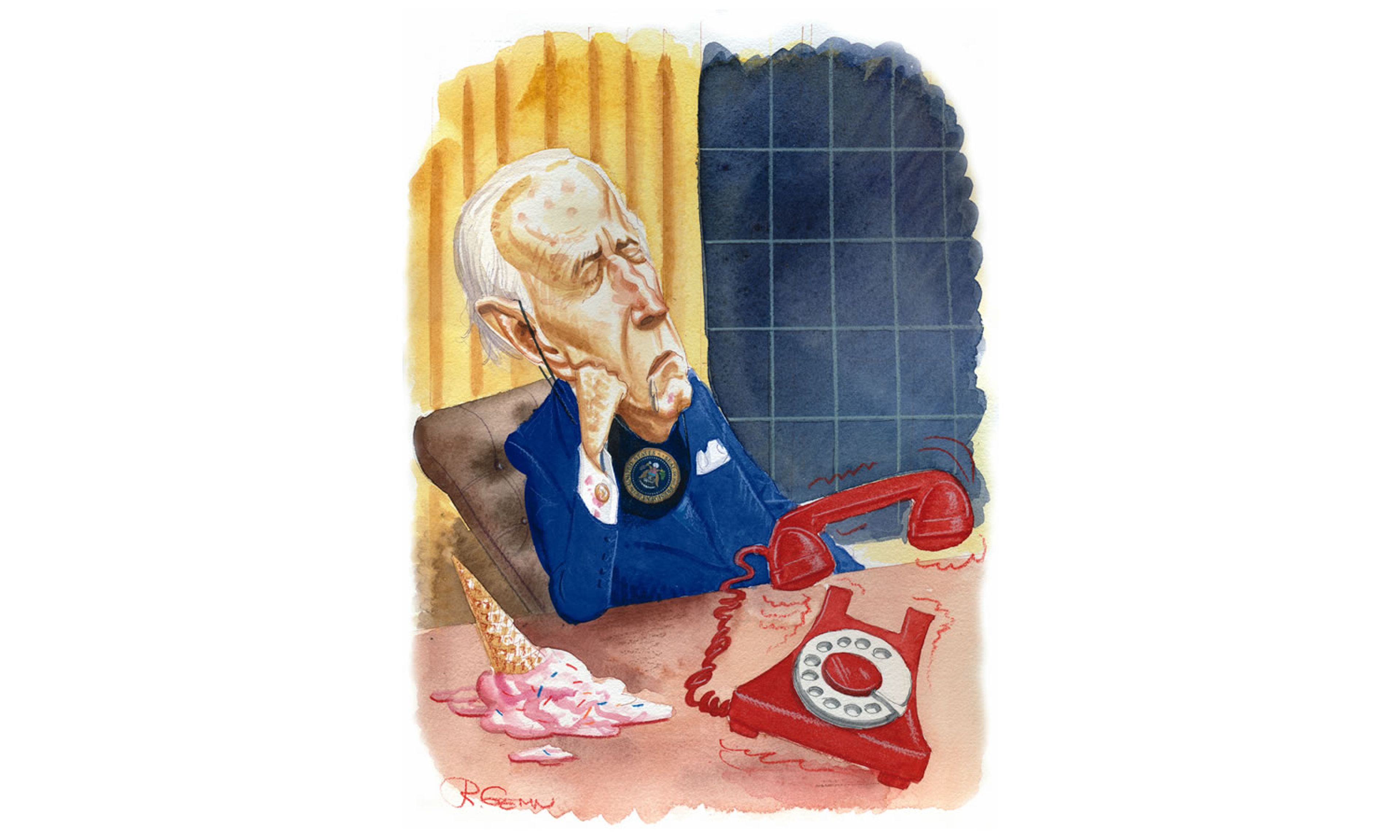
• Don’t think of it as surrender — think of it as a mask mandate for Afghan women.
• A “forever war” is what, according to those who had tired of it, our presence in Afghanistan was: a violent scrum, bloody, pointless, and endless. The only smart thing to do with a forever war, according to critics on both the left and the isolationist right, is end it. Wars, however, do not end when only one party to them stops fighting. Long-standing problems require lengthy efforts. These can prevent wars from becoming much hotter; or they can avert the peace of despair. Every situation requires judgment: De Gaulle abandoned Algeria in part because the revolutionaries there were not intent on attacking metropolitan France (nor have they done so for 60 years). We went to Afghanistan in the first place because the Taliban’s clients attacked us. We fought because we were fighting back. We should fight to protect our interests, and especially our security, for as long as it takes.
• Gil Scott-Heron, proto-rapper, said the revolution will not be televised. In fact the revolutions of the modern era have almost all been media productions, made to be seen in whatever visual forms were current, from letter-press broadsides to social media. The Taliban are as hip, in their way, as the teenagers in the West they abhor. Witness all the shots of them taken in Kabul, in their best turbans and slinging four-foot-long rifles. Witness their parody of the Marines raising the Stars and Stripes on Iwo Jima, with terrorists in stolen camo hoisting an Islamist banner. They yearn for a (mostly imaginary) seventh-century past, but they are creatures of the 21st. Like all of us, they are the stars of the movie playing in their heads, and they are adept at teasers. Their script, however, calls for throwing acid in women’s faces. Coming, they hope, to shut down a theater near you.
• When your enemies attack you it’s business as usual; when your friends join them you should worry. Joe Biden’s stampede from Afghanistan is catching flak from persons and places normally sympathetic to Democratic presidents. “Biden Ran on Competence and Empathy” was the ironic headline on a piece by New York Times White House correspondent Peter Baker, which went on to note “the chaotic endgame” there. “It just struck me,” Leon Panetta, Barack Obama’s secretary of defense, told the Washington Post, “that they were crossing their fingers and hoping chaos would not result. And it doesn’t work that way.” One of Biden’s alleged strengths as compared with Donald Trump was that he would work with our allies, but our allies are not happy. Tom Tugendhat, a Tory MP and Afghanistan vet, ripped Biden on the floor of Parliament. “I’ve watched good men go into the earth, taking with them a part of me, and a part of all of us. To see [Biden] call into question the courage of men I fought with, to claim that they ran, is shameful.” When you abandon an ally, other allies tend to notice.
• Information is always critical, but never more so than in times of crisis. During the current Afghan disaster, the media have performed admirably — maybe too admirably, from Biden’s point of view. He is facing the critical, even withering, press that Republicans have long been accustomed to. In Afghanistan, CNN’s Clarissa Ward was outstanding. She roamed the streets, braving dangers, reporting the news. She did the same at the Kabul airport, amid chaos and violence. One day, she reported a paradox: Militants were chanting “Death to America,” yet they seemed “friendly at the same time.” Online, some people knocked her for what she said, clipping the bit where she said the scene was “utterly bizarre.” Eventually — after more than one close call — Ward was evacuated on a flight to Doha, Qatar. Those who give us the news, particularly at personal risk, are invaluable. So are those who press public officials, hard. We welcome any and all chances to give the media justified praise.
• A fierce debate on the right has broken out about how to handle Afghan refugees, although the correct approach seems obvious. We should be flying out as many Afghans as possible from Kabul consistent with our obligation to help Americans first. But besides Afghans who have already been approved for so-called SIVs — those who worked as translators or who otherwise who were employed by or on behalf of the United States — everyone should go to third countries. This serves the important humanitarian function of getting them out of harm’s way in Afghanistan. It also provides us the time and space to vet and process them and eventually bring SIVs and others who are most deserving into the United States (although reports suggest, maddeningly, that they have had the most difficulty getting through the Taliban at the gates of the airport). We should lean on allies and countries neighboring Afghanistan to take everyone else. By all means, let’s be open-handed and generous to the Afghans who put it on the line for us and lend support, to the extent we can, to Afghan refugees who end up elsewhere. But our refugee policy should demonstrate the rationality and discrimination that President Biden’s bug-out didn’t.
• After causing some mild drama, so-called moderate Democrats agreed to provide House Speaker Nancy Pelosi with the votes to pass a budget resolution. The blueprint paves the way for Congress to enact a sweeping $3.5 trillion social-welfare bill this fall on top of the $550 billion bipartisan infrastructure agreement. Moderates had been hoping to force a vote on the smaller bipartisan bill before voting for the larger budget resolution, but they settled for a commitment by Pelosi to consider the bipartisan bill by the end of September. That commitment is not binding, and the chamber could always consider the bill and vote it down, as progressives aren’t going to vote for the bipartisan package alone without the larger bill. Now Democrats will have to produce actual legislation that will mollify concerns of moderates without driving away AOC and her squad. But this will offer a real test for these moderates. The budget resolution reads like a liberal wish list — subsidized child care, universal pre-K, free community college, an expansion of Obamacare, new dental and vision benefits for Medicare, and a down payment on the Green New Deal, all paid for by trillions of dollars in tax hikes and new debt. Given that the starting point is $3.5 trillion, there is plenty of room for Democrats to scale back the measure and still end up with something massive that advances a host of progressive priorities. If moderates end up settling for a slightly reduced but still radical package, their claim to be exemplars of moderation will have even less credibility.
• Leaving Albany, New York’s disgraced former governor, Andrew Cuomo, piled on a last outrage: clemency for Weather Underground terrorist David Gilbert, convicted of murdering a Brinks guard and two police officers in an infamous 1981 robbery. Gilbert and his Weather cohort Kathy Boudin acted as getaway drivers for Black Panther gunmen. Left-wing terrorists remain Democratic radical-chic. Boudin after two decades in prison was — naturally — hired to teach at Columbia. Cuomo was lobbied to make Gilbert parole-eligible by San Francisco’s radical DA, Chesa Boudin, son of Kathy and Gilbert. Because his parents were in prison for the murders, Chesa was raised by their Weather chums Bill Ayers and Bernardine Dohrn, who escaped terrorism prosecution because of an FBI spying scandal. The avowed “small-c” communists went on to become influential academics and political patrons of Barack Obama. As president, Obama granted clemency to the last of the FALN terrorists not already sprung by Bill Clinton, who had commuted the sentences of two other Weather terrorists, one of whom, Susan Rosenberg, now coordinates progressive fundraising networks that back Black Lives Matter and other radical causes. Gilbert is the second Brinks terrorist granted clemency by Cuomo. Who says he doesn’t have a future in politics?
• Ohio Senate candidate Josh Mandel just keeps tweeting. The former state treasurer is vying for the Republican nomination for the seat being vacated by Rob Portman in 2022, and his plan for prevailing runs through not a city, or a region, but social media. According to his online presence, Mandel boasts a deep understanding of the Middle East (“Why did the Afghan soldiers strip off their uniforms and put on their mandresses?”), a rhetorical advantage over any Democrat he might face in the general (“Hey @JoeBiden: Proper Prior Planning Prevents Piss Poor Performance”), and a talent for building coalitions (“The only thing worse than a Democrat is a RINO”). We saw these qualities come together in a true masterpiece attacking Senator Mitt Romney for criticizing Biden’s abandonment of Afghan interpreters who spent years assisting the U.S. military (“Send RINO Mitt —> Kabul”). Appealing to the base is a necessary part of politics; abandoning your dignity and intelligence is not.
• A Los Angeles Times columnist called Larry Elder, the conservative radio host running for governor in the election to recall Gavin Newsom, “the black face of white supremacy.” A former girlfriend of Elder, supporting a different candidate, claimed he had behaved in a menacing fashion with a gun while they were dating. He denies it. These news items would, by themselves, tell you what the polls confirm: Elder is now the leading anti-Newsom candidate, and Newsom might very well lose in September.
• As summer started, it looked as though COVID was finally ceasing to be a major problem in the U.S. Victory has been postponed, though, thanks to the spread of the Delta variant. Vaccines are highly effective at reducing the likelihood of getting it or coming down with a severe case of it if you do, however, which is part of why daily deaths from COVID are still far below last winter’s numbers. The FDA has now given full approval for the Pfizer vaccine, and its seal of approval may raise vaccination rates a bit, both by making individuals more likely to get the shots and by giving businesses more legal power to require vaccination. The Delta cases themselves should spur some vaccinations too. The wave in the Southeast, which has led to predictable if ghoulish blue-on-red gloating, already seems to be receding. It would not be surprising if other regions were to go through waves of their own as the school year starts. We need, as we have needed from the start, to cultivate an unpanicked vigilance.
• Grade school has become the central front of the mask wars. Thankfully, the stakes are overstated. The evidence that mask usage in children reduces transmission is weak, and that’s especially true of standard cloth masks. Children’s likelihood of getting or transmitting severe cases is also, with important exceptions, quite low. (Beware of statistics purporting to show that a high percentage of COVID cases in children are severe; there are almost certainly a great many undetected cases that aren’t counted.) Requiring kids to wear masks in the classroom is therefore a mistake, although perhaps one that local school districts should be allowed to make. Serious public-health efforts would be much better directed at improving vaccination rates and ventilation.
• The celebrity-backed feminist group Time’s Up, formed to fight sexual misconduct in the wake of the Me Too disclosures, was recently revealed to be advising New York’s now-former governor Andrew Cuomo on his strategy for smearing the women accusing him of sexual misconduct. But it turns out that Time’s Up’s record of helping powerful Democratic men combat sexual scandals goes further back: The New York Times reported that Tina Tchen, the organization’s chief executive, worked with Biden’s campaign in 2020 to quash Tara Reade’s accusations against him. Tchen, a veteran of the Obama administration, leaned on women’s groups to suppress a letter they planned to publish calling on Biden to address Reade’s claim that he had sexually assaulted her while she was serving as his aide in the Senate. When Biden eventually denied the allegation, Time’s Up praised him for it. The organization’s defenders say that not all allegations are equally compelling. That’s surely true, but not exactly in keeping with the group’s (or the movement’s) overall ethos. Time may be up, but hypocrisy is eternal.
• “Census Data Show America’s White Population Shrank for the First Time,” the Wall Street Journal reported. Other news outlets reported the data the same way, a wave of coverage that cheered some and alarmed others. It merely annoyed us, because it’s a misreading of the numbers, which strongly suggest that some people who checked the box for “white” in 2010 decided in 2020 to check “white” and also something else. So while the percentage of Americans who indicated that they were white, simply, dropped by eleven, the percentage of Americans who indicated that they were white and something else dropped by only four. The white-plus-other group didn’t shrink in absolute numbers. Whatever else one chooses to make of it, this is a story about self-definition more than it is about biology.
• On August 18, five staff members of the socialist magazine Current Affairs posted a letter on Twitter explaining that they “were fired by the editor-in-chief of a socialist magazine for trying to start a worker co-op.” That editor, Nathan Robinson, who is the author of the book Why You Should Be a Socialist, requested resignations from staff members who were trying to restructure the organization and “create a democratic workplace,” the letter said. Staffers pitched the idea in a Zoom meeting, and they said his reaction was immediately hostile. In later emails to staff, Robinson wrote, “I think I should be on top of the org chart, with everyone else selected by me and reporting to me,” but he admitted, “I am not good at running an organization.” Funny thing about socialism: No matter how it starts, it tends to end up with one person on top of the org chart who is not good at running an organization. With the dissenters eliminated, Robinson will now be able to create magazine utopia — at least in theory.
• In June, four Supreme Court justices were prepared to rule that the eviction moratorium imposed by the Trump/Biden CDC exceeded the agency’s legal authority. But Justice Brett Kavanaugh sided with Chief Justice John Roberts and the Court’s three liberals in agreeing to let it continue, rationalizing that it had just a month left to run. Kavanaugh was emphatic, though, that the administration could not extend it any further without congressional authorization. Biden aides conceded there was nothing more they could legally do. But progressive Democrats mutinied and Biden caved, extending the moratorium for 60 days — cynically hoping the slow pace of litigation would allow it to run out the clock. A realtors’ group sued. In deference to the High Court, two lower courts left the moratorium in place; but, perhaps perturbed over the administration’s mendacity, they ruled at breakneck speed so that the justices could weigh in before expiration. The Court should invalidate the moratorium and slam Biden’s abuse of the judicial process. And Justice Kavanaugh should remember how he was played.
• In 2019, the Supreme Court prevented the Trump administration from rescinding the Obama Deferred Action for Childhood Arrivals (DACA) policy even though the Trump administration had concluded that the program was illegal. The opinion by Chief Justice John Roberts rejected the Obama theory that DACA was a legitimate exercise of prosecutorial discretion, but it declined to rest the Court’s ruling on the legality of DACA. Instead, the Court applied a flyspecking review of how the Trump administration explained why it was rescinding DACA: If every policy judgment was not thoroughly explained, it was “arbitrary and capricious.” Now the shoe is on the other foot. The Biden administration tried to rescind the Trump “Remain in Mexico” policy. A federal judge in Texas issued an injunction preventing Remain in Mexico from being undone, applying similar “arbitrary and capricious” reasoning. For example, the judge noted that the Biden administration had ignored warnings by career staff and failed to consider the program’s benefits in deterring meritless asylum claims and reducing wait times for meritorious claims. The Supreme Court, citing its decision in the DACA case, left the injunction in place. This is no way to make policy. The courts should step in when the executive branch exceeds its authority, but they should also leave room for elections to have policy consequences. Perhaps those who celebrated the DACA decision should reconsider its approach now that they have to live under it.
• Lithuania and Taiwan are exchanging new diplomatic offices. Although Lithuania will not join the ranks of the 15 countries that officially recognize Taiwan (the new offices are at a lower level), the move is an important step. Beijing reacted with predictable histrionics, including a state-media campaign targeting the Baltic nation. “Crazy, tiny country,” the editor of China’s Global Times called Lithuania on Twitter. But mean tweets are just the start of it. China recalled its ambassador from Lithuania and demanded the expulsion of the country’s envoy in Beijing. It also moved to punish Lithuanian industry, slapping new trade restrictions on agricultural, animal, and timber products and cutting railway freight transportation. That’s just a preview of how the Chinese Communist Party will ramp up its use of economic coercion to get its political way. Since 2020, it’s taken similar steps to punish Australia and Taiwan. The solution to Chinese coercion is the very thing that made Lithuania a target: cooperation between democracies. Although Beijing sought to kill Taiwan’s pineapple farms with trade restrictions, sales actually increased as people across the world went out of their way to buy the Taiwanese fruit. Leaders in Vilnius and Taipei understand that braving China’s backlash together sends a powerful signal to other nervous democracies looking to resist authoritarian coercion.
• Russia will be holding what passes for parliamentary elections in late September. We are going to hazard a bold guess and forecast that when all the votes are, uh, counted, Putin’s United Russia will again emerge as the dominant party even though it is enduring disappointing polling (it is still running first, but in the high 20s at the time of writing, which can be compared with — officially — more than 54 percent of the vote in the 2016 election). A certain cynicism about the proceedings means that many more Putin-skeptic voters will sit the election out, which will help Putin. Among committed voters, United Russia appears to be scoring in the low 40s. Some rule changes will still help, as will the decision to extend the franchise to Russian passport-holders in occupied eastern Ukraine, but the Kremlin is clearly unwilling to take any chances. This caution will be reinforced by the opposition of many Muscovites to United Russia — and their willingness to demonstrate against a rigged vote. Accordingly, a series of measures have been taken to reduce the chance that Putin might be forced into large-scale cheating, ranging from relatively routine harassment to slapping a (legally consequential) “extremist” label on Alexei Navalny’s Anti-Corruption Foundation. Now the Kremlin has designated Golos, an independent vote-monitoring movement, as a “foreign agent” to make it difficult for it to operate. Golos has pledged to continue its work. Thirty years ago this summer, Boris Yeltsin stood on a tank. Another age.
• The Left’s long march through the institutions has long since evolved into a rampage. Nevertheless it was a (slight) surprise to read that the Welsh National Opera’s new production of Puccini’s Madam Butterfly will be supplemented by four online talks on, enticingly, “Modern Day Slavery,” “Reinventing the Narrative,” “Women: Who’s Telling Our Stories,” and “The Long Arm of Imperialism.” In a note previewing the talk on imperialism, the WNO grumbled that it is “only recently that we have started investigating independently what Britain’s role and impact in the world has been in the wake of ‘Blacks Lives Matter.’ How many of us have, in fact, benefitted from formal education about the British Empire?” Not enough, possibly, for it to have sunk in that Japan was never colonized by Britain or, indeed, anyone else. In fact, by the time of Madam Butterfly’s premiere, Japan’s own imperial adventures were well under way in Korea and China, and within two years the Japanese Empire had defeated the Russian Empire in a war, adding more territory as it did so. Anticipating, perhaps, that some might find the connection between the storyline of Madam Butterfly (in which, incidentally, an American naval officer is the villain) and the British Empire a little tenuous, the WNO’s notes include the information that “Madam Butterfly was premiered at the height of the British Empire.” That much is true.
• The Panthéon is one of the greatest monuments of Paris, completed at the time of the French Revolution as a place to inter and venerate those of the dead who have deserved it. True, those who deserved to be honored in one revolution had to be disinterred and thrown out in the next, but by and large the roll call has been fixed: Here are Victor Hugo, Émile Zola, and André Malraux in the company of Napoleonic generals and politicians such as Léon Gambetta and Jean Jaurès. Emmanuel Macron has just exercised his presidential right to add another, Josephine Baker, no less. That should take away some of the solemnity that reigns under the building’s mighty dome. American by birth, beautiful and black, she hit Paris in the Jazz Age. According to Hemingway, she was “the most sensational woman anyone ever saw.” She sang, she danced; one of her turns was called “Danse sauvage.” On stage at the Folies Bergère wearing little more than a pearl necklace and a suggestive skirt made of artificial bananas, she was an instant legend who became ever more legendary with time. General de Gaulle himself decorated her for her war work, and she marched alongside Martin Luther King Jr. Cynics are pointing out that President Macron has an election coming. Paris is well worth a reinterment.
• Caught on the losing side of a political tug-of-war in central Italy and exiled from Florence, his hometown, Dante Alighieri bounced around the peninsula for a couple of decades. He landed in Ravenna, caught malaria a few years later, and died on September 13, 1221. Last fall, in the run-up to the 700th anniversary of his death, Giuliana Turati, a lifelong resident of Ravenna, began to visit his tomb daily and read there from his Divine Comedy. “One of the highest expressions of human genius,” Pope Francis called it in Candor Lucis Aeternae (Splendor of Eternal Light), an apostolic letter he wrote to reiterate the church’s esteem for the artist who, working from the dry blueprints for the Catholic architecture of the afterlife, gave it such remarkable shape and color, populating it with personalities as passionate, diverse, and spirited as any in the Western canon. Now the father of Italian poetry begins his eighth century of rest in the beatific vision, in the blissful company of his inspiration, the mysterious Beatrice, the celebrated soulmates united forever by l’amor che move il sole e l’altre stelle.
• Like Andrei Sakharov and other future dissidents, Sergei Kovalev was a distinguished scientist: a biophysicist at Moscow State University. But he gave up his career in order to stand up for human rights. “At some point you realize that it is shameful to remain silent,” he later explained. Kovalev was imprisoned for seven years, followed by three years of internal exile. His trial took place behind closed doors. Sakharov stood outside, keeping a kind of vigil. In the new Russia, Kovalev was elected to parliament, four times. There was a period of democratic hopes. Then Kovalev was a dissident again. As Vladimir Kara-Murza, his young colleague, wrote in a tribute, “Kovalev spent the last part of his life as he did the first: in opposition to a regime increasingly intolerant of domestic dissent and increasingly aggressive toward others.” Sergei Kovalev has now passed away at 91. His funeral, as Kara-Murza related, was held at the Sakharov Center, now labeled by the Kremlin a “foreign agent.” Several Western diplomats paid their respects; no Russian official attended. We pay our respects, too. R.I.P.
• Donald Kagan, scholar of ancient history and modern war, was many things. One that four decades of students treasure was a devotee of Yale. Kagan made his name as an academic at Cornell but left after the administration failed to discipline armed black radicals who occupied a campus building in 1969. After Yale welcomed him, he returned its embrace with love. He taught flashy intro courses and highest-level graduate seminars. He served as master of one of Yale’s residential colleges, celebrating the casts of student drama productions with cases of champagne. He did a stint as athletic director, and another as dean. His farewell lecture, delivered in one of the large halls he had packed for so many years, surveyed the history of the university. Its current incarnation, he concluded, was most like Oxford and Cambridge in the 18th century, where the sons of the elite went not to learn but to network with their fellow nobs. Not true when Donald Kagan was among us. Dead at 89, R.I.P.
After the Fall
President Nixon warned against the United States acting like “a pitiful, helpless giant,” but he wouldn’t have been able to fathom events in Kabul.
Despite President Biden’s fantastical assurances in July that Afghan security forces had the situation well in hand and there’d definitely be no hasty Saigon-style evacuation of the U.S. embassy, about a month later the Afghan government had dissolved and the Taliban swept into power in Kabul. In Saigon-like scenes, the U.S. embassy was hastily evacuated and Afghans swarmed the tarmac of Kabul international airport, desperately trying to escape.
The next time a U.S. president makes the case for bugging out of a foreign conflict, he’ll have to promise it won’t be “another Kabul.”
Yet the only hint of regret in Biden’s post-defeat statements was his admission that “this did unfold more quickly than we had anticipated,” a euphemistic way of saying that his administration was utterly shocked by and unprepared for the Taliban’s rapid takeover.
Does the stunning rapidity of the collapse of the Afghan government and security forces mean, as Biden, his allies, and some on the anti-interventionist right have argued, that this entire 20-year-long chapter was misbegotten? There’s no doubt that we were often ignorant and naïve about Afghanistan, and the tribal, balkanized nature of the country was a formidable obstacle to the development of coherent, self-sustaining national institutions. Still, with the U.S. in a support role, Afghan government forces were able to fight and hold off the Taliban for years.
The problem was that the Afghan army was built on a foundation of U.S. air support and maintenance, and when those were removed, its forces instantly became less capable. On top of this, the signal sent by Biden’s headlong retreat had a devastating effect on Afghan morale from the top on down. Factor in a politically maladroit Afghan government and endemic corruption, and once the Taliban began to roll up government surrenders in the provinces, their offensive took on a life of its own.
Amid all his explanations and rationalizations, Biden correctly noted the flaws in Trump’s execrable “peace” agreement. The deal obligated the U.S. to leave by May of this year, although the Taliban obviously negotiated in bad faith and were in violation of the terms from the beginning. It would have taken resolve and finesse for Biden to back out of the deal, but this administration has shown no reluctance to reverse field in other areas, such as Iran or the Paris climate accords. Doing so in Afghanistan would have been much better than abandoning a minimal, sustainable American commitment that kept in place a stalemate that was vastly better than the alternative.
Even if one accepts that it was the correct call to withdraw from Afghanistan, this was obviously not how to go about it. With the fall of Kabul, the drawdown quickly dissolved into an emergency with our troops in dangerously constrained circumstances and forced to wait for Americans and Afghans to make their way to the Kabul airport through Taliban checkpoints. We had to operate from the airport because we had given up Bagram Airbase, bugging out in the middle of the night at the beginning of July. We had so many U.S. citizens still in the country because we had bizarrely withdrawn military forces first.
The military leaders who planned and executed this operation, foremost among them Chairman of the Joint Chiefs Mark Milley and Secretary of Defense Lloyd Austin, should resign.
It is true, thankfully, that the evacuation picked up its pace after the initial chaos. On August 25, 19,000 people had been flown out over the preceding 24 hours, with another 10,000 waiting inside the airport, and more than 80,000 had been evacuated since August 14. But as we went to press, the U.S. was racing against time.
The Taliban said it would hold President Biden to his deadline to withdraw all U.S. troops by August 31, and Biden said he has every intention to leave by the date the Taliban is insisting upon, even though members of Congress and foreign allies were urging him to push past it.
A functional and self-respecting superpower would have told Taliban at the outset of the crisis that we were staying until we got every American and every Afghan ally out of the country, no matter how long it took. The Taliban may have outlasted us over the course of 20 years, but it can’t win a straight-up fight against American firepower and we could have reminded them of this in stark terms.
Instead, Biden has publicly adopted a servile attitude to the Taliban, never criticizing it, let alone as harshly as he’s rebuked the Afghan military.
If Biden leaves Americans behind enemy lines, it will be one of the most shameful derelictions of duty by a commander in chief in our nation’s history, a putrid act that will stain Biden’s memory forever. It was Biden’s recklessness and incompetence that stranded these Americans in Taliban-controlled territory, and it would be his cravenness and incompetence that would leave them there.
Whatever the final act in this fiasco, it is a humanitarian catastrophe in Afghanistan. The people facing the most danger are supporters of the Afghan government, anyone who worked with coalition forces in the country (many of whom we won’t get out, despite all our assurances), and the women who flourished in the environment that followed the toppling of the Taliban’s medieval barbarity.
Then, more importantly, there are U.S. security interests. We went to Afghanistan in the first place only because the September 11 attacks emanated from there. Two decades later, the Taliban still have a relationship with al-Qaeda, and the country will certainly once again become a base for terrorist plotting against the U.S. and its interests. In 2001, the Taliban didn’t control the north of the country, but this time they have taken it all, with U.S. intelligence and our ability to undertake counterterrorism strikes both significantly degraded.
This is a debacle and, more than most acts of the U.S. government, it is the responsibility of one man — Joseph Robinette Biden.
Twenty Years Later
Twenty years ago, on a brilliantly clear early-fall morning, four airliners hijacked by terrorists crashed into the Pentagon, the World Trade Center Towers, and a Pennsylvania field. Almost 3,000 innocent Americans were killed; the damage, heaviest in New York City, ran into the billions of dollars.
It was the dawn of a new and awful world. The attack happened to come on the second-to-last day of NR’s production schedule. The editors scrubbed the existing cover and ran the first words of the lead editorial under the headline “At War.”
Several of the fears that arose on that day have not materialized. There was no follow-on attack of comparable magnitude, much less a wave of them. Sensible precautions and intelligence work have kept travel and city centers, nervous systems of our way of life, almost entirely secure. The terrorist attacks that did follow — in Bali, London, Mumbai, and Paris, as well as places in the United States — have been, however deadly, smaller in scale: the work of terror commandos, or ad hoc volunteers inspired to aid the cause.
That cause — a world governed by fundamentalist Islam — has not attracted a significant following in the United States. Most American Muslims reject it as horrific or incredible or both. Assimilation, however hobbled by multiculturalism and by the evangelism of radical religious leaders, still works. The situation among Muslim communities in Europe, more insular and encouraged to stay so by parties of the left that depend on their votes, is worse.
America’s short-term response to 9/11 was characteristic. We threw everything at the problem, with dramatic results, accompanied by much waste and many mistakes. Seconded by our NATO allies, we toppled the terrorists’ Afghan hosts in short order. Our new calculation of risks — suppose terrorists got nuclear or chemical weapons? — led us to topple Saddam Hussein, who had used the latter and was believed by our intelligence agencies to be pursuing the former.
Saddam’s nukes turned out to be a mirage. Rather than find a quick exit, we settled into a long occupation, costing trillions of dollars and thousands of American lives. That decision has understandably been the subject of frequent second-guessing. Having decapitated Iraq, however, we could not have simply left it in chaos. And the costs, as considerable as they were, have obscured the benefits of our action. A bad piece was removed from the region’s board. Established Sunni states, still able to rely on Saddam as a shield, would scarcely have ventured a rapprochement with Israel.
For many years the consensus among critics of the Iraq War (most of whom had supported it initially) was that the smart war worth fighting was in Afghanistan. Three successive presidents have wanted to retreat there too. Our exit, badly conceived and atrociously executed, puts Afghanistan back where it was on 9/10.
We are not where we were on 9/10. We now know, every time we go through an airport check-in or whenever early September comes around, that terrorists out of the Dark Ages have us in their sights. We started fighting back on 9/11, when the passengers of Flight 93, realizing what was going on, battled their captors to the death. We must battle on, violently when necessary, patiently always.












Comments