• The bad news for Ted Kennedy is that it’s not the press that will be judging him now.
• We expect demagogues to be fiery, so the fact that Obama is not works to his advantage. But his public case for his signature initiative, on health care, consists of almost nothing but low rhetorical blows. A recent radio address is typical. He devoted most of it to what he termed the “willful misrepresentations” — most of them in fact accurate, as Ramesh Ponnuru details in this issue — “spread by the very folks who would benefit the most by keeping things exactly as they are.” He begins the speech, that is, by smearing his opponents and speculating uncharitably about their motives. His peroration returns to the theme: “It has never been easy, moving this nation forward. There are always those who oppose it, and those who use fear to block change.” His opponents thus oppose “moving this nation forward” — a formulation that would be offensive were it not so infantile. Obama has talked a lot about health care this year, but at no point has he actually made an honest case for the proposals he favors and dealt fairly with the real criticisms of them. People sense that he is not leveling with them, because he is not. It is now possible to conclude that Obama will not be able to persuade the public to support health-care legislation before the final vote. He will be in real trouble should Americans decide that what lies behind his silky patter is a cool contempt for them.
• On a Friday afternoon, the Obama White House released a new budget projection that added a cool $2 trillion to projected deficits over the next ten years. The total the White House anticipates is now $9 trillion. The current federal debt is $7.4 trillion, so it expects more than a doubling of debt levels. We have never been balanced-budget obsessives, but the size of the deficits matters. Proposals for a new global currency are more serious than ever before: a sign of international angst about our country’s fiscal future. The president likes to talk about “bending the cost curve,” but right now it seems to be bending the wrong way — and it may eventually break.
• George Will urged the U.S. to pull out of Afghanistan and rely on drone attacks and special-forces raids from afar. His column exemplified growing conservative discontent with a war that has been mismanaged, in a ramshackle country with a, shall we say, spotty history of decent governance. But conservatives should hold their discontent in check. It is important to keep Afghanistan from again becoming a haven for dangerous extremists, and the course of the war there will influence the fate of a nuclear-armed Pakistan (if Pakistan thinks we are going to leave Afghanistan, it will have even more incentive to cooperate with terrorists who will ultimately threaten it too). Afghanistan is not in nearly as dire a condition as Iraq circa 2006. Its capital is relatively safe — suffering a major attack only every several weeks — and the areas in the south where the Taliban has had the most success are the ones that we have most neglected. The surge in Iraq shows that classic counterinsurgency tactics work so long as they are supported with enough force (Obama will have to send even more troops) and given enough time (we will have to be patient). The war is far from lost or unwinnable, and deliberately setting out to lose it by pulling out now would be rank strategic folly.
• Attorney General Eric Holder is apparently not as fixated on the future as his boss, who has repeatedly said he doesn’t want to investigate the CIA for what it did in the past. Holder authorized a prosecutor to reexamine cases of alleged prison abuse to see whether they should be investigated criminally. These cases were examined years ago by career prosecutors who declined to take action (except in the case of a contractor who beat a detainee with a flashlight and was convicted of assault). No new information has come to light, and all the obstacles to prosecution that existed before, including the fact that in most or all of these other cases no crimes were committed, are still there — only now there’s the additional obstacle of the Justice Department’s already having looked at the allegations. Politics must explain Holder’s decision: He wants to placate a Left yowling about Bush war crimes. The danger is that he, like so many prosecutors who were assigned politicized cases before him, will not only ruin the lives of his targets but run amok. The CIA has presumably already learned the lesson that it should never take on a tough mission again, lest politicians turn on it when the political climate changes. Obama wouldn’t be a bystander in this matter if his determination to look ahead were sincere and deeply felt. But he tolerates a travesty.
Stimulating Foreigners
Last winter, when economies worldwide were in free fall, governments everywhere enacted stimulus plans. While the United States passed the biggest, a number of other countries were close behind.
Many of the stimulus plans included policy changes that were in effect by the second quarter of 2009. Since economic data for the second quarter are now available, it is possible to obtain a first glance at the success (or lack thereof) of stimulus efforts.
The accompanying chart provides a scatter plot that relates the size of the economic stimulus between 2008 and 2010 to the rate of economic growth for a sample of OECD countries. Each dot in the chart characterizes the data for a given country. For example, Korea had a stimulus bill that was almost 5 percent of GDP, and posted second-quarter growth of about 2 percent. The line in the chart is a regression line through the data points that reveals the central tendency.
The chart suggests that the stimulus efforts helped boost economic growth in the second quarter. Countries that enacted larger stimulus bills grew faster than those that did not.
The regression line through the data is statistically significant, and steep enough that one might guess that a chart like this will be appearing soon at a White House near you.
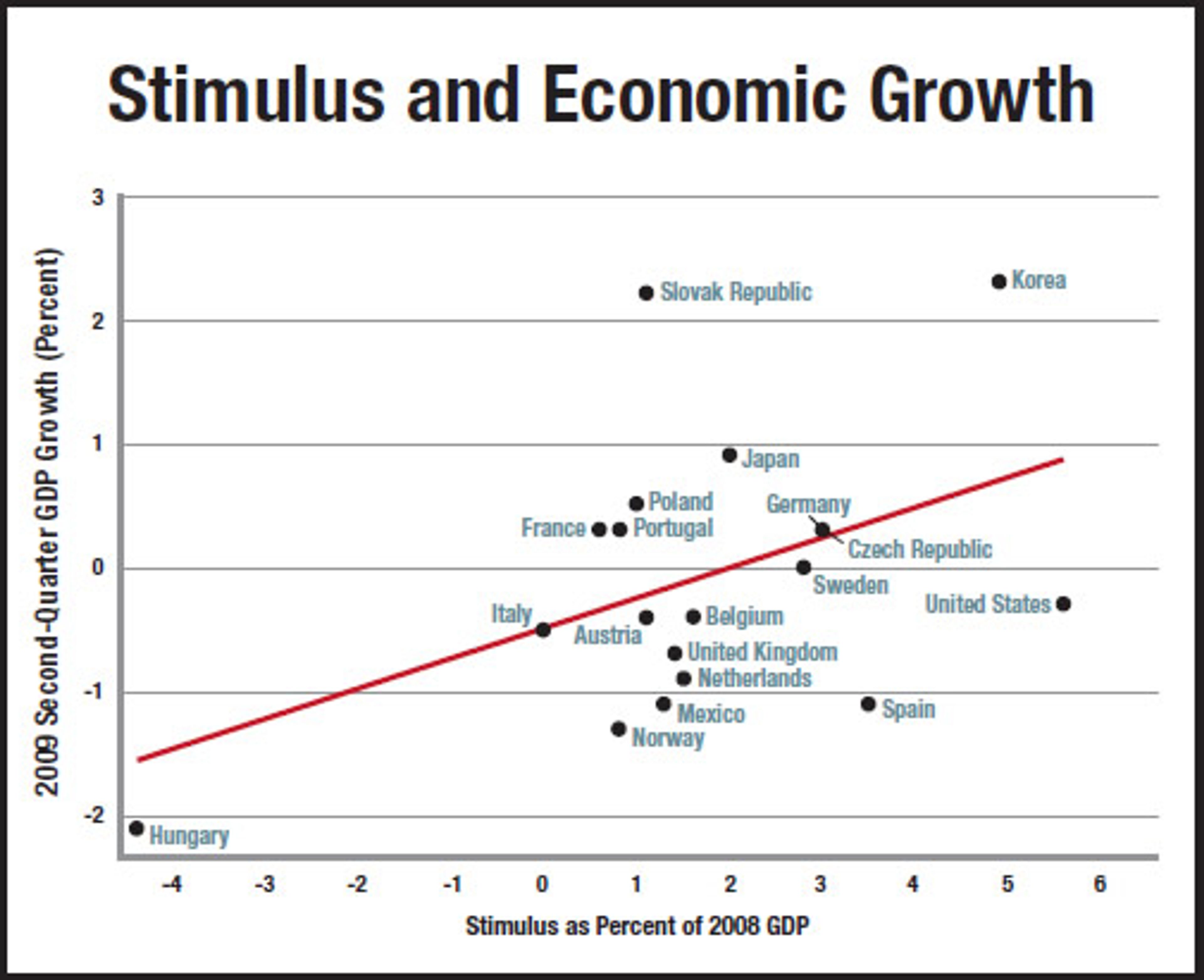
But the relationship is hardly compelling evidence that Keynesian policies were successful. First, the most influential data point in the chart is Hungary, which posted very disappointing growth in the second quarter, and actually enacted a tax increase. The data point is so influential that the relationship between stimulus and growth disappears if we remove it. Cash-starved Hungary increased its VAT from 20 to 25 percent because of the threat that the nation would default on its debt. That this tax hike is associated with weak economic growth is hardly a Keynesian phenomenon.
Second, there was a large difference of opinion among the countries in the chart about how best to stimulate the economy. Korea, for example, adopted a suggestion from Candidate McCain and, among other things, reduced its corporate tax rate. That choice appears to have been a good one. The U.S., on the other hand, took its stimulus bill right from the Keynesian playbook, and got unimpressive bang for the buck. If the U.S. stimulus bill were as effective as the typical OECD policy, then its growth rate would have been about a percent and a half higher in the second quarter. The Obama administration has little to crow about.
As data dribble in over the next few quarters, it seems likely that an updated version of this chart will continue to show at least some positive relationship between stimulus and economic growth. The argument against a big Keynesian stimulus has never been that it will have zero effect. The real problem with U.S. policy will be evident in the medium term, when taxes are hiked to pay the bill for the government’s current largesse and the U.S economy finds itself in the same spot Hungary was in in the second quarter. At that point, we will wish that we had taken a path more like Korea’s.
— KEVIN A. HASSETT
• Holder’s Justice Department also quietly killed an ongoing pay-for-play corruption investigation of New Mexico governor Bill Richardson — a key Obama ally whose nomination to be commerce secretary the probe derailed. Though the Richardson investigation was being conducted by the U.S. attorney in New Mexico and a grand jury, the Associated Press reported that top DOJ officials in Washington pulled the plug. That would reverse Justice Department protocols, which call for local control of public-corruption cases in order to avoid the appearance of politicized law enforcement. The dropping of the investigation comes on the heels of Holder’s dismissal of a voter-intimidation case against the New Black Panther Party (one defendant was an official Democratic-party poll-watcher). During the Bush years, congressional Democrats worked themselves into a frenzy over the mere, never-substantiated possibility that politics would compromise justice. What will they do now that it’s actually happening?
• The ACLU has hired photographers to surreptitiously take pictures of people it thinks are covert CIA agents. The photos are given to military defense lawyers, who show them to their clients — accused terrorists held at Guantanamo Bay. The idea seems to be to identify the agents who interrogated a given defendant, with a view to calling them as witnesses. Considering that Patrick Fitzgerald spent several million dollars investigating the purported outing of a CIA employee, Valerie Plame, and achieved just one trivial conviction, will the Justice Department pour funds into probing this industrial-scale violation of secrecy? Fat chance. It’s much more likely that Holder will ask for copies of the photos.
• The federal government’s “Cash for Clunkers” policy of giving people rebates to trade in their old cars for new ones found a lot of takers, to the surprise of no one — no one, that is, except the federal government. After the first $1 billion ran out, Congress rushed to put another $2 billion into the program. When that dried up, Transportation Secretary Ray LaHood tried to declare victory and go home. We should deny him peace with honor. Cash for Clunkers was neither an environmental nor an economic success. Drivers have an incentive to drive their new vehicles more often precisely because they are more fuel-efficient, blunting the program’s effect. The inducement of new car purchases, meanwhile, did not create wealth — it merely diverted consumer spending. What do you call a program that’s good for small, concentrated groups and bad for the economy as a whole? One that’s bound to be repeated: Cash for Appliances, funded through the stimulus bill, starts this fall.
• The Obama administration deserves praise for its reappointment of Ben Bernanke, first elevated by Pres. George W. Bush, as chairman of the Federal Reserve. A scholar of the Great Depression, Bernanke is as good a choice as reasonable people might expect this administration to make — really, a surprisingly good one, given President Obama’s incoherent economic thinking and the recent decision to install AFL-CIO official Denis M. Hughes as chief of the critically important New York Fed. Bernanke’s performance on the Federal Reserve Board has not been without error, and the suspicion dwells within our breast that “Helicopter Ben” may not prove the ablest hand at battling inflation should it arise. But as the markets have stabilized and the banks have started to repay their emergency funds, the prudence of Bernanke’s program has been borne out, and the chairman has earned a measure of confidence. His next order of business should be to ensure the orderly retreat of the federal government from the commanding heights of the financial sector.
• Republican National Committee chairman Michael Steele has taken to the airwaves to vow that Republicans will defend Medicare from any cuts entailed by Obamacare. By further abandoning small-government principles, Republicans hope to gain support from senior citizens. But seniors have already turned against Obamacare because of worries about rationing. All Steele has done is make it easier for those concerns to be dismissed as partisan fear-mongering. The long-term cost of this gambit is to make it harder to reform entitlements should Republicans ever regain power. Machiavellianism may have its attractions, but failed attempts at it are just pitiful.
• Congress has passed and President Obama has signed a law to make September 11 a “national day of service and remembrance.” Sen. Charles Schumer, who represents one of the states attacked on 9/11, sees it as taking “a tragic day in our nation’s history and turn[ing] it into a force for good. We can make it a day on which we can give back in remembrance of those who lost their lives.” If this is how we start remembering, we won’t do a very good job. September 11 was not a tragedy, it was an act of war by primitive terrorists who wish to repeat their success; their victims did not lose their lives, they were murdered. Franklin Roosevelt called Pearl Harbor Day a “date which will live in infamy,” and added that “the American people in their righteous might will win through to absolute victory.” So long as we are governed by liberal Democrats, they should talk like that.
• One relatively easy way to reduce the amount that Americans spend on health care would be to reform the laws governing medical-malpractice lawsuits. At a town-hall meeting in Virginia, Howard Dean explained that there is a reason tort reform is not on the Democrats’ agenda, viz. “the people who wrote it did not want to take on the trial lawyers in addition to everybody else they were taking on, and that is the plain and simple truth.” The plaintiffs’ bar is indeed a large contributor to the Democratic party, with over 90 percent of their campaign pledges going to Democrats. But there is another reason the Democrats left tort reform out of the discussion: They thought they could push through a massive overhaul of one-sixth of the nation’s economy without any help from Republicans. Former senator Bill Bradley meekly suggested that the Democrats reconsider their recalcitrant stance in light of recent — difficulties. He argued that by using medical-malpractice reform to peel off a few Republicans, the party’s leaders could give Blue Dogs the bipartisan cover they need to vote for Obamacare. The good news is that Pelosi & Co. appear to be ignoring this advice and pushing ahead with their unpopular plan. Better no tort reform than tort reform as a paving stone in the road to single-payer.
• A few days before the 2004 presidential election, Osama bin Laden released a threatening videotape. Attorney General John Ashcroft and Defense Secretary Donald Rumsfeld suggested that such an act merited the elevation of the terror threat level, only to be rebuffed by Homeland Security Secretary Tom Ridge. Now, in his breathtaking tell-all, Ridge writes that the episode was a worrisome instance of the Bush administration’s potentially playing politics with terror. Well, at least that’s how a hyperventilating press has covered Ridge’s tome, The Test of Our Times. A full read of the book shows Ridge’s words to be but one observation among many about the complicated nature of cabinet discussions during wartime. He could have predicted the resulting media tempest. Maybe his PR strategy should have come with a color-coded warning.
• It’s no secret that Obama has ties to the far Left; during the campaign, the Rev. Jeremiah Wright, Bill Ayers, and Bernardine Dohrn were frequent topics of conversation. But this time, as Glenn Beck has publicized, he has brought a former fringe radical into the government: “Green-jobs czar” Van Jones was, by his own admission, once a Communist and black nationalist. He claims to have changed his views, but tends to emphasize that he has changed his tactics: “I’ll work with anybody, I’ll fight anybody if it will push our issues forward. . . . I’m willing to forgo the cheap satisfaction of the radical pose for the deep satisfaction of radical ends.” No wonder Obama picked him.
• The president gave a speech to a VFW convention in Phoenix, and among the crowd outside were about a dozen people carrying firearms. While that might make anyone a little nervous, it’s legal in Arizona, so the Secret Service kept close watch but made no attempt to restrain the gun toters. A non-event? Not at MSNBC, where, over a photo of an armed man, commentators pontificated about the racial angle: “Here you have a man of color in the presidency and white people showing up with guns. . . . [There’s] anger about a black person being president. . . . We see these hate groups rising up — this is definitely part of that.” Only one problem: The man in the photo, which was cropped to show only his torso, was black; he told reporters that he was carrying the weapons “because I can do it. In Arizona I still have some freedoms.” The only prejudices on display here are against conservatives.
• President Obama is not shy about using religious language and religious imagery. He has said that he hopes to be “an instrument of God.” (Shouldn’t we all.) He has allowed himself to be photographed next to neon crosses (pretty garish). Recently he said, “We are God’s partners in matters of life and death.” And he accused critics of his health-care plans of “bearing false witness.” Perhaps Kevin Phillips should write a sequel to American Theocracy.
• After a long bout of homesickness, Sen. Mel Martinez (R., Fla.) resigned this summer, 16 months before the end of his term. Charged with finding a replacement, Florida’s Republican governor, Charlie Crist, tapped his longtime aide George LeMieux (R., placeholder). The pick smacks not just of cronyism but of self-interest, since Crist is already campaigning to win the seat for himself next year. In his way is Marco Rubio, the conservative former speaker of the state house who hopes to topple Crist in the GOP primary. Rubio calls the pick “disappointing,” though Crist’s choice does give Rubio some needed ammunition. It also gives Florida a senator who fancies himself a “Charlie Crist Republican,” which means, of course, a shameless one.
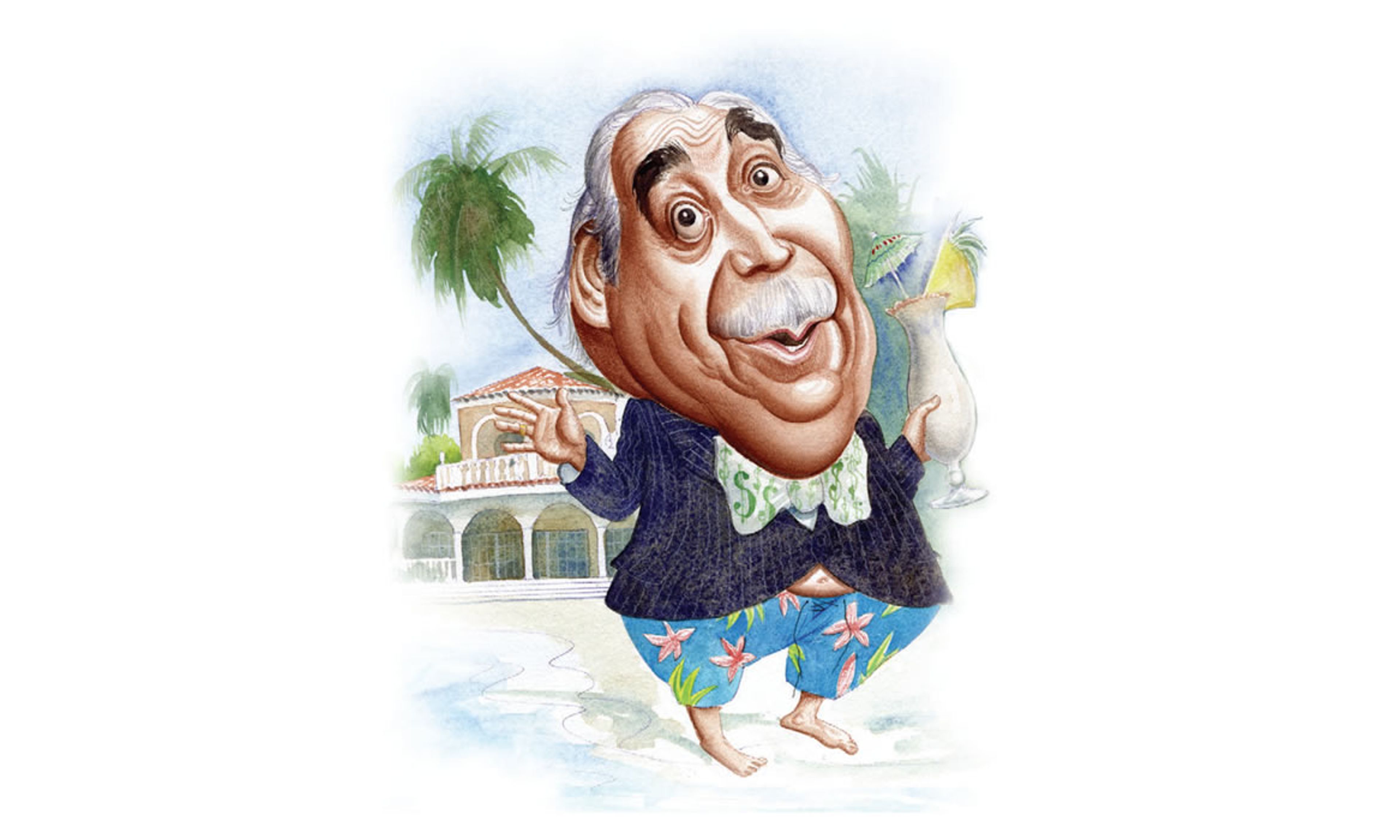
• Remains there doubt that Charles Rangel is a scoundrel? The millionaire congressman/real-estate investor who somehow enjoys the use of several rent-controlled properties in Manhattan again finds himself exposed for having failed properly to account for his income and assets, both in congressional ethics disclosures and for tax purposes. The latest disclosure, courtesy of a New York Post investigation, is that Rangel failed to account for between a quarter million and a half million dollars tucked away in a Merrill Lynch Global account, along with an undisclosed sum in municipal bonds. Thousands of dollars’ worth of stock in fast-food operator Yum Brands and in PepsiCo have gone unreported. He also failed to report income — up to $100,000 — from his New York City real-estate investments. Altogether, Rangel declined to report about half of his net worth. His rap sheet of prior financial offenses is not brief: He is under investigation by two congressional panels on allegations of improperly accepting gifts from donors (in the form of expenses-paid travel to the Caribbean), ethics violations related to the aforementioned rent-controlled apartments, failure to report income from real estate in the Dominican Republic, unpaid taxes, and abusing his office to shake down parties with business before his congressional committee for donations to his favorite charity: the Charles B. Rangel Center for Public Service. The tax-dodging Rangel chairs the committee that writes the tax laws enforced by the tax-dodging Tim Geithner’s IRS: literal limousine liberalism, in action.
• Picture, if you will, an ordinary suburban gas station. Now remove the pumps and place it in the middle of a wide-open landscape, and you have the Whitetail (Mont.) Border Station, which processes about three visitors per day who make the crossing from Big Beaver, Saskatchewan. It’s hardly Ground Zero in the fight to secure America’s borders, yet this sleepy post has been awarded a $15 million appropriation for . . . well, we’re not quite sure what. Neither is Homeland Security secretary Janet Napolitano; at a recent news conference, she did not have her shovel ready and thus could provide no explanation for the grant, but could of course deny that politics was involved. Some might disagree: The Whitetail station was ranked as a low priority until Montana’s two Democratic senators intervened. Meanwhile, reports the AP, “a checkpoint in Laredo, Texas, which serves more than 55,000 travelers and 4,200 trucks a day, is rated among the government’s highest priorities but was passed over for stimulus money.”
• Back in Cold War days, apologists for Communism had a standard line about human rights. It went, “Western countries have political rights: the right to speech, religion, assembly, and so on. Eastern-bloc countries have social rights: the right to food, shelter, clothing, and so on.” (Jeane Kirkpatrick was only one to remark that those countries without “political rights” had very little in the way of food, etc., too.) This nonsense is back. Our new secretary of state, Hillary Clinton, has expressed it several times, most recently saying, “It’s important to look at human rights more broadly than it has been defined. Human rights are also the right to a good job and shelter over your head and a chance to send your kids to school and get health care when your wife is pregnant. It’s a much broader agenda.” It’s bad enough when a college professor or a clergyman takes this line. But an American secretary of state?
• Mohamed ElBaradei has been a depressing and vexing director of the International Atomic Energy Agency. The IAEA is supposed to let the world know about nuclear goings-on. But ElBaradei has been reluctant to do so, in the case of Iran. He told the BBC two years ago, “I wake every morning and see 100 Iraqis, innocent civilians, are dying. . . . I have no brief other than to make sure we don’t go into another war or that we go crazy into killing each other. . . . You do not want to give additional argument to some of the new crazies who want to say, ‘Let us go and bomb Iran.’” Recently, his aides said, anonymously, that ElBaradei was wary of releasing an IAEA dossier on Iran for fear of “pushing the U.S. or Israel closer to a possible military strike on Tehran’s nuclear facilities” (in the words of the Associated Press). In late August, ElBaradei did release a report: mushy, indefinite, unhelpful — and blatantly punch-pulling. Fortunately, ElBaradei will soon leave the IAEA, after a dozen years in that position. Maybe the world can get a more honest and forthright director. ElBaradei may wish to stay at home and admire his Nobel medal, for he was the recipient of the Peace Prize in 2005. Whether his life and career have increased the prospects of peace is highly debatable.
• Japan’s landslide election, in which the ruling Liberal Democratic party lost power for only the second time since 1955, is being hailed as a “revolution.” It certainly marks a significant step in the country’s movement toward a more open, competitive political system driven by policy debates rather than by factions and backroom deals. But we do not expect the victorious Democratic Party of Japan (DPJ), formed just eleven years ago, to make revolutionary changes. It is fiercely divided over everything from economic liberalization to relations with the United States; meanwhile, Japan’s elite bureaucrats (the kanryo), though weakened, still wield immense power and will resist any disruption of the established order. The Japanese economy has officially emerged from its worst post-war recession, but the ferocity of the downturn underscores Japan’s need to reduce its dependence on exports and adopt broad structural reforms. Unfortunately, DPJ leader Yukio Hatoyama is busy denouncing “unrestrained market fundamentalism” and declaring that “the era of U.S.-led globalism is coming to an end.” Hatoyama has also expressed a desire to put the U.S.-Japan alliance “on an equal footing” (whatever that means). Practical realities will promote continuity in Japanese foreign policy. But Hatoyama does not inspire confidence.
• Taro Aso, the outgoing Japanese prime minister, has done something remarkable. In a ceremony marking the end of World War II, he said, “Our country inflicted tremendous damage and suffering on many countries, particularly people in Asia. As a representative of the Japanese people, I humbly express my remorse for the victims, along with deep regret.” And he vowed that Japan would never again behave as it had. There are times for national apologies, and times when such apologies are stupid or cheap, meant only to flatter the apologizers — President Obama’s recent utterances in Europe and elsewhere come to mind. At that World War II ceremony, Aso performed well.
• In late August, the State Department announced that it was suspending “non-emergency, non-immigrant visa services” at the U.S. embassy in Honduras, as a way of pressuring the interim Honduran government to reinstall the exiled Manuel Zelaya as president. The Obama administration is also threatening to freeze all aid to Honduras. Meanwhile, interim Honduran leader Roberto Micheletti has declared his willingness to resign and support Zelaya’s return to the country — provided Zelaya does not seek to resume the presidency. The Honduran government considers Zelaya unfit for office, and with good reason. Recall why he was ousted in the first place: As Judge José Tomás Arita of the Honduran supreme court explained in his arrest order, Zelaya was charged with “acting against the established form of government, treason against the country, abuse of authority, and usurpation of power.” Shortly after his ouster, former Honduran culture minister Octavio Sánchez noted that Zelaya had “triggered a constitutional provision that automatically removed him from office.” Zelaya will be lucky if he avoids jail time. He has no legitimate claim to the presidency.
• Desmond Tutu went to the Holy Land, doing his act. He said that Palestinians are “paying penance” for the Holocaust — a view that many Arabs like to hear, and that mires them further in their misery. He also said, “The lesson that Israel must learn from the Holocaust is that it can never get security through fences, walls, and guns.” Tutu may be internationally admired, but it’s not for his perspicacity.
• The Department for Creating Problems Where None Exist is advancing with leaps and bounds. They’ve banned the traditional 100-watt light bulb in Europe, and anyone found importing or selling them will face criminal charges. By September 2012, the ban will have extended to all “traditional” light bulbs. The new fluorescent or energy-saving bulbs produce an ugly light, can’t be recycled as easily on account of their components (one of which is toxic mercury), and, finally, trigger migraines. Not to be outdone in this area, British officials have come up with the notion that injury owing to alcohol-fueled violence and crime has nothing to do with drinkers, but is caused chiefly by the glasses normally used to serve beer in pubs. To protect the nation, they’re calling on experts to discover some way of drinking beer more safely. A team of designers is working on plastic or polycarbonate glasses, and their spokesman explains that the solution will require “a complete paradigm shift” in materials and form. Cheers, everybody.
• The National Endowment for the Arts joined the White House Office of Public Engagement and United We Serve, the post-campaign Obama campaign, in a conference call to 75 creative types. The agenda, according to Patrick Courrielche, a 39-year-old film producer, was to explore “how the arts can be used for a positive change.” Artists were encouraged to promote “service” in the areas of health care, energy, and the environment; Shepard Fairey’s Obama HOPE poster and will.i.am’s “Yes We Can” track were held up as examples of good work. Since Andrew Breitbart’s “Big Hollywood” website and Fox News ran with the story, the other participants have clammed up. But if the past is guide, we know what’s to come: WPA murals in post offices, Woody Guthrie singing “Roll On, Columbia.” Such stuff is bad for two reasons: First, government should not be manufacturing art propaganda; second, the art stinks.
• Freedom Communications, one of America’s greatest newspaper companies and publisher of the Orange County Register, is entering bankruptcy. We wish them a speedy recovery. Thanks to its curmudgeonly founder, the late R. C. Hoiles, the company has long presented a happy case of truth in labeling: Freedom always has been at the center of Freedom’s vision. Hoiles, who once dared the wrath of FDR’s wage-control cops by giving out unapproved raises, was a longstanding enemy of government overreach in all its forms, from the familiar complaints against excessive taxation to his crusades against the unjust imprisonment of Japanese-Americans during World War II and, later, racial segregation in government schools — and against government schools, period. Of the New Deal, he asked: “Are we intelligent enough ourselves to decide what kind of work we want, how much we should be paid, and how much we should be charged for what we buy, or shall we permit the professional politicians to make these decisions for us?” The question remains relevant. In a mediaverse dominated by illiberal liberalism, the Register and its sister newspapers have provided a dose of grit and welcome relief. Long may they continue to do so.
• The Los Angeles County coroner ruled Michael Jackson’s death a homicide, thanks to the cocktail of drugs, topped off by Propofol, his body contained. His feel-good medical personnel will now be on the spot — and rightly so. Doctors should be guided by their healing profession, not by the whims of maniacs — although rich maniacs have a way of getting immoral doctors to serve them. They are a disgrace to their art. There is also a lesson here for anyone in a position of power, from celebrities down to the hierarchs of everyday life: Yes-men never quite give you what you want, but they do have a way of giving you what you ask for.
• After the 1917 revolution, the USSR adopted the Communist Internationale as its anthem. In 1943, with a greatly expanded Soviet empire looming ahead, encouraging rebellion seemed inadvisable, so a new anthem was adopted, with lyrics like “Great Stalin raised us to be loyal to the nation, inspired us to labor and great deeds.” A dozen years later those sentiments became obsolete when Stalin fell out of fashion, so the anthem was performed as an instrumental only. In 1977, at what one source optimistically calls “the peak of the Leonid Brezhnev era,” a set of new, de-Stalinized lyrics were adopted, and once again Soviet citizens could sing along with gusto (if they knew what was good for them). Another dozen years or so and that version, too, was consigned to the dustbin of history, with help from Ronald Reagan; but in Russia, as elsewhere, the oldies never go out of style, and it was barely a decade before Vladimir Putin revived the Soviet-era anthem with yet another set of lyrics, this time emphasizing Russian nationalism. The man responsible for executing all these successive rewrites, Sergei Mikhalkov, has just died at the age of 96. We hope that his soul’s rest will be more peaceful than the probable future of the nation he served. R.I.P.
• Our colleague of 17 years, Barbara Nowack, secretary to NR chairman Dusty Rhodes, has died of cancer. The cancer was aggressive and discovered at an advanced stage, so the odds of medical victory never favored Barbara. Still, she put up a determined fight — not for any fear of a final judgment, but because of her deep love of creation, her family, her friends, whom she adored, and who adored her. God had other plans. We have our sorrow, soothed by the faith that if anyone is to rest in true and deserved peace, it will be Barbara. R.I.P.
Edward Kennedy, R.I.P.
Edward Kennedy entered middle age with three burdens. The first was the decidedly mixed blessing of his family — large and often loving, but presided over by a feral father and a complicit doormat of a mother, then marked in his own generation by the deaths of his three older brothers, leaving him, in 1968 at age 36, the heir apparent.
The second burden was his manifest incapacity for the role. John Kennedy had cool and wit, Robert was smart and driven. Ted was nobody’s idea of an alpha, and his record of cheating at Harvard showed that he knew it.
The third burden, self-inflicted, was his criminality. The 1969 death of 28-year-old Mary Jo Kopechne in a car he drove off a Chappaquiddick bridge after a boozy party was at least an instance of gross negligence. His efforts to spin his behavior on the lethal night added shame to folly and cowardice.
So, midway this way of life, what does a Prince Not-Charming do to recover? Ted Kennedy buckled down to the Senate, and to liberalism. He could make a mark on his institution, where not being No. 1 actually helped him wheel and deal with his peers. He put his newfound skills in the service of the post-Sixties Democratic agenda. In this he betrayed the legacy of his politician brothers, both of whom were restive liberals: John an anti-Communist and a tax-cutter, Robert suspicious of the Great Society even in its cradle (cf. historian Michael Knox Beran). Ted put his shoulder to the wheel and did whatever the Geist of his party and his talented aides put before him.
His failed 1980 challenge to Jimmy Carter set the pattern in stone: Since the White House would never be his, he would rather be Left than president.
Sometimes his liberal agenda happened to embrace issues that conservatives could approve, as when he advocated deregulation of the trucking and airline industries. Sometimes he pioneered new lows: His assault on Judge Robert Bork in 1987 sank Bork’s nomination to the Supreme Court and inaugurated the modern era of the politics of personal destruction. Not least of his failings was the corruption he spread around him among liberals willing to exculpate his misdeeds, from Ted Sorensen ghosting his Chappaquiddick cop-out down to blogger Melissa Lafsky asking, on Opinionistas.com, whether Mary Jo Kopechne might not think that his post-her career justified her death (“Who knows — maybe she’d feel it was worth it”).
His 1992 marriage to Victoria Reggie (he had divorced Joan Kennedy ten years earlier) finally weaned him from man-boy habits, and he tried as he aged and grayed to be an avuncular figure for his many fatherless nieces and nephews.
Dead at 77. R.I.P.
Britain’s Disgrace
The release of Abdelbaset al-Megrahi is worse than a crime; it is a mistake, from any and every point of view. The terrorist who brought down Pan Am Flight 103 over Lockerbie in Scotland is now back in his native Libya, happily ensconced with his admiring family in a luxurious villa and treated as a national hero. Alleged to be terminally ill, he has been freed from life imprisonment, ostensibly on grounds of compassion — he who showed no compassion to his victims.
The blatant irrationality of Megrahi’s release clearly establishes that something more powerful than law and justice is at work. What might that something be? Big money, of course, and the politics that go with it. Moammar Qaddafi, the dictator of Libya for the past 40 years and a man with a long record of sponsoring terror, has stated that the real issue here has always been trade. Megrahi was his agent, and if the British wanted the oil-and-gas contracts now available in Libya, they had to release him. Qaddafi’s smarmy playboy son is just as open about it. For the past two years, evidently, British ministers have been putting in place the agreements and the bureaucratic machinery to allow Qaddafi to blackmail them.
Particularly dishonest is the way the British government is pretending that Scotland alone has been responsible for handling the Megrahi affair. The Scots have their own courts, and devolution has given them a new parliament in Edinburgh, but both are limited to dealing with domestic matters. Foreign policy remains the exclusive preserve of the Westminster parliament. This smokescreen of evaded responsibility has ended up doing real damage to the British character and to Britain’s global influence. Many in Britain resented the help given in the past by Irish Americans to the IRA; the release of Megrahi cuts the ground from under their feet and challenges the supposed transatlantic “special relationship.”
Robert Mueller certainly sees nothing special about it. The current FBI director, who in the early 1990s oversaw Megrahi’s investigation and indictment, sent the Scottish justice secretary a blistering letter: “Your action makes a mockery of the rule of law. Your action gives comfort to terrorists around the world.” And then he started getting angry. The administration’s reaction, on the other hand, was tepid: Obama called the release a “mistake,” while Secretary of State Clinton complained in a written statement that she was “deeply disappointed.”
Remember the slogan “No Blood for Oil”? At last it has a point.










Comments