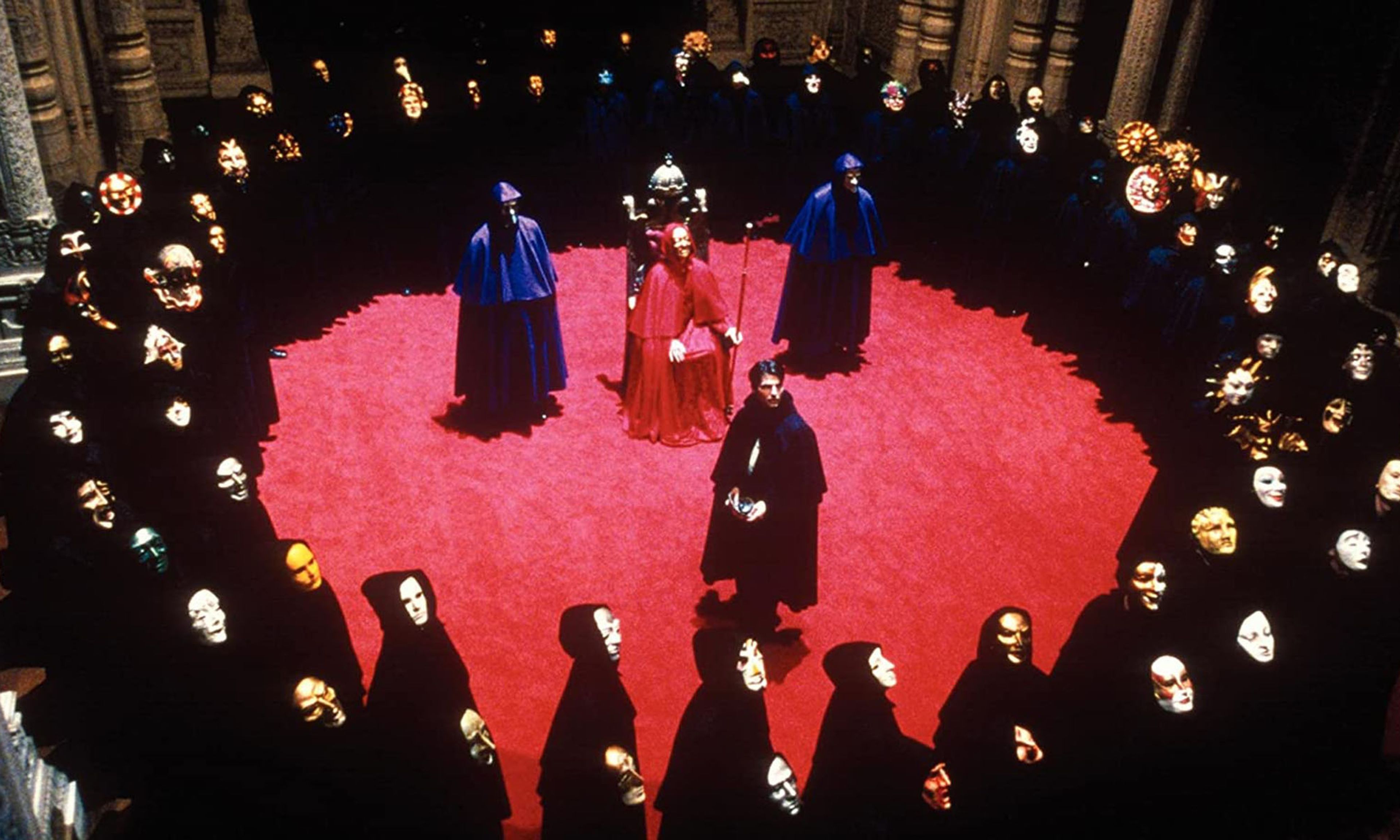
At what point does a filmmaker cease to benefit from an obsessed fan base? In the case of Stanley Kubrick, that point is reached when such obsessiveness starts to obscure the actual qualities of his films.
Trust me. When it comes to being obsessive about the maker of Dr. Strangelove (1964), 2001: A Space Odyssey (1968), and A Clockwork Orange (1971), I know whereof I speak. In 1999, when I was 16, I spent my summer vacation seeing Kubrick’s final film, Eyes Wide Shut. From mid July through early September, I saw the film ten times in all. Every week or two, as ordinary, unconverted audiences moved on to other movies, I lined up to buy my ticket, plunked down in increasingly empty theaters, and communed with the aesthetic spirit of my recently deceased favorite filmmaker. (Kubrick had died that March.)
Why did Kubrick inspire such feelings of devotion? Born in New York in 1928, he became widely known during a period when many filmmakers were regarded with awe and treated with extreme deference: Their names were not simply above the title, as in the days of Frank Capra; they were guests on the leading talk shows, fixtures on the red carpet, and the subjects of magazine cover stories — Kubrick himself appeared on the cover of a 1972 issue of Newsweek.
Yet Kubrick managed to project a definite image to the public without going to a lot of effort — in fact, he did it largely by disappearing from sight, at least as compared with his omnipresent peers such as Francis Ford Coppola or Steven Spielberg. You might say that he was a master of addition by subtraction: By choosing to remain tantalizingly elusive, Kubrick — who, in the early 1960s, fled the razzmatazz of Hollywood for the pastoral comfort of England — inspired intense loyalty among studio bosses, underlings, and ticket-buyers.
Like the ghosts who periodically drop in on Jack Torrance (Jack Nicholson) in The Shining (1980), Kubrick every five or seven or twelve years deposited a masterpiece in multiplexes. Whereas Woody Allen arguably became underappreciated because of the frequency with which his films came out, Kubrick surely realized that his long spells of seeming inactivity punctuated by bursts of filmmaking contributed to the keen interest that surrounded each new release. In a sense, even if the director had not died prior to the release of Eyes Wide Shut, seeing the film that summer would still have been like receiving transmissions from another dimension.
Kubrick’s sphinxlike image may have seduced the brass at Warner Bros. — which proudly funded his films and tolerated his lavish production schedules — but, on balance, that image has clouded the critical faculties of countless film critics, journalists, and talking heads. Kubrick risks being genuflected to as a guru rather than studied as a real, working filmmaker.
Happily, David Mikics’s new book, Stanley Kubrick: American Filmmaker, is bracingly commonsensical and free from the combination of over-the-top awe and geeky obsessiveness that too often mars commentary on the director — a tendency the author identifies early on. “Because Kubrick is so lucid yet at times so enigmatic, a few of his movies seem tailor-made for conspiracy theorists,” Mikics writes. “Legions of web-based crackpots long ago fell in love with The Shining, which is said to prove that Kubrick faked the Apollo 11 moon landing for NASA. . . . But Kubrick’s films cannot be decoded this way. They are open-ended works of art, not puzzles waiting to be solved.”
To be sure, Mikics, an English professor at the University of Houston, was a Kubrick fan before becoming a Kubrick scholar. “I first saw 2001 at about age twelve, a few years after its premiere,” he writes. “From the beginning, the movie possessed me completely. I pored over Jerome Agel’s book The Making of ‘2001,’ which was full of curiosities (the zero-gravity toilet instructions, HAL’s deathbed monologue printed in full).”
Yet this book, which is part of the superb Jewish Lives series of Yale University Press, is clearly not the product of a 2001-mad twelve-year-old. Mikics proceeds judiciously through Kubrick’s life and work, drawing links between the two as they present themselves but only rarely straining to make such connections; particularly persuasive is his argument that Kubrick’s loving, supportive mother, Gert, cast a long shadow over his work, evident in, for example, the bond between Lady Lyndon (Marisa Berenson) and her grown son in Barry Lyndon (1975) and in the one between a robot boy and his adoptive human mother in A.I. (a film initiated by Kubrick but actually made by Spielberg in 2001).
Particularly admirable is Mikics’s attempt to situate Kubrick within larger filmmaking currents. Countering critics who charged that Kubrick was detached from the nation of his birth, Mikics insists that he remained tethered to American culture, extolling the virtues of Super Bowl commercials, excelling at short-order-style cooking, and, in The Shining, creating a horror film that, the author intriguingly argues, followed in the footsteps of other “great American movies about masculine rage,” including John Ford’s The Searchers (1956).
Lazy critics often treat Kubrick’s work as a closed system, but Mikics — while never hesitant to identify through-lines connecting his films — is always eager to point out the work of other directors that Kubrick built on. He observes that a famous shot in A Clockwork Orange of the homicidal hooligan Alex (Malcolm McDowell) speeding in a car against intentionally artificial back projection was anticipated in Bonnie and Clyde (1967). And in contrast to the wearying overthinking present in many analyses of The Shining, he smartly notes that the infamous Room 237 — whose ghostly inhabitants beckon Jack Torrance — is “the place where trauma dwells, like the fruit cellar in Psycho.”
Mikics applies the same care and attention to each of Kubrick’s 13 feature films, even those most likely to be underestimated by today’s audiences, such as Spartacus (1960) and Lolita (1962). Yet some of us may still wonder: If we denude Kubrick of the sort of grandiose mythology that too often accrues to him, what does it all come to? Mikics hardly breaks new critical ground when he states that Kubrick’s films “are about mastery that fails.” “Perfectly controlled schemes get botched through human error or freak accidents, or hijacked by masculine rage,” Mikics writes, and while the plots of many of Kubrick’s films conform with this pattern — and Kubrick’s on-screen interest in strategies of control, and their potential to unravel, certainly parallels his own tenaciously well-thought-out working methods — I remain unconvinced that the observation applies equally to all the films in Kubrick’s grandly diverse filmography. By the same token, I question Mikics’s assertion that “Kubrick liked his protagonists baffled and beaten, and not overly smart,” a description that doesn’t seem to take into account the keen verbal skills of Alex in A Clockwork Orange or the self-conscious intellectual ambivalence of Private Joker (Matthew Modine) in Full Metal Jacket (1987).
Surely many Kubrick films sprang from deep-seated personal interests — for example, the director’s terror over the prospect of nuclear war fueled what became Dr. Strangelove — but, just as often, he kept his antennae attuned to unlikely material, quickly settling on A Clockwork Orange as a replacement project for the long-planned Napoleon and reading Stephen King’s The Shining after a studio boss sent it to him. Perhaps what animated Kubrick was a desire not to alter the course of cinema history but merely to tell good stories in a stylish and intelligent manner to a wide audience — something Mikics intuits when he writes that Kubrick did not wish to be consigned to art houses (as was obvious from the hyped-up marketing campaigns the director supervised, including the famously misleading one for Eyes Wide Shut).
In the way he told his stories, Kubrick seldom seemed exercised by the demons that plagued his protagonists. “He is an arch modernist, allergic to tearjerkers, joyous endings, and scenes full of heart,” Mikics writes. Indeed, the director observes a range of behavior — the misplaced bravado of General Buck Turgidson in Dr. Strangelove, the pitiable social-climbing of Redmond Barry in Barry Lyndon, and the psychotic murderousness of Jack Torrance in The Shining — from the comfortable distance of a photojournalist who has happened upon a compelling, sometimes grisly scene. Not coincidentally, Kubrick was once employed as a photographer for Look magazine — a pre-filmmaking career ably sketched by Mikics. It is rare for Kubrick to engage in outright lobbying; Dr. Strangelove is surely alive with rage at the leaders entrusted with nuclear arsenals, but the critic Robert Brustein has noted its non-polemical quality: “Kubrick has managed to explode the right-wing position without making a single left-wing affirmation.” Mikics compellingly argues that Kubrick revealed more of himself in the portrait of marital confusion in Eyes Wide Shut and would have revealed still more in an unproduced film about the Holocaust, The Aryan Papers.
This contention should not be taken as a repetition of the canard that Kubrick was a cold or unfeeling director. Like Vincente Minnelli, he was energized by cinematic style itself: the joy of making a felicitous camera move (Mikics notes that “Kubrick always reserved for himself the handheld camera sequences, with their rough, jostling feel”) or selecting the right color scheme; when you watch the men’s-room scene in The Shining, does Kubrick seem more engaged by what the characters are saying or by its blinding cherry-red walls and stalls? Not that Kubrick was uninterested in acting. His many stretched-out dialogue scenes, such as the famously halting, awkward one that concludes Eyes Wide Shut, should be taken not as desultory exposition but as evidence of his surprising delight in actors — a delight that seems to have prompted, in part, his much-noted penchant for rolling repeated takes. “It isn’t right, and we are going to keep doing it until it is right, because you guys are good,” Kubrick told a complaining Adolphe Menjou while making Paths of Glory (1957). Mikics marvels at the bravado of that comment — “‘You guys are good,’ said to a seasoned star like Menjou!” — and it’s just the sort of solid, unpretentious detail that enriches this book and deepens our understanding of this incredible moviemaker.












Comments