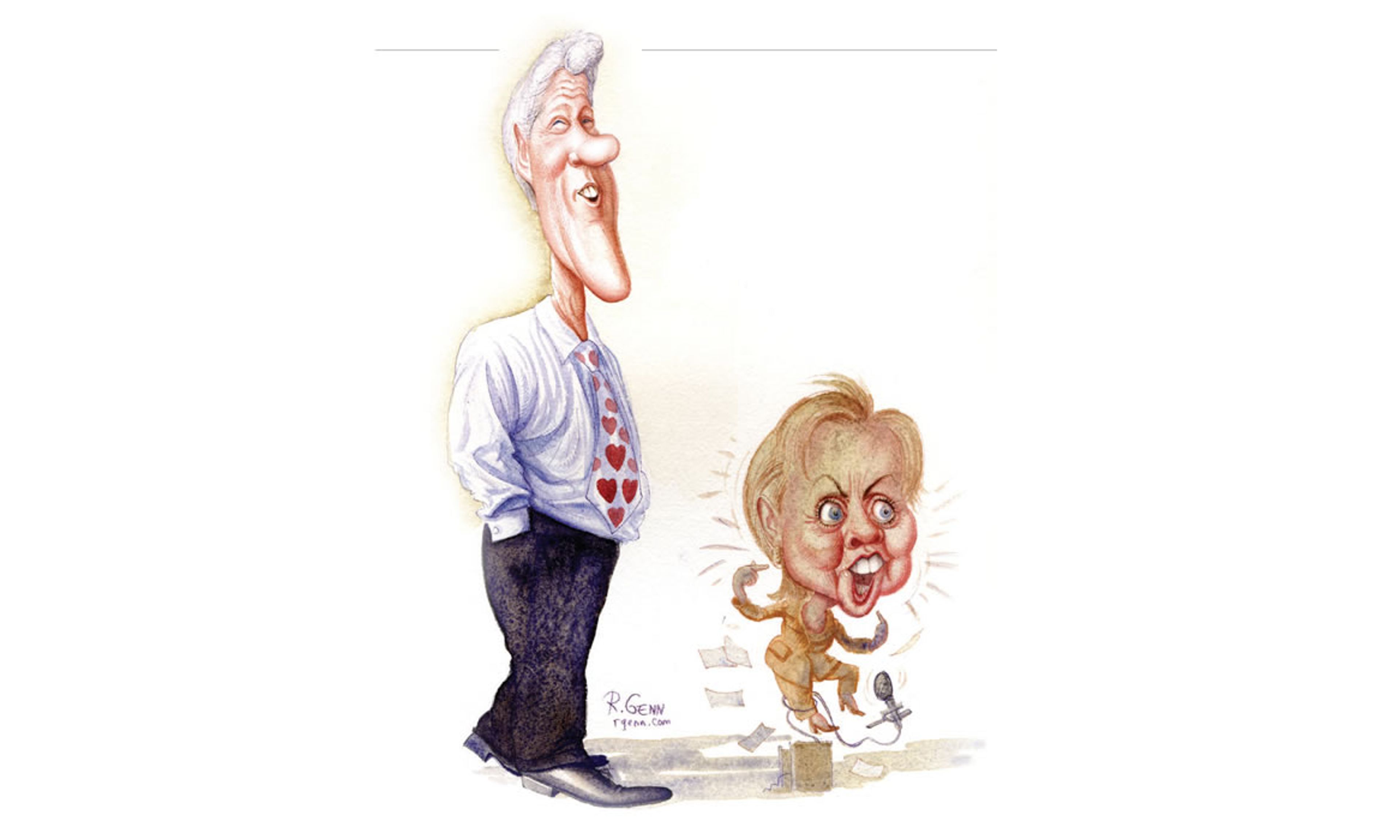
• New left-wing slogan: Dissent is the highest form of tastelessness.
• Congressmen’s town-hall meetings on the president’s health-care plan have caused a backlash of un-American fury. It comes from liberals, outraged that anyone could oppose President Obama’s intention to hog-tie one-sixth of the economy. We have decided that it is good for you; how could you disagree? National health-care plans may impart a patina of security and egalitarianism. In practice, they degrade care, impose red tape and crushing expense, and habituate the public to the national teat. Ordinary Americans, conservative and otherwise, are right to be suspicious of such plans; the chaos of Obama’s implementation — doorstop-sized bills that no one has read — gives them additional reason. So there is heckling. Are congressmen nobility, only to be approached at levees? As in any mass movement, there are instances of the tasteless and the pernicious. Criticize them, but don’t imply that they characterize the thousands expressing their concerns, or threatening to vote out Blue Dogs, or blue-state mainstays, in November 2010.
• Nancy Pelosi started it. The speaker of the House accused opponents of Obama’s health-care plan of “carrying swastikas and symbols like that” to town-hall meetings. One unhappy sign indeed declared “No to Fascism”; another showed a circle and slash over a swastika, equating Obamacare with totalitarianism. But Pelosi implied that the protesters were pro-Nazi. So Rush Limbaugh rang the changes on her, asking where the resemblance really lies. He recited the Nazis’ array of goo-goo welfare programs and said that the health-care plan’s caduceus rather looks like a Nuremberg rally prop. Nazism was national socialism, and there is a choked-throat seriousness to many of Obama’s gestures — vero possumus, the mile-long unblinking gaze — that would be annoying if they were not risible. But the Nazis’ main legacy to mankind was enslaving their neighbors and murdering Jews, and no one in America outside the bughouse wants that. In the contest to be like Hitler, Republicans and Democrats both lose.
• One bystander at a town hall has received special attention. William Kostric was outside Barack Obama’s town-hall meeting in Portsmouth, N.H., wearing a pistol in a holster. New Hampshire has open-carry laws, and Kostric was in no way disorderly. What should cause alarm was the sign he carried: “It is time to water the tree of liberty.” This invokes Jefferson’s 1787 letter on Shays’ Rebellion, an uprising of indebted farmers in Massachusetts. “What signify a few lives lost in a century or two?” Jefferson, thousands of miles away in Paris, asked. “The tree of liberty must be refreshed from time to time, with the blood of patriots and tyrants.” Jefferson was a great man, but some of his thoughts were greatly mistaken. In the Declaration of Independence, he more reasonably observed, “Prudence, indeed, will dictate that governments long established should not be changed for light and transient causes.” But the sign bearer has taken it upon himself to nudge theory toward action. If “it is time” to water the tree of liberty, then “it is time” to kill people. For a citizen of a free country, with a free press, a right to assemble, and free elections, to say such things is dangerous madness. It is time for the half-educated to take a deep breath.
Hunting Nazis
What was it Al Pacino said in Godfather III? “Just when I thought I was out — they pull me back in.”
That’s sort of how I feel these days about the current fight over liberals and fascism. In case you haven’t noticed, fascism talk is everywhere. Nancy Pelosi with her Sixth Sense–ish “I see swastikas,” Rush Limbaugh fighting back, Glenn Beck pounding the table, town-hallers hauling around pictures of Obama with a Hitler mustache: These are good times to be moving a book called Liberal Fascism. And that leaves out the White House’s asking Americans to rat out neighbors who peddle “fishy” e-mail. It overlooks the fact that Obama’s science adviser, John Holdren, and one of Obama’s health-care gurus, Ezekiel Emanuel, have written things that would fit nicely into my chapter on eugenics. And — oh yeah — it also leaves out that Obama has essentially nationalized much of the banking and auto industries while vowing to do his darnedest to make us more like European social democracies. The news out of this administration bolsters one argument after another in my book.
But the thing is, I’ve been arguing about fascism and liberalism non-stop for nearly two years now. And it is exhausting. Moreover, the glorious thing about the Obama Moment is that I can just say “look around” to those who thought I was imagining things when I first wrote the book and gave little thought to an obscure Illinois state legislator.
But there’s a problem. Many folks claim to see in Obama the makings of an actual Hitler and in Obamaism a repeat of the National Socialism of the 1930s. Worse, some think my book supports their fears. And maybe it does, though I hope not.
The simple truth is that I do not think it is in the cards for America to go down a Nazi path. I never said otherwise in Liberal Fascism, either.
It’s important to keep in mind that, as bad as various other avowedly fascist regimes were, only the Nazis did what they did. Mussolini was a bad man and a dictator, but he was no Hitler. The Italians did bad things, but they don’t amount to a fraction of German crimes. Supposedly fascist Franco wasn’t nearly as bad as Mussolini, and Franco’s complicity in the Holocaust was nil. In other words, fascism brings out things in specific cultures at specific moments. Not only is Obama obviously not interested in being a Hitler, he couldn’t pull Hitlerism out of the American people if he wanted to.
Indeed, while I don’t think it is remotely right or fair to call Obama a crypto-Nazi (if by that you mean to say he’s a would-be Hitler), the real problem with all of this loose Nazi talk is that it slanders the American people. Daniel Jonah Goldhagen may have overstated his case in Hitler’s Willing Executioners, but he was certainly right that the German people were Hitler’s willing enablers. The overwhelming majority of the American people — in their history, culture, bones, hearts, souls, DNA, and carbon molecules — are not like that. That goes for American liberals and leftists too. The extent and depth of liberalism’s obtuseness on the subject of fascism (and much else) stews my bowels, but American liberals are still Americans, and Americans will not goose-step behind a Hitler, period.
As I make clear in Liberal Fascism, the obvious and pressing threat is not from a Hitlerite-Orwellian dictatorship but from a Huxleyan namby-pamby mommy state. That sort of system could seduce Americans into becoming chestless subjects of the State in exchange for bottomless self-gratification and liberation from the necessity of adult decision-making. Yes, there’s a danger that such a society could then be susceptible to some darker vision that lionizes the lost manhood of a half-forgotten past. But, by that point, this would be America in name only, if even that (“U.N. District 12” has a nice ring to it).
— JONAH GOLDBERG
• Democrats launched nasty campaigns against Republican Supreme Court nominees in 1987 and 1991. Republican senators, seeking a respite, voted for President Clinton’s nominees in 1993 and 1994. The pattern of cheek-turning continued into the early part of this decade, when President Bush renominated some of Clinton’s unconfirmed lower-court nominees. These courtesies were not returned. Democrats filibustered several of Bush’s lower-court nominees, and most of them voted against Samuel Alito’s confirmation. As a senator, Barack Obama voted against even John Roberts, notwithstanding the legal establishment vouched for him with near-unanimity. The 31 Republican “no” votes on Sonia Sotomayor’s confirmation to the Supreme Court suggest that the party is finally waking up to the realities of modern judicial politics. The Democrats are quite serious about packing the courts with left-wing policymakers. Republicans need to be just as serious about defending the Constitution. The nine “yes” votes from Republicans, meanwhile, show that some people are slow learners.
• Being a surgeon must be great. If you want that new plasma TV, just take out a child’s tonsils; for high-def, hack off somebody’s foot. So President Obama seems to think, judging from comments he made at a recent press conference (“The doctor may [say], ‘I make a lot more money if I take this kid’s tonsils out’”) and in a town-hall meeting (“If that same diabetic ends up getting their foot amputated, that’s $30,000, $40,000, $50,000 — immediately the surgeon is reimbursed”; in fact, a surgeon usually gets $700 to $1,000 for an amputation, and the total hospital bill would be about $10,000). Okay, perhaps we’re being unfair. The president may just have gotten confused and tripped over his words; he’s good at that. But his sloppiness symbolizes what’s wrong with the entire health-care-reform process. Before revolutionizing a giant portion of the nation’s economy and affecting the health of every citizen, shouldn’t the president have some clue about how doctors work and what things cost?
• Would the private sector be allowed to compete on even terms with Obamacare? Consult the president, who protested, “UPS and FedEx are doing just fine, right? It’s the post office that’s always having problems.” Thank you ever so much, Mr. President. Of course, what UPS and Federal Express do not do — what they are in fact expressly forbidden by law to do — is compete with the Postal Service in delivering letters and routine mail. The USPS is a government-protected monopoly, competing with it is illegal, it gouges Americans on letters to Grandma in order to subsidize junk mail for reasons of pure financial self-interest, and still it loses billions upon billions of dollars each year — to the extent that even the reliably statist New York Times has characterized its business operations as “General Motors territory.” And the GM comparison is apt enough, save one thing: You can buy a Honda. Or a Ford. Or a Hyundai. You can take the bus. Pay FedEx to deliver your daily mail and everybody goes to jail. And there is the blueprint for government-run health care.
• Sens. Chris Dodd and Kent Conrad, Democrats both, again were given a sweetheart deal by friends in high places: The Senate Select Committee on Ethics, led by Democrat Barbara Boxer of California, dismissed accusations that the two committee chairmen knowingly received preferential treatment from disgraced mortgage lender Countrywide. Their VIP loans came through Countrywide’s infamous “Friends of Angelo” program, named for former CEO Angelo Mozilo, who now is facing fraud and insider-trading charges. The most the ethics panel could manage was to gently admonish the two. Their eventual awareness that their loans were being handled through a program with the name “VIP” should have “raised red flags,” it wrote to the senators. The fact that they’re getting off so lightly should raise red flags for voters.
• Betsey Wright is in the news again. She was Bill Clinton’s chief of staff in Arkansas and a key operative in his 1992 presidential campaign. She was a tamper-down of “bimbo eruptions”: her phrase for talking by women who were supposed to keep mum. Wright is now “facing 51 felony charges of attempting to smuggle needles and knives onto Arkansas’s death row,” in the words of one report. Really. What a carnival the eight years of Clinton were.
• Reportedly, John Edwards — the former North Carolina senator, vice-presidential nominee, and presidential candidate — has been confirmed as the father of a campaign worker’s child and is set to publicly admit paternity. Anyone of good will must wish Edwards, his long-suffering wife, the child, and her mother the peace that has eluded them for so long — and be glad that this situation did not unfold with Edwards in the White House.
• A necessary attribute of diplomats is the poker face. After sitting through a drunken and indecent after-dinner speech by the king of England, Talleyrand said only: “C’est bien remarquable” (“That was certainly remarkable,” or, more idiomatically, “No comment”). Hillary Clinton should have taken a lesson from the great Frenchman. At a student Q&A during a trip to the Congo, a translator mistakenly asked her what her husband (the questioner had in fact asked about President Obama) thought of Chinese business dealings there. She snapped, “You want to know what my husband thinks? My husband is not the secretary of state, I am. So you ask my opinion, I will tell you my opinion. I’m not going to be channeling my husband.” What French tag would be appropriate for that wounded outburst — ce n’est que la vérité qui blesse (it’s only the truth that hurts)? If there was any Congolese Talleyrand in the audience, he was certainly thinking “bien remarquable.”
• Our secretary of state also told political activists in blood-drenched, corruption-wracked Nigeria that she understands their plight: “As you may remember, in 2000 our presidential election came down to one state where the brother of one of the men running for president was governor of the state. So we have our problems too.” Given our current administration’s top priorities — apologizing for America’s existence and blaming everything on its predecessor — it would perhaps have been too much to expect Secretary Clinton to pass up a twofer like that. What’s most offensive about her remark is how patronizing it was: She might as well have gone to a battered-women’s shelter and said, “Yeah, my husband’s a real piece of work too.” One of the few highlights of Barack Obama’s presidency has been his tough-talking speech on Africa’s problems and the pressing need for accountability and freedom. Frivolous ad-libs like Clinton’s undercut that message.
• Attorney General Eric Holder may soon name a prosecutor to investigate CIA interrogators. Earlier, President Obama had appeared to immunize the interrogators, acknowledging the unfairness of harassing agents who followed Justice Department guidance. But that comment opened the door to investigating interrogators who deviated from the guidance. This exercise proceeds from a false premise: To warrant investigation, a person must violate a statute, not a DOJ memo. The relevant statute is the federal anti-torture law, which, Holder’s own Justice Department has argued in court submissions, sets a high burden of proof on prosecutors. It is not enough to show infliction of severe physical or mental pain; the government must also prove that the interrogator specifically intended to torture. Waterboarding — as administered by the CIA under DOJ guidance, for the purpose of saving lives — does not meet the standard. When there is no case, an ethical prosecutor does not investigate.
• The Left’s main complaint about the stimulus was that it was too small. Looking overseas, Paul Krugman and economists of his stripe contended that stimulus packages in Germany, France, and other major economies also were too small. The United States spent 2 percent of GDP, while Germany, whose export-driven economy had taken a much harder hit, spent only 1.5 percent. France spent even less. It is true that “automatic stabilizers” — countercyclical features of the Euro-welfare state — complicate the picture a little, but even accounting for those, the Europeans spent less in response to more radical contractions. If the neo-Keynesians were not immune to evidence, they might find it persuasive that Germany and France have shown unexpected growth and have exited the global recession, in spite of their allegedly anemic emergency measures. Also on the rebound: China, Hong Kong, South Korea, Singapore, and Japan. Our idea for a stimulus would have been much cheaper: Export Paul Krugman.
• Speaking from Martha’s Vineyard (civic motto: “Begone, peasant!”), Obama-administration “pay czar” Kenneth Feinberg has announced that he will be reviewing, with a gimlet eye, the paychecks handed out to workers at Citigroup, Goldman Sachs, and other financial institutions. A sort of fiduciary time traveler — think of Timecop in the boardroom — Czar Kenneth stands ready to challenge both future compensation and past compensation, and invokes “clawback” provisions that empower him to demand the return of money that already has been paid to financial-sector employees. Alles klar, Herr Kommissar? “Anything is possible under the law,” he says. If so, the law should be changed.
• Annually, thousands of Americans defend themselves with guns. Usually these incidents are nonviolent — the victim draws a weapon, the criminal runs away — but sometimes they end in bloodshed. Such was the case recently in Harlem: With the aid of a shotgun, 72-year-old store owner Charles Augusto Jr. fended off a group of robbers, killing two and injuring two more. Apparently thinking this experience insufficiently traumatic, officials considered a misdemeanor weapons charge against Augusto because he did not have a permit for the gun (the NYPD informs us the case is “still under investigation”). We do not endorse illegal gun ownership, but perhaps Augusto lacked a permit because the process for acquiring one in New York City is so burdensome: It costs about $240 just to apply and be fingerprinted for a rifle/shotgun permit, $440 for a handgun permit. In this case, the good guy prevailed, but with no help from his government.
• What, if anything, should be done about global warming is a knotty issue. Among those equipped to analyze the relevant information, there is no agreement. Common sense suggests that large political projects to deal with the issue, if there is an issue, be deferred until we have better understanding. That would leave politicians with little to do, however — an intolerable state of affairs for some politicians, who would persuade us that action must be taken with no time for thought. Hence Debbie Stabenow, junior U.S. senator from Michigan, telling us that “climate change is very real. . . . I feel it when I’m flying. The storms are more volatile.” Hence also U.N. secretary general Ban Ki-moon at a Global Environment Forum in his native Korea, urging the world’s great and good to come to agreement before the next big climate-change junket in December: “We have just four months . . . to secure the future of our planet.” So after December the whole tiresome business will become moot, and we can stop bothering about it? If only!
• Former president Bill Clinton made a trip to North Korea to secure the release of Laura Ling and Euna Lee, two American journalists imprisoned there since March. The North Koreans claimed they were spies and sentenced them to twelve years’ hard labor. The real purpose, however, was not punishment, but the extortion of a diplomatic demarche of the kind North Korea subsequently got. The Obama administration has stressed that Clinton’s trip was purely humanitarian, but the North Koreans view Clinton as a channel for direct negotiations with the United States, which would enhance the regime’s prestige, and perhaps allow it to cut side deals with neighbors anxious about being left out. Clinton’s mere presence, splashed over the world’s media and slathered over North Korea’s, is a first installment of that goal. The lesson for North Korea is clear: Rewards come to those who do ill.
• Lots of good people hold up British socialized medicine as the example to follow, but that is not the view of Daniel Hannan. An up-and-coming conservative and a member of the European parliament in Brussels, he allows himself the pleasure of saying what he thinks. His recent demolition of Prime Minister Gordon Brown in a speech of just three minutes won him instant international fame. On the Sean Hannity show, he has taken apart another feature of the British landscape, the National Health Service, a sacred cow farther beyond critique than the monarchy. In Hannan’s view, the NHS is a relic from another age, like the system they have in Cuba or North Korea, and it’s almost impossible to get rid of, despite its huge waiting lists, bad survival rates, and placement of life-and-death decisions in the hands of state bureaucracy. Brown and other socialists are accusing Hannan of being nasty and unpatriotic, no less, and they have been issuing the equivalent of fatwas, while Tory leader David Cameron disowned his colleague Hannan as “eccentric.” Speaking the truth is indeed an eccentricity in Cameron’s party these days, which is why third parties are increasingly winning conservative votes.
• The lights keep going off in Venezuela. Independent media outlets are being shut down. Hugo Chávez has not yet achieved Castroite darkness — but he is bidding fair. Now he has turned his ire and power on golf, closing some of the country’s courses, and denouncing the sport in general. He called golf “bourgeois,” that asinine pejorative of the Marxists. And he said, “I respect all sports — but there are sports and there are sports. Do you mean to tell me this is a people’s sport? It is not.” Not that he would care, but many poor people have risen in golf — a backwoodsman like Sam Snead; a barrio kid like Chi Chi Rodriguez. But even if this were not true — so what? Golf is part of freedom, which is increasingly not part of Venezuela. It’s easy to make light of the issue. At Foggy Bottom, our spokesman P. J. Crowley joked that Chávez was “out of bounds.” Other people’s loss of freedom is so amusing.
• So the president decided that health-care costs were too high and boldly implemented measures to curb them. Step 1: Close down rural hospitals and clinics — if they really need health care, the peasants can travel to the cities. Step 2: Replace 15,000 doctors with totally unqualified army conscripts — no need to mollycoddle every wailing baby with a team of expensively educated MDs. Step 3: To improve health statistics, forbid the reporting of hepatitis and other infectious diseases. There’s no denying that Saparmurat Niyazov, the late president-for-life of Turkmenistan, was a visionary when it came to nationalized health care, albeit a barking-mad one. Clamping down on costs, rationing care, chasing doctors out of the profession, bringing political pressure to bear on medical practices: Niyazovcare isn’t the twin sister of Obamacare, but it is an unruly third cousin, one currently enduring an outbreak of the bubonic plague.
• John Mackey is co-founder and CEO of Whole Foods Market Inc., the nation’s largest retailer of organic foods. All kinds of people buy Whole Foods products, of course, but leftish, Obama-voting, bourgeois-bohemian types predominate. There was therefore great consternation and anger among Whole Foods customers when the Wall Street Journal published an op-ed piece by John Mackey opposing the Democrats’ health-care reform plan. The plan is, wrote Mackey, wrongheaded and unaffordable. He suggested some sensible alternatives. The Internet was soon ringing with peals of outrage from elements of the nutburger brigades vowing never to shop at Whole Foods again. Perhaps they should have paid attention a week earlier when, under the headline “As Sales Slip, Whole Foods Tries Health Push,” the Journal reported Mr. Mackey’s saying, “We sell a bunch of junk” and vowing that the firm would henceforth “take a leadership role in educating people about a healthy diet.” Let’s see: Mackey’s admission that Whole Foods has just been pretending to sell healthy food to yuppies caused not a ripple in the customer base; Mackey’s opposing the administration’s health-care spend-o-rama has them up in arms. Progressives are even stranger than you think.
• The Human Space Flight Plans Committee, a ten-person panel appointed by President Obama to work out a future strategy for NASA, has met with administration officials prior to its final report at the end of August. The committee’s deliberations, widely leaked, do not bode well for NASA and its contractors. The space shuttle will be retired next year, leaving the U.S. with no way to put human beings in space. The shuttle’s replacement will enter service around 2016 — just as the International Space Station, a political extravaganza of no scientific value, is likely to be crashed into the Pacific Ocean. Striving to come up with manned missions we can actually afford, the panel may recommend a visit to one of the Lagrange points. These are locations in empty space, on the moon’s orbital path, where physics predicts a gravitational “plateau.” Some fragmentary loose matter may have settled there: interplanetary dust bunnies. This would not be NASA’s most exciting mission; but it’s just as far as the moon, without the expensive necessity to land on anything. Such are our current ambitions. What a falling-off was there!
• Yale University Press — after the usual vetting process, which drew rave reviews from prominent Muslims — agreed to publish Brandeis professor Jytte Klausen’s book The Cartoons That Shook the World, about the Danish caricatures of Mohammed that triggered global Islamist mayhem. Before publication, however, Klausen was advised by YUP and top university administrators that the actual cartoons, the raison d’être for the book, could not be published. What’s more, Yale extended its ban to all representations of the Prophet, including Gustave Doré’s famous illustration of an episode from Dante’s Inferno. Yale claimed to have consulted an extraordinary panel of two dozen experts who, an official told the New York Times, “unanimously” recommended against publication. But one of the experts consulted has already gone public, explaining that she vehemently opposed the purge. One is left to wonder how far this defensive compliance with sharia law, which prohibits depictions of Mohammed, will go. Roger Kimball of The New Criterion fears for Adolph Weinman’s representation of the Prophet holding a sword, currently in bas-relief at the United States Supreme Court.
• The Social Security Administration has published its lists of the most popular baby names in 2008. For boys, Jacob was No. 1 for the tenth consecutive year, having broken Michael’s 38-year reign back in 1999. Emily, after twelve years at No. 1 for girls, was unseated by Emma, which seems hardly to have been worth the trouble. But who’s this rocketing up from No. 12,535 to No. 2,409 in a single year? Why, it’s Barack. That ten-thousand-plus advance is the biggest on record. The SSA predicts that Barack will enter the top 1,000 boys’ names this year. Possibly so; but our own suspicion is that Barack may have peaked last year.
• Forty years ago, 300,000 kids or more converged on a dairy farm in upstate New York for a weekend of rock and roll. Woodstock became myth even as it happened. James Burnham, writing about it for NR, compared it to an orgiastic rite from ancient mystery religions. The devotees of such cults felt inspired, in communication with a god. They could also (see Euripides’ Bacchae) be torn apart. So there were a lot of great riffs and shout-outs, as well as a lot of hunger, thirst, dirt, infection, and exploitation. (Who passed out the bad drugs? Bad druggies.) And how, all the mornings after, do you keep the feeling going? The long answer was, more music, more drugs, and more sex. The short answer is, you don’t.
• Michael Vick, the hotshot quarterback who spent a year and a half in prison for running an illegal dog-fighting ring, has been hired by the Philadelphia Eagles. The NFL will allow him to practice with the team, and will review his suspension from the league in October. PETA has criticized Vick’s reprieve, and indeed he ran a sadistic operation that beat, drowned, and electrocuted dogs, in addition to pitting them against each other in combat. But he was tried and convicted, and served his penalty. Under the aegis of the Humane Society he talks to kids about treating animals well. A change for Michael Vick’s career, or a change of heart? Time will tell, but he deserves the chance to prove it is the latter.
• Robert Novak was a figure of the telephone/shoe-leather/source-lunch era. For decades he worked his political beat, tirelessly pursuing stories, leads, trends. In 1968 he noted the volatility of the white working class, sometimes for Bobby Kennedy, sometimes for George Wallace. Four decades later, he was a key figure in the Plame affair. Novak was an ardent supply-sider, boosting the theory and its champions, Ronald Reagan and Jack Kemp, seeing it and them as a way for the GOP to regain the blue-collar cred it had not had since William McKinley (it was typical of Novak to know what the blue-collar vote thought of William McKinley). At the dawn of the Terror War, he fell into dismaying misjudgments: 9/11, he wrote, was not as bad as Pearl Harbor, since the Japanese and their German allies sought to control the world while al-Qaeda really only hated Israel. Tell that to Cantor Fitzgerald and Flight 93. Younger journalists should hope to work so hard, and to have as high a batting average. Dead at 78. R.I.P.
• Rather than leave students free to choose, the professor of Economics 301 at the University of Chicago assigned seating by alphabet. That put Rose Director and Milton Friedman next to each other. They married in 1938, forming one of the 20th century’s most important intellectual and personal partnerships. As a free-market economist, Milton earned scholarly respect and popular fame. Rose was his constant collaborator, especially on books and columns that involved questions of public policy. Friends regarded her as a bit more practical — and a bit more conservative — than her libertarian husband. Pres. George W. Bush once joked that she was the only person known to have won an argument with him. Until Milton’s death in 2006, they were almost inseparable, often seen holding hands in public, as if their 1930s romance had never ended. Rose Friedman died as this issue was going to press, age 98. R.I.P.
• Eunice Kennedy Shriver was a rare person, a member of a prominent political family who made her own, highly individual mark on society. In founding the Special Olympics and in her other activism, she helped bring disabled Americans to fuller participation in our national life. Her advocacy for the mentally retarded was of a piece with her broader commitment to the defense of human life, a cause in which she was passionate. For her Democratic party, she represents, sadly, the Road Not Taken. For everyone, she stands as an example of the civilization of love. Dead at 88. R.I.P.
• Budd Schulberg was a Hollywood brat, a Dartmouth man, a novelist (What Makes Sammy Run?), a screenwriter (On the Waterfront, A Face in the Crowd), a journalist, a matchless boxing writer, and an OSS officer in World War II. His writing was characterized by its brutal honesty, but his most honest moment was his testimony before the House Un-American Affairs Committee in 1951. Schulberg had been a member of the Communist party in the 1930s, before quitting when they tried to tell him what to write; in his testimony, he named fellow members and explained what he knew of the party’s insidious workings. Schulberg said later that he decided to testify after learning how many of the writers he had met on a 1934 trip to Russia were subsequently murdered by Stalin. From then on, he was an implacable foe of bullies and demagogues, whether in politics, labor, or business. Dead at 95. R.I.P.
•Les Paul never became quite as famous as the musicians who play his guitars — a group that has included Eric Clapton, Ace Frehley, Jimmy Page, and Slash — but make no mistake about it: The man was an American innovator. After rising to prominence as a jazz guitarist in the ’30s and ’40s, he helped pioneer the electric solid-body guitar and several recording techniques. His inventions dramatically altered the landscape of popular music, and will continue to do so in his absence. Dead at 94. R.I.P.
Adverse Reactions
According to the Washington Post, President Obama “is reportedly frustrated that his message hasn’t broken through.” Maybe that’s because so many of his messages cancel each other out, as when his budget director promises to find hundreds of billions of dollars in savings from Medicare while the president claims that no benefits will be cut. Or maybe it’s because his messages keep hitting the brick wall of reality. The Congressional Budget Office, run by Democrats since 2007, has repeatedly called into question Obama’s premises. Most recently it has found that increased funding for preventive care will not reduce health spending.
The Democrats’ health-care legislation is enormously expensive at a time when government spending is already at record levels. It raises taxes on employment at the beginning of a halting economic recovery. It threatens the quality of care. If it goes through, the only way the government will be able to stay solvent is to raise middle-class taxes, deny treatments to those who want them, control prices, or suppress innovation — and probably some combination of all of the above. It threatens freedom, too. There is no end to the mischief that federal responsibility for individuals’ health can license.
Even if the Democrats drop the government-run insurance program from their bills, a step the Obama administration keeps hinting it would accept, the reform would still lead to higher spending, higher taxes, less innovation, and more rationing. The government should not run an insurance program, which would put us on a fast track toward national health care — and opponents of Obamacare should be alert to the possibility that disguised versions of the program remain in the bill. But we should not take the slow track to national health care, either.
The bills contain an “individual mandate”: a requirement that everyone buy insurance that meets the government’s standards. The only defensible rationale for this requirement is that people who lack insurance raise everyone else’s premiums when they get emergency-room care. But the best estimates are that this effect is small, and we have reason to think that the costs of a mandate would be high. The states have given us a preview of what would happen. Health-care lobbyists have gotten state governments to require that their services be included in any insurance policy, driving premiums up and up. Will the lobbyists’ zeal diminish when they have one place to go, and the product is mandatory for all Americans?
Instead of forcing people to buy insurance policies they do not want, the government should make it easier to offer people policies they do. Allow them to opt out of their states’ regulations by letting them buy insurance across state lines, and let them do so without paying a tax penalty for buying it themselves rather than through their employer. We cannot cut costs by expanding coverage, but we may be able to expand coverage by cutting costs.
Liberals are having one of their periodic fits of rage, blaming their political difficulties on the madness of the Right and the ignorance of the public. There is, of course, never enough civility to go around. We wish that no conservatives had ever tried to drown out a congressman at a town-hall meeting. We also wish Senate majority leader Harry Reid would not call Obamacare’s opponents “evil-mongers.” (Speaker Nancy Pelosi combined incivility with ingratitude when she called the insurers, who back most of Obamacare, “villains.”) But the legislation is worth getting worked up over. If liberals were out in force, it would be called “righteous indignation.”
The Democrats may be at the start of a retreat on health care; let it be a long one.











Comments