The most famous fiasco in literary history occurred when Thomas Carlyle gave John Stuart Mill the first part of his great work The French Revolution to critique. Mill’s maid thought the manuscript was wastepaper and threw it into the fire. The loss was total. Carlyle had no copy.
Carlyle and his formidable wife, Jane, were newly arrived in London from Scotland, with scant savings in their purse. The loss of the book, and its anticipated revenue, threatened them with ruin. Carlyle (who had just been introduced to high society, and was keeping company with grandees such as Mill and Wordsworth) manfully resolved to work as a laborer.
Mill commendably insisted upon paying for the loss. After fierce entreaties, Carlyle accepted half the sum that Mill had proposed. He set himself to rewrite the manuscript, imagining God as a stern Scots schoolmaster tearing up an assignment and saying, “No, boy! You must do better!”
The task of recomposition was staggering. It was far more difficult than rewriting a conventional history. The power of the book is in its imagery. Carlyle’s work is Dantesque in its sheer range of allusion: mythological, biblical, literary, historical — a compendium of Western culture.
Here are some representative images. The Paris working class, before the revolution, sets off fireworks on the fall of a royal minister: “gamboling merely, in awkward Brobdingnag sport, . . . yet in its huge half-vacant laugh lurks a shade of grimness.” The Bastille falls, not so much by force as by the roar of the encircling crowd, “like the City of Jericho, . . . overturned by miraculous sound.” After Louis XVI is dethroned, the French nation “cannot believe, though his giant bulk, covering acres, lies prostrate, bound with peg and packthread, that he will not arise again, man-devouring.” Regicide and the Reign of Terror follow. The French legislature is cowed by the Jacobin radicals: “Are ye not all doomed, as in the Polyphemus Cavern: the fawningest slave of you will be but eaten last!”
The book is a gallery of portraiture. Lafayette, commanding the National Guard, is compared to Poseidon (“In all tempests, Lafayette, like some divine Sea-ruler, raises his serene head”). King Louis, well-meaning, indecisive, ineffectual, “sits there, as he has ever done, like clay on the potter’s wheel; perhaps the absurdest of all pitiable and pardonable clay-figures that now circle under the Moon.” Marie Antoinette “delights to succor the poor — such poor as come picturesquely into her way,” and fatally postpones escape from Paris, since “no Queen can stir without new clothes.”
On the left, in the legislative hall, is the Mountain, an elevated space where the Jacobins sit — barren of talent, but “lava welters redhot in [its] bowels.” Its leader is Robespierre, whom Carlyle calls “the seagreen Incorruptible” because of his bilious complexion and pretensions of rectitude. Appointed a judge as a young man, he resigned to protest capital punishment. Later he sent thousands to the guillotine as leader of the dictatorial Committee of Public Safety. Revolutionaries embraced him, because “Doubt dwelt not in him, . . . his feline eyes excellent in the twilight.”
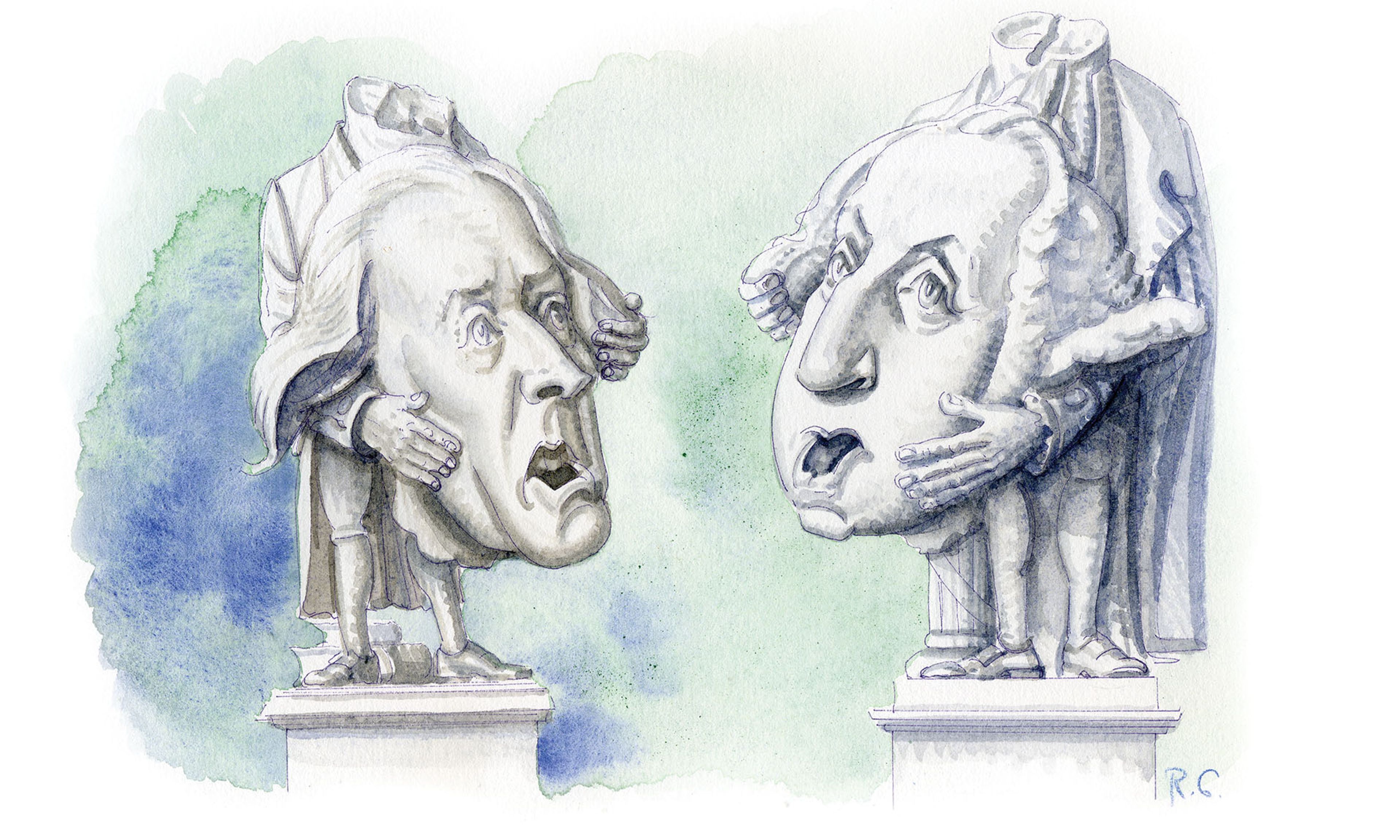
Charles Dickens and Mark Twain, master storytellers, used to carry The French Revolution around with them for the sheer delight of reading it. Mordant humor abounds in its pages, but it is a deadly serious book. It merits close attention today, in the smoldering aftermath of riots and the toppling of statues. It illuminates our own political and cultural crisis.
A central theme of Carlyle’s narrative is “the Gospel of Jean-Jacques” — Jean-Jacques Rousseau, author of The Social Contract and other utopian works. Rousseau is the leading spirit of the cultural Left, in our time as in his. He voiced the great paradox of the Left — libertarian selfism in morals combined with coercive, collectivist statism in political arrangements.
Rousseau’s first writings present an anthropology that, in essence, prevails on the cultural Left today. He envisions human beings as bundles of individual desire. He is preoccupied with autonomy, “the power of willing or rather of choosing, . . . and the feeling of this power.” He identifies self-love as the predominant human impulse. But (in sharp contrast to the doctrine of original sin and to earlier secular thinkers such as Hobbes and Machiavelli) he sentimentalizes self-love. He argues that human beings are fundamentally unaggressive by nature. He teaches a feelings-based morality and argues that compassion can ensure a benign social order. He imagines a prehistoric libertarian golden age, and he aspires to utopia.
Meanwhile, he denounces existing institutions as corrupt. The Social Contract famously opens, “Man is born free, and everywhere he is in chains.” Rousseau and the cultural Left that follows him must find their way from an autonomy-obsessed, hedonistic notion of human nature to a collectivist, coercive theory of government organized for purposes of reform. Rousseau accomplished this paradox with his theory of the General Will.
Rousseau’s concept is that, human nature being essentially benign, the impulses of the general public inevitably tend toward the common good. He grounds this notion in a sentimental deism (“The voice of the people is in fact the voice of God”). True freedom therefore requires conforming each person’s will to the General Will. It is the “real will” of each citizen. Thus, as Rousseau expressly states in The Social Contract (and as Robespierre despotically asserted), people can be “forced to be free.”
These concepts readily passed from Rousseau’s sentimental deism, to Hegel’s doctrine of world-historical progress, to Marx, and to progressivism today. The concepts lend themselves to a mystical exaltation of the state (and of leaders who speak on its behalf) as constituting the General Will. Such thinking contrasts with most of Anglo-American political thought, which emphasizes human corruptibility, is adamant to place restraints on power, and seeks incremental reform.
Carlyle makes this contrast a leading theme of The French Revolution. He repeatedly cites “the Gospel of Jean-Jacques” as having supplanted the Christian gospel and consciousness of original sin. Thus:
The Gospel of Jean-Jacques has come. . . . A Gospel of Brotherhood, not according to any of the Four old Evangelists, and calling on men to repent, and amend each his own wicked existence, that they might be saved; but a Gospel . . . according to a new Fifth Evangelist Jean-Jacques, calling on men to amend each the whole world’s wicked existence, and be saved by making the Constitution.
Rousseau’s hedonistic utopianism laid the ground for the French Revolution. Carlyle inveighs: “Fools, that expect your verdant Millennium, and nothing but Love and Abundance, brooks running wine, winds whispering music, — with the whole ground and basis of your existence champed into a mud of Sensuality; which daily growing deeper, will soon have no bottom but the Abyss!”
Thus runs the tale. Moral bankruptcy, sped by the gospel of Jean-Jacques, soon becomes financial bankruptcy. King Louis fatefully convenes the Estates General of the realm: 1,200 representatives of the Clergy, Nobility, and Commons. Plots, effervescence, and tumults follow, leading to the fall of the Bastille. The Estates declare themselves the National Assembly, and they undertake revolutionary reform.
The gospel of Jean-Jacques guides the arc of the revolution. There is a “Night of Pentecost,” abolishing feudalism in one session of the Assembly. A constitution is devised, and the “Twelve Hundred Jean-Jacques Evangelists” disperse. Their place is taken by a legislature increasingly controlled by the Jacobins. Carlyle calls them “the Ecumenic Council and General-Assembly of the Jean-Jacques Churches,” with Robespierre as their Chief Priest.
Jacobin utopianism fails, as utopianisms all do. This naturally is seen as owing to traitors. “Tremble, ye traitors; dread a People which calls itself patient, long-suffering; but which cannot always submit to have its pocket picked, in this way, — of a Millennium!” Thus, the gospel of Jean-Jacques issues in apocalypse: the murderous rhetoric of Jean-Paul Marat, the September Massacres in the prisons, the Reign of Terror, death-tumbrels to the guillotine. Sentimental visions of utopia lead to atrocity and horror. So has it been in subsequent revolutions arising from utopianism in Russia, China, Cambodia, and other lands. So might it be in our own land if recent trajectories prevail.
The gospel of Jean-Jacques is ascendant in America today. Its libertarian strain is found in Planned Parenthood v. Casey, refining the logic of Roe v. Wade to justify abortion on these grounds: “At the heart of liberty is the right to define one’s own concept of existence, of meaning, of the universe, and of the mystery of human life.” Rousseau himself abandoned his infant children to near-certain death in orphanages, and this is his legacy — human beings conceived as atomized, arbitrary bundles of desire. Rising out of that legacy are assaults on moral norms of every sort: unrestricted abortion, assisted suicide, ubiquitous pornography, marijuana lotus-eating, insistence that all norms are mere social constructions. This paradigm largely reduces, as Carlyle says, to the maxim that “pleasure is pleasant.”
Meanwhile, the collectivist strain of Jean-Jacques’s gospel goes from strength to strength. It inspires a progressivism unburdened by any wariness of the will-to-power and human corruptibility. Utopian calls for mass mobilization (a Green New Deal, Medicare for All, free college for all, a guaranteed minimum income, social workers replacing police forces) ride on a sense of the general will. And that sense of the general will finds unprecedented expression in social media — emotive tweetings to legions of followers, instant consensus, and the merciless suppression of dissent. Our Internet postings resemble the placards flung up each morning on Paris walls. Our Twitter mobs (translated now into street mobs) resonate with a punitive rage suggestive of the French Revolution.
Other tenets of Jean-Jacques’s gospel also are ascendant today. Rousseau treated government forms as provisional and subject to abrupt change in response to the general will. Thus, he called for periodic assemblies to determine: “Does it please the sovereign [the people] to preserve the present form of government?” That protean spirit imbued the French Revolution, with its multiple constitutions, its constitution placed in abeyance, its insurrectionary Paris Commune, and its bestowing of absolute power on the Committee of Public Safety. An utterly contrary spirit informs the American Constitution, framed to endure and very difficult to amend. But behold the gospel of Jean-Jacques regnant on the cultural left today, advocating peremptory changes of form — an end to the Electoral College, an end to small-state equality in the Senate, attacks on the Constitution itself as an illegitimate slaveholders’ project.
A central tenet of the gospel of Jean-Jacques is that “there should be no partial society within the state.” Thus, all facets of civil society (families, churches, associations) are suspect and are subject to restraint because they impede the general will. Rousseau’s thought is deeply antithetical to the robust civil society integral to American history, as classically described by Tocqueville. But in our time, families, churches, associations, and other entities standing between individuals and the state are alarmingly in decline.
That preeminently is true of churches. Rousseau disliked the Church as an institutional rival to the state and a barrier to the general will. The clash between faith and the new French Republic, the state’s annexation of the Church, and then the calamitous state-sponsored dechristianizing of society were key thrusts of the revolution. Carlyle vividly describes them.
When the Jacobins came to power, Christianity came under brutal attack both from the government and from mobs in the streets — churches looted; clergy banished, massacred, or driven underground; the Christian Sabbath abolished and the calendar revised into ten-day weeks; heathenism, atheism, and ceremonial deism alternately regnant in the culture. These somber events bear pondering in our own dechristianizing era.
The Church was derided on the eve of the revolution by Voltaire, d’Holbach, and other atheistic or vaguely deistic “philosophes.” Carlyle relates:
Philosophism knows only this, . . . that in spiritual supersensual matters no Belief is possible. . . . Shall we say then: Woe to Philosophism, that it destroyed Religion, what it called “extinguishing the abomination (écrasez l’infâme)”? Woe rather to those that made the Holy an abomination, and extinguishable.
Those who made the holy an abomination were clergymen of scandalous life, whom Carlyle vividly portrays. Cardinal Louis de Rohan grotesquely curried favor with Marie Antoinette, exposing her to scandal and ridicule, in the Affair of the Diamond Necklace. Bishop Talleyrand, womanizer, peculator, nationalizer of the Church, excommunicated, laicized, a diplomat for all sorts of regimes, became a watchword for worldly guile. Gobel, archbishop of Paris (Carlyle calls him “Goose Gobel”), went before the legislature, cast off his episcopal garb, and put on a red radical nightcap.
Anticlericalism flourished in this atmosphere, first with the philosophes, then among the bourgeoisie, and finally with the Paris mob. As priests were being massacred, Carlyle imagines the mob exclaiming: “Priests of Beelzebub and Moloch; of Tartuffery, Mammon and the Prussian Gallows; — which ye name Mother-Church and God!”
Analogies to our own era are obvious. The Catholic Church has been wracked with scandal, Evangelical churches disheartened, the Millennial generation mostly estranged from organized religion, the great work of John Paul II and Mother Teresa and Billy Graham largely undone. Anti-Christian bias is rife in the academy, in the media, and among all sorts of cultural elites, while worship wanes in the working class. As Carlyle observes, the Church “is in the most submissive state; quite tamed by Philosophism; in a singularly short time.”
The French Revolution is an ominous portent. But countless Christians acted with steadfastness and courage in those times. The peasants of La Vendée and the people of provincial cities rose in armed resistance to the Jacobins. Thousands of priests defied orders of banishment and persisted in their ministry, at peril to their lives. The Church emerged from the revolution chastened and humbled but resilient and capable of impressive witness (as seen in the sublime figure of the bishop in Victor Hugo’s Les Misérables).
Few tasks are so vital today as renewing moral authority in the churches. As Jean-Jacques’s emotionalism proliferates in the culture, as people are socialized to see themselves as self-validating vectors of desire, the groundwork of the republic trembles. Washington famously warned, in his Farewell Address, that religion and morality are indispensable props of the Constitution. If those props fail, our trajectory easily might lie into the sort of hellish vortex that engulfed revolutionary France.
Carlyle’s view of revolution was summed up by his biographer James Froude: He opposed it because he knew that it meant “letting the devil loose, whom it was man’s duty to keep bound.” A principal theme of The French Revolution is the monstrousness of anarchy and the fragility of social order. That theme is of urgent relevance today.
Carlyle presents a recurring image of social order as the Earth’s crust, a rind above oceans of red-hot lava. The breakdown of institutions leads to hellish eruptions — the “deepest upturn of the black-burning sulphurous stratum whereon all rests and grows.” Such outbursts defy constitutional governance. They are led by those who most shrilly articulate the impulses of the mob.
Carlyle expresses these dynamics with infernal imagery: Erebus, Tophet, Tartarus, the Abyss erupting into the upper air. Paris after the fall of the Bastille is a “roaring Hell-porch. . . . Seven Bastille Prisoners, borne shoulder-high; seven Heads on pikes.” The Revolutionary Tribunal, guillotining thousands with summary trials, is a Jacobin “Sword of Sharpness . . . tempered in the Stygian hell-waters.” A law authorizing peremptory searches of private homes sends mobs breaking into them, amid “the tumult of Satan.”
Carlyle reflects on the Girondins, the centrist party that unsuccessfully tried to hold the Jacobins at bay. Their leaders mostly were attorneys, confident in their rhetorical skills. They tended to view the poor as “mounds of combustible explosive material, for blowing down Bastilles with.” They were shocked when the revolution proved impossible to control: “The great gulf of Tophet . . . opened itself at the magic of your eloquent voice; and lo now, it will not close at your voice!”
There follows the bloody tale of the Jacobins in power, riding the whirlwind of anarchical insurrection. The rioting of recent weeks in America recalls Carlyle’s account. We see the fragility of social order and the violent aggression unleashed when social order breaks down. We must refute the sentimental vision of human nature arising from the gospel of Jean-Jacques (especially as it issues in calls for the abolition of police). That vision has been shown false by the cruelty and carnage of every revolution to which it has given rise.
Revolution naturally tends to empower its most aggressive, ruthless elements. Dislocations and grievances cause the mob to gravitate to them. Thus Lafayette and Danton fell while Marat and Robespierre took power. Thus, in the Russian Revolution, Lenin prevailed over Kerensky. As facile Jacobinism is propagated today, it’s urgent to argue that revolution devours moderates and empowers the violent.
Carlyle was “a Tory to the Radicals and a Radical to the Tories.” That epigram (from The Harvard Classics) conveys a great strength of The French Revolution. The book is conservative in its anti-libertarian, anti-utopian, and anti-collectivist tone, and in its resolute insistence on the fact of original sin. It vividly argues the perennial conservative theme of caution in disturbing social arrangements. It offers a castigating rebuttal of the gospel of Jean-Jacques. Yet it dramatically appealed to men of the Left such as Mark Twain and Dickens (who modeled A Tale of Two Cities on “Mr. Carlyle’s wonderful book”).
That appeal was effective precisely because of Carlyle’s ability to speak also as a radical to the Tories. Rarely has a conservative writer, skeptical of change, so harshly and vividly indicted corrupt institutions. Ponder this passage, in which he expresses the indignation seething in France upon the eve of the revolution:
O ye Hypocrisies and Speciosities, Royal mantles, Cardinal plush-coats, ye Credos, Formulas, Respectabilities, fair-painted Sepulchres full of dead men’s bones, — behold, ye appear to us to be altogether a Lie. Yet our Life is not a Lie, yet our Hunger and Misery is not a Lie! Behold we lift up, one and all, our Twenty-five million right-hands; and take the Heavens, and the Earth and also the Pit of Tophet to witness, that either ye shall be abolished, or else we shall be abolished!
Carlyle could impressively rally social reformers against the wickedness perpetrated in the name of reform. That quality made him a much more effective critic of the French Revolution than were conservatives such as Edmund Burke. Carlyle had sardonic words for them:
Great Burke has raised his great voice long ago; eloquently demonstrating that the end of an Epoch has come, to all appearances the end of Civilized Time. . . . Who will say that Church, State, Throne, Altar are not in danger: that the sacred Strongbox itself, last Palladium of an effete Humanity, may not be blasphemously blown open, and its padlocks undone?
Today the sacred strongbox largely is in the hands of the cultural Left. Big business, big tech, big philanthropy, and the billionaire community mostly are devotees of the gospel of Jean-Jacques. Conservatism meanwhile has pivoted to enlist the working class. That enlistment largely has been Burkean in its appeals to patriotism and to traditional social norms. It’s urgent to follow Carlyle in addressing workers’ financial woes as well. As globalization, automation, and the pandemic stress blue-collar families, racial minorities, and Millennials, conservatives must offer more than platitudes about rising tides lifting all boats.
Carlyle relentlessly attacked cant (platitudes and dogmatic clichés employed to justify the status quo). He called cant “the materia prima of the Devil, from which all falsehoods, imbecilities, abominations body themselves.” The cultural Right harbors plenty of such sclerotic platitudes today. Conspicuously, they involve the benign effect of market forces, globalization, deregulation, automation, and efficiencies of scale. Those values must be balanced with a communitarian frame of reference and with a compassionate eye. Carlyle observes:
The beginning of all Thought, worth the name, is Love; and the wise head never yet was, without first the generous heart. . . . Mammon, cries the generous heart out of all ages and countries, is the basest of known Gods, even of known Devils. . . . Generous hearts, discerning, on this hand, widespread Wretchedness, dark without and within, moistening its ounce-and-half of bread with tears; . . . cannot but ejaculate, cannot but announce: Too much, O divine Mammon; somewhat too much! — The voice of these, once announcing itself, carries fiat and pereat in it, for all things here below.
Fiat: Let it be done — earnest, measured social reform, grounded in the Constitution and in our strong civic traditions, tempered by awareness of human frailty. Pereat: Let it be done away with — utopian selfism on the left, and Mammonism on the right. May the message of the four evangelists prevail against the gospel of Jean-Jacques. May Jacobinism be firmly forsworn. And may the lessons and portents of the French Revolution, rendered so vividly by Carlyle, be ever remembered.












Comments