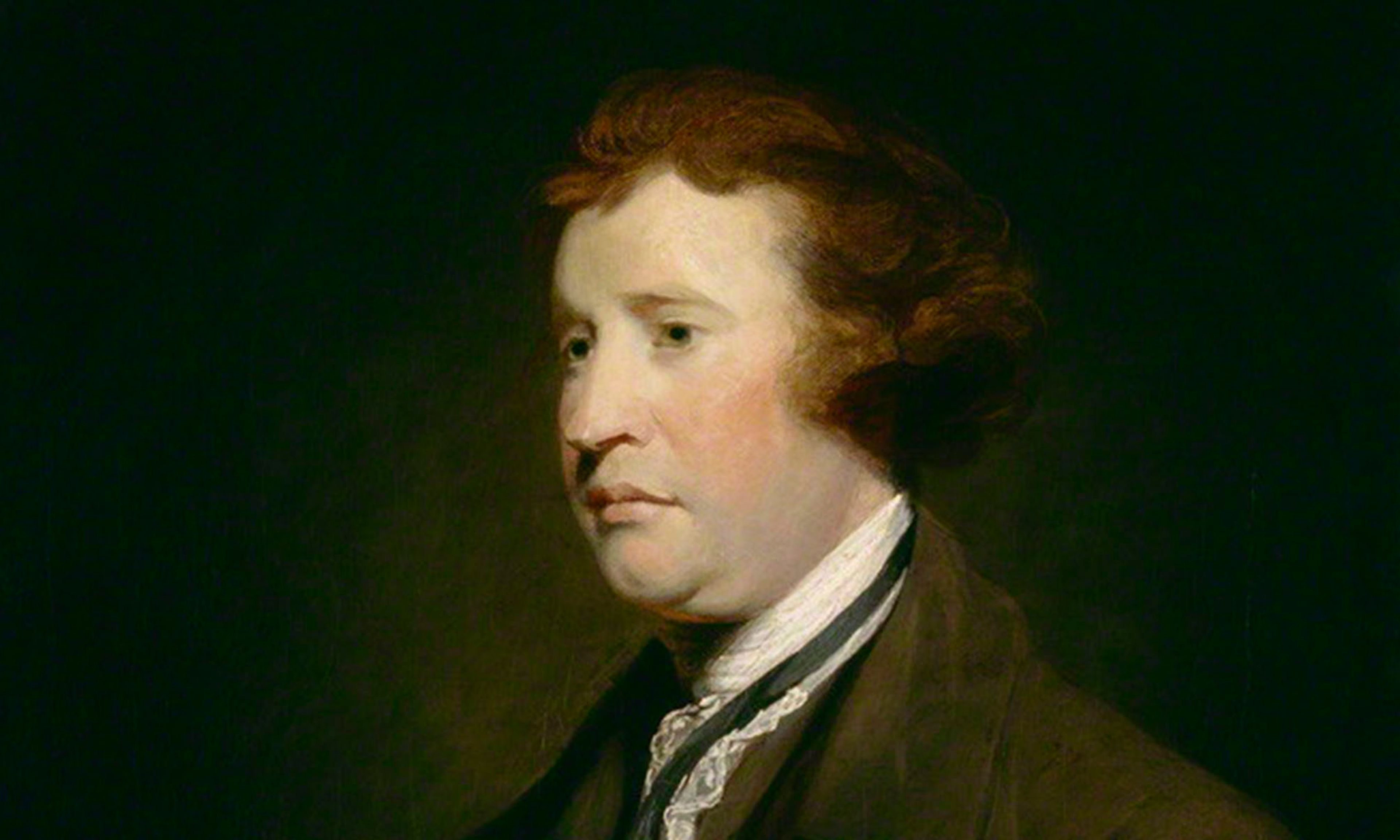
Gregory Collins believes that dedicating oneself to getting great figures right is a good way to do political philosophy. He has immersed himself in Edmund Burke, dedicated to getting him right. The result is this 578-page book plus several scholarly articles on Burke’s views, including those on slavery.
Collins is a postdoctoral associate and lecturer at Yale University’s political-science department. The book grew out of his dissertation at Catholic University of America. Does he get Burke right? I think so, though perhaps the account is off in minor ways.
Now the leading Burke scholar on this side of the pond, Collins emphasizes Burke’s stress on “manners” as preconditions for healthy commercial society. Manners, or mores, must themselves be tended to by wise legislators. Burke would protect, even privilege, religious establishment, families, marriages, moderate amounts of landed property, select public monuments and other structures of national significance, foreign policy, and public service to the state, among other things listed by Collins. Morals-as-preconditions makes the main chord of the book. The chord is true, if a bit trite.
The melody is Burke’s liberalism in policy, within the framework of a stable polity. The book is impressive in its thoroughness on Burke on issue after issue, focusing on his words and deeds. Born in 1729, Burke was a member of Parliament for 29 years and died in 1797. Collins delves into the major issues of Burke’s career, involving Ireland, India, the American colonies, and of course France, but also many obscure issues, such as the Butcher’s Meat Bill.
Burke favored liberal policy presumptions, as rang clear in his Thoughts and Details on Scarcity. But of course Burke did things that could reasonably be seen as compromises and feints, as one should expect of any politico, including a true statesman. On the British East India Company, Burke worked to open up market competition, to rein in the company’s political abuses, and to bring greater accountability, while Adam Smith advised bringing an end to its charter altogether. The bill in Parliament that Burke got behind, which failed, was quite possibly a wager on the politically possible. Collins notes: “Burke’s committee reports and speeches were articulated in a tense political environment rather than in a university classroom.”
Burke’s liberalizing tendency was mixed with his solemn consideration for the moral framework of society and the peaceful enjoyment of the constitution. Like the Soviets once and China today, France was a potentially hostile government, even before the Bastille, and in 1787 Burke opposed a treaty that would have liberalized trade with France. In 1790 he published his most famous work, Reflections on the Revolution in France, developed a cold-war posture toward France, and even proposed a hot war in Letters on a Regicide Peace.
Radical passions were ablaze in France and catching fire elsewhere, including Britain. Burke saw the need to explain the blessings of accreted institutions of powers now regularized and made halfway reasonable. Shake or topple the structures, and power may turn scarcely reasonable. The blaze was a new quasi-religion. Burke was the one-man fire department, supplying the water tank and fire hose and dousing dangerous passions throwing off multifarious babble.
In “Tocqueville’s Burke, or Story as History,” Ralph Lerner writes, “Burke and Tocqueville each engaged all their art in retelling their respective nation’s history with a view to reshaping prevailing perceptions.” Writing in the 1850s, Alexis de Tocqueville, in The Ancien Régime and the Revolution, used Burke in a way that served Tocqueville’s prospective message.
There is something of the same at work with Collins’s Burke. In the 1790s Burke produced a profound set of writings on the reverence due to the traditions, sensibilities, and manners that conduced to history’s best approximations of a liberal nation-state. Today we should perceive Burke as an exemplar in searching one’s soul to appreciate all that we should feel grateful for.
Collins presents Burke as a challenge to those classical liberals and libertarians who can think of politicians only in an unseemly light. Whom would you have be our governors? Collins explains Burke’s sensibility for a “symbiotic relationship between government and the people,” expressed in his 1780 speech on economic reform. Indeed. How else shall we hope for less bad governors? Collins describes Burke’s posture of “instilling a sense of confidence in the people and deepening their healthy — though not blind — attachment to government.” If we got our wish, and there were a person in government leadership, a person embodying virtue and hoping to improve matters, what could we expect but that posture? Collins quotes Burke: “It is for the sake of Government, for the sake of restoring to it that reverence, which is its foundation, that I wish to restrain the exorbitance of its influence.” “Burke’s position,” Collins writes, “is that for any society to exist, there must be some authority that warrants enough admiration so that citizens are willing to abide by its established laws. Otherwise, social disorder would persist.”
Collins’s message is that we should be grateful for the grace of life, and not for the gratifying of immediate desire. Collins recruits Burke into a mode of chiding against gratification, commodification, transactional society, and so on. He seizes Burke’s remarks about “calculators” and “oeconomists” and Burke’s criticism of contractarian slogans about government by consent, to paint a portrait of Burke’s combating a philosophy of the marketization of social existence, of consumerism. “In Burke’s judgment,” Collins writes, the French Revolution corrupted the integrity of the moral fabric “by consecrating transactional and speculative inclinations. . . . Morality was monetized.”
Shallowness, vanity, and vice show themselves in different manners and verbalisms, depending on circumstances. The commodification of human experience was not a manifestation that Burke was particularly contending with. Absorption in moneymaking and frivolous divertissement may be vents for the bored. But as Burke (or Tocqueville) tells the story, they would be more by-product than cause of the revolution. Burke saw Rousseau as a leading influence on the revolutionaries, and Rousseau was hardly a prophet of consumerism and marketization — quite the opposite. In characterizing what Burke was against, Collins makes primary something that was secondary.
Also, Collins draws a contrast between Burke and the Scottish moral philosophers, a contrast that is overdrawn and somewhat contrived. The contriving comes from J. G. A. Pocock, whom Collins credits. The contrast holds that the Scottish moral philosophers, notably David Hume, William Robertson, and Adam Smith, taught that the spread of commerce improved manners and morals — what some call the doux commerce thesis. Collins writes, “They had adopted the Enlightenment perspective of political economy that attributed the growth of civil order to the advent of market liberty.”
But, says Collins, Burke “reversed” the relationship, seeing that the flourishing of extensive commercial society was made possible, and is sustained, by good manners and morals. Collins writes: “The steady hands of chivalry and the nobility and religion spawned the preconditions of economic vitality. Ancient virtue furnished the civil environment necessary for commercial virtue to blossom.”
On the causal relationships between morals and flourishing commerce, Burke elaborated one direction while the Scots gave more notice to the other. But for both camps the link was bidirectional. A large part of the difference in emphasis could be chalked up to circumstances. Burke was a politician; Hume, Robertson, and Smith were not. More important, those three Scots died in 1776, 1793, and 1790, respectively. Six years younger than Smith, Burke was very much alive into the 1790s and saw civilizational conflagration. It was all-important to emphasize the moral preconditions of institutions and ordinary life. The lesson was about moral preconditions per se, not just of commercial relations but of stable and honest government and courts, the integrity of the family, the security of property, local customs, and myriad social practices.
Bidirectionality of causation between morals and commerce creates layers of social life. When the layer we have been plying runs into crisis, we naturally excavate the moral preconditions of that layer. Collins himself acknowledges bidirectionality in both camps, but, still, perhaps he makes too much of their differing emphases.
How much daylight should we see between Burke and Smith? The question is not new, but answering it opens rich avenues for learning about Burke and synthesizing political theory, political economy, and moral philosophy in the historical context of Burke’s times. In doing so, we ponder our formulations, familiarize ourselves with the polysemy of central words, and refine our definitions. Burke put it sagely when he said, “A clear idea is . . . another name for a little idea.”
Collins gives us the resources to take up such matters. He successfully exposits the coherence in Burke’s words and deeds. Collins’s Burke is a liberal in the original political sense of that word, and a conservative in an important conceptual sense of that word. Collins speaks of Burke’s “resolute belief that a strong and effectual state was a trim and selective one.” Burke’s thought provides “timely lessons about the possible harmony between liberty and virtue.” There’s another word to ponder, virtue.
These days we may feel especially moved to excavate the moral underpinnings of the social fabric, and to look up to Burke as one who fought the human penchants that tend toward servitude and submission to an irresistible centricity. The job is perennial. Burke’s efforts are eternal.












Comments