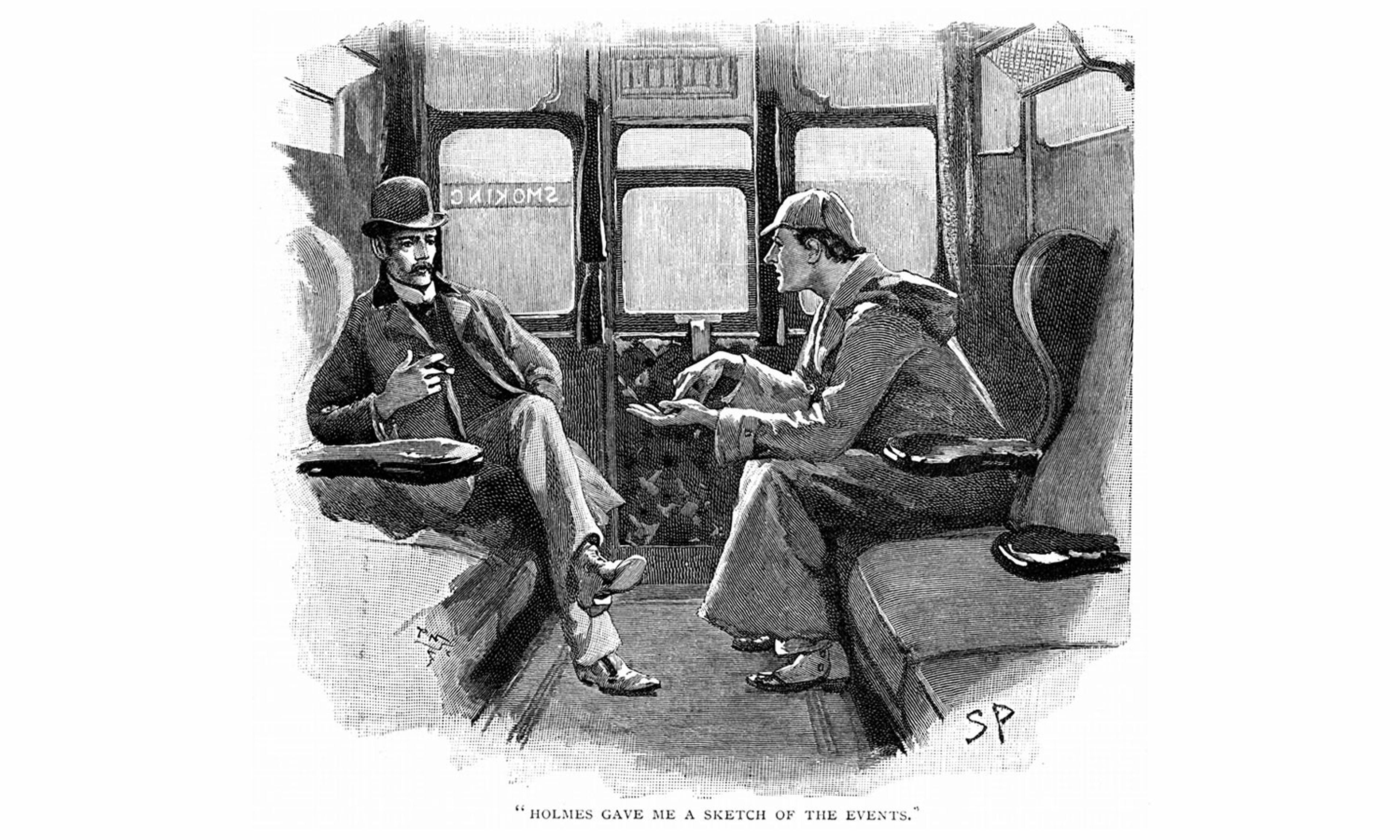
A benefit of the year of COVID was supposed to be that, unflattened by the daily grind, we could expand into new areas of intellectual interest. At the beginning of the lockdown I checked in with two colleagues: One was reading Eusebius, the other explained a sentence in Wittgenstein’s Tractatus. That was the spirit. For me, I read — Sherlock Holmes stories.
Not those alone. I read some 19th-century novels (read, in this context, means read aloud; I have a mature adult wife with the requirements, and the keen attention, of a five-year-old). But when we were done with these, we returned to Holmes.
I say returned because we have done almost all the stories numerous times — and almost all because I am not a completist. A few late stories are not in Dr. Watson’s voice; fuhgeddaboudit. There is also one where Holmes helps the war effort (World War I). Patriotism in genre fiction is the last refuge of exhaustion. Holmes’s brother Mycroft, who missed being an even greater detective from an unwillingness to get his knees a little dirty, and so lives as an eccentric civil servant instead, is amusing when we first meet him. But when he turns out to be the mastermind who keeps the British government organized — an anxious early-Progressive fantasy: surely someone can run this state we have called into being? — he loses all credibility. Professor Moriarty, the mathematician who runs the universe of crime, never had any credibility to lose; our organized criminals are found in the tabs, and Hollywood. My wife exercises a liberum veto: She doesn’t like the retired colourman’s divorce settlement, or the amateur surgery performed upon the young engineer. But that leaves over half a hundred occasions when a puzzled civilian or a stumped inspector comes to consult the odd genius and his normal sidekick, and we are off.
The stories vary in quality — black-faced-langur injections, indeed — but all satisfy. Why?
The primary, and obvious, reason is the immortal pair. Holmes is fascinating by himself: the law-enforcer who is a skillful house-breaker, the misanthrope and misogynist who can charm stable hands and old ladies, the loner who defends society, the man who sports personal items presented to him by two different European royal houses but who is familiar with waterfront opium dens. He is simultaneously benevolent and cold; when the KKK — one clue that this mid-century boy reader did not need to have explained — manages to kill one of his clients, Holmes is wounded as an outfoxed professional and moved by the horror of the deed.
Dr. Watson is a reader transported into the story. Though he cannot unravel the mysteries any faster than we can, he does have a field of expertise (besides medicine) — and that is Holmesology. He does not know what his friend is thinking, but he almost always knows that he is thinking, and he can tell whether those thoughts are fruitful or still stymied. Watson’s double function as “author” also applies the final coat of verisimilitude. His elaborate fretting over how much his accounts have had to conceal, or the other cases he might have presented instead, are like fake footnotes in an academic hoax.
The stories thrive on their sense of place. The crime-fighters venture into the countryside, where, however small the town, there is an inn to serve as a base of operations, and a noble or at least centuries-old house in which they must operate. But their preferred habitat is the city — Holmes “loved to lie in the very centre of five millions of people.” Restaurants, clubs, concert halls, railway stations, neighborhoods are not described so much as checked off (surely you know them already). One aspect of urban life that is presented in detail is journalism. Arthur Conan Doyle — I admit it, the actual author — tries out various foreign accents, none all that successfully (his Yanks will say, “I reckon”), but his pastiches of newspaper crime stories, complete with editorial harrumphing, are perfect.
The best, most vivid place is the era. The stories existed in real Victorian time when they first ran, but by the end of Doyle’s career they became nostalgic (the last ones appeared alongside flappers). A century-plus on, they are wholly so.


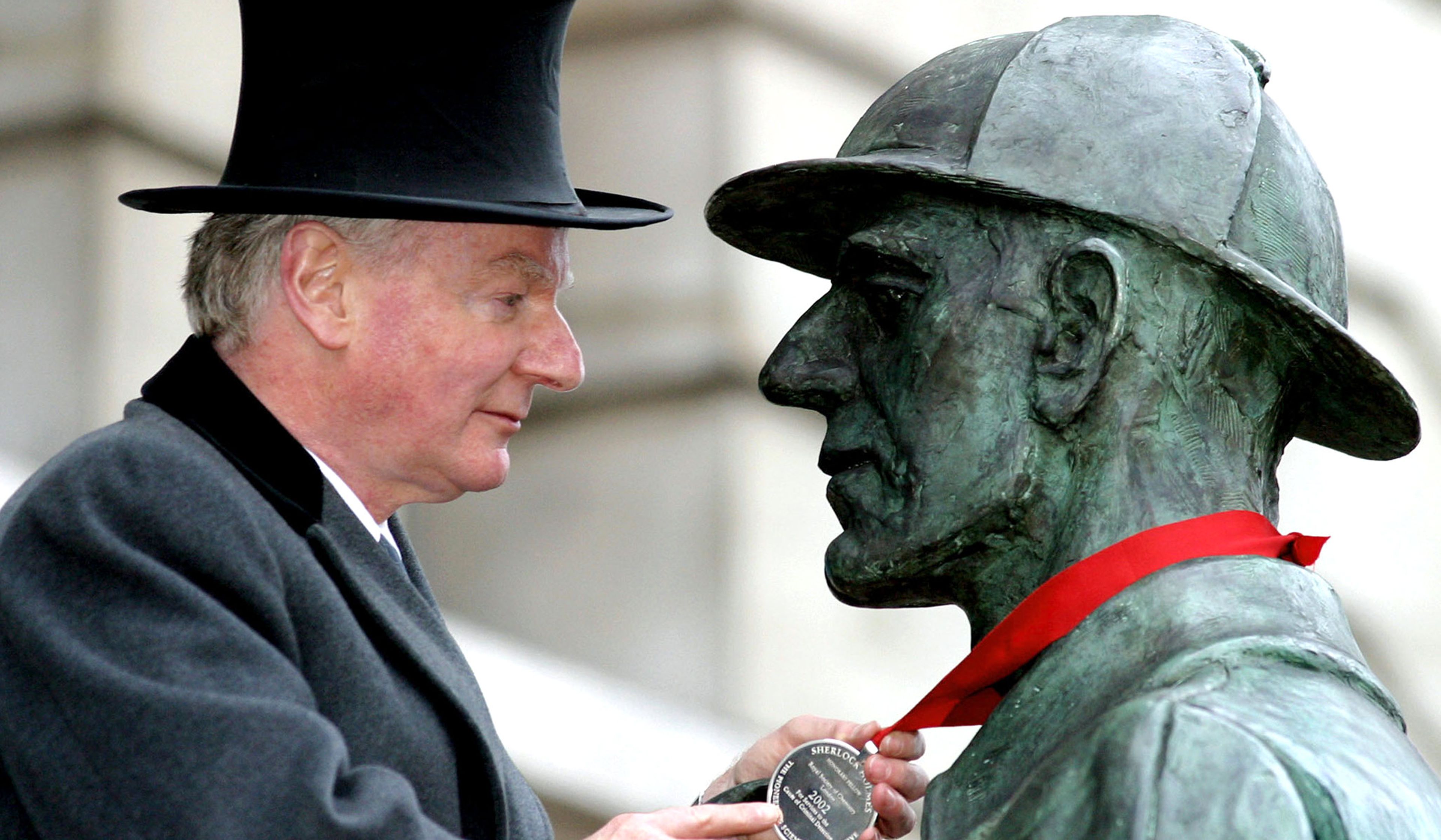

A life-size bronze figure of Arthur Conan Doyle’s character Sherlock Holmes created by artist John Doubleday 1988 on the main square in Meiringen, Switzerland, July 6, 2010.
Arnd Wiegmann/Reuters
London is the metropolis of the world hegemon. Strange things happen in the empire (India, Australia, South Africa) and the former empire (America). Peoples untouched by British rule are prey to dictators and secret societies. Crime and vice flourish at home, but they are held in check by the law, which, though it may need Holmes’s help in identifying culprits, is tireless in pursuit, and always reads the accused his right to remain silent, however guilty he obviously is. Public schools are the hope of the future, Britain and the United States may one day reunite. Noblemen are often shown to be feckless or unreasonably proud, but such types receive their comeuppance, and there is no hint of revolutionary sentiment. The only time Holmes approaches despair is after one tragic and gruesome double murder. “What object is served by this circle of misery and violence and fear?”
Doyle’s favorite story was “The Adventure of the Speckled Band,” which is terrific (hint: if you find your bed bolted to the floor, move). My favorite is “The Adventure of the Blue Carbuncle,” which turns out to be one of the great Christmas stories (the titular carbuncle, a stolen gem, is discovered in a holiday goose). It ends with a confessional, Holmes as priest; the tone is set early on when a minor character exclaims in surprise. He could have exclaimed anything, but Doyle makes him say, “Great Lord of mercy!”
We want that sense of place, even more than the assurance that Holmes (usually) gets his man, in this time of two places, visited reeling city, lovely but still unfamiliar country. When we no longer seem to live anywhere, it is soothing to visit Baker Street.












Comments