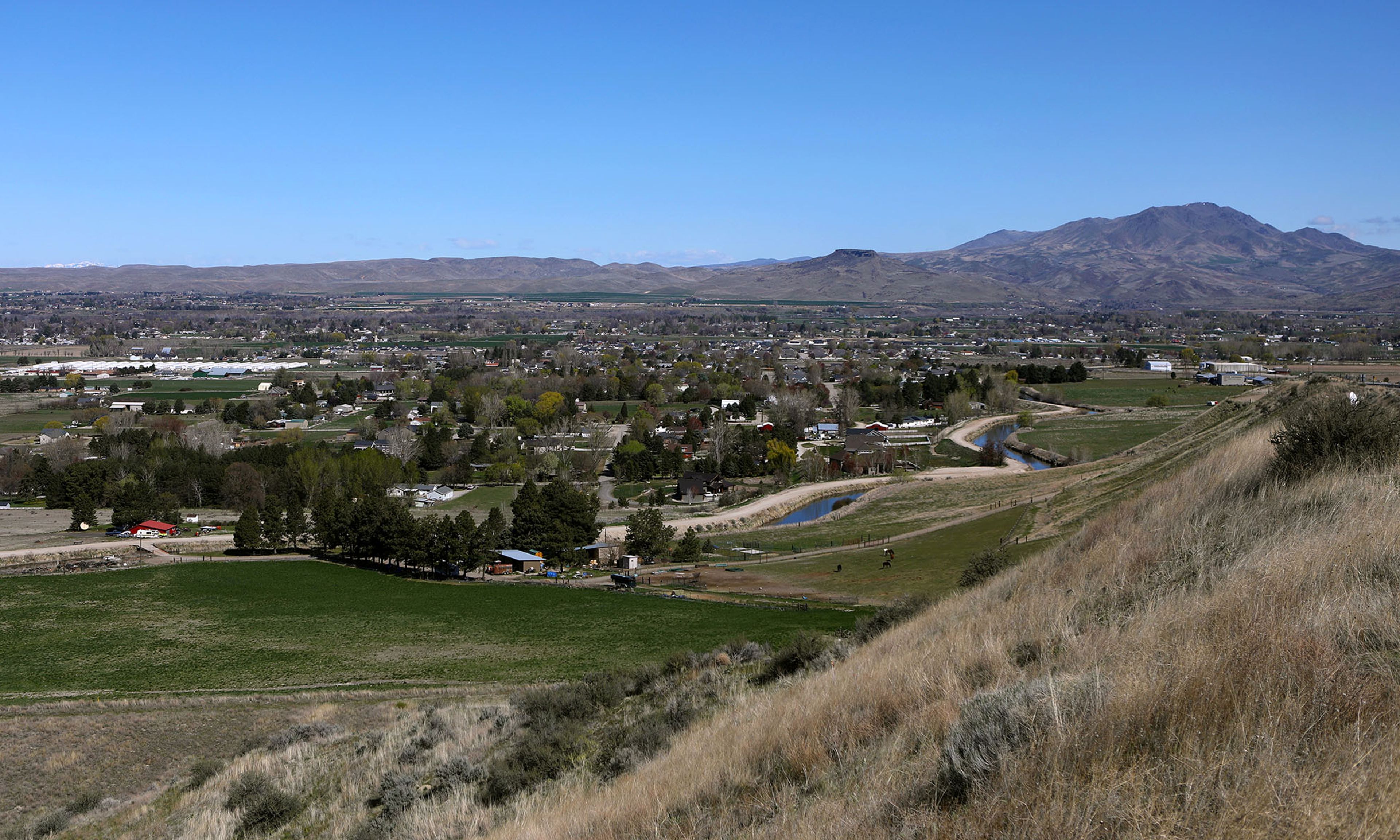
Grace Olmstead’s new book ends where it began: in a graveyard. “I stand here with the dead because I believe they matter,” she writes. “This land matters. And all the roots that sink down deep into this ground, lending strength and life to this soil, will matter long after any of us are gone.”
That land lies in the tiny farm town of Emmett, Idaho, where Olmstead grew up. Like many of her peers, Olmstead left her town to pursue opportunity in a prosperous coastal city. As a journalist at The American Conservative, she became known for her commitment to localism and small-scale agriculture in the style of Wendell Berry. Although she left her home behind, Olmstead worries about the cultural and personal costs of severing our identities from our commitment to the particular places we’re from.
Olmstead uses her own story — and the story of Emmett — as a microcosm. By diving deeply into these stories, we can better understand the ways our economy and our culture have been transformed over the past century, for good and ill.
In the introduction, Olmstead describes her book as an “ode to the past, an attempt to pay back the debt” she owes to those who came before her. It is “an attempt to push back against the exploitation and extraction” of our modern economy and “an homage to the ‘nobodies’ who maintain our unknown places today.” Yet, even more than that, Olmstead writes, the book is “an exercise in discernment.” Torn between her deep roots in Idaho and the newer ones she has put down with her young family in Virginia, Olmstead knows that “sooner or later,” she “will have to make a choice.”
Olmstead’s writing is vivid, with chapters that open with memorable, interesting vignettes: stories from her childhood, interviews with local farmers, and tales about the historical figures who shaped Emmett’s past. The story of the town illustrates the larger evolution of American agriculture from small family farms to contemporary factory farming and big agribusiness. Olmstead avoids oversimplifying or romanticizing the past, probing deeply to understand what makes some people become “boomers” (who come to the valley in search of profit and leave once it has been extracted) and others “stickers” (who choose to put down roots and stay, come what may). She takes care to note the complicated history of Japanese and Chinese immigrants and African Americans who came to Emmett, as well as the discriminatory attitudes and practices that often kept them from staying. She also points out the negative effects of poorly structured government aid programs and agricultural subsidies.
Oddly, Olmstead mentions the problem of substance abuse and the opioid epidemic only twice. The first is a passing reference to the “troubled homes” of some of Emmett’s struggling high-school students, “where there is substance abuse and poverty.” The second comes just a few pages before the book’s end, where she writes: By “making it difficult for many Americans to be fully rooted in place, it’s likely that we have fostered the epidemic of loneliness, anxiety, and drug abuse experienced by many Americans in our own time.”
As someone who grew up in a rural farming community that has been hit hard by the opioid epidemic, I found it strange that so little attention was given to this part of the story. On the other hand, the omission does fend off critics who might be tempted to write Olmstead off as a copycat J. D. Vance. Hillbilly Elegy this is not. Olmstead writes less about rural poverty than about the dark side of economic growth, observing that “when everything is shiny and new, it is easy to forget everything that came before.”
Olmstead explores the scientific realities she describes, as well as their poetic resonances, in great detail. Take the irrigation canals. Olmstead’s great-grandfather, “Grandpa Dad,” used “ditch cows” to keep the grass surrounding his canals under control instead of spraying the chemical herbicides that many of his neighbors employed. When asked for an explanation, he said simply, “It makes the land pretty and the animals happy.” As it turns out, the cows’ grazing also stimulated the growth of the plants’ root systems, holding the land in place and preventing the soil runoff that plagued other farmers’ irrigation canals. In this case, as in many others, Olmstead shows that the old ways hold wisdom that modern methods miss.
The canals provide a segue for Olmstead to turn her attention to bigger problems, such as the depletion of the soil through unsustainable farming practices, and then to discuss the historical development of those practices after World War I. Practices such as monocropping dangerously depleted the land, eventually leading to the catastrophe of the Dust Bowl. Over time, farmers became more dependent on the federal government for loans and subsidies and less capable of feeding themselves. As their production became more specialized, their goods were shipped around the world instead of being sold down the street. This, in turn, cut rural communities off from the sources of their food, most of which now comes from faraway places and is cheap but not necessarily healthy. Olmstead also emphasizes the importance of intermediary institutions and the cost of letting them atrophy by telling the story of how Idaho farmers banded together to form community partnerships to develop the irrigation canals.
Olmstead draws thought-provoking connections between particular events, people, or memories and broader philosophical insights, ecological lessons, historical developments, or structural issues plaguing the contemporary American economy. Within each chapter, these layers unfold beautifully and intuitively. Yet, strange as it may sound, Olmstead may actually be a little bit too adept at multiplying connections. Because she does not offer a clear roadmap of where the book is going — the chapters don’t even have titles — it can be hard to remember how where we are now relates to where we’ve been.
Rather than anchoring her analysis to a strong narrative arc or succinctly articulated theoretical framework, Olmstead prefers to dwell with a set of themes and ideas — introducing them here, developing them there, letting them fade into the background as she discusses something else, then letting them resurface later on. As a result, the book creates a general impression or feeling — punctuated by certain facts and scenes — rather than providing a compelling story or a strong argument.
This initially seems like a weakness. Yet it’s possible that this inchoate quality of the book’s structure is intentional. Maybe it’s even a strength.
Remember, Olmstead calls her book “an exercise in discernment.” When I read this description, I expected something in an Ignatian vein, though perhaps not explicitly religious: introspection and contemplation in a deeply personal mode, using one’s own emotions and experiences as keys to discern the way forward. I expected a memoir-style narrative that would progress chronologically and end with a choice to stay in Virginia or move back to Idaho. Yet Olmstead doesn’t mention until the very last chapter questions such as whether her husband could find a job in Idaho or whether her parents might need support as they age, even though she notes that these will be key factors in her decision.
Instead, most of the book is dedicated to a different kind of “discernment”: the effort to see clearly. This is something akin to the effort you make to “discern” the contours of the furniture around you when you suddenly find yourself in a dark room. Such discernment requires patient presence. You have to let your eyes adjust. Then, gradually, the blackness that surrounds you becomes full of detail. Shapes emerge, and you slowly gain a sense of their spatial relationships to you and to one another.
“Nostalgia,” Olmstead writes, “can make us blind: it can prompt us to view complicated, messy places with a false simplicity or sentimentality. It can convince us to return home to a place that no longer exists — one that perhaps never existed in the first place.” In the process of writing this book, Olmstead’s vision has become “complicated”:
That is what happens when we commit ourselves to long attention in one direction. It is a necessary part of growing and deepening our love for our homelands. Anything less would not be love; it would be idolization, a blindness that prevents us from truly knowing, serving, or loving our landscapes.
Olmstead asks the same thing from her readers. Those who choose to devote “long attention” to her beautiful book will be richly rewarded — not with easy answers, but with a new awakening to what surrounded them the whole time.












Comments