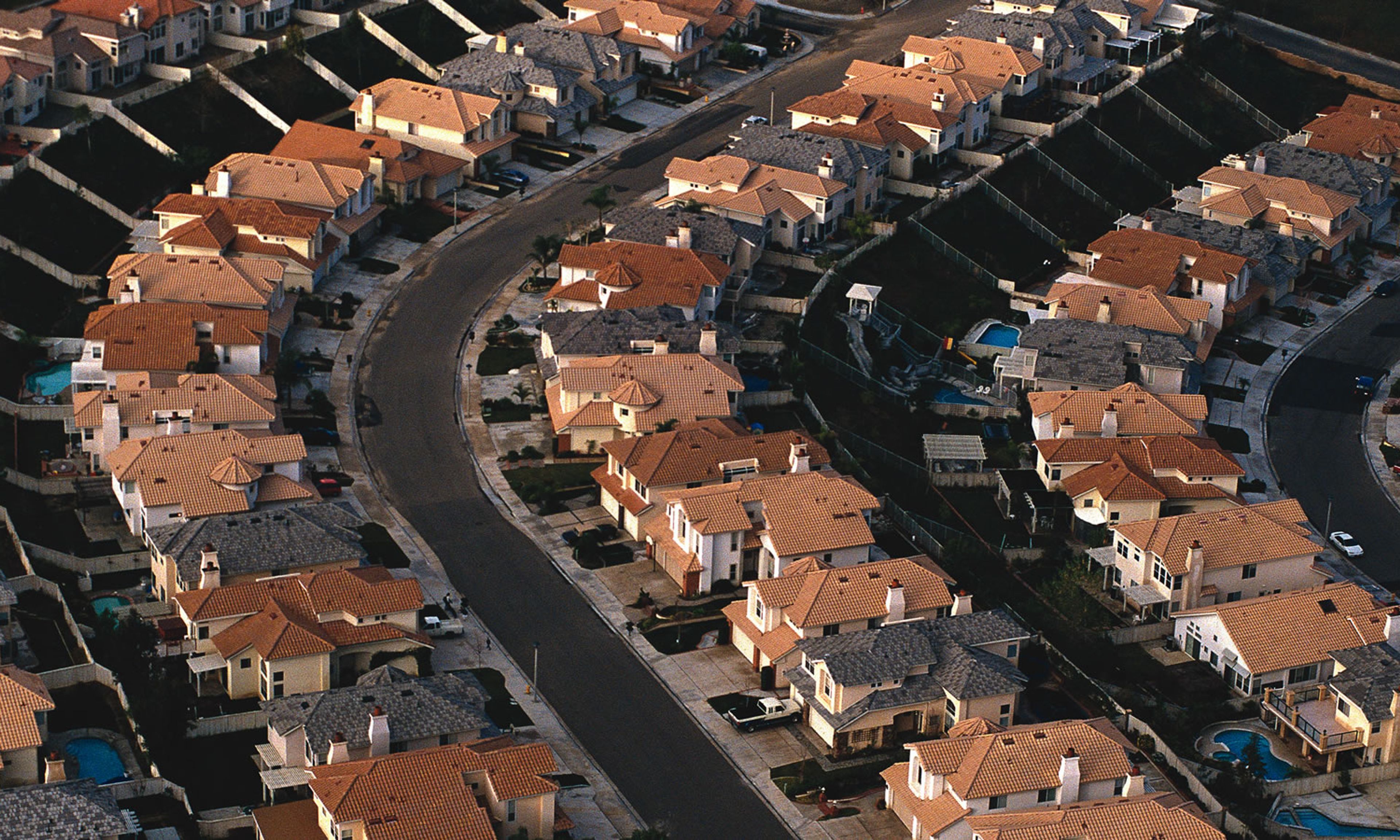
My suburban-born-and-bred Millennial kids recognize the 1962 hit song “Little Boxes” only because it’s the theme for Weeds, the 2005–12 Showtime series about a widowed, hypersexual suburban California mom who deals weed to pay the bills. The plot was invariable — street drugs and traffickers meet school bake sales, lawn maintenance, and sex, sex, sex (can’t you just eat up the comic juxtapositions?) — and each episode opened with “Little Boxes,” a song that reveals the contempt of Californians for suburbs, the place where most of us (Californians) live.
The song’s origin story has it that Berkeley folk-singer Malvina Reynolds was driving south to La Honda for a performance in support of the Friends Committee on Legislation (“a national, nonpartisan Quaker organization that lobbies Congress and the administration to advance peace, justice, and environmental stewardship”). Somewhere around Daly City, Reynolds espied the community of Westlake, a Levittown-like, then-whites-only, master-planned community of low-cost homes for California’s exploding post-war population. Simultaneously disgusted and inspired, she delegated the driving to her husband and, in the hour or so before they arrived in La Honda, penned “Little Boxes” in the passenger seat.
In little more than the time it took to write it, “Little Boxes” blew the lid off folk music. Reynolds loaned it to her friend Pete Seeger, who, in an irony of market efficiency that has bedeviled such revolutionary artists as Gang of Four, the Clash, and the Situationist International, took the song to boffo global sales and luxury-level royalties. It has spawned dozens of covers by name-brand and nearly anonymous artists, including a 1969 version in Spain under Generalissimo Francisco Franco (“Cajitas”), the 1971 Chilean recording (“Las Casitas del Barrio Alto”), and (as you’d probably expect) multiple French renditions, the seminal interprétation of which is “Petites boîtes,” by the Kiwi-born French folkie Graeme Allwright. Etymologists trace the now common words “ticky,” “tacky,” and “ticky-tacky” directly to this pop Big Bang, and to Reynolds’s description of suburban homes in Daly City:
There’s a pink one and a green one
And a blue one and a yellow one,
And they’re all made out of ticky-tacky,
And they all look just the same.
And the people in the houses
All went to the university,
Where they were put in boxes
And they came out all the same.
There’s no accounting for taste, but the song captured the zeitgeist of the bohemian age in a way that makes it worth thinking about more deeply. But for now let’s just note that the lyric emerges from Reynolds’s very materialist perspective that men and women (per Karl Marx’s The Eighteenth Brumaire of Louis Bonaparte) may “make their own history” but not “as they please.” They must contend with “circumstances existing already, given and transmitted from the past.”
The academic translation, for Reynolds’s purposes: The apparent placelessness, homogeneity, and sameness of suburban planning produce blunted humans, and those humans must be liberated by a vanguard of enlightened artists, workers, and bureaucrats.
And it’s to this California revolution that we now turn.
For decades, progressives have labeled California’s suburbs racist — sometimes because, like Westlake (now a part of Daly City), they actually were, actually banning minority homeownership. Such apartheid wasn’t just racial. The developers who created the post-war suburban L.A. County city of Lakewood were banned from buying their own homes — because they were Jews. My own family was part of what was called the “white flight” of the 1960s and 1970s. But our departure from suburban L.A. for Orange County in 1970 was less about race than about the booming aerospace industry’s search for more and cheaper land; as with military families, my family moved with my dad’s company. We arrived in Mission Viejo, moving into a neighborhood that was, indeed, white, mostly Christian, occasionally Jewish. We had three times the square feet, with a backyard where we could have engaged in subsistence farming and that looked out over an actual country club.
The neighborhood was also (except for my Catholic family and our Jewish neighbors) mostly Republican. Even we (papists and Jews) were what you might call “country-club Republicans.”
Indeed, Orange County as a whole was so reliably Republican that prominent national conservatives, it was said, came here to raise two things: hell and cash. But we developed an outsized reputation for a kind of conservatism that occasionally strained credulity. It’s no accident that historian Lisa McGirr begins her 2001 book Suburban Warriors: The Origins of the New American Right not with Levittown but with the claim of our own congressman, James B. Utt, that “barefooted Africans” (his term) were “training in Georgia to help the United Nations take over the country,” as McGirr paraphrased him. “Mainstream America snickered. . . . Yet, in Utt’s home district of Orange County, thousands of middle-class suburbanites proceeded to organize a powerful conservative movement that would land Ronald Reagan in the White House and redefine the spectrum of acceptable politics into the next century.”
From Utt to Reagan, the narrative goes, as if Utt (who also claimed that it was African Americans training in Cuba for the same aforementioned purpose of national conquest via the U.N.) were the logical predicate for Reagan.
Nor was Utt unique. He was succeeded in Congress by John Schmitz, who wrote the introduction to the conspiracy tract None Dare Call It Treason. Schmitz’s liberal critics loved (still love) to point out that he was a fire-breathing member of the anti-Communist, far-right John Birch Society and, what’s worse, a hypocrite who, in an extramarital affair with one of his college students, fathered two children, taking down his own career and his wife’s as a political commentator. The story might have died with his hasty disappearance from public life, except that, years later, his schoolteacher daughter, Mary Kay Letourneau, resuscitated the whole nightmarish ordeal when it was revealed that she, daughter of that John Schmitz, had had sex (which similarly yielded a child) with one of her former students, an eighth-grader she later married.
I tell you these stories — and could tell you more — not because Orange County is bad, or because Utt and Schmitz are archetypes for OC Republicans, or because California’s suburbs produce broken people. I tell you all this because politics is marketing, and California’s suburbs get some of the worst marketing, and Democrats have made bank on that.
In newsrooms there was (and maybe still is) a saying among editors: Give me three examples and a five o’clock deadline, and I’ll give our readers a trend. You see the trend here.
The trend got wind beneath its raven-black wing — got cash to spread the anti-suburban gospel — when Governor Jerry Brown (in his late-1970s, Linda Ronstadt period) made membership in government unions a condition of most jobs in state and local government. With guaranteed dues payments from (at the peak in 2018) 1.5 million public employees to a few friendly union leaders (dues that, according to the California Policy Center, where I work, total about $2 billion-with-a-B every election cycle), Dems were able to amplify the narrative of Republican hypocrisy.
Brown’s deal was a win-win for the unions and the (mostly) Democratic politicians they helped elect: Once elected, those politicians were in a position to approve pay and benefits and state labor laws that boosted union fortunes.
And so the messaging continues. It’s McCarthyism turned upside down: The suburbs (not just Orange County, but everything outside the actual cities of Los Angeles and San Francisco) are nurseries of fascism, and in this California version of the Spanish Civil War, only the vanguard of the proletariat (Democrats, bureaucrats, and government unions) can stop the suburbs.
In their fight to kill the suburbs — as places of white people, conservatives, and (heaven forfend) Republicans — California’s environmentalists are helpful allies. Arguing that suburbs are sprawl, and that sprawl is killing the planet, they front a blizzard of legislation designed to choke the ever-living ghost out of the suburbs.
Animated by this philosophy, the regulatory war on suburbs takes many forms. One new law ties suburban development to a government-approved estimate of the number of miles a new homeowner might drive each day. As my California Policy Center colleague Edward Ring put it, the law “has a synergistic value to the greens: It makes war on single-family dwellings at the same time it makes war on the family car.” Instead of allowing suburbs to expand, another new law allows for benign-sounding “neighborhood multi-family areas.” Translation: In order to boost housing units but limit suburban growth, California governments may authorize the bulldozing of single-family homes in favor of subsidized multifamily units. (Two notable exceptions in that law exempt super-wealthy communities Marin and Santa Barbara.)
Other “inclusive zoning” laws don’t just require the legitimate abolition of racist prohibitions on home purchases; they require that local governments subsidize home purchases and apartment rentals in communities the poor cannot otherwise afford. Leveraging the state’s Ottoman environmental codes, private-sector building trades extort home-builders for union contracts. Government unions demanding new revenue have boosted the cost of residential-building permits to as much as $100,000 per home.
One of my favorite epiphenomena of the accelerating purge of the suburbs is the new podcast Dwellings. A production of San Jose’s housing department, Dwellings reveals that, like most local governments in California, the one in San Jose has been taken over by activists. In this case, the government is “enabling multi-unit housing on properties with a Residential Neighborhood General Plan land-use designation,” the city’s website says. “In San Jose, these are typically properties in single-family neighborhoods.” The city calls such “enabling,” which is backed by the coercive power of the state, “Opportunity Housing.”
In one episode of Dwelling, a guest asserts that the goal of Opportunity Housing — to pack more people into less space, in the midst of people who bought suburban homes precisely to escape density — is actually “a return to the way humans have lived for millennia.” Yes, yes, we honor the memory of our Navajo forebears, who famously lived in towering condos with dog-walkers, doormen, and DoorDash.
The podcast goes on like this, a free-market website in Silicon Valley observes, miking up only lefty activists or housing-department staffers. Who’s not welcome on the podcast? “Builders, contractors, landlords, renters, architects, developers — anyone from the market side of the issue. . . . And bizarrely, the stakeholder group most impacted by the Opportunity Housing — homeowners — gets zero voice and representation. Zero.”
Given such propaganda efforts and the galaxy of regulations aimed at densifying the suburbs, it’s no surprise that the U.S. Census Bureau recently documented California’s deepest population decline since William McKinley was president. And it’s no surprise that politics in the suburbs appear to be moving from red to purple and blue.
There really is a specter haunting California, and it really is the specter of something like communism, but this time a variant so dumb, so sanctimonious, so obviously incompetent and self-defeating, that it’s remindful of Marx’s aphorism that history appears first as tragedy and then as farce. That’s how, within a decade of the death of Joseph Stalin and his island chain of political labor camps, we get a Bay Area folk-singer decrying bourgeois values and the rise of an American suburb. And today we see her progeny — a California political class (politicians, government-union leaders, environmentalists) and a business class that resembles Wesley Mouch, the rent-seeking antagonist in Atlas Shrugged — at the apparent apex of their power.
Is there no one to speak out in defense of California’s suburbs? We could turn to Thomas Pynchon, whose 1965 novel The Crying of Lot 49 is an examination of how, in our cities and suburbs, there’s a kind of parallel universe in which Californians live outside formal government. Pynchon manages to broadcast both contempt for and appreciation of California suburbs. His best use of Dickensian nomenclature is his fictitious L.A. suburb of San Narciso, “less an identifiable city than a grouping of concepts — census tracts, special purpose bond-issue districts, shopping nuclei, all overlaid with access roads to its own freeway.” Pulling her Chevy to the side of a road in the hills above San Narciso, Pynchon’s heroine, Oedipa Maas, looks down “onto a vast sprawl of houses which had grown up all together, like a well-tended crop, from the dull brown earth; and she thought of the time she’d opened a transistor radio to replace a battery and seen her first printed circuit.” But there, “in her first minute of San Narciso, a revelation also trembled just past the threshold of her understanding. . . . She and the Chevy seemed parked at the centre of an odd, religious instant.”
Oedipa Maas doesn’t discover spirituality in San Narciso so much as a conspiracy. But that’s what passed for deep. Equally flat-earth was the work of Marxist geographers such as David Harvey; historian Mike Davis (City of Quartz); and Kenneth T. Jackson, who, in Crabgrass Frontier, offers an uninformed psychoanalytic, semiotic critique of my own hometown. (It turns out that the reason Irvine’s homes face the streets garage-door-first is not that developers declined to waste land on alleys but that we have literally turned our backs on community.) I read Richard Yates’s novel Revolutionary Road and anthologies such as Sprawl and Suburbia, a collection of our best and brightest doing their best to explain the attraction of suburbs despite what our brightest know is best for us, viz., “a fresh urbanism — appealing and persuasive models of life at greater density, with greater diversity, and within genuine communities.” Not, that is, ye olde suburbs.
Such criticisms were already antique — the ages-old arrogance of city folk toward those who live outside the castle walls — when they were delivered more simply in Malvina Reynolds’s “Little Boxes.”
But it really took author D. J. Waldie to put a sock in the mouths of our densifying, human-herding, urbanizing social betters.
Waldie is a suburban anomaly — an anomaly, that is, unless you subscribe, as I do, to the theme of his 1996 book Holy Land: A Suburban Memoir, which argues for the idea that we humans bend toward the sacred wherever we are. We make places sacred, even places as rigorously and ruthlessly planned as Waldie’s hometown, the L.A. County city of Lakewood.
He lives there still, in the wee house his parents bought in the 1940s. And he is, as I say, an anomaly, unless you accept that suburbs can be surprising. Waldie himself embodies that surprise, serving, as he did, as Lakewood’s public-information officer, as a translator of French symbolist poetry (his work on Stéphane Mallarmé is featured in name-brand museums and libraries worldwide), and as the author of multiple books and articles on urban design. Though he lives in L.A. County, he doesn’t drive a car.
His insights about suburbs are delivered in prose that evokes the symbolists. It’s a book of little sections, like meditations that begin as fragments, break off, and begin again sometimes much later — as if he’s only slowly, iteratively revealing the truth of Lakewood, or maybe Lakewood is revealing itself slowly to him. The suburban predictability that had Malvina Reynolds reach for her bitter pen isn’t really real. It’s a “necessary illusion,” a sheltering fiction that Waldie’s parents and neighbors, survivors of the Second World War, sought as much as a roof and walls. Similarly, “the grid” — Waldie’s word for the real-estate developer’s map — “limited our choices, exactly as urban planners said it would.” “But” — and this is key, to Waldie — that was a good thing. The grid is about “humility,” about simplicity and having “enough,” creating “a place that permits restless people to be still.” The grid wasn’t “paralyzing,” he says, but more like “focusing,” like voluntary submission to God. “There are an indefinite number of beginnings and endings on the grid, but you are always somewhere.”
“Somewhere” on Lakewood’s grid might be Crazytown, of course, but that’s no more common in California’s suburbs than in any cosmopolitan place on the planet — New York, L.A., Paris, Berlin, London, or Rome. Like those places, Holy Land’s Lakewood has its share of the loony and grim. There’s arson, suicide, divorce, drinking, and “ugly deaths.” There are monuments in kids’ parks to the city’s war dead. But mostly, Waldie says, the familiar and predictable pattern of a suburb, “of asphalt, grass, concrete, grass — is as regular as any thought of God’s.”
I am reminded of Waldie’s book whenever I read or hear of some new Sacramento plan to kill California’s suburbs. These days, I’m reminded often. Just the other day, I read that residents of the L.A. suburb of Venice were going to get multiple, high-density apartments in their community, whether they wanted them or not. Sacramento insists on it, and locals can do nothing to preserve their little slice of heaven: Their social superiors, heirs of Malvina Reynolds, know better.
I have no doubt that these people who bought little houses in Venice will go on living; that’s what we do. But I can’t help thinking of Waldie, who learned his faith from his parents and from the Sisters of St. Joseph, but who learned something of his humanity “in the ways in which we revealed ourselves in these small houses.”











Comments