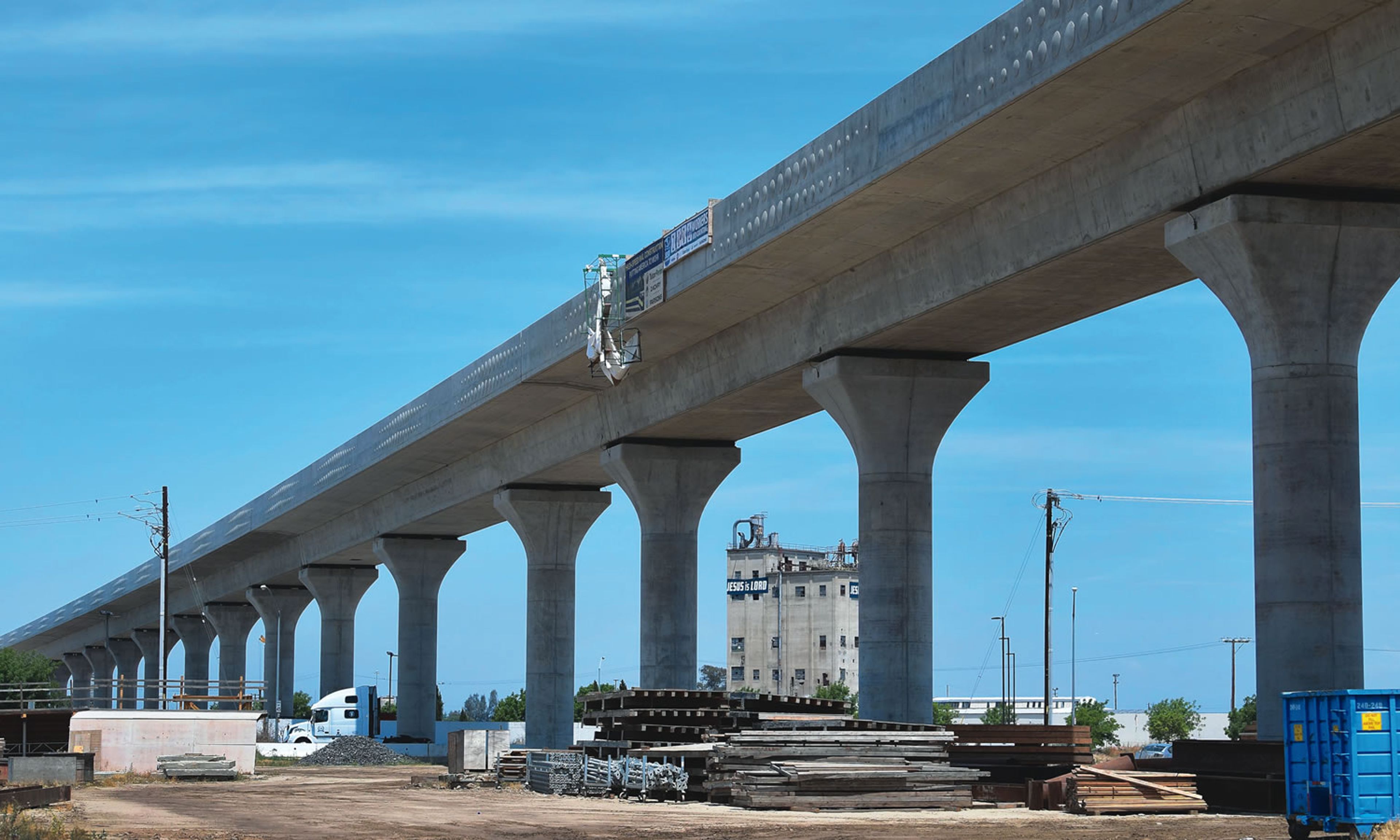
There was a time when California dreamed. These were big dreams that built great things: railroads, dams, roads, universities, a way of life. California invented itself over a century-long stretch of public largesse and private ingenuity that gave this arid frontier, as Mark Twain put it, “a name for getting up astounding enterprises and rushing them through with a magnificent dash and daring and a recklessness of cost or consequences, which she bears unto this day.” But that final clause is no longer true.
This day, it’s more like the California High-Speed Rail Authority’s barely laying any track over a quarter century while costs balloon 200 percent before a single train leaves the station — in a state built by rail and big spending, turned from a frontier outpost into the world’s fifth-largest economy with the laying of the transcontinental railroad in 1869 and going on to become “America’s arsenal” in World War II. By the 1970s, though, something had changed. Gone were hopeful figures such as two-term governor Pat Brown, who proclaimed, “If we don’t build it, they won’t come.” He and his kind were replaced by those like his son, Jerry Brown, himself a governor twice over, who read such books as Small Is Beautiful.
But let’s start from the beginning, back when California built things and was thirsty for water, the sine qua non of civilization. The state’s engineer, William Hammond Hall, devised a plan for immense water projects that would take the two-thirds of California’s rain that falls in the northern third of the state and distribute it to thirstier land through dams, reservoirs, aqueducts, and, above all, irrigation. What resulted was an American Garden of Eden that fed the 20th century.
The Los Angeles Aqueduct alone was, as historian Kevin Starr describes it, “235 miles of canals, conduits, tunnels, flumes, penstocks, tailraces, and siphons,” from the heights of the Sierra Nevada through the Mojave into the valleys of Los Angeles. Its construction, between 1907 and 1913, employed thousands. Water in turn enabled Los Angeles to grow from 100,000 souls at the turn of the century to 1.2 million in just 30 years. In 1923, the O’Shaughnessy Dam plugged up the Hetch Hetchy Valley near Yosemite and directed its waters to thirsty San Franciscans. And all the while the Golden State’s flat, dry Central Valley was becoming America’s farm thanks to its own network of reservoirs and canals. Clean water, of course, also meant clean energy powering metropolitan California.
But there was yet more for California to build, starting with the roads and bridges for an “auto-civilization” in the making. As early as 1924, there were more cars entering Los Angeles on a daily basis than there were registered vehicles in the entire state of New York. Throughout the 1920s, Los Angeles’s grand boulevards — such as Wilshire and Sunset — fanned out across the city’s great plains. By 1938, construction had begun on the Arroyo Seco Parkway to Pasadena, the first modern freeway in America, whose stream of headlights cascading into L.A. by night seemed almost to prophesy the gridlock to come. The prophets of California might also have looked north to the Bay Area and its two great bridges, one stretching across the bay to Oakland on its way to becoming what was then the most expensive public-works project in American history, and the other a symphony of sculpted steel across the Golden Gate Strait.
The Second World War put California’s growth on steroids. The federal government spent more than $600 billion (in today’s dollars) in California alone over the war years to arm the arsenal of democracy. Millions of Americans made their way through California to train in San Diego or sail into battle through the Golden Gate, and when they fought it was in B-17 bombers fashioned in Hawthorne and in landing craft made in Richmond’s shipyards. Many veterans made California their home; in the decade to 1950, the state’s population grew by more than 50 percent, and by nearly as much in the decade after that. California, barely larger than Kansas in 1900, was by 1963 the most populous state in America.
Just when there was talk of beating swords into plowshares and airplanes into appliances, the Korean War broke out. More than 40 percent of all aerospace contracts by the mid 1950s had made their way to Los Angeles County, and suburban communities sprang up around bases and factories. In Lakewood — “Tomorrow’s City Today” — there were enough homes planned for 3,400 Orange County acres to make it the greatest subdivision the world had yet seen, complete with America’s largest retail complex, mall parking for 10,000 cars, and jobs aplenty at a flag-draped Douglas factory. An estimated 900,000 new homes were needed in California after the war; the state built that many homes and more, and they were affordable, too.
A late-1950s-era Californian pulling his new car out of a new garage drove onto new freeway, 150 miles of which were built every year. The state planned in 1959 for a freeway network nearly a third the size of the entire interstate-highway system — and California finished half of it just three years later. These sprawling Californians could send their 3.6 children to their pick of world-class universities, brought together under the state’s visionary 1960 Master Plan. Quality higher education meant a better life for their kids, yes, but also progress with a capital P, much like the kind envisioned in the pledge of private Stanford University to influence “humanity and civilization.”
In the decades after the war, the good life in California could be had for a song. And then, for some reason, the music stopped. If you’re looking for a date for when the California dream died, you could hardly do worse than 1972. That was the year when a ballot initiative birthed the California Coastal Commission to regulate development of the state’s coastline through practices that Justice Antonin Scalia later called an “out-and-out plan of extortion,” answerable to no one. That was also the year a state court ruled that private development was subject to the California Environmental Quality Act (CEQA) and therefore to the litigious whims of any aggrieved party with a few hundred dollars and time to spare. Suddenly, the California dream was being recast in textbooks as a nightmare. Californians took up Brown’s mantra “If we don’t build it, they won’t come.” They succeeded, more or less, at stopping the building but were not so successful at keeping people away, at least until very recently.
In a normal state, when things are going wrong, citizens may look to their legislature for answers, but California turns to the ballot box (as John Fund explains elsewhere in this issue of NR). The result of a century of direct democracy is that the vast majority of California’s spending each year is set on autopilot by referenda. Dressed up in a fiscal straitjacket, the state pushes capital spending down to the local level, where it’s met by a feeding frenzy of interest groups. As it stands, roughly half of all dollars the state currently spends on infrastructure go to debt service rather than to construction costs. All the while, California’s actual water and transportation infrastructure is decaying — or being dismantled and rationed to save a fish while attempts are made to preserve laundromats as historic buildings so that new housing cannot be built.
After becoming a state, California boomed in population every year until 2017, when it suddenly stalled. An era of growth has been replaced by a legacy of growth — a stagnancy of aging institutions and infrastructure from the days when California built things, all of which demand their pound of flesh. California figured out how to build, but never how to maintain. Some say money is the problem, but have you seen the state’s bloated budget? No, it’s more that institutional sclerosis has set in and taken the shine off the Golden State.
California has become obsessed with the distribution of its own civilizational gains — who gets water and how much — which narrow interests compete for at everyone else’s expense. And all of this is made worse by a certain California brand of progressive paralysis in which the democracy of ballot initiatives meets a conservationist’s guilt over the costs of growth. The sum total means that, even as California’s wealth grows, its civilizational capacity shrinks.
Governor Jerry Brown was once heard to say, “Inaction may be the biggest form of action.” It seems the days of Twain are long gone.











Comments