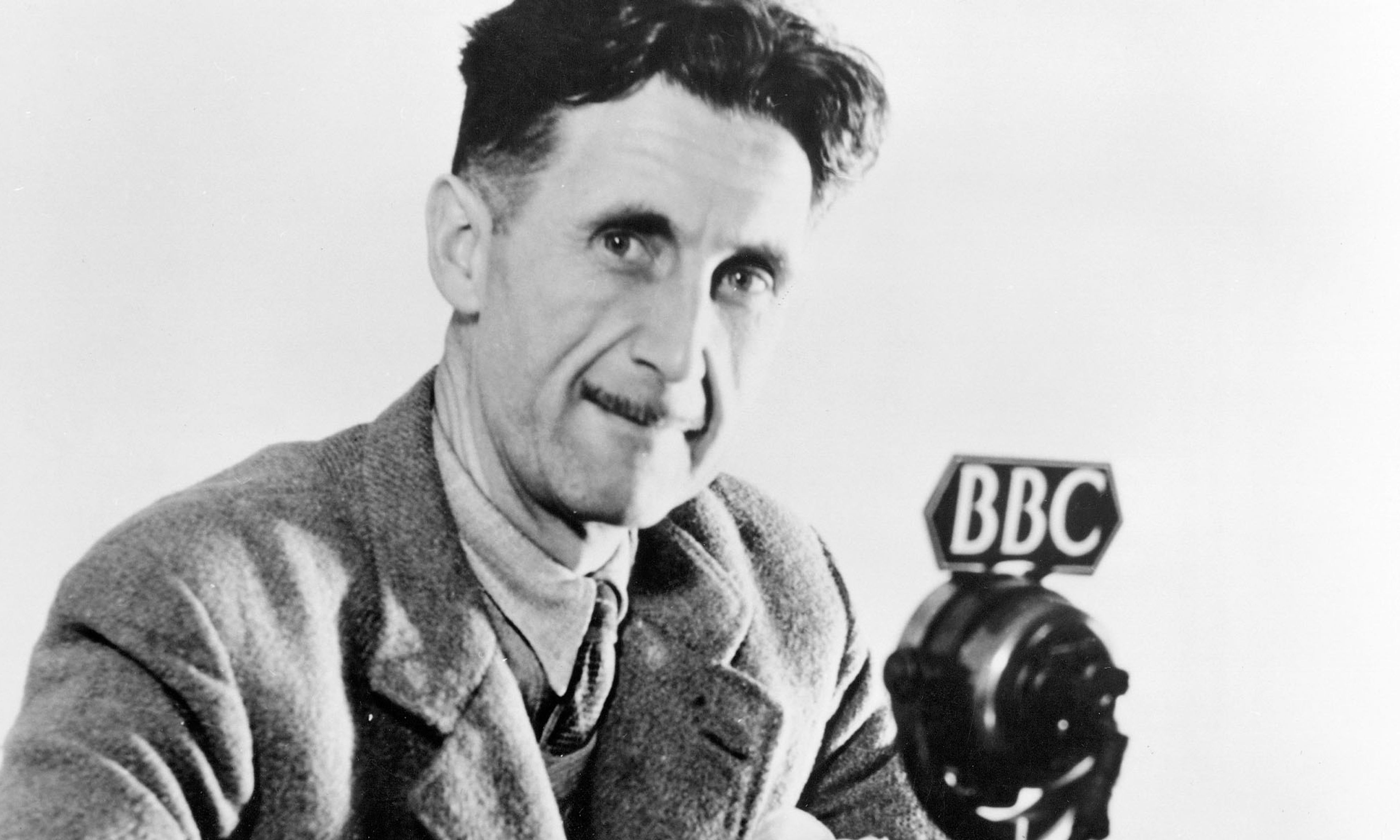
Few writers have left a literary and intellectual legacy as hotly disputed as George Orwell’s. Since his death in 1950, neither the Left nor the Right has ceased to assert its claims to Orwell ‘s sympathy, as Peter Stansky reminds us in his brisk and engaging though not entirely persuasive new book. The Left wants to keep Orwell firmly within a tradition of articulate British socialists while conceding the eloquence and profundity of his critique of Stalinism. Conservatives insist that 1984 and Animal Farm were about not just Stalin and the gulags but also inevitable tendencies of collectivist societies on the left — about, that is, the folly of believing in socialism with a human face.
A veteran Orwell scholar, Stansky provides a sketch of his subject’s formative experiences before, during, and after some of the most seismic convulsions of the past century. He argues that the author of both Homage to Catalonia and 1984 — books that are, respectively, an accolade to and a damnation of the Left — is properly understood as a Cold War socialist who believed that the triumph of the socialism that was good and necessary for England and the world required that the ideology’s more monstrous iterations be vanquished. He makes an admirable attempt to present the real Orwell in all his seeming contradictions, a socialist who loved his capitalist homeland, a decent man who came to see the necessity of war, and a leftist who reviled communist tyranny.
Stansky details early experiences of Eric Blair, as the writer was known before he adopted his pen name. Blair was an intelligent and curious boy from a humble background but lucky enough to enroll on half fees at St. Cyprian’s, a prestigious boarding school in Sussex. For Orwell and others, it was a stepping-stone to Eton, even more venerable. Though Orwell’s family was not as well-off as those of many of his classmates, the administrators respected that his father had been a civil servant in India. Blair in his tenderest years rarely saw his father, Stansky reminds us, and of course saw him even less after going off to live at St. Cyprian’s.
Although Stansky downplays somewhat the snobbery and ostracism to which Blair was subjected in his two years at the school, that harsh experience informs one of Orwell’s most celebrated essays, “Such, Such Were the Joys,” as witty as it is harrowing. Orwell writes that he repeatedly wet the bed at St. Cyprian’s and soon received a warning that further infractions would lead to his whipping by older boys in the sixth form. “By the social standards that prevailed about me, I was no good, and could not be any good,” he observes. “But all the different kinds of virtue seemed to be mysteriously interconnected and to belong to much the same people.” By some strange alchemy, those who were rich also happened to be beautiful, charming, and first-rate athletes, compounding Orwell’s sense of inadequacy and alienation.
Acknowledging Blair’s resentment of life at St. Cyprian’s, Stansky notes as well what the boy appreciated about the school. “In many ways it gave him a good education,” he writes, “with its emphasis on the classics and the necessity to write well if he were to secure a scholarship to a top-ranked public school.” In “Such, Such Were the Joys,” Orwell does share fond memories of waking up early to read his favorites (Thackeray, Kipling, H. G. Wells), of playing cricket, and of taking walks through a lush and unquiet natural world. Orwell appreciated nuance and held mutually antagonistic ideals at the same time: Understanding that is crucial for those sections where Stansky makes his case that Orwell never lost his faith in socialism despite the horrors that Marx’s acolytes let loose on the world.
The Orwell of this book is acutely sensitive to inequality and exploitation. In Stansky’s telling, Orwell’s socialist enthusiasm blossomed during his trip to the north of England, where he observed the lives of working families in a depressed economy and collected material for The Road to Wigan Pier (1936). Even more formative was his visit to Barcelona in December 1936, in the early days of the Spanish Civil War. There, as he related in Homage to Catalonia, Orwell saw the daily life of a town where the workers were in charge. He found it (Stansky’s words) “deeply exhilarating and inspiring”:
He thought it was a socialist paradise. Hats and ties had vanished. Rents had been reduced by half, tipping had been abolished, 70 percent of all industry had been collectivized. It was during his time in Spain that his concept of a possible democratic socialism would take its mature form.
Stansky’s Orwell knows how to walk and chew gum, all right. His patriotism does not quell his budding socialism. Neither, despite socialism’s association with pacifism, does he hesitate to endorse going to war to defeat Hitler once Nazi Germany signs a pact with Soviet Russia in August 1939.
The problem for Stansky is that, while the abolition of markers of class and privilege gave Orwell in Spain a rush of exhilaration, it also stoked his distrust of leftist overlords. Tensions ran high among members of the Unified Socialist Party of Catalonia (which enjoyed communist support), the anarchist National Confederation of Labor, and the Workers’ Party of Marxist Unification, or POUM. No sooner did Orwell join the POUM than he sought to enlist in the International Brigade and the defense of Madrid. Street fighting broke out when socialists tried to seize control of the city’s telephone exchange from anarchists. Should not the two sides have acted in concert instead? Here Orwell saw up close the intolerance of even minor degrees of difference on the left.
“If you want a picture of the future, imagine a boot stamping on a human face — forever.” That this is spoken not by an enemy of Ingsoc but by Winston’s tormentor, O’Brien, the representative of that Marxist variant that dominates the world of 1984, complicates Stansky’s efforts to paint Orwell as a committed socialist up to his death. The totalitarian nightmares that Orwell fleshed out most fully belong largely to two books, Animal Farm and 1984, that were published near the end of his life and are a more reliable expression of his informed thought than is his work from before the Second World War. (A stern critic of his own early writing, Orwell regretted especially his novels A Clergyman’s Daughter and Keep the Aspidistra Flying.)
Stansky’s argument that Orwell remained committed to his vision of socialism to the end would be more persuasive if he set major works on both sides of the scale. Where are the books expressing a continuing faith in socialism? He quotes a letter of Orwell’s from November 1945: “I belong to the Left and must work inside it, much as I hate Russian totalitarianism.” He quotes as well Orwell writing to an American trade union in June 1949: “My recent novel [1984] is not intended as an attack on Socialism or on the British Labour Party (of which I am a supporter), but as a show-up of the perversions to which a centralized economy is liable and which have already been partly realized in Communism and Fascism.”
Here is what Stansky does not quote in The Socialist Patriot. In “Literature and the Left,” an essay published in Tribune on June 4, 1943, Orwell expresses in the baldest terms the difficulty of his continuing to affiliate with a movement so ideologically inflexible and lacking in humanity: “There is no knowing just how much the Socialist movement has lost by alienating the literary intelligentsia. But it has alienated them, partly by confusing tracts with literature, and partly by having no room in it for a humanistic culture. A writer can vote Labour as easily as anyone else, but it is very difficult for him to take part in the Socialist movement as a writer.” Though he indeed acknowledges his habit of voting for the Labour Party, Orwell here unmistakably affirms the difficulty faced by his mature, reflective, creative self in keeping any real faith in the socialist movement in his country.
Stansky argues that Orwell acknowledged highly troubling tendencies within socialism but saw the solution “to be a continual and frequent change of those in power.” So, if you want a vision of the future, imagine a boot stamping on a human face for four years. Then we get a different boot. It all works out.












Comments