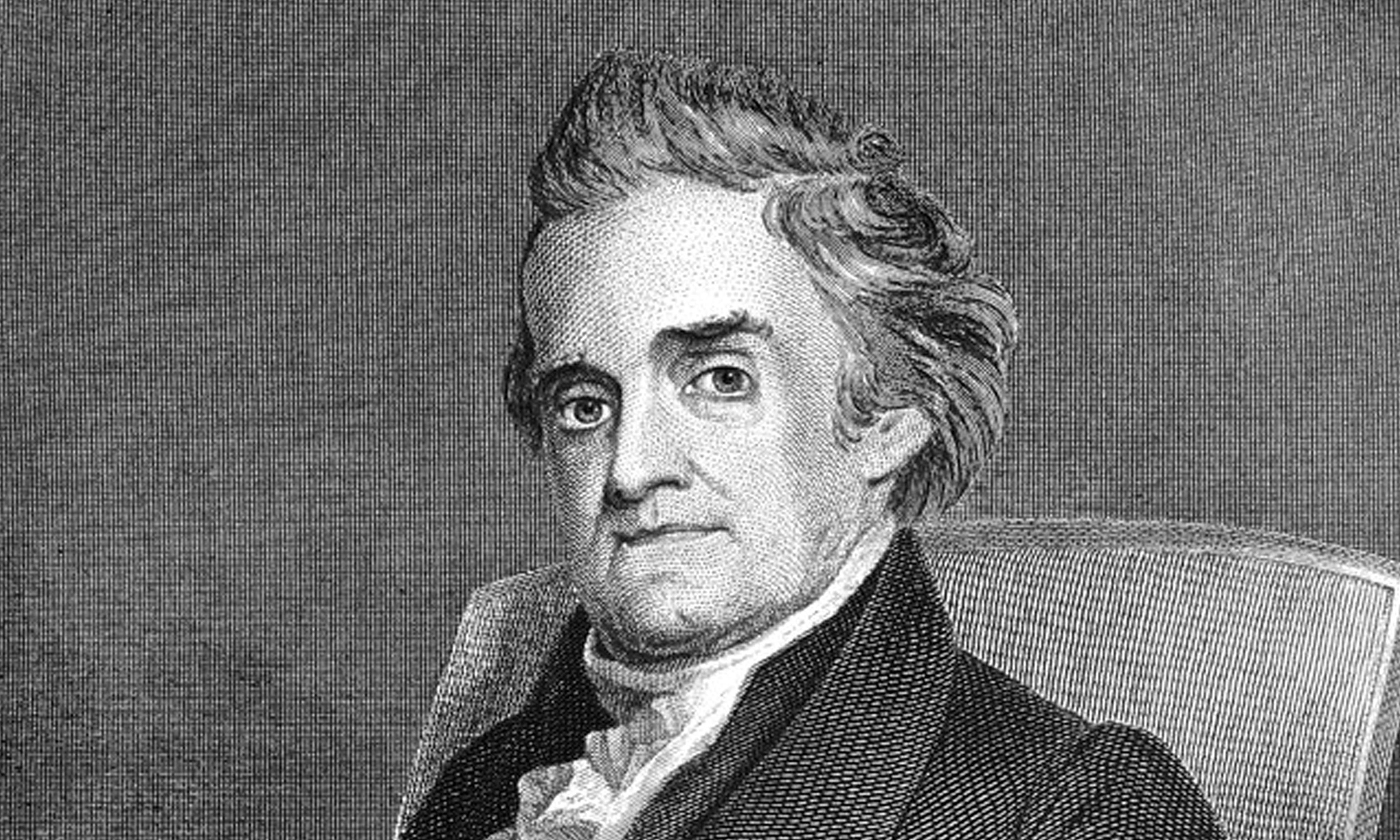
Have you ever known someone who, after being accused of a moral failing, becomes a fervent accuser of others for that very fault? It’s a prominent aspect of Noah Webster’s life and legacy.
Webster is known to posterity as the father of the American dictionary. He began with a 1783 spelling book titled “A Grammatical Institute.” It was an adaptation of a decades-old British best seller called “A New Guide to the English Tongue in Five Parts,” by Thomas Dilworth — who had died three years before. Webster sought to establish a standard for spelling, and his book was extremely conservative: Following Dilworth, he wanted to retain the u in favour, honour, labour, etc. He ridiculed its removal as a “mere fad.”
Shortly after the book came out, an anonymous reviewer called “Dilworth’s Ghost” assailed Webster for plagiarism. He was accused of “transcribing” Dilworth in a “laughable affair,” of writing a book that was “greatly defective” and “very badly copied.” Webster, the Ghost said, lacked “the Modesty of some of the Authors whom [he had] copied and abused.”
Webster defended himself, saying: “The materials of all English grammars are the same. . . . Every writer whose works I have seen is liable to the charge of plagiarism.” That stance didn’t last long.
The contretemps profoundly affected Webster: He became a spelling reformer and a zealous accuser of others who might lift parts of his work. By 1789, he was promoting extremist spelling reforms by proposing to (1) omit all silent letters — hence bilt, frend, giv, hed, relm; (2) replace ea and ie with the double-vowel ee — hence neer, speek, greev, zeel; and (3) establish various odd simplifications — hence karacter, korus, masheen, obleek, and toor. In 1790, he published “An Address to Yung Ladies,” which began: “Altho men in general are exposed to the suspicion of your sex, . . . yet the tenor of the following remarks wil, it iz presumed, bear such marks of sincerity az to giv them a place in your confidence.”
Soon mocked for these radical innovations, Webster swung back toward moderate spellings that we now recognize as American: ardour becomes ardor, judgement becomes judgment, offence becomes offense, theatre becomes theater, and so on. It took decades for Webster to settle on his preferred spellings. All the while, his name appeared simultaneously on many books recommending contradictory spellings. Critics reviled him.
In 1806, Webster issued his Compendious Dictionary of the English Language — an acknowledged adaptation of a best-selling British dictionary by John Entick. He altered spellings and added some peculiarly American words, such as caucus, checkers, chowder, constitutionality, hickory, opossum, skunk, and succotash. But most of the definitions — thousands of them — were drawn verbatim from Entick.
Soon Webster became incensed to discover that an American expatriate living in England, Lindley Murray, had adopted some of his grammatical ideas: “He incorporated a great number of my principles. For one extract of nearly three pages of my grammar, he has given me credit; the other extracts are dispersed in various parts of the work, in such a manner that a comparison of the two works with his former editions is necessary to enable the reader to detect the plagiarisms.” Webster felt deeply aggrieved; Murray wisely declined to engage his accuser.
But the best and worst were yet to come. Webster’s magnum opus was 20 years in the making: the two-volume American Dictionary of the English Language (1828). Still unstable on matters of spelling, he was hypersensitive to anyone who might borrow from his work.
What followed was one of the great literary scandals of the 19th century. Enter Joseph Worcester, the only lexicographer in history to edit three dictionaries covering the same subject matter for three competing publishers in three consecutive years.
First, in 1828, Worcester issued a well-received American abridgment of Johnson’s Dictionary of the English Language. It came out the same year as Webster’s big book. Then Worcester started working on his own long-planned dictionary.
In late 1828, though, Webster’s publisher, Sherman Converse, wrote to Worcester requesting a shortened version of Webster’s Dictionary. Webster himself was too exhausted to do it. Twice Worcester declined requests by letter. Undeterred, Converse traveled with Webster’s son-in-law to Worcester’s home in Cambridge, Mass., offering cash — the equivalent of $50,000 in today’s money — for eight months of work. With the in-person appeal, and the financial blandishments, Worcester relented.
But Webster hadn’t been fully apprised of the circumstances, or of his son-in-law’s assuring Worcester that he could alter Websterian spellings, which he did. You can imagine the result. Oh, but you really can’t: That’s why you’d be well advised to read Peter Martin’s book The Dictionary Wars: The American Fight over the English Language (2019). Worcester’s abridgment of Webster appeared in 1829, and then Worcester’s own dictionary in 1830. Scandal ensued.
Worcester was a tireless scholar and, by all reports, an admirable man who happened to be naïve about conflicts of interest. His succumbing to the entreaties to abridge Webster’s Dictionary dogged him for the rest of his life. He endured torrential allegations of literary theft — not just from Webster but also, after Webster’s death, from Webster’s publishers. Many knowledgeable critics thought Worcester innocent of the charges — and the better lexicographer.
Although Worcester wasn’t a plagiarist, he might as well have had a scarlet P emblazoned on his chest. Which brings to mind a funny coincidence: One of Worcester’s closest pupils, who defended his reputation in later years, was Nathaniel Hawthorne.
As far as we know, Worcester never accused others of plagiarizing his work. The worst offenders happened to be the Merriam brothers, who had acquired the rights to Webster dictionaries. Peter Martin tells how, once Worcester had completed his own big dictionary in 1860, “the Merriams . . . and their editors could take full advantage of what Worcester had wrought by using his edition as a benchmark and source.” By doing that, together with relentless marketing, they secured Webster’s legacy.
Nasty business, lexicography.











Comments