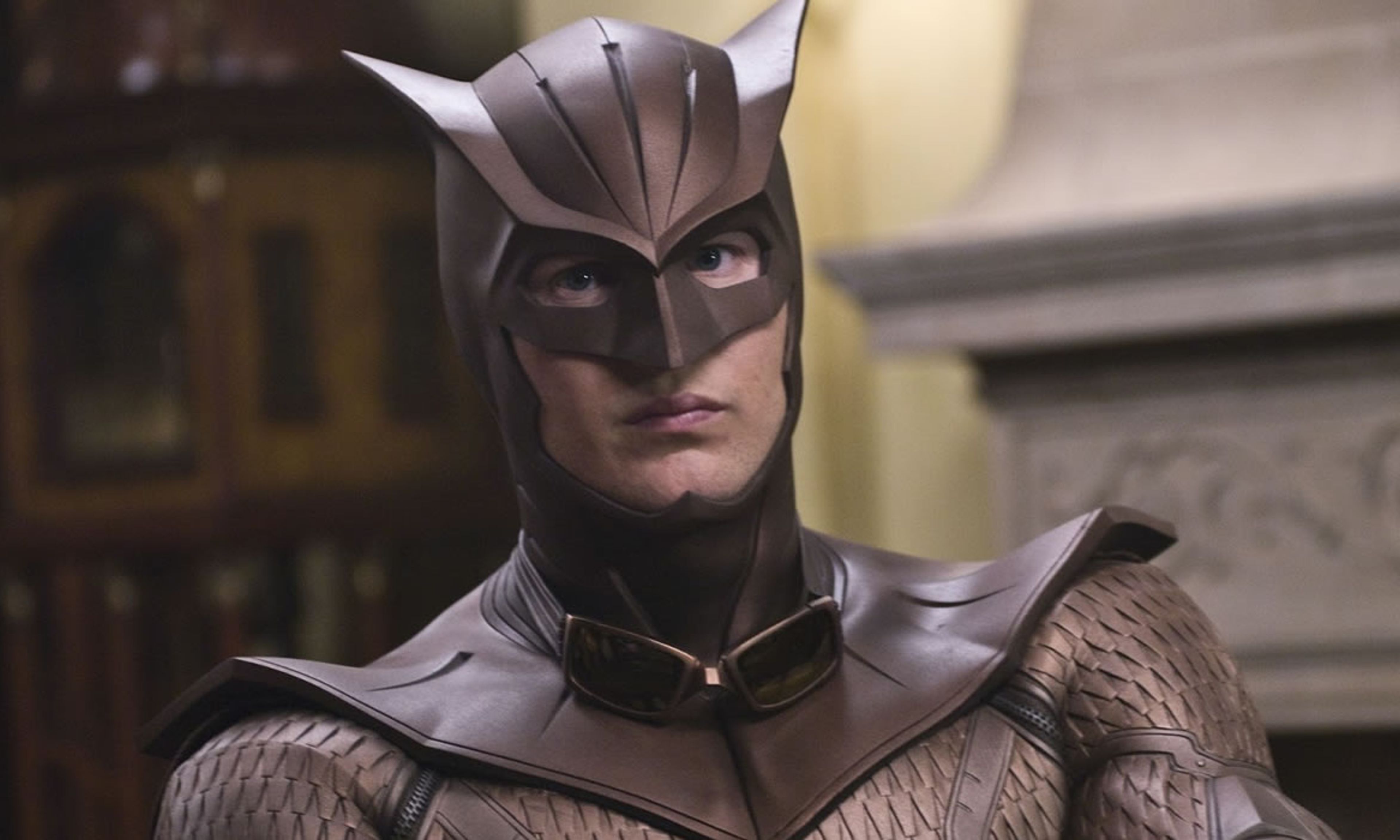
I’m not sure whether to be glad or sorry that I buckled down and read Alan Moore and Dave Gibbons’s Watchmen, the mid-1980s graphic novel that looms over the genre like the Colossus over Rhodes, before I saw the movie. I’m glad because I went in with some sense of the baggage that the comic book’s committed fans carried into Zack Snyder’s big-screen version — and that Snyder himself doubtless carried into the work of adaptation. I’m also glad because having read the book guaranteed that I would understand roughly what the heck was going on. But I’m sorry because it robbed me of the chance to experience the film the way most of its audience will experience it: not as the much-anticipated adaptation of a beloved work of art, but as a would-be blockbuster aimed at the same kind of pop-cultural sweet spot as E.T., or Indiana Jones, or last summer’s Dark Knight.
My suspicion is that if you walked in with those expectations, you’d walk out mystified by what you’d just spent two hours and forty minutes sitting through. Most successful blockbusters trade on a single big “what if?” What if an alien landed in your backyard? What if the Nazis were after the Ark of the Covenant? What if a man dressed up as a bat to fight crime? Try to write the same one-liner for Watchmen, though, and you end up with something like this: What if the year were 1985, but in an alternative timeline that diverged from ours in the 1940s, when people starting dressing up in costumes to fight crime — and what if a fluke nuclear accident in the alternative-timeline 1959 created a genuine superman who contributed to an American victory in Vietnam, which in turn led to Richard Nixon’s being reelected four times and a constantly escalating arms race — and what if by the time the Eighties rolled around New York were filled with semi-retired superheroes, all of them either depressed, impotent, megalomaniacal, or some combination thereof?
That’s the load of bricks that Snyder’s film drops on the unsuspecting moviegoer. Watchmen is set in an alternative version of an era that’s 25 years gone, featuring superheroes you’ve never heard of (Ozymandias? Rorschach? The Nite Owl?) indulging in various kinds of R-rated conduct, with occasional cutaways to scenes of escalating nuclear brinkmanship between the U.S. and Soviet Russia and a finale that turns every superhero-movie convention on its head. “Welcome to a world without rules,” The Dark Knight’s tagline ran, but that film never really broke the mold. Underneath Heath Ledger’s Nietzschean sermonizing was a fairly conventional superhero plot, larded with a little more suffering than usual but still following the basic comic-book rules. Watchmen, on the other hand, really does upend your expectations of what a superhero movie should be — with Tarantino-esque violence, full frontal nudity, and the kind of horrific mass murder that a more conventional comic-book story often threatens but never, ever actually delivers.
Rule-breaking is to be encouraged where comic-book conventions are concerned, especially in an era that’s glutted with superhero flicks. But that doesn’t mean the results are automatically pretty. There are things to admire about Watchmen: The bravura opening-credits sequence, which fills the audience in on 40 years of alternative history with a swift parade of arresting images and scenes; game performances from Patrick Wilson (the gone-to-seed Nite Owl, a Batman-lite with a potbelly) and Billy Crudup (the mournful, blue-skinned, semi-omnipotent Dr. Manhattan), and a great one from Jackie Earle Haley as the vengeful vigilante Rorschach; and a screenplay that partakes of the same ambitious fidelity to difficult source material that made Peter Jackson’s Lord of the Rings trilogy such a success.
But these strengths aren’t enough to save the movie from being an interesting misfire. Some of the casting decisions hurt — particularly Malin Akerman’s unfortunate turn as Silk Spectre II, which invests the film’s only major female character with all the verve and depth of a bored extra on Gossip Girl. But the director’s abiding hackishness hurts even more. Snyder’s Spartan epic 300, whose massive box-office numbers won him the chance to take on Watchmen, was the kind of movie best viewed drunk with your college buddies at 2:00 a.m. He’s improved on that effort, but his sensibility is still essentially adolescent — straining to be grown-up, but not quite getting there. He ratchets up the carnage in a story that was bloody enough on the page, overaestheticizing every gouge and punch and blood-splatter. And the rest of his flourishes tend to be either risible (an extended airborne sex scene set to Leonard Cohen’s “Hallelujah”) or thuddingly obvious — “Ride of the Valkyries” playing over a Vietnam scene, Nixon and Kissinger plotting in the war-room set from Dr. Strangelove, and so forth.
The deepest problem, though, is the datedness of the source material. Like many Reagan-era dystopias, from Margaret Atwood’s The Handmaid’s Tale to Alan Moore’s own V for Vendetta, Watchmen the comic book drew a lot of its dramatic oomph from anxieties and paranoias that look somewhat less frightening in hindsight. (As it turns out, a Republican-led America wasn’t on an irreversible course toward nuclear war.) Judging by Hollywood’s War on Terror cinema to date, it’s almost certainly a good thing that Snyder kept the 1980s setting, rather than trying to update the story for the post-9/11 age. But there’s still an air of mothballs about the whole production — like a rigorously faithful Civil War reenactment, or a meticulous waxworks exhibition. If you aren’t already passionately invested in the material, Watchmen feels impressive without being immersive: It sometimes inspires admiration, but never inspires love.












Comments