In Afghanistan, President Obama has pledged to “wage the war that has to be won.” To accomplish that, the administration will unveil a new strategy in April. Recently the doughty Sen. Joseph Lieberman published an op-ed in the Wall Street Journal, proposing one such strategy. What is needed, Lieberman opined, is for someone to take charge, for additional troops to be sent into action, and for the U.S. Congress to sustain a nation-building strategy. This is all good advice, but implementing it will be exceedingly tricky.
First of all, it is not clear who will be in charge. Obama has appointed Richard Holbrooke, who played a key role in halting the war in the Balkans in the mid-1990s, as the presidential special representative for Afghanistan and Pakistan. Holbrooke, nicknamed “The Bulldozer,” said his mandate was “to help coordinate a clearly chaotic foreign assistance program.” He promised to achieve progress by expunging chaos: “If our resources are mobilized and coordinated and pulled together, we can quadruple, quintuple, multiply by tenfold the effectiveness of our efforts there.”
A recent report to Congress criticized a “lack of coherence” in disbursing $32 billion in U.S. and $25 billion in NATO European reconstruction funds. Here’s just one example of this incoherence: We know the Afghans will have to protect themselves eventually, yet training, equipping, and paying the Afghan army has accounted for less than 10 percent of U.S. expenditures in Afghanistan. Although there are 74,000 U.S. and NATO European troops in country, we are short 2,000 trainers for the Afghan security forces. That reflects badly on past management priorities. Indeed, General Petraeus is arguing for a doubling of the size of the Afghan army.
Perhaps Holbrooke will emerge as a deus ex machina to set things straight. But right now he is one of eight strong-willed senior officials who include Afghanistan in their portfolios. General Petraeus, who turned around a losing situation in Iraq, is putting together a strategy for both Pakistan and Afghanistan. Gen. David McKiernan, who commands the troops in Afghanistan, also has a strategy; he reports both to Petraeus and to Gen. Bantz Craddock, the NATO commander in Brussels. Craddock has his own ideas, including a clampdown on drug trafficking, which several European countries oppose. Karl Eikenberry, who will be the new ambassador to Afghanistan, was the military commander there in 2006–2007 as an Army general; he views the feeble and corrupt Kabul government as the key problem. Vice President Joseph Biden, who visits Afghanistan frequently, holds similar views about Kabul. The chairman of the Joint Chiefs of Staff, Adm. Michael Mullen, meets monthly with the Pakistani chief of staff to urge action along the Afghan frontier. Retired Marine general Jim Jones, now Obama’s national security adviser, served as NATO commander and has views on Afghanistan similar to those of Petraeus.
The record of presidential envoys like Holbrooke in theaters of war is spotty. After Amb. L. Paul Bremer was appointed presidential envoy to Iraq in 2003, he reported directly to President Bush, offering judgments on military operations. This created turmoil and resentment inside a U.S. military that believed unity of command had been violated. After Bremer departed the scene, Gen. George Casey and Amb. John Negroponte co-authored a strategic campaign plan specifying their respective responsibilities in Iraq. Amb. Ryan Crocker and General Petraeus continued that tradition. If that model is followed, the Afghan campaign plan will be authored by Ambassador Eikenberry and General McKiernan, with Holbrooke’s dual-country diplomacy covered in an appendix. Under that framework, though, Holbrooke would not play the role of über-coordinator. Moreover, Afghanistan is a NATO project, so any strategy for it must emanate from NATO, and not be presented as solely an American reassessment.
As national security adviser, Jones must pull together these diverse strands. And either he or the chairman of the Joint Chiefs must assume the role of independent risk assessor, alerting the president when things are not going well. When Iraq deteriorated in 2006, it was the national security adviser, Stephen Hadley, who assessed the risk and developed the surge strategy while the Pentagon dawdled. Jones is likely to be thrust into a similar position as the risk assessor for Afghanistan, offering judgments to the president if friction arises between the military commanders and the president’s envoy.
As lines of authority and responsibility are being clarified, another very important issue concerns the Afghan strategy itself. On this matter there are two broad choices: intense nation-building, or nation-building lite. Senator Lieberman favors the former, calling for “a nationwide, civil-military campaign plan,” which would include sending more American civilians into the field to jump-start government services, plus stiff anti-corruption and anti-drug-trafficking measures. On the other hand, Secretary of Defense Robert Gates has advocated what sounds like nation-building lite: “If we set ourselves the objective of creating some sort of Central Asian Valhalla over there, we will lose.” The basic objective, according to Gates, is to keep Afghanistan from becoming a haven and a launching pad for extremists. That is considerably less ambitious than nation-building. To achieve that minimalist goal will require three tasks: (1) provide security in the rural areas, (2) link that security system to the government in Kabul, and (3) prevent disruptive raids from Pakistan.
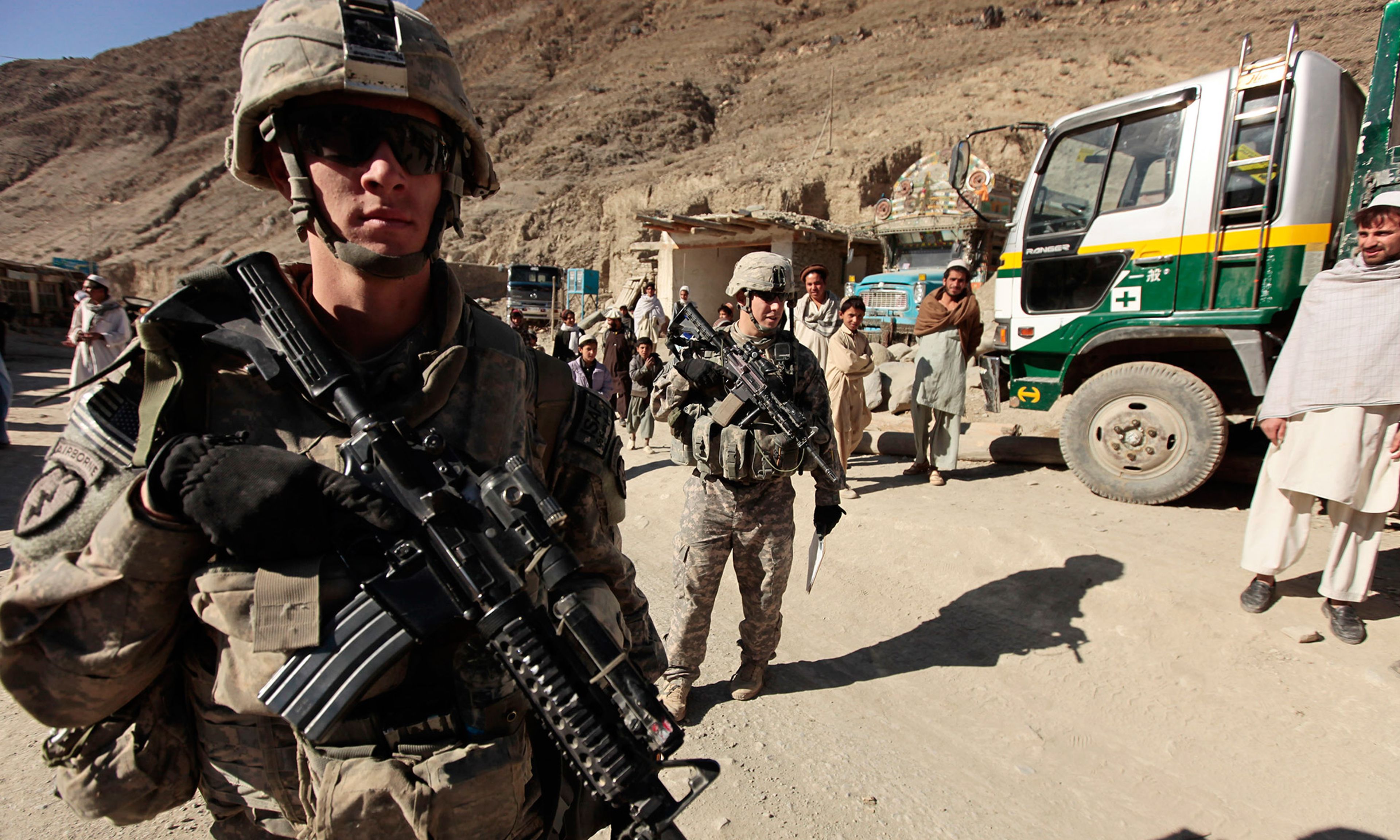
The first task — providing local security — depends on the morale of the fighters on both sides. War is about killing until the other side quits. The preferred American way of war is to fix and destroy the opposing army, but that doesn’t work with insurgencies. Instead, the population must be protected from, and persuaded to inform against, the insurgents. To accomplish that, the American soldier must lead the Afghan soldier by example and seek out the Taliban, who are more than willing to fight.
Due to the distances between units, our forces cannot do that right now. Instead they are only reacting to Taliban attacks. To seize the initiative and provide local security will require aggressive patrolling, pursuit, and raids when the opportunity arises. The Taliban must learn to fear NATO, Afghan, and American soldiers. So by summer, U.S. forces must initiate heavy fighting to push back the Taliban, then turn over to reliable Afghan forces the areas that have been cleared.
Gates is reluctant to send more than 60,000 U.S. troops into Afghanistan; he has said he wants to put an “Afghan face” on the war. That has been done successfully before. Special Forces and combined-action platoons in Vietnam employed squad-sized units to train village militias, backed up by regular units of the South Vietnamese army. These militias were successful in the limited role of protecting their home villages; the war was lost for larger-scale strategic reasons. Similarly, in Iraq, U.S. soldiers partnered with hundreds of local neighborhood watches to expunge al-Qaeda.
Currently there are more than a hundred American platoons partnered with Afghan units in rural outposts near the Pakistan border. That program will be expanded. Simultaneously, Special Forces teams are training village-level militias to protect their homes and a main highway leading to Kabul. Once these techniques are developed, they will be applied in other villages.
In Iraq, the Sunni tribes started coming over to the American side in late 2006. That change in attitude, called the Awakening, provided the bedrock upon which Petraeus based his winning strategy. Shortly before al-Qaeda killed him, I asked Sheik Abu Risha Sattar, who led the Awakening, why the tribes hadn’t awakened earlier and saved bloodshed on both sides. “You Americans couldn’t convince us,” he replied. “We Sunnis had to convince ourselves.”
Sattar’s words should serve as a warning about the difficulty of predicting when and why the tide of an insurgent battle will begin to ebb. We don’t know what dynamic, if any, will cause the Pashtun sub-tribes on the Afghan side of the border to band together decisively against the Taliban gangs of Pashtuns attacking from Pakistan. We do know that the example set by staunch American soldiers can make a huge difference. Americans will provide a temporary glue, but eventually the Afghans must bind together through their own tribal dynamics.
The second task is creating a responsive central government that deserves the support of the population. While most Afghans detest the Taliban, they don’t think much of Pres. Hamid Karzai’s government either. It has degraded its legitimacy through corruption, selfishness, and inaction. At least the Taliban has an ideology and a ruthless, fervid religiosity intensified by jihad against the foreigner. Kabul has offered no credible counter-ideology. Afghans will be much more likely to oppose the Taliban if the government presents an alternative they can believe in.
President Obama, signaling his displeasure, has held Karzai at arm’s length. Karzai has countered with the populist card, complaining to the press about civilian casualties caused by NATO air strikes. He also threatened to move the upcoming presidential election forward to May instead of holding it in August (when opposing candidates will be better organized), until local and international pressure made him back down. It will take all the skills of Holbrooke, Eikenberry, and McKiernan to keep the government in Kabul focused on delivering services to vulnerable rural areas instead of manipulating every lever of power to ensure its reelection.
The case of Iraq showed that the U.S. government can exert leverage on a shaky government by using tenacity and moral suasion. There, American officers and diplomats took up residence in the key ministries, both mentoring and intervening when catastrophe loomed. The dodgy prime minister, Nouri Maliki, was cajoled and boxed in by the admirable Amb. Ryan Crocker and the U.S. military. On numerous occasions I watched as a captain, a colonel, or a general, simmering with anger over obvious incompetence or corruption, forced an Iraqi official to do the right thing. Over 10,000 U.S. officers and NCOs were attached to the Iraqi government at every level, from the neighborhood to the prime minister’s office — a ratio of about 20 or 30 U.S. military officers for each U.S. civilian.
The Pentagon does not want to duplicate that model in Afghanistan, so it will expect the State Department to beef up its own ranks and take the lead in putting Afghan civil servants on the right path. There’s a problem, though: The World Bank, the U.S. Agency for International Development, and diplomats have traditionally accepted corruption in a host nation as part of doing business. This culture will have to change. In particular, the Kabul government can be turned around only if its ties to drug money are cut. Eikenberry, taking over as ambassador, understands this problem. He and Holbrooke must persuade the State Department to take up a mission of hectoring officials on a massive scale. Our objective is to prevent the reemergence of extremist dominance, and whether this can be achieved with a weak central government is questionable.
The third task will be the hardest of all: depriving al-Qaeda of its sanctuary in Pakistan. Peeling away Taliban hangers-on within Afghanistan is a sound tactic, but it’s not a recipe for success inside Pakistan’s western frontier, where Pashtun tribes are increasingly controlled by extremists. In recent decades, Pakistan’s elite in Islamabad believed their country’s Inter-Services Intelligence (ISI) agency could manipulate Pashtun fundamentalists, collectively called the Taliban, to make sure Afghanistan did not align with India. Beginning in the late 1970s, CIA contacts with the mujahideen were controlled by the ISI. Three decades later, U.S. officials don’t know whether the controlling interests inside Pakistan have swung against the extremists or are playing both sides.
After the Marriott Hotel in Islamabad was bombed last September, the Pentagon believed the incident had turned Pakistan’s army against the extremists. Yet in mid-February the government ceded the district of Swat to the Taliban, which had fought the army to a standstill. Inside the army, officers are wary of one another’s loyalties. It will take at least a decade for the Pakistani army — which now lacks motivation, tactics, and equipment — to establish control along the frontier. Before that happens, the ISI could fracture the radical movements by using treachery, assassinations, and bribery — especially if U.S. Special Operations forces covertly assist them. The Obama strategy for dismembering Pakistan’s terrorist sanctuaries must be multifaceted and covert, including more U.S. airborne and ground attacks against high-value targets.
Today, trends in the border region are unfavorable, because neither the government of Afghanistan nor that of Pakistan has a compelling message or a track record that attracts widespread loyalty. Despite all their faults, we must aid both governments, not least because we did not finish the fight while the world still trembled before our wrath. When thousands of Americans were killed at Pearl Harbor, our nation went to war. Had the Japanese claimed we could not pursue them, say, across the International Date Line, we would have laughed. Yet after bin Laden killed thousands in 2001, our generals, politicians, and president stopped at the arbitrary Durand Line (the official border between Afghanistan and Pakistan, drawn by a British colonial official in 1893) and thus granted a sanctuary to al-Qaeda when it was at its weakest. When attacked at home, we responded as a kinder, gentler nation — and were less feared for our response.
On the positive side, the Taliban and al-Qaeda lack a coordinated strategy inside Afghanistan. They have no oil-spot tactic of creeping toward the capital city, village by village, as did the Viet Cong in the early 1960s. Their advantages are hardiness, a sanctuary, and a ferocious ideology; their weakness is threadbare logistics, which supports only episodic attacks and engenders resentment from villagers forced to provide food and shelter. Their depredations have so alienated the tribes that American advisers find plenty of volunteers for the local militias they train; the problem is distrust that NATO forces will really remain. The U.S. Army also gives the Afghan army the necessary lift and firepower support to respond to large-scale insurgent assaults. In exchange for paying and equipping the army and police, though, the U.S. must insist upon shared control over promotions and leadership. Getting there will be rough, but given time and resources, our military can be relied upon to control the battlefield and gradually turn over the fight to Afghan forces.
Still, building up Afghanistan’s army and militia amounts to playing defense and containing the threat, which is not war-winning. To win the war, al-Qaeda must be crushed inside Pakistan. Mullen has achieved a quiet cooperation between U.S. units and Pakistani border outposts, aimed at sharing intelligence, but the U.S. and Pakistan still have reason to distrust each other. Congress has switched aid to Pakistan on and off, while the executive branch has alternately embraced and rebuffed Pakistan’s leaders, whose motivations and loyalties are opaque and mercurial.
Obama has said that “the heart of the new Afghanistan policy is going to be a smarter Pakistan policy.” Inside Pakistan, the political struggle pits some government officials against others who secretly favor the fundamentalists; how we can be “smarter” about this remains to be seen. Both Afghanistan and Pakistan have an incentive to project a perception of unrest in order to ensure the steady infusion of U.S. money, so whatever the answer, being smarter is certain to cost us hundreds of millions of dollars.
In sum, satisfactory outcomes in Afghanistan and Pakistan will require generational patience in the face of difficult and changing conditions. The basic question is whether the political will exists in America to sustain a low-level war for the next decade and to remain implacable in destroying al-Qaeda.
Sen. John Kerry, chairman of the Senate Foreign Relations Committee, recently wrote that “a comprehensive strategy, sufficient resources and bipartisan resolve will lead to success in Afghanistan.” These were brave words, considering that Kerry and his fellow Democrats have refused to supply sufficient resources for defense. Obama has proposed a budget that reduced spending for Iraq and Afghanistan from $140 billion in fiscal 2009 to $50 billion in fiscal 2011. That won’t be possible if there’s serious fighting in Afghanistan. In addition, Obama intends to hold total military spending constant through 2016. That will reduce defense from 4 to 3 percent of GDP. As personnel costs have increased over the past five years, procurement funding has decreased. With less-modern equipment to fight the next war, the net capability of our forces will fall and casualties will increase. The services are understandably concerned.
Obama has reason to tread carefully. Pres. Jimmy Carter also had high goals, but the gap between his performance and his rhetoric inculcated an attitude of cynicism throughout the ranks of the military. To win in Afghanistan, Obama must lobby his party to support the war effort, year after year, and to supply the necessary resources. Instead, by promising that he will win while reducing funding, he’s made a daunting task sound impossibly easy.
Another reason President Obama is off to an inauspicious start is that he doesn’t understand the nature of warriors. He recently flew to North Carolina to address the Marines he is sending to Afghanistan. His subject was withdrawing from Iraq, and his remarks and tone might have been appropriate for, say, the Council on Foreign Relations. He told the troops they “got the job done” by removing Saddam Hussein and establishing a sovereign government. He then dwelled on the theme of loss. He said the Marines had “endured tour after tour,” “bled for your best friends,” and “borne an enormous burden.” He used the word “sacrifice” repeatedly, portraying the warriors as victims rather than as the strongest tribe. He concluded by saying, “Thanks to the sacrifices of those who have served, we have forged hard-earned progress.”
Progress? Our troops won in Iraq, al-Qaeda lost, and a democratic government emerged. That merits more than a nod toward “progress.” The Marines respectfully listening were primed for the fight; they intend to kill Taliban, not to be killed. Warriors want to be praised for winning, not consoled for being battered. Asked after the speech what he expected the troops to accomplish, Obama replied that our goals were not clear and that a strategy was being devised: “We’ve seen a sense of drift in the mission in Afghanistan . . . what kinds of strategies and tactics we need to put in place. I don’t think we’ve thought it through.”
On the NewsHour in late February, Jim Lehrer asked President Obama to define victory in Afghanistan. Obama replied: “The achievable goal is to make sure it’s not a safe haven for terrorists, to make sure that the Afghan people are able to determine their own fate . . . My goal is to get U.S. troops home as quickly as possible without leaving a situation that allows for potential attacks against the United States.”
Provided Pakistan doesn’t collapse, containing the insurgency inside Afghanistan seems achievable. We know, based on Iraq, that the counterinsurgency strategy works. We know that the surge of American forces will push the Taliban back. We know Afghan forces will be trained and expanded. We don’t know, however, if our society will remain united in support of the war year after year, or if Congress will provide the funding. Much depends our commander-in-chief.
For the time being, Obama’s leadership in foreign policy will revolve around Afghanistan — what he has called “the war that has to be won.” Troops have been dispatched and a minimalist budget has been proposed. Obama has promised to unveil his strategy at the NATO meeting in April. What does Obama think “winning” means in this context? The ghost of Vince Lombardi will be listening with interest, as will 90,000 U.S. and NATO European soldiers.












Comments