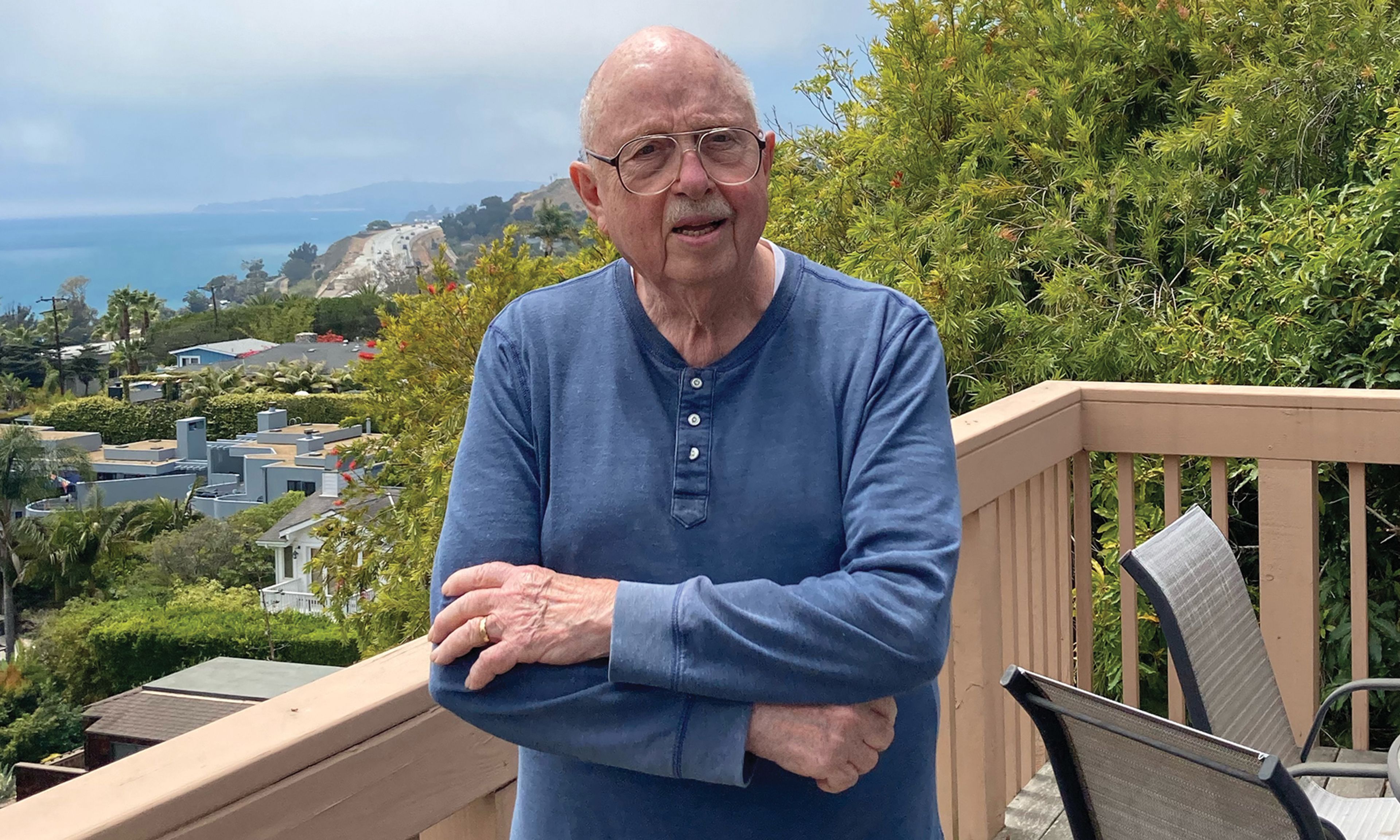
As a rule, Lou Cannon is the interviewer, not the interviewee. He’s one of the premier political journalists in America. But he has sat for his share of interviews, as he is now. “As long as you don’t defame my wife or my children, I’m happy.”
Cannon has been reporting for more than 70 years — since high school. He is best known as a Reagan biographer. “Reagan’s Boswell” is a moniker long attached to him. He also wrote a splendid book on Los Angeles and the 1992 riots. Back in 1977, he wrote a book called “Reporting: An Inside View.” A good 20 years ago, I asked him some basic questions: “What’s ‘on background,’ exactly? How about ‘off the record’?” He emailed me some excerpts from his 1977 book.
“Full disclosure,” as people say today: We are old friends.
I have come to see him at his home in Summerland, Calif., just south of Santa Barbara. He and his wife, Mary, are on a hilltop, overlooking the Pacific. You can hear the trains blow their whistle down below. On the patio, the Cannons’ wind chimes do their thing.
Summerland started out as a Spiritualist colony, Lou tells me. That’s why the lots are small: You pitched a tent on them. Summerland is also an oil town. In 1969, there was a huge spill, offshore, which led to the first Earth Day (April 22, 1970).
The spill was one of the causes, Lou cautions. “Things tend to be more complicated when you look into them.”
He came to this area when he was a roving California reporter. He came here quite a bit when he was covering Reagan’s presidency — the Reagan ranch is not far away, in the Santa Ynez Mountains.
From 2005 until the end of last year, Cannon wrote a column for State Net Capitol Journal, based in Sacramento. He retired from the column in order to work full tilt on his memoirs. I have had a sneak preview of those memoirs. They are superb: both memoiristic, in a traditional sense, and reportorial. Cannon can’t stop being a reporter. He even fact-checks his mother’s age! (His brother, Bob, discovered that she had lopped six years off it, unbeknownst to her husband and the rest of the family.)
Lou Cannon’s own birthday is not in doubt: June 3, 1933. He was born in New York City. His mother was an easterner, his father a westerner. The family moved to Nevada when Lou was about three.
The Cannons lived in Reno, and, for three years during the war, Fallon, about 60 miles to the east. (After Lou tells me this, he says, “When you’re my age and you say ‘the war,’ you mean World War II.”) The senior Cannons ran a thrift shop. And managed an auto-court motel. And did other things. “The term ‘latchkey kid’ did not exist when I was a child,” says Lou, “but that’s what I was. I never particularly minded that. I’ve always been able to find something to do.”
Lou’s dad, Jack, was Irish Catholic. Lou’s mother, Irene, came from a Hungarian Jewish family. She was very smart (and denied a college education, sadly). She wanted Lou to become a lawyer. As Cannon explains, “lawyer” was a byword for an educated, professional man, back then.
Jack Cannon was a “roustabout,” as Lou puts it, and a “nomadic character.” He worked all over the West, and beyond. He could build anything with his hands, Lou says. He was also “the most colorblind white person I ever knew.” One day, Jack picked up a black hitchhiker in Arkansas. A cop pulled them over, and Jack spent the night in jail. What happened to the hitchhiker, Lou doesn’t know.
Jack had an affliction, namely alcoholism. “That was very difficult for me,” Lou says, with understatement. “He was fine when he wasn’t drinking, and when he was drinking, he wasn’t fine.”
Now and then, after an interview, Ronald Reagan and Lou Cannon would have a personal conversation. Often, these touched on their mothers. One time, however, when he was president, Reagan asked Cannon about his father. Cannon explained that his father was an Irish American named “Jack” who moved around a lot and suffered from alcoholism. Reagan commented, “Maybe that’s why you’re interested in me.” (All of those things were true of Reagan’s father, too.)
In Reno, the Cannons had a friend who was Finnish. In November 1939, the Soviet Union invaded Finland. Lou was six. And owing to the family friend, he was very interested in the war, which would be known as the “Winter War.” He is reminded of that war by today’s war. “I follow the twists and turns of the invasion of Ukraine obsessively,” he says. “Normal people are going to work, and then their houses are destroyed or their children are killed. That gets you pretty damn concerned, if you’re a small-d democrat.”
He adds, “I think it’s quite clear that Putin won’t stop in Ukraine.” Putin himself will tell you as much. He has not been shy about his ambitions, as Cannon notes. Cannon further says that dictators have often spelled out their intentions, unmistakably — “and we in free countries seem to have an unlimited capacity for disbelieving what they say.”
In 1949, when he was 16, Lou was one of two Nevadans who went to Washington, D.C., for Boys Nation. Afterward, he traveled to New York, ostensibly to see some of his mother’s relatives — but mainly to see Joe DiMaggio and Jackie Robinson. He saw them both, at Yankee Stadium and Ebbets Field.
Before he was a political reporter, he was a sports reporter — covering football, stock-car racing, and other pastimes for the Nevada State Journal, when he was a high schooler. He graduated in 1950. He attended the University of Nevada and San Francisco State College — but then was drafted. He spent two years in the Army, at Fort Ord (California). When he got out, he had two kids (out of an eventual four). Rather than go back to college, he went to work. And newspaper ink was in his blood.
He worked for little California papers, and then bigger ones. Eventually, he landed at the San Jose Mercury. He would make his biggest mark at the Washington Post.
In 1964, he was at the Mercury, and the GOP presidential contest was hot. Exciting. Goldwater versus Rockefeller. Naturally, Cannon wanted to cover the convention in San Francisco. But the Mercury was not able to send him. So he used his vacation time to go cover the convention for another paper — the Pine Bluff Commercial, in Arkansas.
When Rocky gave his speech, the Goldwater delegates were booing him, roundly, but there was one man near the Arkansas delegation who was cheering Rocky on. It was a familiar figure, to Lou Cannon and most every other American: Jackie Robinson.
The next year, another familiar figure, Ronald Reagan, experimented with running for governor of California. The election would be in 1966. But, in ’65, Reagan was doing “out-of-town tryouts,” as the veteran actor would say. Cannon covered him then and never stopped.
Reagan had “a phenomenal rote memory,” as Cannon says, and had a large repertoire of stories and answers. Reagan interviews could be uninteresting — actually, “great bores,” Cannon says — if you knew the repertoire. But Cannon was able to get his subject to go beyond the repertoire.
With Nancy Reagan, Cannon’s relationship was tense in the early years, warm in the later ones. In 1968, Cannon reported something not widely known: Mrs. Reagan’s father, Loyal Davis, was her adoptive father, not her biological one. Born Anne Frances Robbins, the future first lady had a complicated upbringing. Dr. Davis adopted her at some point in her teens. Mrs. Reagan was furious — furious — at Cannon for reporting this fact.
The reporter is sympathetic. Mrs. Reagan “showed a fierce devotion” to Dr. Davis, Cannon says, “who was her father in every way but the biological.”
Flash way forward. When Edmund Morris published his authorized biography of Reagan in 1999, Nancy Reagan was furious at the outcome. “I’m so mad,” she said to Cannon, complaining about the book at length. Cannon pointed out that she herself had arranged for Morris to write the book. “I know,” she admitted, “and I’m so mad at myself.”
“We came to value each other,” Cannon says, and “I grieved when she died.”
Cannon has a lot to say about Reagan in his forthcoming memoirs. He is engrossing, and penetrating, on his longtime subject. Many Reagan fans have found him too critical; many Reagan non-fans have found him too admiring. The memoirs “will be seen by some people as too kind about Reagan,” says the author, “but I don’t care.” He then clarifies: He very much cares about getting Reagan right — or any other subject right. And then people respond as they do, pro and con.
“I don’t believe in writer’s block,” says Cannon. He is a hard worker, now as always. “I believe you write every day, and you don’t know beforehand what will be a good day or a bad day. Or an average day. But if you write every day, you don’t have to worry about it.” You just work away.
He has an “excuse” for writing his memoirs, he says: “I’ve got seven great-grandchildren, and maybe one of them will be interested.” So will many other people. Lou Cannon is a journalist’s journalist, and a classic American. He appreciates and chronicles his country, while being mindful of the world at large. He is also a helluva colleague and friend.









Comments