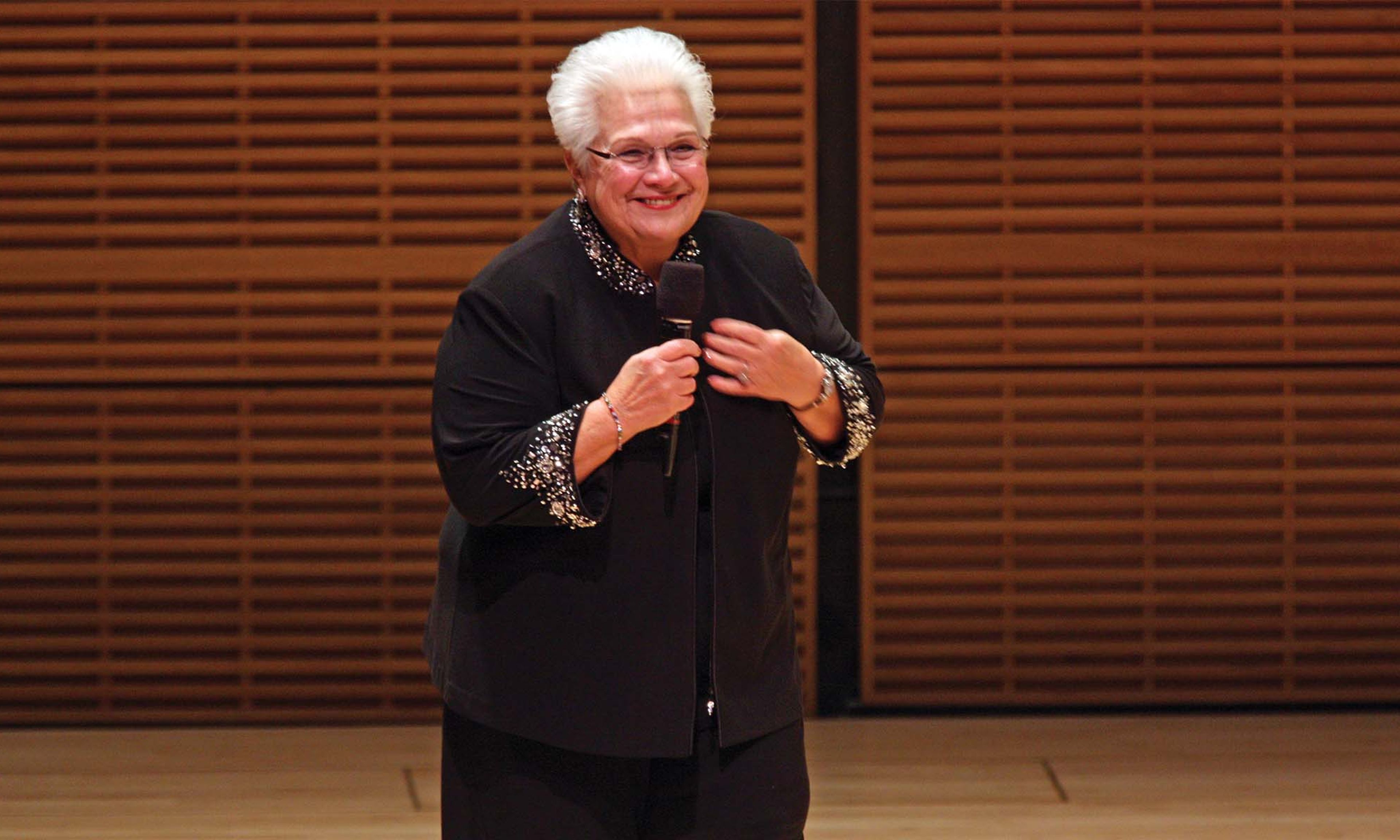
Long ago, Marilyn Horne’s father told her, “Remember, Peanut: The only thing that separates you from the rest of humanity is a little piece of gristle in your throat.” He did not want his daughter to get high and mighty. She quoted him in her 1983 autobiography. She has quoted him frequently.
“Peanut,” as her father called her, went on to be one of the greatest singers who ever lived: in art songs, opera, American standards, folk songs — the works. Or almost the works.
She never performed rap. “It may be rhythm,” she was known to tell an audience. “It may be rhyme. But it ain’t music.”
One night, I heard her say this before she sang an encore — a song outside the classical repertoire, but one that she made sound sort of classical nonetheless: “Bridge over Troubled Water,” by Paul Simon.
Together, sitting in her living room, we sing some of it. She does most of the singing, thank heaven. A couple of times, she corrects my words, nicely.
She remembers reams of music, and the words to go with them. “It’s still working, the brain,” she says. “At my age, an awful lot of my friends are in la-la land.”
Forget her brain, back to her gristle. I ask, “Was it Van Johnson who used to say, ‘How’s your gristle?’” (Van Johnson was a movie star.) “Yes,” she answers. “He said other things, too.” At this, we both laugh, though I can only imagine what he said.
“How’s your gristle, by the way?” When I ask this, Horne’s eyes get bright. “It’s still there,” she says. “And I’m happy about that, because I had it my whole life. I don’t remember a moment in my life when I wasn’t singing. Apparently, I started at like one year old.”
Recently, she recorded a message for a friend of hers — Robert Sherman, the veteran broadcaster and writer in New York, who is turning 90. She sang her message, actually: “Happy Birthday to You.” “How’d it go?” I ask. “Fine,” she says. “I bet,” I say. “Any key,” she says.
I have come to her home in Santa Barbara, Calif., high on a hill, with sweeping views of the city, and the ocean beyond. Outside the door is a mat marked “H.” When you enter, you see pictures of Horne with two presidents: Bush (41) and Clinton. On this sunny afternoon, she and I talk over many things: past, present, and future.
She has an extensive history here in California. Her family moved to the state from the East when she was eleven. They settled in Long Beach, in Greater L.A. Marilyn joined the Roger Wagner Chorale when she was twelve. She would do a lot of studio work, before she embarked on her classical career — work in the movies. For instance, she dubbed Dorothy Dandridge in Carmen Jones (1954).
Marilyn attended USC, where she was taught by Lotte Lehmann, among others. Marilyn participated in many master classes with the great German soprano. The first song Marilyn sang for her, as a freshman, age 17, was “Die junge Nonne” (Schubert).
“Did Lehmann enjoy teaching?” I ask. Horne reflects on this question for a bit. Then she says, “You know, my sense of it is that she enjoyed being in front of an audience. And out of it came the teaching.” Lehmann was a real performer, and why not? In any event, “I learned a helluva lot from her,” says Horne.
Our discussion of the L.A. years ping-pongs between the classical and the popular. She worked with Stravinsky, yes. (He lived on North Wetherly Drive, just above the Sunset Strip.) She also sang with Judy Garland, at a party at Rock Hudson’s.
A dear old friend is the actress Marsha Hunt — who today is 104.
As a youngster doing studio work, Marilyn attended school, right on site, as the law required. Among her classmates were Elizabeth Taylor and Jane Powell. Mention of Powell leads to mention of Fred Astaire — with whom Jane danced.
“Was he a good singer?” I ask Horne. “He was Irving Berlin’s favorite singer,” she answers. “His favorite singer of his own songs.” That’s an impressive commendation. On May 11, 1988, Berlin turned 100. And Carnegie Hall staged a concert, televised, for him. Horne sang probably the biggest song of all: “God Bless America.”
Yes, she is a California girl, to a large degree. But she is still a Bradford girl, inside, she says. Bradford?
Marilyn Horne was born in Bradford, Pa., in 1934. Bradford is a small town in sort of the northwest part of the state on the border with New York. Visiting with Horne, I happen to be sitting in a chair from the University of Pittsburgh at Bradford — Horne got it when she gave the commencement address in 2011. Her archives are there. The Marilyn Horne Museum and Exhibit Center is in Marilyn Horne Hall.
But her music — her sheet music, with all its notations and so forth — is in the New York Public Library.
She tells me a story about a beloved elementary-school teacher in Bradford: Lorina Peterson. Miss Peterson loved music. During the war, she drove with a friend to Buffalo, about two hours north, to hear Jascha Heifetz in concert. There was a ban on pleasure driving. So this trip was illicit.
In or near Buffalo, they were pulled over by a policeman. They told him they were going to hear Heifetz. Far from arresting or ticketing them, he jumped onto the running board and guided them to the concert.
“There was an appreciator of culture,” I say. Horne says, “There were more of them in those days.” This is a sober remark, not just a wistful or passing one.
Very few have done as much to further the art of song as Marilyn Horne has. She sang recitals, with a variety of songs, all over the world. This includes all 50 of our states. (Mississippi and Wyoming were the last two to check off.) Once she retired from the stage, she presided over the Marilyn Horne Foundation, devoted to the perpetuation of the song recital.
As we talk, I mention an album of hers — one of her last, from 1998. It features songs by Samuel Barber, Leonard Bernstein, and William Bolcom. “The American Three B’s,” she says. She also says that the album “sold about two copies.” “That happens,” I observe. She replies, “It happens a lot if you sing songs!”
She is worried — very worried — about the future of song, despite all her efforts.
Mention of Bernstein leads me to ask whether she has seen the new West Side Story — the movie directed by Steven Spielberg. She has. And hated it. I loved it (as did her daughter, Angela). This is one of my few disagreements with Marilyn Horne.
Incidentally, Bernstein recorded his musical in 1984, with classical singers — and it’s Horne who sings “Somewhere” on this album. Jessye Norman was scheduled to sing it, but she had to withdraw, and Bernstein asked Horne to come in and do it. She was preparing to fly off to Berlin, but she said yes. She did it, in two takes, and flew off. It was New Year’s Eve.
Of opera, Horne sang virtually every type, and she has a special relationship with Rossini. He was good for her, she was good for him. “I did nine Rossini operas,” she says. “He had a great sense of humor.” So does Horne. “In another life, I was probably a stand-up comedian.”
About the opera world today, she is feeling gloomy, as are many of us. Most new operas, she says, she “can’t stand.” And productions? That is, stage directors’ presentations? “I don’t want to see most of the productions. I really don’t. They ruin the music for me. I know I’m probably very small-minded about it, and I’m old, so I get to be that way. But I am just not interested in seeing all that trash on the stage.”
I myself am quite concerned about the intrusion of “identity politics”— a refusal to stage Madama Butterfly or Turandot, for example, on grounds that these operas are “insensitive,” culturally and otherwise. “I hate all of that,” says Horne. “I hate that.” And “God knows what it’s going to be like 50 years from now.”
“Maybe it will be better,” I hazard. “I’m hoping there will be a backlash.” Horne replies, “You’re dreaming, dear. No way. No way.”
She has seen countless students in her life, especially since the end of her singing career: She has out-Lehmanned Lehmann. I want to know: What is a common error among singers today? “They don’t know how to breathe,” Horne answers. “You have to remember: A singer — a classical singer — is half artist, half athlete. You develop all those muscles.”
In her career, she saw chiropractors quite a bit, to deal with neck problems. One time, she went to a chiropractor near San Francisco, and he said, “You have a back like a 49er” — meaning a member of San Francisco’s NFL team. He knew because he treated a lot of them.
Horne was not only talented, she worked hard. “I worked damn hard,” she affirms.
She sang bel canto arias, Wagner arias, mélodies, Lieder, canzonette — and hymns, standard American hymns, and she sang them superbly. With utter conviction, as well as vocal excellence. “I am not particularly religious,” she says, “but I grew up with all this music, in church. I can still sing my hymns, my dear.” And she does: “Softly and tenderly, Jesus is calling”; “I come to the garden alone, while the dew is still on the roses.”
Let me tell you: When Marilyn Horne sings to you, one on one, she looks right at you, locking her face with yours. I wish everyone could experience it. It’s better than a stick in the eye, as my dad would say.
I could go on and on. Speaking of that: Marilyn had a friend who called her “a piccolo cavallino [a little horse, a pony] that just keeps going.” She is a formidable, marvelous, unique woman, Marilyn Horne.










Comments