
• The CDC has announced that the goalpost moving will continue until the public’s trust in it improves.
• The Capitol riot of January 6 was a serious event: an attack on Congress and indirectly on the states, whose electoral votes were to be counted. We ought to know precisely what happened, when and why (it should not have taken months to learn the cause of officer Brian Sicknick’s death). A House-appointed committee was always going to be open to the charge that it was tainted by the partisanship of the majority. House Republicans should not, however, have used the Democrats’ partisanship as an excuse to trivialize the attack. Minority leader Kevin McCarthy erred in filling two of the seats allotted to him with Representatives Jim Jordan and Jim Banks, Trumpist cheerleaders. Speaker Nancy Pelosi erred too in booting them from the committee, an action that violates longstanding House protocol. There are skunks at every picnic. She should have let them do their thing, and worked around them. The politicians may have predetermined their conclusions; the public still deserves information.
• McCarthy called Representatives Liz Cheney and Adam Kinzinger “Pelosi Republicans” after they agreed to serve on the select committee investigating the Capitol riot. The wisdom of their decision to join is open to question, and no one in McCarthy’s position would like being bucked by his troops, or can afford to let them make it a habit. But Cheney and Kinzinger agree with McCarthy, not Pelosi, on everything from guns to abortion to taxes. Representative Elise Stefanik, whom McCarthy just ushered into the party’s leadership to replace Cheney, is closer to Pelosi on such issues than are either of the objects of his ire. If McCarthy turns disagreement over how to respond to the riot into a make-or-break issue for his caucus, he will be tying it even more closely not just to Trump’s presidency but to its worst aspect.
• The assault on Justice Brett Kavanaugh by Senate Democrats and the mainstream media continues. Nearly three years after Kavanaugh’s bruising Supreme Court confirmation fight, the New York Times reported that Senate Democrats have been outraged to learn in a letter from the FBI that the agency received 4,500 tips about Kavanaugh during a supplemental background investigation and passed the “relevant” tips on to the White House. “The letter left uncertain whether the FBI itself followed up on the most compelling leads,” the Times reported. But the “paper of record” left three crucial details out of its report. First, senators had reached a bipartisan agreement that the supplemental background investigation would be limited to one week and to “current” and “credible” allegations – it would not be a fishing expedition for new allegations. Second, summaries of all 4,500 tips were included in the FBI’s 2018 report on Kavanaugh, which all 100 U.S. senators and some senior Senate staff could read. Third, there’s good reason to believe none of the tips were actually “compelling.” A Republican senator who thoroughly reviewed the tips sent to the FBI tells National Review that there was “nothing anywhere providing a shred of corroboration” of a new or existing allegation. Democratic senators now expressing outrage could have flagged any compelling information at the time or passed tips on to the press, but three years later they’re still empty-handed.
• “We are facing the most significant test of our democracy since the Civil War. That’s not hyperbole. Since the Civil War.” The president of the United States, a man long known for hyperbole, doth protest too much. Joe Biden’s speech at the National Constitution Center painted new state election laws as a “21st century Jim Crow assault” on voting rights. It is not Jim Crow to implement popular, commonsense rules for the fair, orderly, and honest conduct of American elections – lists of registered voters checked by identification, casting ballots on time and at the correct location, and protections against electioneering and intimidation. Comparisons to the brutality of Jim Crow are embarrassing coming from Democrats too young to remember that era. They are obscene coming from Joe Biden, who sat in the Senate with many of the Democratic leaders of the Jim Crow–era South, considered them friends, pandered to their supporters, gave encomia at their retirements and eulogies at their funerals, and speaks with warmth of them to this day. Most worryingly, Biden’s speech appears to be laying the groundwork to undermine public confidence in the 2022 and 2024 elections in the event that they do not turn out well for Democrats. Biden is offering cover for more Democrats to take the Stacey Abrams route and reject the legitimacy of election losses. What was that about the health of our democracy again?
• At a recent hearing, Senator Rand Paul warned Dr. Anthony Fauci that lying to Congress was a crime; Fauci said the only liar of the two of them was not himself. The casus belli was gain-of-function research at the Wuhan Institute of Virology, and whether the National Institute of Allergy and Infectious Diseases, which Fauci heads, has funded it. Such research seeks to manipulate viruses, the better to study and combat them. The Wuhan lab, not some creature in a wet market, looks more and more to be the source of the COVID virus. Fauci’s denials were loud, but lawyerly. As Josh Rogin of the Washington Post has pointed out, NIAID money has been funneled through EcoHealth Alliance, a research nonprofit, to Wuhan. The point is not that America’s health bureaucrats inadvertently bankrolled the creation of COVID. It is that such research is fraught with danger; that Chinese labs do not have sufficient safety protocols in place; and that we must be much more careful in the future and candid about the past.
• A surge in COVID cases, mainly driven by the “Delta variant,” has led to renewed calls for vaccine and mask mandates. The Centers for Disease Control is calling for indoor-masking mandates, including for the vaccinated. But some evidence suggests that cases in this wave have already peaked, thankfully. Vaccinated people are at low risk of getting severe cases. Vaccination rates continue to rise, if slowly. There are contexts in which mandates make sense: If you’re working in a nursing home, vaccination should be a condition of employment. Those who choose not to get vaccinated are, however, mainly taking risks for themselves. They should be persuaded, not punished.
• According to new preliminary data released from the Centers for Disease Control, more than 93,000 people in the United States died of drug overdoses last year. This number represents a 30 percent increase from 2019, and the sharpest annual increase in at least three decades. The CDC reports that this was primarily the result of a surge in opioid-related overdoses, which accounted for nearly 69,000 of the total deaths. The agency added, too, that a proliferation in the U.S. of fentanyl – which is 50 times more potent than heroin, and frequently mixed into other illicit drugs, often unbeknownst to the user – significantly contributed to the uptick. Shannon Monnat, a professor at Syracuse University who researches the geographical patterns in overdoses in the U.S., told the Associated Press that the root of the surge is the poisoned drug supply. “Nearly all of this increase is fentanyl contamination in some way,” Monnat said. “Heroin is contaminated. Cocaine is contaminated. Methamphetamine is contaminated.” We are only just beginning to count the toll of the pandemic and lockdowns, including the stress and lack of human contact they entailed for addicts.
• During her stint as head of the Department of Education’s Office for Civil Rights under President Obama, Catherine Lhamon used Title IX sex-discrimination rules to conduct an unprecedented attack on due-process rights on college campuses – often denying students accused of sexual misconduct the ability to question accusers, to review allegations against them, to present exculpatory evidence, and to call their own witnesses. Schools that followed Lhamon’s rules have consistently lost when challenged in the courts. None of this has deterred President Joe Biden, who nominated her for the same position. Education comes all too slowly for some people.
• The White House wants Facebook to crack down on “disinformation.” And – ever helpful! – the Biden administration stands ready to advise Facebook on what kind of speech should be quashed. Facebook is, of course, a sewer of disinformation, as is practically every social-media channel – the structure of social-media products and the cloak of anonymity practically ensure that this is so. White House press secretary Jen Psaki blandly says the administration is “flagging problematic posts for Facebook” and “helping get trusted content out there.” What could possibly go wrong? Facebook and its antsy CEO, Mark Zuckerberg, are sore about being blamed for the election of Donald Trump in 2016, a fact that – compounded by the inevitable bias of Silicon Valley’s conformist political monoculture – makes the firm all too eager to act as a handmaiden to powerful Democrats. The White House doesn’t tell the New York Times what letters to publish, and it should not be in the business of leaning on Facebook about its content.
• A Buzzfeed report raised questions about the Justice Department’s prosecution of several members of the Wolverine Watchmen, a militia group accused of plotting to kidnap Michigan’s Democratic governor, Gretchen Whitmer. The report suggests that the defendants were entrapped because FBI informants were aggressive and numerous (as many as a dozen played some role), and that the conspiracy might not have happened had the Bureau not “manufactured” it. Such claims are common after an undercover investigation, particularly in the pretrial stage, when defense lawyers tend to be the most chatty media sources. As a matter of law, however, there is no entrapment if the accused proposed the scheme; and even if the government was the instigator, the defense fails if the accused was predisposed to commit it. These legal rules reflect the commonsense point that decent, law-abiding people cannot be enticed by the blandishments of government operatives to commit violent crimes. This is why entrapment claims so rarely succeed – and virtually never do in organized-crime or terrorism cases, where the public expects law enforcement to be aggressive. The prosecution should be closely scrutinized for signs of government overreach, but people generally don’t get duped into plots to kidnap governors.
• Young women may soon join the military’s draft pool after the Senate Armed Services Committee voted the National Defense Authorization Act out of committee with bipartisan support. Eight of the 13 GOP senators voted in favor. An amendment in this legislation would require women to register for a future draft at 18, just as young men do now. This change has little to do with making an American wartime military stronger but instead operates as a signal of supposed social progress in the present day. A draft of American women would neither accomplish the goal of gender equality nor create a more capable fighting force. When events warrant a draft, efficiency in enlisting the most soldiers and bringing them to battle-ready status is vital. Recruiting female soldiers would harm this effort. Arguments of morality aside, women are not as competent in combat, they suffer higher casualties, and they would increase logistical stresses upon facilities. The members of the committee have shown themselves unfit for duty, and don’t even have the excuse of having been drafted for it.







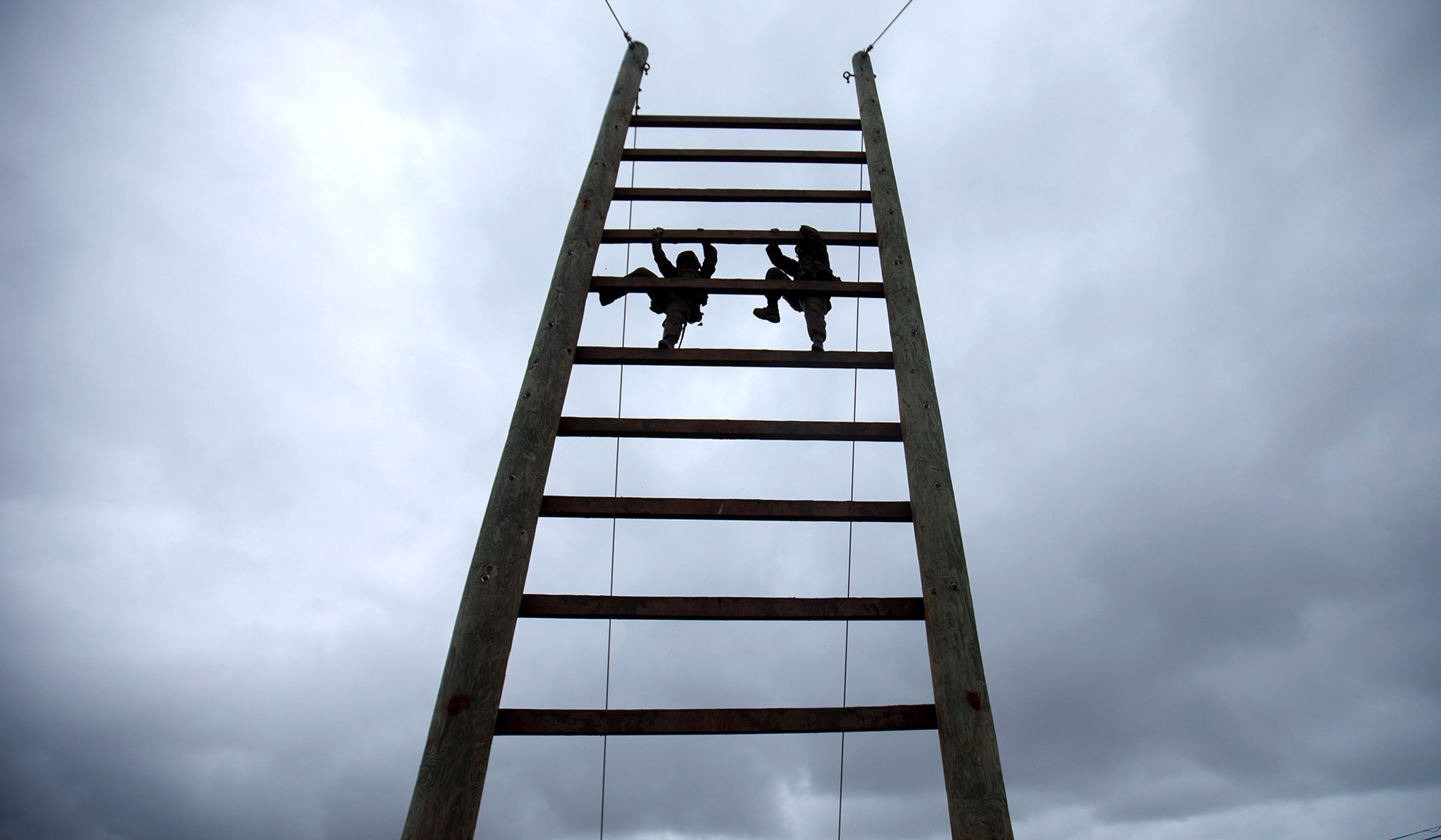



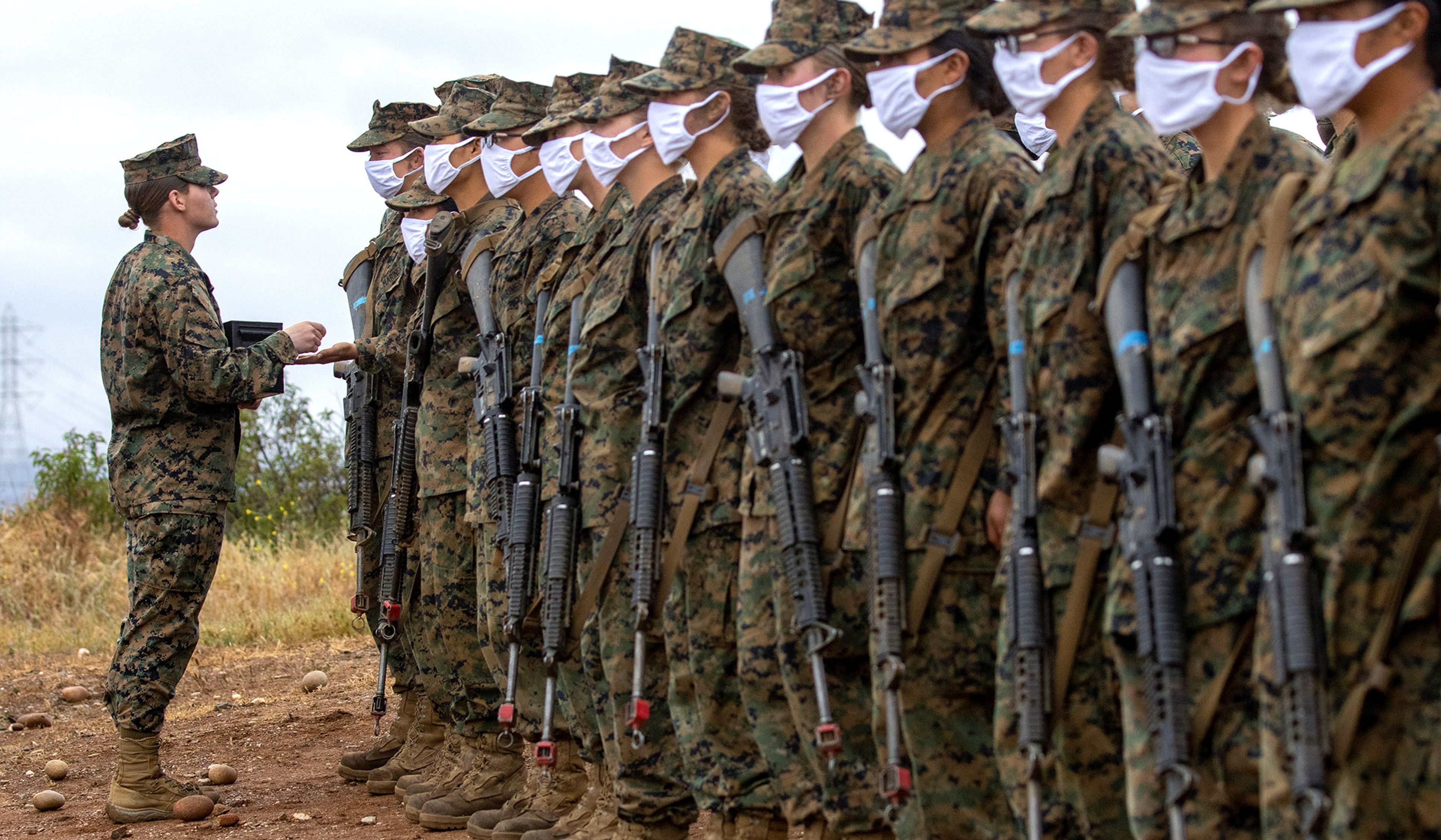
A female recruit from U.S. Marine Corps Recruit Depot San Diego participates in the grueling crucible training as her platoon breaks a barrier becoming the first ever women Marines trained at Camp Pendleton, Calif., April 21, 2021.
Mike Blake/Reuters
• As we have noted before, defense is the one category of federal spending where the Biden administration is stingy. It proposed a defense budget that does not keep up with inflation, let alone include the 3 to 5 percent annual increases a bipartisan expert commission recommended. Surprisingly many Democrats seem to agree: When the Senate Armed Services Committee voted on next year’s budget, 25 members voted for $25 billion in additional funding (Elizabeth Warren was the lone holdout, according to Politico). It is a welcome rebuke to an administration that seems more focused on microaggressions than on the real kind.
• The U.S. Navy took a broadside amidship when Senator Tom Cotton and Representatives Jim Banks, Dan Crenshaw, and Mike Gallagher filed a report outlining various flaws in the maritime branch. Prompted by numerous incidents in the fleet, including ship-to-ship collisions and the capture of Navy craft by the Iranian Revolutionary Guard, Cotton’s report found sailors “deprived of the training and leadership they need to fight and win at sea.” It also warned that the nation’s seagoing force is “distracted from the number one threat to American national security: the Chinese Communist Party.” It is burdened by a political and media-sensitive officer corps, bureaucratic excess, and unnecessary administration. Interviews with active and retired members of the Navy by congressional staff illuminated and gave flesh to these failures. These informed voices and examples of mismanagement give the impression of a branch adrift from its primary function – winning battles through sea-based power. May the Navy change tack and be quick about it.
• Democrats want to pass a large-scale amnesty for illegal immigrants as part of their proposed $3.5 trillion – maybe more – reconciliation bill. Reconciliation, of course, is the process that allows budget bills to pass the Senate with 51 votes, rather than the 60 required to end filibusters and pass other legislation. Under the rules, provisions included in reconciliation can’t have merely an incidental budgetary impact. This obviously should rule out amnesty. Democrats have advocated a pathway to citizenship for illegal immigrants for decades now, but never have they said that we must create one primarily as a budgetary matter. Democrats like to believe that Biden has a far-reaching mandate to enact a transformative agenda. If this were remotely true, they wouldn’t need to come up with ridiculous schemes to get around the fact that they have the slenderest possible Senate majority and there is no groundswell for them to use it to work their will on culturally fraught issues.
• The Deferred Action for Childhood Arrivals program arose in 2012 when President Obama grew tired of waiting for the “DREAM Act” to pass Congress, and instead implemented some of its provisions by executive order. DACA allows illegal immigrants brought to the U.S. as children to defer deportation and receive work permits for renewable two-year periods. A federal judge has now enjoined the program from taking new applicants. He concluded that Congress did not delegate authority to the Department of Homeland Security to “give every illegal alien currently present in the United States legal status,” which he found to be the logical endpoint of the legal theory behind DACA. Naturally, the Biden administration is appealing. The courts should continue to remind Biden that making laws is not a one-man job.
• After spending 25 years at the Bureau of Alcohol, Tobacco, Firearms, and Explosives (ATF), David Chipman transformed into a media-seeking anti-gun activist. In that role, the former agent specialized in hyperbole and falsehoods regarding firearms. It was no accident that Senate majority leader Chuck Schumer combined Chipman’s confirmation hearing for ATF chief with three other nominees, limiting questioning from senators to only five minutes. Chipman, who has belittled law-abiding gun owners as bumpkins preparing to fend off “zombies,” is certainly the right man to speak for gun-control groups. But the ATF director has great latitude in creating and enforcing his regulatory regime. And for this job, he’s a misfire.
• Eastman Kodak (remember them?) became the latest U.S. company to kowtow to the Chinese Communists. After posting photos documenting the Uyghur genocide on Instagram, the company quickly removed them. In its English-language statement, Kodak explained that it did not intend to make “political commentary.” In China, the company touted its “good relationship” and “close cooperation with” the Chinese government. Kodak should reflect that history is not kind to regimes that airbrush or destroy photographs, or the companies that make themselves complicit with them.
• Lawmakers from both houses and both parties want to boost U.S. defense cooperation with Taiwan. The Taiwan Partnership Act would call for the creation of a joint program of the U.S. National Guard and Taiwan’s defense forces, eventually leading to a force capable of rapid deployment in the event of a crisis. It also encourages exchanges between the two countries’ military and defense officials. The U.S. hasn’t stationed troops on Taiwan since normalizing relations with the PRC in 1979. In the event of a Chinese attack on the island, and an American response, U.S. forces could well be at a disadvantage due to their general unfamiliarity with the terrain and with Taiwan’s military. Passing this bill ought to be the first move in a broader effort to rebuild our military ties.
• Julián Castro, the former Democratic mayor of San Antonio and sometime presidential candidate, claimed in a tweet that new Texas curriculum rules would “recast the KKK as the good guys,” an “assault on history that must be stopped.” At issue was Texas’s new education law, which prohibits indoctrinating students with certain concepts associated with “critical race theory.” The basis of Castro’s smear was a Huffington Post report that distorted the legislative history of the law. Democrats had inserted a long list of provisions mandating what the curriculum would cover, at a level of detail properly reserved to the state board of education. The state’s Republican-led senate pared down that list, including an item about the KKK. It did not thereby prohibit or discourage teaching about the evils of the KKK. The curriculum continues to require that students be able to “explain how Jim Crow laws and the Ku Klux Klan created obstacles to civil rights for minorities such as the suppression of voting.” If Castro is looking to stop assaults on truth in Texas, he might begin with his Twitter account.
• California has agreed to pay reparations to thousands of its residents who were forcibly sterilized decades ago by the state’s government. A eugenics law was passed in the state in 1909 that allowed medical officers to sterilize anyone they deemed “feebleminded” or unfit to have children. More than 20,000 Californians were subjected to these procedures over a period of decades, and the program drew the attention, admiration, and imitation of the Nazi regime in Germany. Now $7.5 million has been set aside by the state legislature to compensate the few victims who are still with us. Californians account for around a third of the total number of eugenic sterilizations perpetrated in the United States; only two of the other 31 states that provided for forced sterilizations, North Carolina and Virginia, have also offered reparations. Let the money be a reminder that progressive causes, even when embraced by all the great and good, can have all too many victims.
• Forget flying horses: Pegasus is spyware, developed by an Israeli company, NSO Group. It is implanted on phones. In theory, the spyware combats “serious crimes and terrorism.” That’s how the product is marketed. In practice, it is being used by governments to spy on journalists and opposition politicians. This has been done flagrantly by three U.S. allies: Saudi Arabia, Hungary, and India. We have perhaps glimpsed the tip of the iceberg. An international scandal burgeons. Spyware, like most technology, is double-edged. It should rest in responsible hands. And if spyware is being used irresponsibly, the wizards will just have to invent further technology to counter it. And on it goes . . .
• Washington and Berlin struck a bargain on Nord Stream 2, the 760-mile pipeline that runs from Russia to Germany under the Baltic Sea. The agreement all but ensures (barring an extraordinary intervention by the EU) that the project, which is over 95 percent complete, will become operational. Effectively, President Biden deferred to German chancellor Angela Merkel, the Russian pipeline’s chief proponent. The U.S., standing with its allies in Eastern Europe, particularly Ukraine, had warned that Nord Stream 2 is a malign Russian influence project designed to starve Kyiv of the fees from gas that already flows through its territory; the pipeline, and this deal, diminishes its leverage as Russia continues to carve up the country. The deal stipulates that Germany will retaliate against Russia for any attempts to weaponize its energy flows and will help Ukraine negotiate a renewal with Russia of its current gas-transit contract. But the White House’s talk of defending embattled democracies sounds tinnier after this deal.
• Democrats propose to inflict ruinously counterproductive environmental policies on American businesses, and further propose to offset the diminished competitiveness of U.S. businesses by imposing tariffs on foreign companies that do not adopt similar policies. Count us as skeptical that imposing a heavy new sales tax on Americans – which is what a tariff is – will prove effective in getting the Chinese Communist Party to rethink the fuel mix in its electricity generators. This will touch every aspect of the U.S. economy but will fall especially hard on manufacturing, construction, transportation, and farming, because it will jack up the price of energy and fuels, chemicals, steel, iron, cement, etc. Protectionists, whether of the green variety or the MAGA type, talk about tariffs as though they were mainly a tax on iPhones assembled overseas or on flip-flops sewn in distant sweatshops, but they would add significantly to the cost of raw materials and components for industrial users, including export-oriented manufacturers. Rather than try to offset the damage the Democrats propose to do, a far better approach would be – see if you can follow this, Mr. President – to refrain from imposing those destructive policies on American businesses in the first place.
• Assorted pop warblers kicked off the Tokyo Olympics with an uber-synthed rendition of John Lennon’s “Imagine.” The track was written in Lennon’s Yoko period, i.e. after he had lost his sense of humor and Paul McCartney’s musical ingenuity. While the tune is dreamy, the lyrics are disturbingly dour, conjuring up a “brotherhood of man” (sounds good) in a world of “no possessions” (oops). It’s a five-year plan set to elevator music. What it has to do with athletic excellence is anyone’s guess. Hit mute, jump straight to the starter’s gun.
• The NFL announced that it will begin every season-opening game with a rendition of “Lift Every Voice and Sing,” “The Star-Spangled Banner” to be played second. “Lift Every Voice” was written in 1905 by a pair of brothers, James Weldon and J. Rosamond Johnson, to mark Lincoln’s birthday. It soon became known as the black national anthem. It is an earnest hymn of endurance and hope; it concludes with a prayer to remain “true to our God” and “our native land.” Featuring it as the NFL proposes to do is boneheaded racial politics. America has a national anthem, focused on a desperate historical moment. Highlighting the “black” national anthem casts “The Star-Spangled Banner” as white; it also leaves non-white non-blacks anthem-less. H. L. Mencken wrote that the greatness of “The Star-Spangled Banner” was that, uniquely for a national anthem, it begins with uncertainty: Does the banner yet wave? Not, it seems, for the NFL.
• If you play beach handball, you have to wear bikini botoms – if you’re a woman, that is. Norway’s team objected to this, finding the bikini bottoms degrading and otherwise inappropriate. In a Euro 2021 match against Spain, the Norwegian women came out in shorts. So, they were fined by the sport’s federation. It’s ungallant, and poor sportsmanship to boot.
• In December, under pressure from the baseball commissioner, the front office of the Cleveland Indians announced that they would change their name after the 2021 season. The brain trust on Ontario Street has now rolled out its new branding. The Cleveland Guardians, as they will be known beginning in the fall, enter the world accompanied by a set of new logos and designs just as uninspired as the name, a reference to a Depression-era public-works art project that adorns a bridge between downtown and the West Side. The new name points to “the way we fight together for all who choose to be part of the Cleveland baseball family,” said team owner and chairman Paul Dolan. They may as well have called them the Cleveland Incoherents.
• Pope Francis has restricted access to the Latin Mass, reversing a decree of his predecessor, Benedict XVI, who had removed the requirement for priests to get their bishop’s permission to pray the liturgy according to the old missal. In his apostolic letter Traditionis Custodes (Guardians of tradition), promulgated in July, Francis reinstated the requirement, in the name of unity and “ecclesial communion.” Granted, some Catholics have made the Latin Mass a symbol of their dissent from what they regard as modernist tendencies in the church since the Second Vatican Council. While Francis’s wariness of movements that have developed around traditional liturgy is not unfounded, his decision to take this measure against them was imprudent. The church includes more than 20 rites, most of them deriving from Eastern Christianity; its accommodation of those who prefer to worship in an ancient form of the main, Roman rite is not inherently problematic. Acting on the assumption that it is, Francis has fed the mutual suspicion between Catholics who are traditionalists and those who are not. He should have left well enough alone.
• Edwin Edwards, four-term governor of Louisiana and eight-year guest of the federal government, typified the rascally southern pol. He spoke the lingo of his Cajun upbringing, charmed all and sundry, pushed assorted public-works projects, and stole and stole and stole. He boasted that he would go to jail only if he were found in bed with a dead girl or a live boy. In 1991, in his last gubernatorial race, he found himself, thanks to a crowded field and Louisiana’s open-primary system, in a runoff against former Klan leader David Duke. Duke, handsome and ambitious, was laboring to join the mainstream. Edwards crushed him. (A bumper sticker urged: “Vote for the Crook. It’s Important.”) After his term ended, he was convicted of 17 counts of racketeering and other crimes (one beaut: he took a $400,000 bribe to get the briber a casino license). Men such as Edwards amuse. But they lower the tone of public life and plunder their constituents as readily as the operators who grease their palms. Dead at 93. R.I.P.
• Sometime in 2005, a Danish children’s writer complained that he had been unable to find an illustrator for the book he was planning about the prophet Mohammed: Potential candidates had been unwilling to risk taking on an assignment that would necessarily involve picturing Mohammed, and doing that, they feared, would invite reprisal. Intrigued (and appalled) by the story, Jyllands-Posten, a Danish newspaper, invited 40 cartoonists to submit pictures of Mohammed “as you see him.” Twelve did, and we all know what happened next. One of those twelve was Kurt Westergaard, who drew perhaps the best-known of those cartoons, in which his subject wore a turban that appeared to double up as a bomb. His point, he said, was that the prophet was being used as an excuse for terrorism. For a while Westergaard lived under police protection, and then after the discovery of a plot to kill him, he was forced into hiding. When he returned to an approximation of normal life, a would-be assassin broke into his home. Danish in his understatement, he made no claims of great bravery, and Danish in his determination, he made no apologies for what he always insisted was the right thing to have done. Dying peacefully in July, albeit once again under police protection, at the grand old age of 86, he had the last laugh, but it would have been a laugh tinged with sadness, not only for those who have been murdered because of those cartoons, but because of his hard-earned awareness that there are so many in the West who, if not hostile or indifferent to free speech, are unwilling to defend it. R.I.P.
• Jackie Mason came out of the Catskills resorts to star on Broadway stages. WFB knew Jackie, as he knew so many. Jackie once told him something like the following: “If you blindfolded me and parachuted me down to any spot in America – Provo, Pittsburgh, Peoria, doesn’t matter – I would start telling jokes. It would take me a minute or two to gauge the audience. Then I could tell jokes for an hour and have them rolling.” It was almost certainly true. To borrow a phrase from Paul Johnson, Jackie Mason “added to the gaiety of life.” The comedian has died at 93. R.I.P.
• Growing up in the projects in Harlem, Bob Moses was introduced by his parents to the local public library, his springboard to Stuyvesant High School, Hamilton College, Harvard. As a young math teacher at the Horace Mann School in the Bronx, he was “mesmerized,” he later recounted, by news photos he saw of black civil-rights activists, peaceful but defiant, sitting at whites-only lunch counters in the South. He went to Mississippi in 1960 to join the activists, helping to register voters. He was beaten and shot at for his efforts. After several years in Tanzania in the 1970s, he returned to the States and in 1982 founded the Algebra Project, a national mathematics-literacy program for minority and low-income students. The idealist was a pragmatist, his own experience having taught him that basic academic skills can form the foundation for a citizen’s political awareness and civic participation. Noted for his soft-spoken manner and calm demeanor, he was a model of the nonviolence that he preached and practiced. At an age when most of his peers had retired, he taught high school in the South. His awards included a MacArthur Fellowship. Dead at 86. R.I.P.
Right on RoeLynn Fitch, the attorney general of Mississippi, gets right to the point in the state’s legal brief in defense of its ban on abortions after 15 weeks’ gestation: “On a sound understanding of the Constitution, the answer to the question presented in this case is clear and the path to that answer is straight. Under the Constitution, may a State prohibit elective abortions before viability? Yes. Why? Because nothing in constitutional text, structure, history, or tradition supports a right to abortion. A prohibition on elective abortions is therefore constitutional if it satisfies the rational-basis review that applies to all laws.”
The two obstacles in that path are Roe v. Wade and Casey v. Planned Parenthood, which ignored text, structure, history – ignored the Constitution nearly completely – to pretend that abortion requires the federal courts to extend it special protection. Fitch and her colleagues explain patiently and thoroughly why those obstacles should be removed. The decisions were “egregiously wrong.” They have inflicted harm to self-government. They have not resulted in the stable consensus the Court has repeatedly sought and predicted. They have rested on premises – about the reliability of contraception, the career prospects of women, and the state of medicine – that no longer apply if they ever did. These outdated premises are at the heart of the Court’s previous findings about women’s “reliance” on constitutionalized abortion rights.
And they have proven incapable of generating a predictable body of law. The brief notes that just last year, the five justices who agreed to strike down an abortion regulation could not agree on the basis for doing it, and the five justices who agreed on what Casey meant did not reach the same judgment in the case. The justices’ inability to devise a predictable set of rules that protects abortion from legislatures, gives them some leeway to set policy, and has some plausible grounding in the Constitution does not stem from any lack of cleverness on their part. The thing cannot be done.
When the Court handed down Casey in 1992, it tacitly conceded many of the faults of Roe while insisting that the need to preserve public respect for itself as an institution required it to stick with the pretense that the Constitution protects abortion. Fitch gently but firmly observes that after nearly 30 years, this judgment has proven spectacularly wrong. It is the Court’s extraconstitutional role in setting abortion policy, more than anything else, that has diminished and distorted it.
The justices may duck this argument, but they cannot refute it. The Constitution, federalism, the separation of powers, and moral truth all converge on an answer in this case, and Mississippi has just identified it. The justices should have the courage and integrity to admit that the Court has been wrong.











Comments