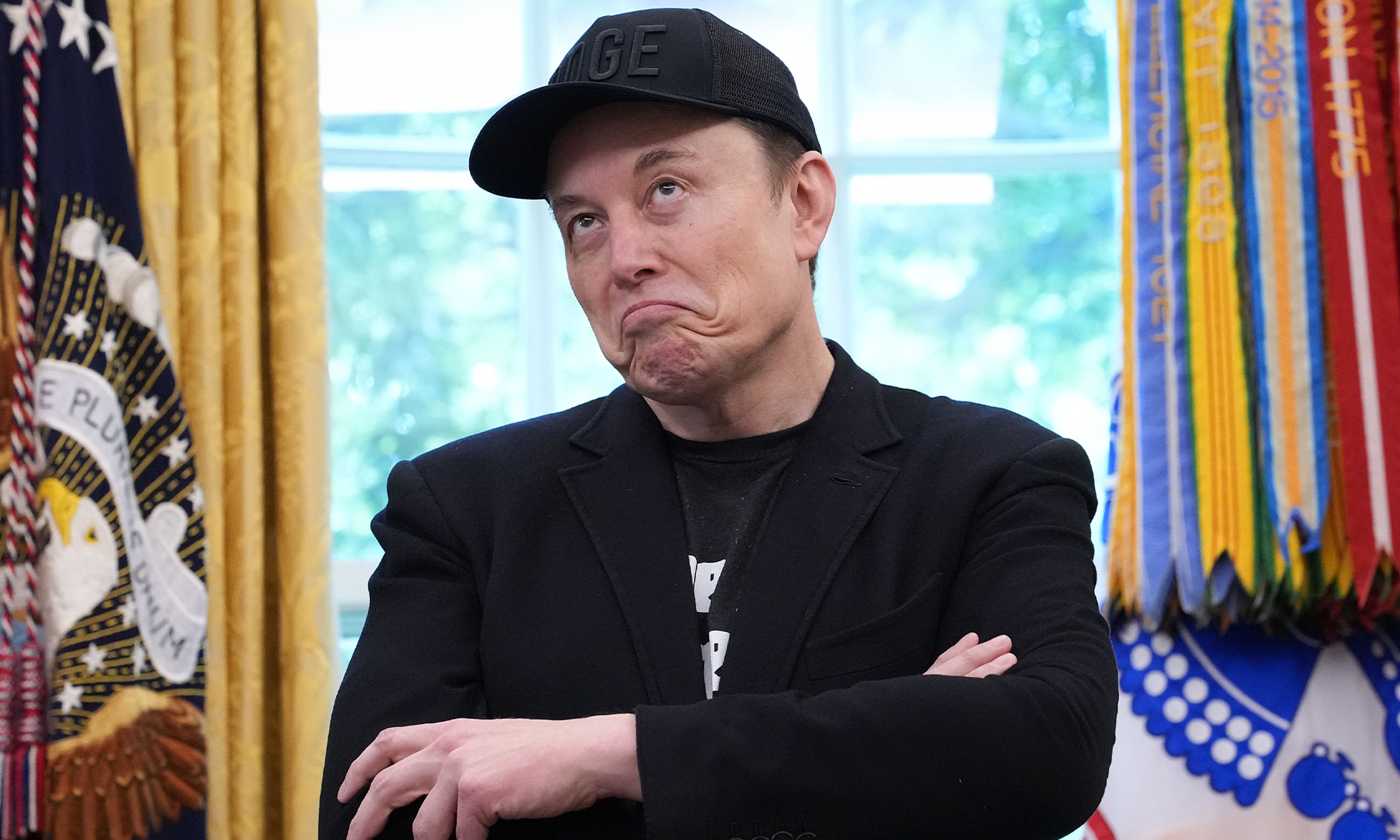
Begin with the upside: President Donald Trump was never much of a fiscal hawk in his first term, but at least for the first stretch of his second term, he established the Department of Government Efficiency and put the world’s most energetic — probably hyperactive — billionaire in charge of it, and made cutting wasteful spending a priority.
As of this writing, according to DOGE’s data, it has identified an estimated $175 billion in savings — about $1,086 per taxpayer — from a combination of “asset sales, contract/lease cancellations and renegotiations, fraud and improper payment deletion, grant cancellations, interest savings, programmatic changes, regulatory savings, and workforce reductions.”
That sounds good. But if you paid attention during Trump’s big Madison Square Garden rally on October 27, 2024, you’ll recall that Elon Musk pledged to future Secretary of Commerce Howard Lutnick that DOGE would save taxpayers “at least $2 trillion.” By March, President Trump was boasting that DOGE was going to save so much money that the savings would be returned to taxpayers in the form of “DOGE checks.”
“They’re saving billions and billions of dollars every single day, and there’s even under consideration a new concept where we give 20 percent of the DOGE savings to American citizens, and 20 percent goes to paying down the debt, because the numbers are incredible,” Trump said during his address at Saudi Arabia’s annual investment conference, held in Miami Beach.
On May 28, Musk announced on the social media platform he owns that his scheduled time as a special government employee was coming to an end. While the work of DOGE will go on, $175 billion represents 8.75 percent of Musk’s bold stated goal. And according to Lutnick, recalling the episode during his appearance on the All-In podcast on March 20, Musk doubled the announced objective on a whim: “When I say to him, ‘How much are you going to cut?’ The deal was, he’s going to cut $1 trillion. And then he’s supposed to say, ‘And how much are you going to earn?’ And I’m supposed to say, “$1 trillion.’ And then we’re supposed to say, ‘Together we’re going to balance the budget of the United States of America!’”
As Lutnick recounts it, he asked Elon, “‘How much are you going to cut?’ Well, because we’re in front of 22,000 people, and the place is erupting, he says ‘$2 trillion!’ And then I’m sitting there going and I’m like” — Lutnick makes a nonplussed expression — “I think I said, ‘All righty then!’ or something like that. What was I supposed to say? . . . The answer was always that 25 percent of the waste, fraud, and abuse is a trillion dollars.”
Keep in mind, the U.S. federal budget’s total discretionary spending in 2024 was $1.8 trillion. Nondiscretionary spending is Social Security, Medicare, Medicaid, supplemental nutrition assistance, federal civilian and military retirement benefits, and unemployment insurance. Discretionary funding is everything else.
Musk’s time at DOGE has been off the charts on theatrics, such as his waving a chain saw through the air alongside Argentine President Javier Milei at CPAC. The results are a less dramatic and less cheery story.
First, assessing the work of DOGE is complicated by the fact that some batches of data it released proved to be riddled with errors; in early March, DOGE erased or altered more than 1,000 contracts it claimed to have recommended for canceling, representing more than 40 percent of all the contracts listed on its site, including five of the seven largest.
To be clear, “DOGE does not cut spending. DOGE does not fire people. DOGE does not cancel contracts,” Michael McConnell, director of the Constitutional Law Center at Stanford Law School and a senior fellow at the Hoover Institution, explained on an episode of the We the People podcast. “What DOGE does is it advises the agency head, and the agency head then exercises the authority that’s been vested in him or her under the statutes. Now, it is true that DOGE is extremely influential, but DOGE does not actually do the canceling and the firing and the reductions.”
At first glance, the DOGE website offers an impressive list of 10,781 canceled contracts — until you dig into the numbers and notice what’s missing. For example, on March 1, a U.S. Agency for International Development contract worth $283.7 million was canceled. The vendor’s name is “unavailable,” and the description of the contract is “unavailable for legal reasons.” Quite a few USAID contracts share those unnamed contractors or descriptions. DOGE-targeted federal grants also often have “currently unavailable” as their description.
The incomplete data make it difficult to verify the administration’s claims of cost savings. On May 20, Securities and Exchange Commission Chairman Paul Atkins, speaking to the House Appropriations Committee about DOGE’s efforts at his agency, said: “The savings is up to $90 million that they’ve identified.” An independent calculation of the publicly available data on the DOGE website puts cost savings at the SEC at $18.9 million.
Was Atkins getting bad information? Was the site not updated with another round of savings from recent cuts? Were some SEC savings misattributed to some other agency? It’s impossible to know with the limited information disclosed by an administration that boasts “truly the most transparent, accessible president in American history.”
Speaking of transparency, DOGE argued in court that its internal records were not subject to the Freedom of Information Act. In March, Obama-appointed U.S. District Judge Christopher Cooper ruled that those documents were indeed covered by FOIA and concluded that DOGE’s “operations thus far have been marked by unusual secrecy,” and “the authority exercised by [DOGE] across the federal government and the dramatic cuts it has apparently made with no congressional input appear to be unprecedented.”
DOGE is the new name of the United States Digital Service, established during the Obama years to provide consultation services to federal agencies on information technology. Unsurprisingly, the torrent of budget cuts and staff firings directed by what is supposed to be an advisory agency spurred a slew of legal challenges. (See Dan McLaughlin’s “The DOGE Ate My Constitution” in the May 2025 issue.)
Take the U.S. Institute of Peace, a nonprofit institute funded by the federal government, established in 1984 by congressional legislation and signed into law by President Ronald Reagan. The USIP employs about 600 people worldwide, had a budget of $55 million in the 2024 fiscal year, and works out of an architecturally striking building at the corner of Constitution Avenue and 23rd Street, across from the Lincoln Memorial. A February 19 Trump executive order called for the elimination of the institute’s non-statutory components and functions; the administration terminated the board. When the board balked and refused to leave the building, DOGE called the cops.
In mid-May, another Obama appointee, U.S. District Judge Beryl A. Howell, ruled that the administration had acted “without asking Congress to cease or reprogram appropriations or by recommending that Congress enact a new law to dissolve or reduce the Institute or transfer its tasks to another entity” and took over the building with “blunt force, backed up by law enforcement officers from three separate local and federal agencies.” She ruled that while the Institute of Peace was part of the federal government, it was separate from the executive branch, and the president lacked the power to terminate its board at will. She reversed all the changes.
There is a Republican Congress that could legislatively eliminate the U.S. Institute of Peace, but there’s no sign of action on that front.
And then there are the DOGE-recommended cuts that even the most ardent budget cutter might find difficult to justify. Scientists at the National Institutes of Health contend that the reduction in staff and the purchasing slowdowns are delaying the development of cell-based immunotherapy techniques for cancer. Eliminating two National Oceanic and Atmospheric Administration weather balloon stations in Michigan and Wisconsin meant that local meteorologists had a smaller database to help them predict ice storms and tornadoes. And some cuts seem to contradict other administration priorities. If English is the official language of the United States, as Trump decreed, then it likely makes sense to have programs designed to teach kids English when it isn’t their first language or spoken in the home. Waste is sometimes in the eye of the beholder.
At a cabinet meeting in February, Musk said, “We will make mistakes. We won’t be perfect. But when we make mistakes, we’ll fix it very quickly. So, for example, with USAID, one of the things we accidentally canceled, very briefly, was Ebola prevention. . . . So, we restored the Ebola prevention immediately, and there was no interruption.” Some international aid workers contend that the USAID cuts did disrupt the U.S. response to an Ebola outbreak in Uganda this spring.
“Measure twice, cut once” isn’t common advice in DOGE, where sweeping firings of federal workers are announced, then sometimes hastily reversed once the consequences are clear. In February, up to 350 employees at the National Nuclear Security Administration were abruptly laid off; a day later, “the agency’s acting director, Teresa Robbins, issued a memo rescinding the firings for all but 28 of those hundreds of fired staff members.” In April, a Centers for Disease Control and Prevention research facility in Pleasant Hills, Pa., laid off 300 employees. One month later, the facility announced the rehiring of “dozens of respirator certification workers.” One employee at the Consumer Financial Protection Bureau has been fired twice and rehired twice. One DOGE effort to reduce the number of federal employees has been to offer buyouts; more than 15,000 U.S. Department of Agriculture employees took the deal. By May, Secretary of Agriculture Brooke Rollins told the Senate Appropriations Committee that the department was “actively recruiting” to fill some of those empty positions. “If they want to come back, and if they were in a key position, then we would love to have that conversation,” she told the panel.
Referring to his fight with the U.S. Institute of Peace, Musk posted on X, “Any government institution is most likely to be the opposite of its name.” Indeed, the Department of Government Efficiency doesn’t always seem all that efficient.
Unsurprisingly, other Trump cabinet officials were less than thrilled that a billionaire and his team of wunderkind staffers with nicknames like “Big Balls” were attempting to force budget cuts and firings of people within agencies under their management.
The tensions led to a showdown in the Cabinet Room of the White House on March 6, featuring a clash between Musk and Secretary of State Marco Rubio. Musk reportedly complained that Rubio hadn’t fired anyone, and Rubio accused Musk of not being truthful and ignoring more than 1,500 State Department officials who took early retirement in buyouts.
President Trump appeared to side with Rubio and the rest of his cabinet, declaring on Truth Social, “As the Secretaries learn about, and understand, the people working for the various Departments, they can be very precise as to who will remain, and who will go. We say the ‘scalpel’ rather than the ‘hatchet.’” In other words, DOGE would no longer be calling for the firing of federal workers without the agreement of the cabinet secretaries.
It didn’t help that Musk is incapable of holding his tongue when he thinks others are making a mistake. In the opening days of the administration, Trump happily announced the Stargate Project, “a new company which intends to invest $500 billion over the next four years building new AI infrastructure for OpenAI in the United States,” a joint venture with SoftBank. Musk posted on X, “They don’t actually have the money. . . . SoftBank has well under $10 [billion] secured. I have that on good authority.” (There has been long-standing tension between Musk and Sam Altman, OpenAI’s CEO.) During the fight about the “liberation day” tariffs, Musk posted that Trump’s primary adviser on trade, Peter Navarro, was a “moron.” According to one report, Musk and Treasury Secretary Scott Bessent got into a profanity-laden screaming match in the White House over who the next IRS commissioner ought to be.
Every administration has internal disputes, but Musk’s brash, confrontational style likely further alienated cabinet officials whose cooperation would have made his task easier.
In a May interview with ABC News, the world’s richest man said of budget-cutting, “It’s not easy. This is . . . a way to make a lot of enemies and not that many friends.” He said the ability to reduce spending depends on “how much pain is the cabinet and Congress willing to take. It can be done, but it requires dealing with a lot of complaints.” In a separate Washington Post interview, he lamented, “DOGE is just becoming the whipping boy for everything. So, like, something bad would happen anywhere, and we would get blamed for it even if we had nothing to do with it.”
The GOP-controlled Congress didn’t really buy into the Musk mindset, either. “I was disappointed to see the massive spending bill, frankly, which increases the budget deficit, not just decreases it, and undermines the work that the DOGE team is doing,” Musk told CBS News Sunday Morning.
In the ABC interview, Musk conceded, “I think we’ve been effective, not as effective as I’d like, . . . but our rate of savings per day is pretty good. You know, we’re like, $1.6 billion a day, 100 days in.” (By the end of May, that was down to $1.36 billion per day.)
The problem is that so far in the 2025 fiscal year, the U.S. government is spending $11.4 billion per day.
Finally, firing people, offering buyouts, rehiring people, and fighting all those lawsuits costs money. One study by the Partnership for Public Service calculated that when you add up all the “firings, re-hirings, lost productivity and paid leave of thousands of workers,” it will cost taxpayers “upward of $135 billion this fiscal year,” nearly eating up all of the savings generated by DOGE’s efforts. That figure may be an exaggeration, but there’s no denying that the tumult generated by DOGE is at least partially offsetting the savings it generates.
This year’s deficit will be higher than last year’s. Trump and the GOP Congress will get blamed, but little of it has to do with any decisions they’ve made so far (although tariffs that dampen economic growth would likely reduce U.S. tax revenues). The last of the Baby Boomers are retiring, meaning we’re paying out more in Social Security checks and spending more on Medicare. And when the national debt gets bigger, the U.S. must pay more in interest each year.
Eliminating a wasteful program is worthwhile on its own merits. But DOGE’s recommended cuts are a drop in the bucket — perhaps $200 billion in cuts, when the deficit for fiscal 2025 is projected to be $1.9 trillion. The perception of DOGE’s effectiveness is largely driven by innumeracy.












Comments