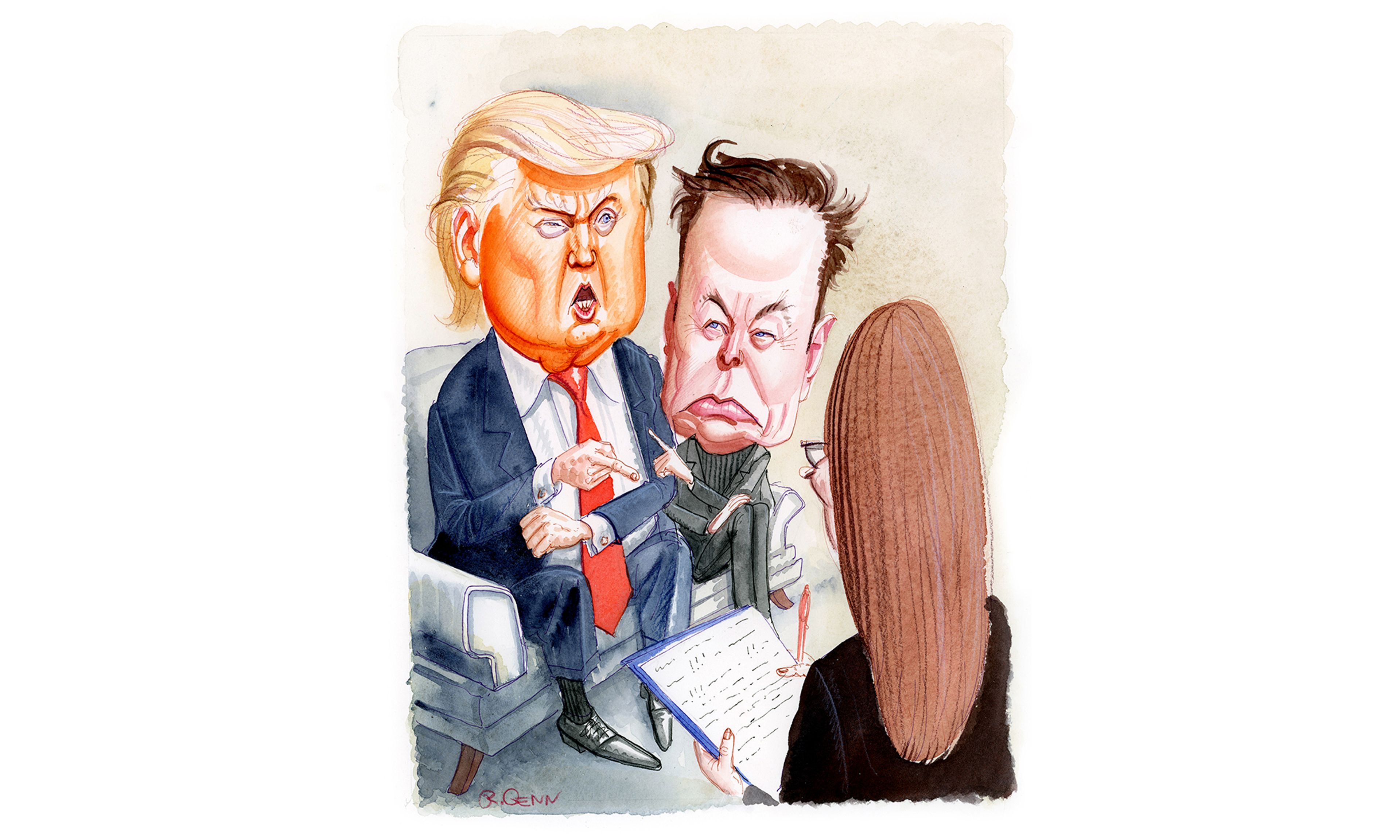
• “Some say the world will end in fire, some say in ICE.”
• What have the self-driving vehicles done to anyone? Rioters across Los Angeles set Waymo cabs ablaze in a spasm of violence over federal immigration enforcement in the West Coast metropolis. As is always the case with “mostly peaceful protest,” left-wing demonstrators have destroyed property, blocked traffic, and hurled objects at law enforcement. President Trump responded by activating California National Guard troops without a request by the governor, Gavin Newsom: a highly unusual move, but one within his legal authority. State and city officials are condemning the activation of the Guard as a “provocation,” although usually the only people provoked by troops standing in front of a federal building to keep it from getting attacked are those who might want to attack it. There’s much talk of what can be done to “de-escalate” the situation. The first step would be for L.A.’s left-wing activists to stop harassing and assaulting federal officers — and the police officers of their own city — for doing their jobs.
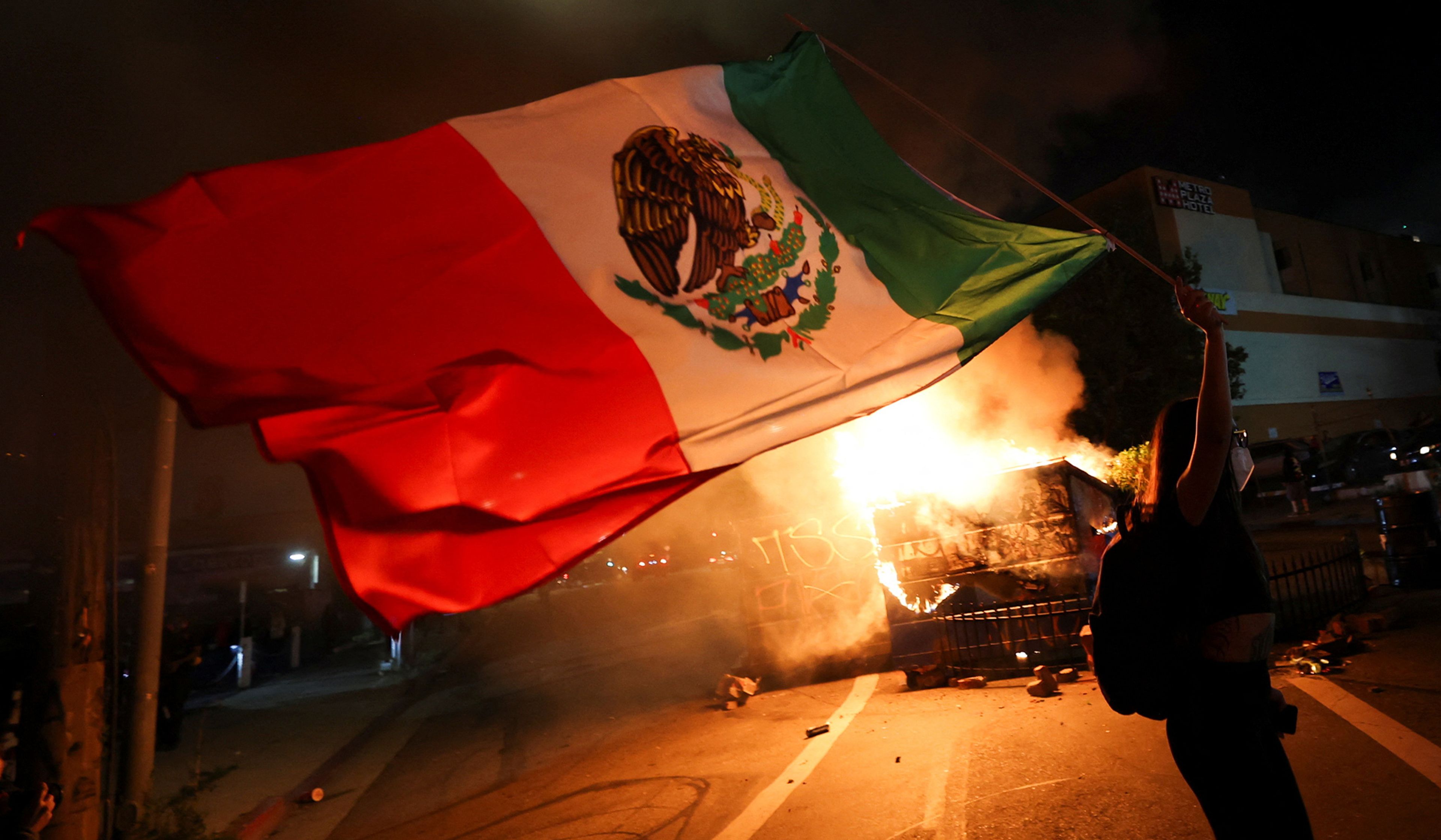

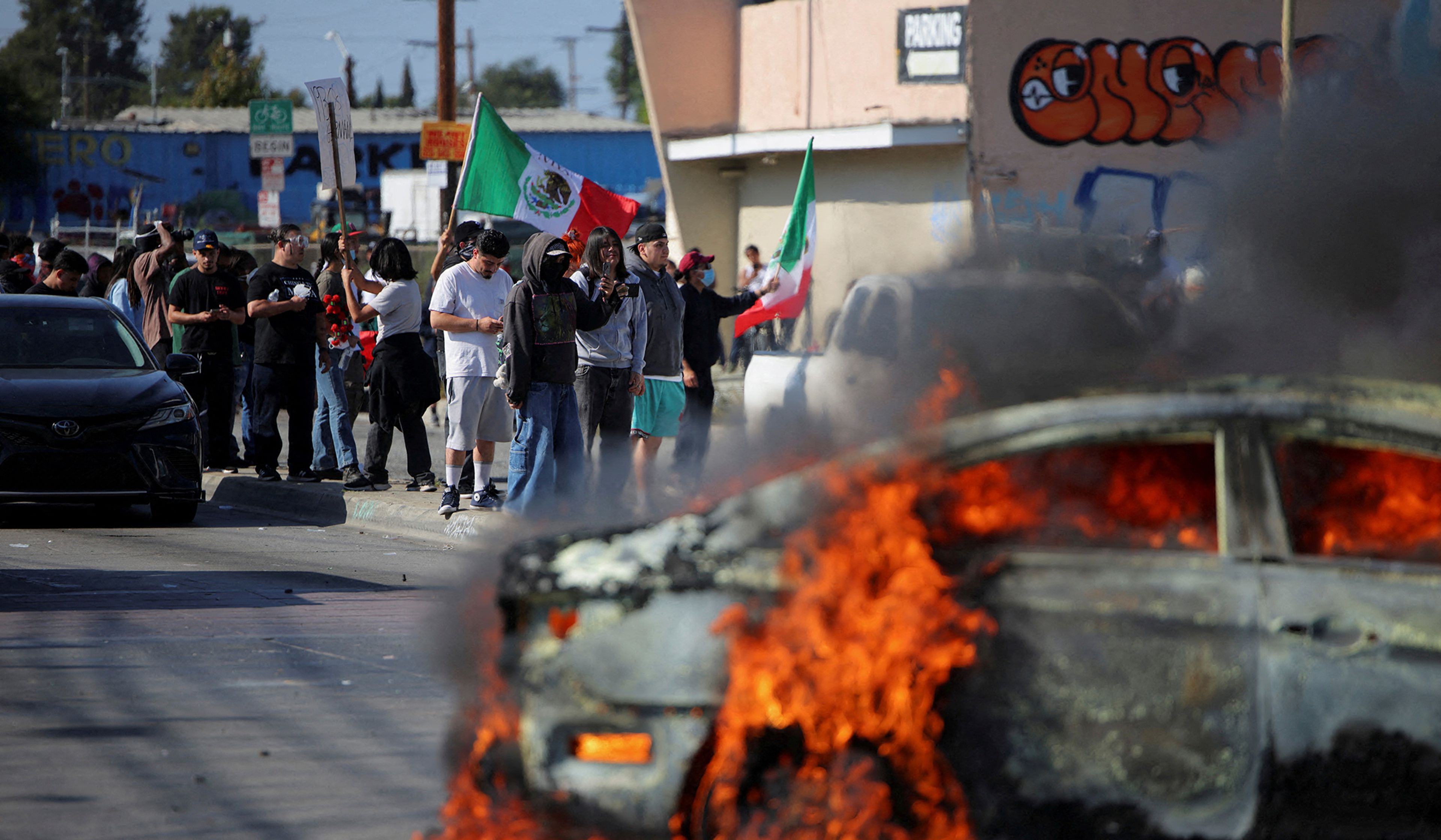

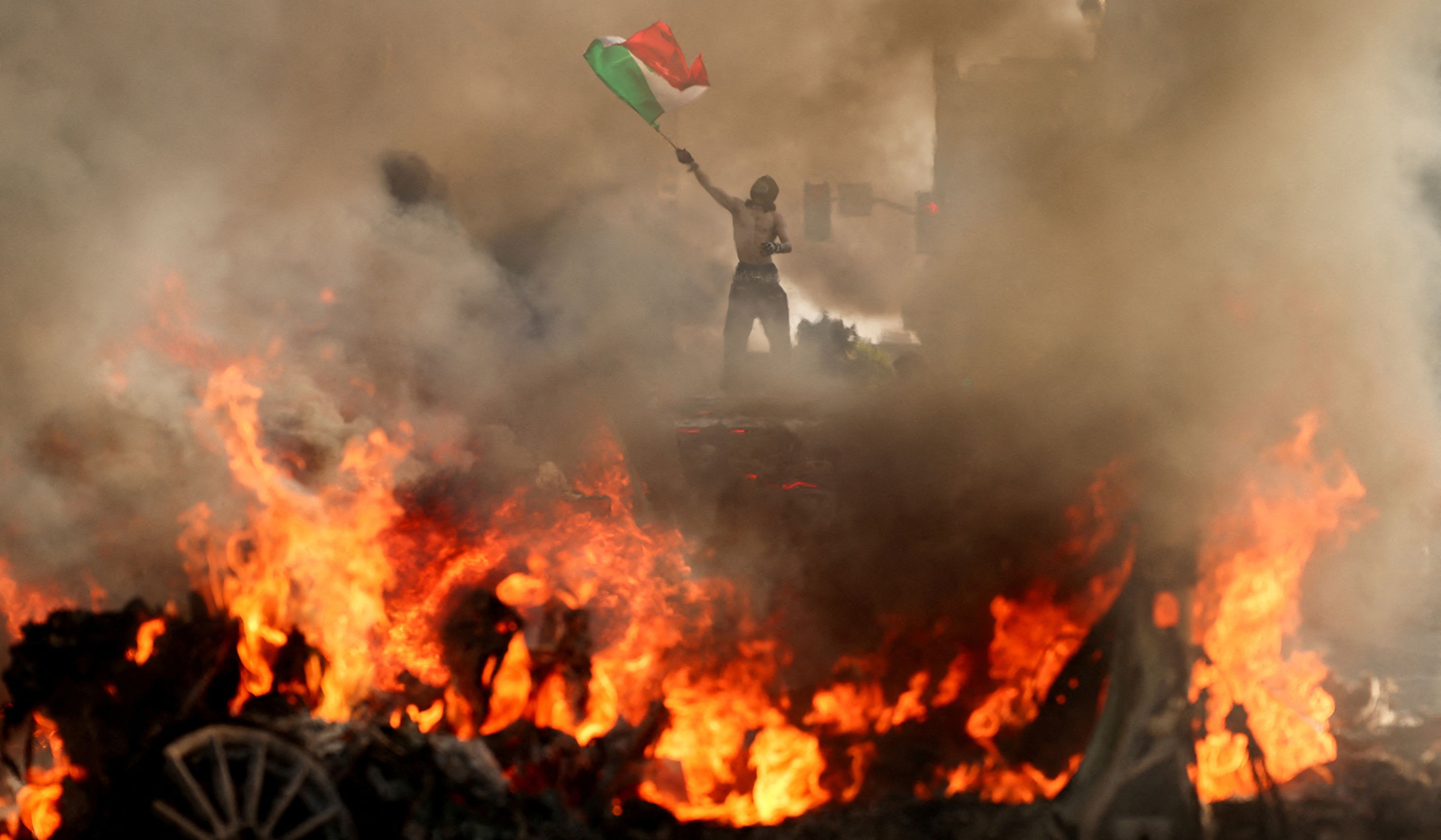
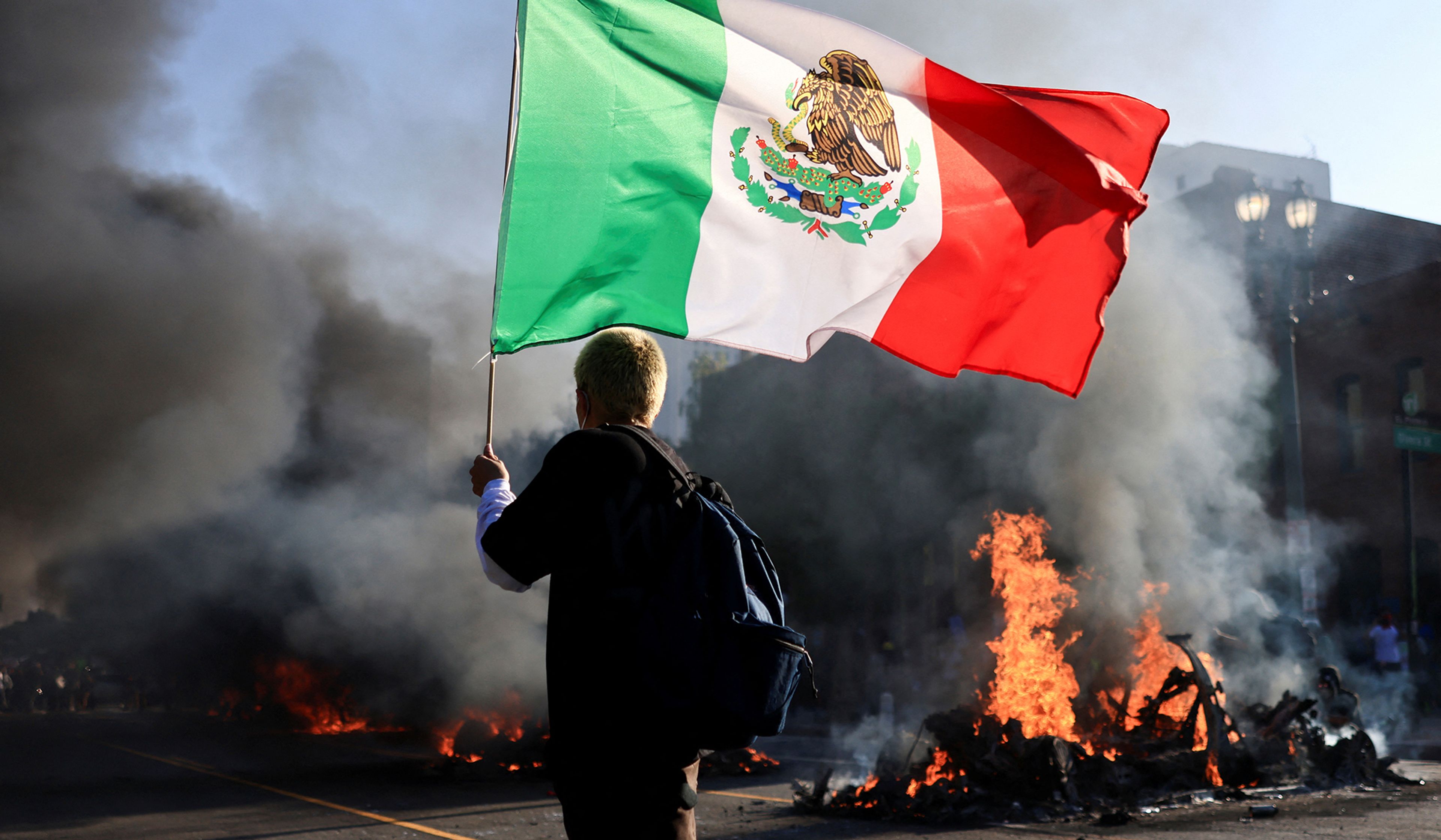
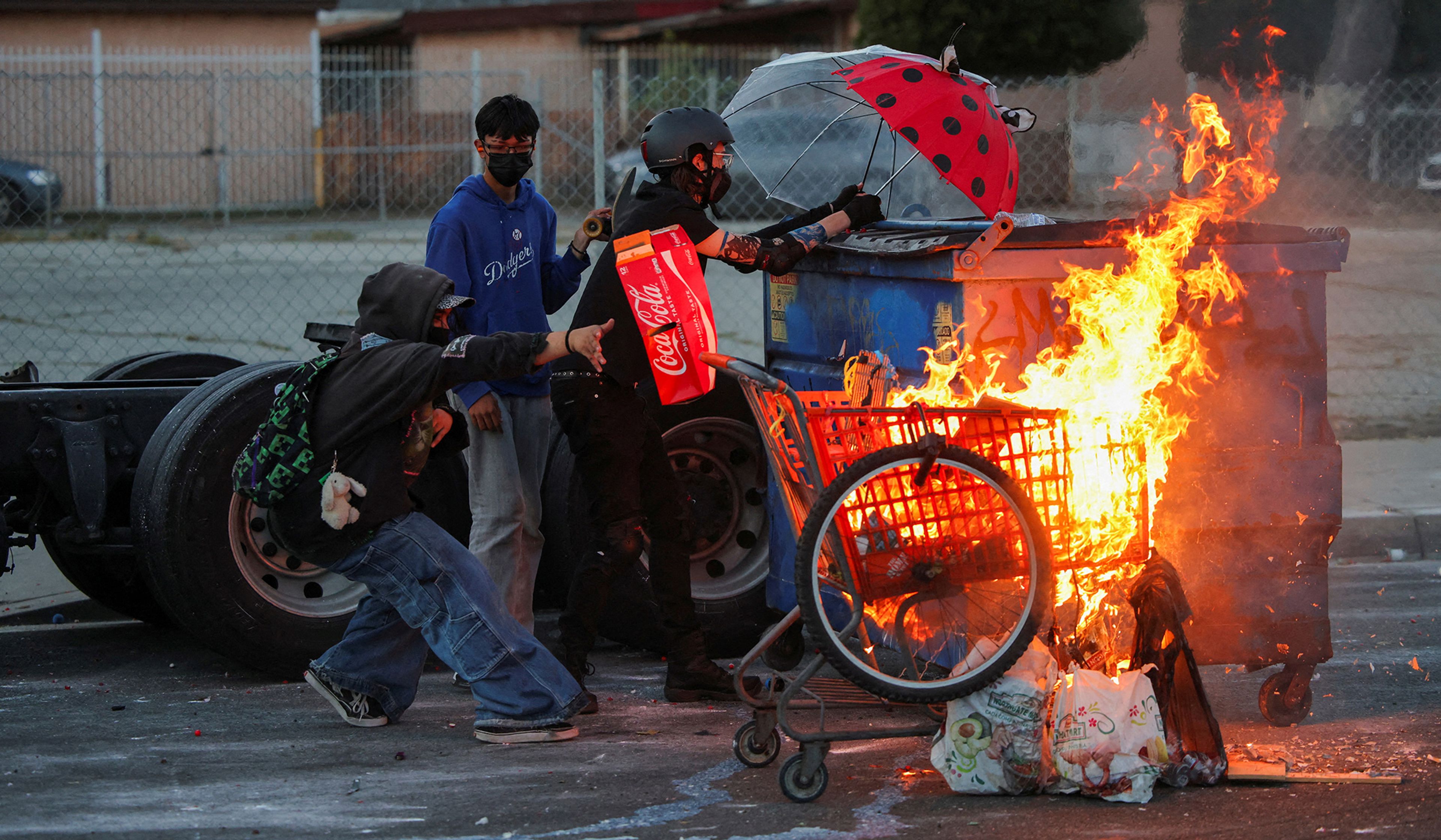

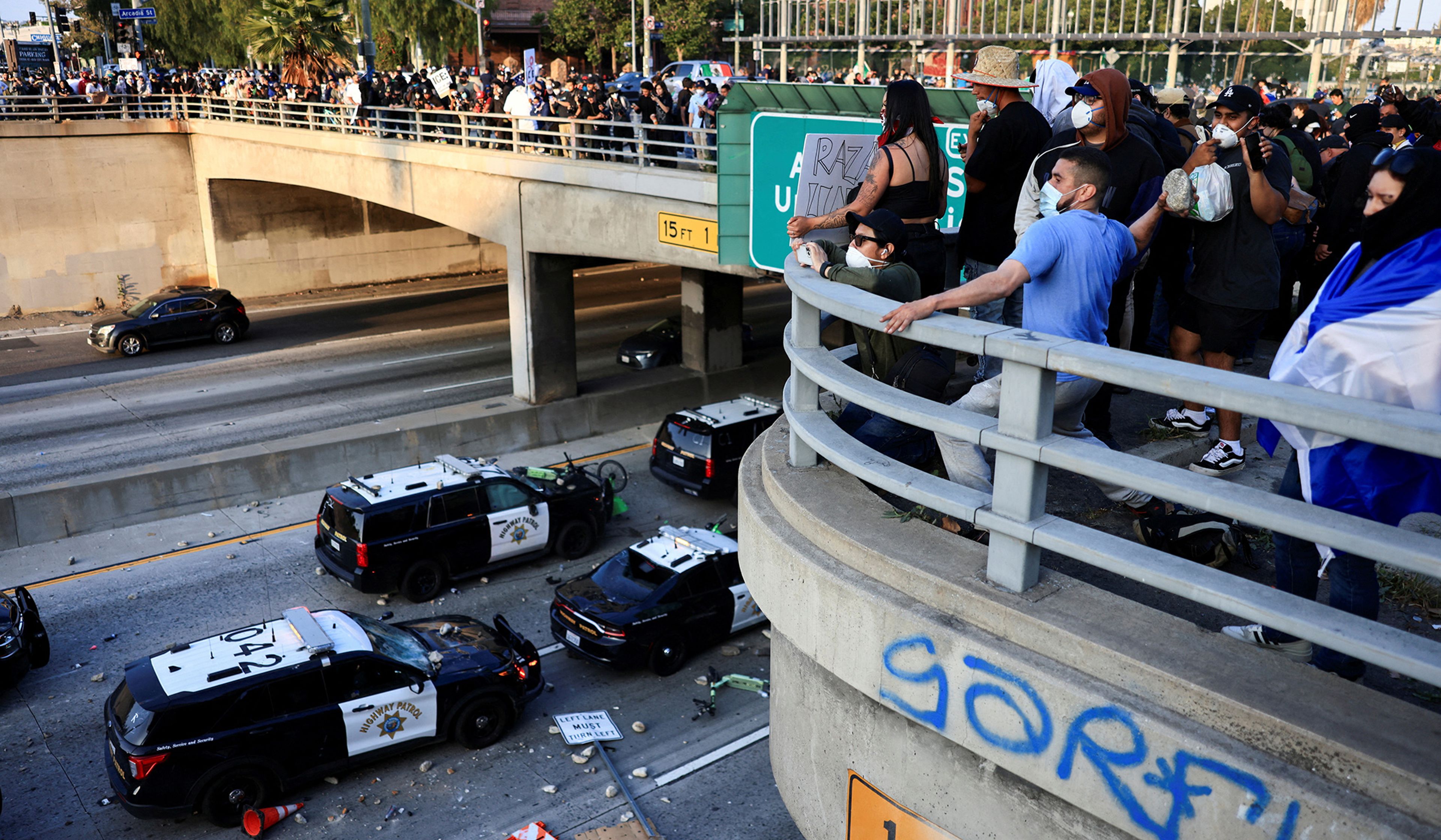

A demonstrator waves a Mexico flag in front of burning dumpsters during a protest against federal immigration sweeps in downtown Los Angeles, Calif., June 8, 2025.
Aude Guerrucci/Reuters
• Sometimes in the Trump administration, doing the easy thing is hard. Regarding the celebrated case of Kilmar Abrego Garcia: Once he was deported to El Salvador in violation of a court order, the administration should have quickly brought him back to the U.S. and then legally deported him. After devoting countless man hours to obfuscating in courtrooms and legal briefs, the administration has finally availed itself of this obvious option. That said, Abrego Garcia was never the father of the year, as the left tried to portray him, and the DOJ has now charged him with human smuggling. The administration will have to prove its case in court but is now unquestionably operating in accord with the law, which is the best way to do law enforcement.
• The House passed its version of the reconciliation bill, which makes permanent the tax rates and the higher standard deduction signed into law by Trump in the Tax Cuts and Jobs Act of 2017, which are currently set to expire at the end of this year, shunning the demands from some on the populist right to raise taxes on the rich. It restores the child tax credit to the value it had after that act was passed. It simplifies and reduces spending on the federal student-loan program. It strengthens work requirements for Medicaid and SNAP. It defunds Planned Parenthood. All of this is good, and some of it, such as defunding the nation’s largest abortion provider, is long overdue. The bill has two major problems: It increases deficits by too much, and it will generate hardly any economic growth. The Senate should address both of these concerns by cutting more spending and by permanently allowing businesses to write off the full cost of their investments when they make them. The revenue could be made up by brushing off demands for grossly enlarged deductions for the taxes imposed by spendthrift states. The Senate should also look to cut more of Joe Biden’s so-called Inflation Reduction Act, implement site-neutral payments for Medicare, and remove handouts in the House bill such as the “Trump accounts” and the various tax deductions for overtime, seniors, car interest, etc. House members from high-tax states are threatening to vote down the bill if they do not get the huge tax break they want; let’s see if they are really willing to let taxes increase for nearly all taxpayers because they’re upset about one deduction.
• Opponents of Republicans’ Medicaid plans say that they will reduce enrollment in the program. They’re correct, and that’s a good thing. Medicaid enrollment is currently too high, for several reasons. The first, and most troubling no matter what you think of the efficacy of the program, is that millions of people who are not eligible for it because their incomes are too high are currently enrolled. The second is that some states have allowed illegal immigrants to enroll. Everyone should be on board with kicking those two groups of people off the program. The third reason, where opinions differ, is that Obamacare expanded Medicaid to cover able-bodied, working-age people, and the federal government pays states a higher reimbursement rate to cover them than it does to cover the children and disabled people that Medicaid is supposed to be for. That has led to the current situation, where the national Medicaid enrollment rate is double the poverty rate, and disabled people are on waiting lists while able-bodied people are covered. Medicaid is also the No. 1 program for improper payments. Getting Medicaid under control means spending less money on it and covering fewer people, and Republicans should not be ashamed of doing so.
• President Trump’s acceptance of a $400 million Boeing 747-8 — the “palace in the sky” — from Qatar would be indefensible even if the sharia-supremacist regime were not Hamas’s lifeline and Iran’s close ally. His attempt to defend it — as “a very public and transparent action” that benefits the Defense Department — has been pathetic. A bribe’s visibility can enhance its impact. That’s why Qatar spends openly and lavishly on American universities, institutions, and corporations. The constitutional prohibition against foreign emoluments unambiguously applies to presents “of any kind whatsoever, from any King, Prince, or foreign State.” There is an exception only if Congress approves, which it has not. Trump pressed Doha for the “gift” because of irritation over the delays (until at least 2027) of Boeing’s delivery of the new Air Force One. The plane is for his personal use and ultimately to be transferred to his presidential library. As Hamilton observed in Federalist No. 22, “One of the weak sides of republics, among their numerous advantages, is that they afford too easy an inlet to foreign corruption.”
• Where does former special counsel Robert Hur go to get his reputation back? Hur was known as a nonpartisan straight shooter before he accepted the assignment to investigate President Biden’s possession of classified documents in January 2023. In October 2023, Hur interviewed Biden, and as both the transcript and the newly released audio reveal, Hur accurately described the president when he said that “Biden would likely present himself to a jury . . . as a sympathetic, well-meaning, elderly man with a poor memory.” When Hur released his report in February 2024, Democrats exploded over Hur’s characterization; Kamala Harris called Hur’s description “gratuitous, inaccurate, and inappropriate.” The president himself held an evening appearance before the cameras and claimed, falsely, that Hur had brought up the topic of Beau Biden’s death. Hur was right the whole time; Biden and Harris lied. The week that the audiotape was released, Biden’s office revealed that he had been diagnosed with prostate cancer. It is surprising, to say the least, to learn that within 15 months, Biden went from a sparkling clean bill of health — “fit for duty,” as Biden’s doctor characterized him — to a stage 4 metastasized cancer diagnosis. After the Biden team did everything possible to hide Biden’s faltering abilities throughout 2024, it is hard to blame anyone for not trusting declarations about his health.
• Ever since the massacres of October 7, 2023, Hamas-sympathizing radicals have regularly chanted “Globalize the intifada” in protests that have taken over college campuses, blocked off city streets, disrupted traffic, and shut down access to airports. Now, radicals have turned those words into action. In late May in Washington, D.C., a gunman opened fire near the Capital Jewish Museum as attendees were leaving an American Jewish Committee event for young diplomats. The gunman, who chanted “Free, free Palestine” when taken into custody, killed a young couple who were about to get engaged: 30-year-old Yaron Lischinsky, an Israeli Christian who served as a research assistant at the Israeli Embassy, and Sarah Milgrim, a 26-year-old Jewish Kansan who organized missions and delegation visits for the embassy. Less than two weeks later, a man shouting “Free Palestine” and ranting about Zionist killers used Molotov cocktails on a crowd of people in Boulder, Colo., injuring twelve. Those targeted were gathering as part of a weekly “Run for Their Lives” event calling for the return of the hostages that Hamas is still holding captive. There must now be a concerted strategy to make sure that America remains a safe place for Jews to live and worship — a strategy that starts by listening to, and taking seriously, what the protesters have been saying all along.
• It’s easy to forget, amid a deluge of emergency petitions to the Supreme Court on nationwide injunctions against the Trump administration, that the Court also has a regular docket. On the emergency side, the Court’s conservative bloc has upheld the administration’s broad claims to fire even statutorily protected executive officials, audit executive accounts under the Department of Government Efficiency, and set broad immigration policy, but has drawn the line — to the president’s ire — at demanding that due process be provided to individual deportees. On the regular docket, however, the Court has been nearly unanimous in limiting judicial environmental activism; rejecting a two-tiered standard for employment discrimination depending on whether the plaintiff is a member of a minority group; quashing a Mexican government lawsuit aimed at regulating the American gun industry; and protecting Catholic Charities from losing a state tax exemption for religious activities simply because it provides charitable aid to nonbelievers. If it’s not a perfect record, it’s one that should do legal conservatives proud. But the hardest cases, as usual, are stacked in the term’s final month, which beckons.
• Double or nothing! Trump announced right before they came into effect that the steel and aluminum tariffs would be 50 percent instead of the previously announced 25 percent. He said so in a speech at a steel plant in Pennsylvania, and the American Iron and Steel Institute applauded the move. What’s good for the steel industry is bad for just about everyone else, especially domestic manufacturing firms that will now have higher input prices. American businesses already pay almost double the world price for steel, and tariffs allow domestic steel producers to raise prices as well. Doubling the tariff rate right before enactment also discredits any “strategic” justification for this protectionism: What thoughtful strategy assigns no importance to the difference between one tariff rate and double that rate? But Trump enjoys tariffs, and no court has ruled against these. So American businesses will have to pay the price for his caprice.
• President Trump’s tariff policy — declaring bogus national emergencies as a pretense to unilaterally author tax policy on all imports under the authority of a law that has never before been used to implement tariffs — was always unconstitutional. Congress should have acted against Trump’s usurpation of legislative authority, but it failed to do so. Big businesses that would have faced the most harm should have taken the administration to court, but they were more interested in cozying up to Trump than challenging him. So the task of holding the executive branch accountable fell to small businesses represented by libertarian public-interest law firms. One of those lawsuits, brought by Liberty Justice Center, succeeded at the U.S. Court of International Trade, with three judges, including one appointed by Reagan and one appointed by Trump, ruling unanimously that Trump’s tariffs imposed under the International Emergency Economic Powers Act were unconstitutional. The court cited legal doctrines that have typically been championed by conservatives. The decision has been temporarily stayed pending appeal. But it’s heartening to see that in the face of a massive power grab by the president, Americans can still go to court, point to the Constitution, and win.
• After the court’s ruling, Trump blamed, of all people, Leonard Leo. “I was new to Washington,” Trump says, “and it was suggested that I use The Federalist Society as a recommending source on Judges.” Now, Trump rues the “bad advice” he got “on numerous Judicial Nominations.” Never mind that the one Trump appointee on the three-judge panel came recommended by Trump’s U.S. Trade Representative Robert Lighthizer and is a lifelong Democrat, not a Federalist Society stalwart. Not only is Trump’s broadside an echo of left-wing smears against Leo — one of the right’s most effective activists — it’s also profoundly ungrateful. Exit polls in 2016 found that Trump owed his margin of victory to voters who ranked the Supreme Court as their top issue. Trump was able to bid successfully for those voters by aligning himself with Federalist Society views of the judiciary. Listening to the advice of Leo and other conservative legal-movement figures helped Trump send the Senate a steady pipeline of high-quality judicial nominees, resulting in an unprecedented number of confirmations to the federal appellate courts as well as three Supreme Court justices. Without the conservative majority on the Supreme Court, Trump might well have spent the summer and fall of 2024 on trial in federal courtrooms. Leo responded with characteristic grace; Trump could still learn something from him.
• The Food and Drug Administration is supposed to protect consumer health. That often takes the form of an excess of paternalistic regulation of drugs, but it has done the opposite with the mifepristone-based abortion pill. Successive Democratic administrations — most recently using Covid as cover — have stripped away rules designed to ensure that the pill is used under close medical supervision. When ProPublica revealed cases of women who died following complications from the pill, it somehow blamed pro-life states — and was rewarded with a Pulitzer. But those cases are not rare. In April, the Ethics and Public Policy Center released a study of over 865,000 insurance records — a sample 28 times larger than all the FDA-cited clinical trials put together — revealing that nearly 11 percent of women suffered a serious adverse effect from the drug. In response, at the insistence of Senator Josh Hawley (R., Mo.), Health and Human Services Secretary Robert F. Kennedy Jr. called on the FDA to change the warning label on the drug and conduct a top-to-bottom review of the pill’s risks. FDA Commissioner Marty Makary is following through. Meanwhile, the attorneys general of California, Massachusetts, New Jersey, and New York are petitioning the FDA to loosen the remaining restrictions — further proof that, where abortion advocates are concerned, the health and safety of women take a distant second place.
• American Catholics have known for years that the FBI under President Biden considered the traditionalists within their ranks as domestic terror threats, but they did not know just how deep the suspicion went. In February 2023, a former FBI agent leaked a memo produced by the bureau’s Richmond, Va., field office warning against the emerging threat posed by “radical traditionalist Catholic ideology.” Called before Congress to answer for the memo, then–FBI Director Christopher Wray downplayed it as the product of a single office and insisted that it never led to any investigative operations. Now internal FBI documents obtained by Senator Chuck Grassley (R., Iowa) suggest more widespread targeting of traditionalist Catholics. The memo, based largely on the findings of the left-wing Southern Poverty Law Center, was distributed to more than 1,000 agents and was the product of input from agents across the country. The memo also appears to have been part of what was supposed to be a sustained effort: A second anti-Catholic memo was being drafted when the first memo leaked. Beyond the memo, a presentation delivered by an analyst in the Richmond field office argued that “radical traditional” Catholicism’s beliefs are “comparable to Islamist ideology.” The comparison is unfair, as the Biden administration never showed so much hostility to the latter.
• A culture that values human life is a fragile thing. The costs of abandoning it fall unevenly on those with disabilities or special needs, with mounting incentives to discount their lives to save the government money and effort. Physician-assisted suicide also corrupts medicine: Doctors who are supposed to swear to do no harm do the worst kind of harm there is. Assisted suicide is legal in ten blue states, Montana, and the District of Columbia. Campaigns to adopt it elsewhere depend on the support of pro-abortion Democrats. The Democrats who control New York’s legislature have passed the “Medical Aid in Dying Act” over Republican opposition, with some — but too few — Democrats defecting. The bill’s death warrant is limited to patients with a diagnosis that is believed incurable and with less than six months to live. Experience from other jurisdictions shows that there will be pressure to expand that either in law or in sub rosa practice. As we go to print, Governor Kathy Hochul has yet to commit herself. We have little faith in Hochul’s record of bucking her party, but we hope she may not be diagnosed as incurable.
• New York City’s Democratic candidates for mayor met in a long, clamorous debate that changed no minds. Former Governor Andrew Cuomo still leads the field, with seven left-wing midgets biting his heels. Worst of these is Zohran Mamdani, socialist (he wants free bus rides, a rent freeze, and government-owned grocery stores) and Israel-hater (he supports BDS: boycott, divestment, and sanctions). Cuomo mocks his youth: “He has been in government for 27 minutes.” Some of Cuomo’s minutes in government — harassing female colleagues, putting Covid patients in nursing homes — haunt him. The Democratic primary employs ranked-choice voting, so there is always a chance for a dark horse to slip in front. To borrow a formula from a long-ago Louisiana election: Vote for the old hack, it’s important.
• Executives at Citigroup have discovered that conservatives use financial services, too. The company announced that it will no longer require retail clients to restrict gun sales as a condition of service — and clarified that it does “not discriminate on the basis of political affiliation in the same way we are clear that we do not discriminate on the basis of other traits such as race and religion.” In the wake of the 2018 shooting in Parkland, Fla., Citi announced that it would no longer do business with retailers that sold guns to individuals under 21, among other restrictions. The decision to reverse the policy comes as Republicans have grown increasingly exercised about the prospect of political de-banking of the sort that was used against the Canadian truckers who protested lockdowns in 2022. President Trump raised the issue of de-banking at the World Economic Forum earlier this year, and Republicans have introduced legislation to prevent it. Our bankers should be our bankers, and not our tutors.
• According to many progressives, fare evasion on public transit is just a fact of urban life, and efforts to clamp down on it are inherently racist. The District of Columbia City Council decriminalized fare evasion in 2018, and fare evasion on the Metrorail system became endemic. In 2022, a new general manager, Randy Clarke, took over the system. He has led a fare-enforcement campaign that involved installing taller fare gates that are more difficult to jump over and changing the law to let transit police question fare evaders. “Not everyone who fare evades commits crimes, but almost universally, everyone who commits serious crimes fare evades,” Clarke said. Transit police have scooped up dangerous criminals, and the Metro is now on pace for its safest year on record, as fare evasion has declined by over 80 percent from two years ago. There’s a term for this approach that you’re not supposed to say anymore, but it rhymes with “spoken pintos.”
• “Russia holds all the cards,” Trump told Ukrainian President Volodymyr Zelensky in a tempestuous Oval Office exchange in March. Now that a Ukrainian operation 18 months in the making has culminated in spectacular success, we know why the latter was unfazed. Ukraine managed to smuggle into Russia a fleet of small quadcopter drones armed with explosives. Those drones were loaded into crates, which were piled onto modified shipping containers and trucked to locations throughout the Russian Federation. Each was parked adjacent to a key airfield and, at the appointed time, the drones executed simultaneous remote attacks on Moscow’s strategic long-range aircraft. The operation, innovative and daring, destroyed at least a dozen bombers, fighters, and reconnaissance planes. The targets, all military, accentuate the moral distinction between Ukraine’s tactics and Russia’s barbarous efforts to bomb Kyiv’s civilians into submission. Although the operation highlights America’s vulnerability to a similar asymmetric assault, it also demonstrates once again why Ukraine is a worthy as well as a righteous partner.
• “This offer won’t be around forever,” said Secretary of State Marco Rubio in May following what the Trump administration billed as its final proposal for a new nuclear deal with Iran. “At some point, decisions will have to be made about more maximum pressure and other options because Iran can never have a nuclear weapon.” Yet weeks later, the offer is still there. Administration officials, including the president himself, repeatedly insisted that they would not accept a deal that allows Iran to enrich uranium on its soil. Yet multiple media reports indicated that the proposal sent to Tehran would allow it to enrich uranium to levels required for use in civilian reactors. Still, Iran rejected the overture, insisting that it must have indigenous enrichment capabilities. “They’re just asking for things that you can’t do,” Trump complained recently. “They seek enrichment. We can’t have enrichment.” Despite the president’s frustrations, the talks with Iran are ongoing, with new rounds of negotiations already slated to take place in Morocco. So far, the only party to these talks that has shown any flexibility is the United States. Trump clearly doesn’t want to resort to the military option should these talks conclusively fail. Yet, as the president himself once observed in a past life, the party that isn’t willing to walk away from a deal won’t strike a good one.
• A U.S.-backed charity, supported by both private security and the Israel Defense Forces, embarked on an effort to distribute humanitarian aid to the Gaza Strip. With the help of a shockingly credulous press, a variety of international institutions have responded by retailing fabrications designed (and sometimes explicitly said) to show why they should have a monopoly on aid distribution. We were told the population was starving as a result of an IDF hold on aid — a fallacy exposed by the AFP’s observation that “residents have resorted to grinding lentils, pasta and rice for baking bread amid severe shortages of flour.” We were treated to the staggeringly innumerate claim that 14,000 infants would starve within 48 hours if action was not taken. And when the U.S.-Israeli aid program ramped up, U.N. officials and their stenographers regularly alleged that the distribution sites were kill boxes into which Israelis were luring civilians. There is a sense of dread pervading all this that the U.N. aid effort, which has been co-opted by Hamas, could be coming apart — and with it, the terrorists’ rule over the Strip.
• The Israeli military thwarted erstwhile climate activist Greta Thunberg’s plan to sail to Gaza. Thunberg and eleven other celebrity activists boarded a “Freedom Flotilla” and set sail from Catania, Sicily, with nothing more than the keffiyeh on their backs and a “symbolic” amount of humanitarian aid (the ship was too small to carry anything significant). When the activists neared the Gaza coast, Israel promptly detained them for attempting to violate its naval blockade. Thunberg immediately claimed that the settler-colonialists in Israel had “kidnapped” her: inartful phrasing, given Hamas’s actual kidnapping of 251 civilians from Israel on October 7, 2023. Although eight activists chose to remain in Israeli custody and demand a trial, Thunberg and three other activists were voluntarily shipped back to their home countries. Israel has assured the activists that the “tiny amount of aid” they brought with them on their attention-seeking “selfie yacht” will be delivered to Gazans through the proper humanitarian channels. The activists’ stunt could have been more ridiculous only if they had tried to build a pier off Gaza.
• Hong Kong authorities have stepped up their disgraceful harassment of pro-democracy figures. In May, they arrested the brother and father of Anna Kwok, a pro-democracy activist living in exile in America. The city’s police force accused them of financially supporting Kwok. Then they hit Joshua Wong, the imprisoned face of Hong Kong’s student movement, with new charges under the draconian national-security law that Beijing imposed on the city in 2020, accusing him of colluding with foreign governments. Once a free city, Hong Kong is now a Chinese city like any other, under the jackboot of the Communist Party. President Trump can do an immense amount of good by spreading the word about the party’s malign intentions and standing up for Kwok (a U.S. citizen), Wong, Jimmy Lai, and all others who have been targeted for their political activities.
• Earlier this year, Turkish-born Hamit Coskun stood outside the Turkish Consulate General in London, lit a Koran on fire, and shouted rude remarks about Islam. The protest was (Coskun says) against Turkish President Erdoğan’s support for radical Islamism. A man emerged from a nearby building, exchanged angry words with Coskun, went back inside, and reemerged with a knife with which he started slashing at Coskun, who was also attacked by a second individual. Coskun was hospitalized and then arrested. The knifeman has also been charged. The other attacker fled. Under English law, there are strong (it was thought) protections for free speech on religious matters. But in this case, authorities circumvented these laws by charging Coskun with a separate public-order offense. His conduct was entirely peaceful, but a court found him guilty, because his actions were “provocative” and likely to harass, alarm, or distress someone who could see or hear them. The reaction of Coskun’s assailants apparently proved this was the case. His fine was increased because the offense was “religiously aggravated.” Supposedly, England repealed its blasphemy laws in 2008.
• PornHub’s parent company Aylo blocked service in France to protest a law that requires porn companies to verify the ages of their users, citing privacy concerns. In a statement, Aylo defended its “legal and regulated porn” as a better option than what is offered on “irresponsible porn sites.” Aylo operates some of the most trafficked pornographic platforms in the world. The real story here is that the United States has been outflanked on pornography regulation — by the French. There’s nothing wrong with restricting “adult entertainment” to adults.
• In other news from l’Hexagone: France, the land of Gitanes dangling from the lips of tough guys, world-weary mistresses, and philosophers, will ban smoking on beaches, in parks, and outside schools beginning in July. The national stub-out is designed to protect youth from secondhand smoke. “Where there are children,” said Catherine Vautrin, minister of labor, health, solidarity, and families, “tobacco must disappear.” The reform acknowledges national character enough so that smoking will still be allowed on café terraces. Dieu merci. But if brandy and coffee are ever found to cause cancer . . .
• During the 2024 Paris Olympics, Italy’s Angela Carini quit 46 seconds into a women’s boxing match against Algerian opponent Imane Khelif. Khelif was one of two competitors in the women’s boxing division who was previously disqualified from the 2023 International Boxing Association’s women’s championships after failing a sex-identification test. Association president Umar Kremlev said in 2023 that Khelif and Taiwanese boxer Lin Yu-ting were ineligible for the women’s championship because DNA tests had “proved they had XY chromosomes.” Lin did not appeal the association’s decision; Khelif appealed but then withdrew. In defense of its “inclusive” policies, the Paris 2024 Boxing Unit and the International Olympic Committee asserted that, as was the case in previous competitions, “the gender and age of the athletes are based on their passport.” Khelif and Lin were permitted to continue competing in the women’s division, and each won a gold medal. Recently, American journalist Alan Abrahamson, who is a member of the IOC’s press committee, published an excerpt of Khelif’s 2023 lab test results stating that “chromosome analysis reveals male karyotype.” That the IOC allowed Khelif to compete against women is, and always was, below the belt.
• Harvard has parted ways with behavioral scientist Francesca Gino in the fallout from an inquiry into data falsification in her research. There have been dueling lawsuits. A rising star at Harvard Business School, Gino had been seen as an expert in the fields of honesty and ethical behavior. She also held tenure, and no Harvard professor has been known to have lost tenure since at least the 1940s. No longer a rising star, she may nonetheless be a trend-setter.
• After nearly 30 years, Sam Tanenhaus has finally published his biography of William F. Buckley Jr., an epic 900-page project to match an epic life. Tanenhaus deserves credit for the care he took in the research and writing. But Tanenhaus is a center-left writer who pronounced conservatism dead nearly 15 years ago, and his preoccupations blight the book. He maintains that Buckley was a mere “intellectual entertainer,” which significantly underrates his talent and achievement. Buckley obviously made an indispensable contribution to defining modern conservatism through his writing and advocacy, his friendship and correspondence with every conservative intellectual worth knowing (all of whom considered him at least a peer), through his institution-building, and through NR. Predictably, Tanenhaus dwells on Buckley’s editorials in the 1950s favoring segregation. Those editorials were disgracefully wrong, but Buckley had changed on the underlying question by the 1960s. Tanenhaus is also fond of making, as Barton Swaim of the Wall Street Journal aptly put it in his review, “vague imputations of dishonesty,” which tend to be loosely supported at best and tell us more about the worldview of the biographer than the integrity of his subject. Tanenhaus does grant that Buckley was a “great man.” Still, his massive volume doesn’t do justice to a man who lived a legendary life and changed the 20th century for the better.
• Alasdair MacIntyre began his landmark 1981 work After Virtue asking us to imagine an apocalypse. Disasters occur, and science and scientists are blamed; angry nonscientists wipe out nearly all traces of their work. Realizing later they had erred, they attempt to restore science, “but all that they possess are fragments” of prior knowledge. Such was the condition of the modern world, in the judgment of this preeminent philosopher: cut off from true sources of meaning, philosophically uncertain, morally adrift. He spent a prolific academic career — begun in his native United Kingdom, after 1969 carried out in America, and from 1985 onward at the University of Notre Dame — attempting to reanchor modernity by piecing together fragments of the truths he argued that it had discarded, and thereby to restore our ability to live well by something like the classical standard. His consistent sense of the profound brokenness of modern times brought him first to communism. He is not alone in leaving behind the god that failed, and thereafter finding succor in the Catholic faith. But his intellectual and academic achievements in rigorously, if sometimes diffusely, elucidating and challenging virtue ethics and reviving and reapplying Aristotelian and Thomistic thought stand unparalleled. Difficult to categorize politically, he had an abiding discomfort with liberalism, with many of whose precepts and progeny we have quarreled as well, in particular its autonomy monomania. Yet he defined it so expansively as to include — and thus to condemn — some of the foundations of this magazine, and perhaps even of this country. But ethics, philosophy, and modernity are better off for his work, and for his challenges. The work of answering them now belongs to new — doubtless very different — MacIntyres. Dead at 96. R.I.P.
• Michael Ledeen’s signature cause was the need for vigilance against the threat to liberty posed by totalitarian regimes. In his academic work as a historian, his popular books, his labors at the American Enterprise Institute and the Foundation for the Defense of Democracies, and his frequent essays and posts in our pages, he was ahead of his time. He exposed how the jihadist threat of Iran was interlocking with China, Russia, and North Korea, forming a formidable alliance against the United States. Beyond his erudition, his insights into Italian fascism and counterintelligence craft, and his bridge-playing prowess, he was skilled in the art of friendship. He and his wife, Barbara, a force in her own right as a longtime Senate Judiciary Committee staffer, made their home an oasis off the Beltway, where thinkers, policymakers, and journalists convened to solve the world’s problems. It was also where they raised three remarkably accomplished children, all of whom served our country in the wars against antisemitic, anti-Western Islamic radicals. A loyal, learned friend, dead at 83. R.I.P.
• Bernard Kerik had a hard-knocks early life: wastrel mother; high school dropout; father of an illegitimate child during an Army tour of South Korea. Policing saved him. New York Mayor Rudy Giuliani promoted him through the ranks to serve as commissioner of the Department of Corrections, then police commissioner. He was in the latter slot on 9/11, on which day he was showered by debris from the plane that hit the South Tower. President George W. Bush charged him with reconstructing Iraq’s Interior Ministry during the American occupation, and nominated him to be secretary of Homeland Security. Urbanist Fred Siegel believed that had Kerik been in that job, there would have been no dithering by Louisiana officeholders as Hurricane Katrina approached. But Kerik had a weak side. He pulled the plug on his DHS nomination, admitting to having employed an illegal immigrant. Other misdeeds came to light, some tawdry (he kept a love nest for two mistresses), some felonious. He served three years in prison. President Trump gave him a retrospective pardon. Dead at 69. R.I.P.
Politics
The Musk Wears Off
Even casual observers of the parties involved were not surprised that the Trump–Musk bromance broke up. Donald Trump discards associates and allies like cracked golf balls. They take the fall for his as well as their own failures, earning demeaning nicknames on the way out. Elon Musk for his part became the world’s richest man via smarts, energy, and maniacal single-mindedness. Hubris plus hubris was bound to equal nemesis.
Musk initiated the spat by attacking the Big Beautiful Bill after stepping away from his role at DOGE (Department of Government Efficiency). It was as if he finally began to suspect truths about the federal government that he should have known before taking on the job of trimming it. Cuts are there to be made, but they often require the help of Congress (since Congress mandates many a bloated function in the first place). Federal jobholders, meanwhile, are well versed in the arts of survival, using civil-service protections and their own congressional allies.
Cutting all the waste, fraud, and abuse in the world cannot right the federal deficit, because the main drivers of overspending are Social Security, major health-care programs, and the interest costs to finance them. But no one in Washington wants to tackle them, certainly not a White House or a GOP modeled on Trump populism.
Musk will lose the feud, if it continues, because he has other jobs — making electric vehicles, getting to Mars — and distraction entails loss of focus. Trump, however, has no other job apart from asserting dominance. He is president of the United States, of course, but he fills that office by commanding the news cycle, wooing, intimidating, and steamrolling all those about him.
It was a show while it lasted. On to the next.
Corrections:
In “A Cheat Sheet on Textualism and Originalism” (June issue), Bryan A. Garner wrote that the New York Times never apologized for misspelling “just deserts” as “just desserts” when quoting Justice Antonin Scalia. In fact, the Times did issue a correction on March 2, 2011.
In “Silicon Valley Finds Patriotism” (July issue), Jimmy Quinn incorrectly stated that the Pentagon has already awarded a contract for the Golden Dome project and that Anduril founder Palmer Luckey attended an event at the White House.
The Stat
96 percent — the proportion of the growth in total government employment since 1955 that is from state and local government employment, according to data from the Bureau of Labor Statistics.
In 1955, the first year in which BLS data for federal, state, and local government employment are all available, there were 6.95 million civilian government employees in the United States. Today, there are 23.6 million. That 240 percent increase is much higher than the 127 percent increase in the U.S. population over that same time span. The enormous expansion of the federal welfare state in the 1960s and the continuous expansion of federal regulations over the decades might lead one to believe that most of the government employment surge is from the federal government, but of the 16.7 million additional government employees since 1955, 15.9 million are in state and local government. In percentage terms, state government employment has increased the most, 379 percent. Local government employment has increased by 329 percent. Federal civilian employment has increased by only 31 percent. Total state government employment was actually lower than federal civilian employment until 1972. State and local government employment accounted for 67 percent of total government employment in 1955; it accounts for 87 percent today. Almost the entire increase in government employment over the past several decades is at the state and local levels — the complete opposite of the trend in the balance of government power, which has shifted toward the federal government.
by Dominic Pino










Comments