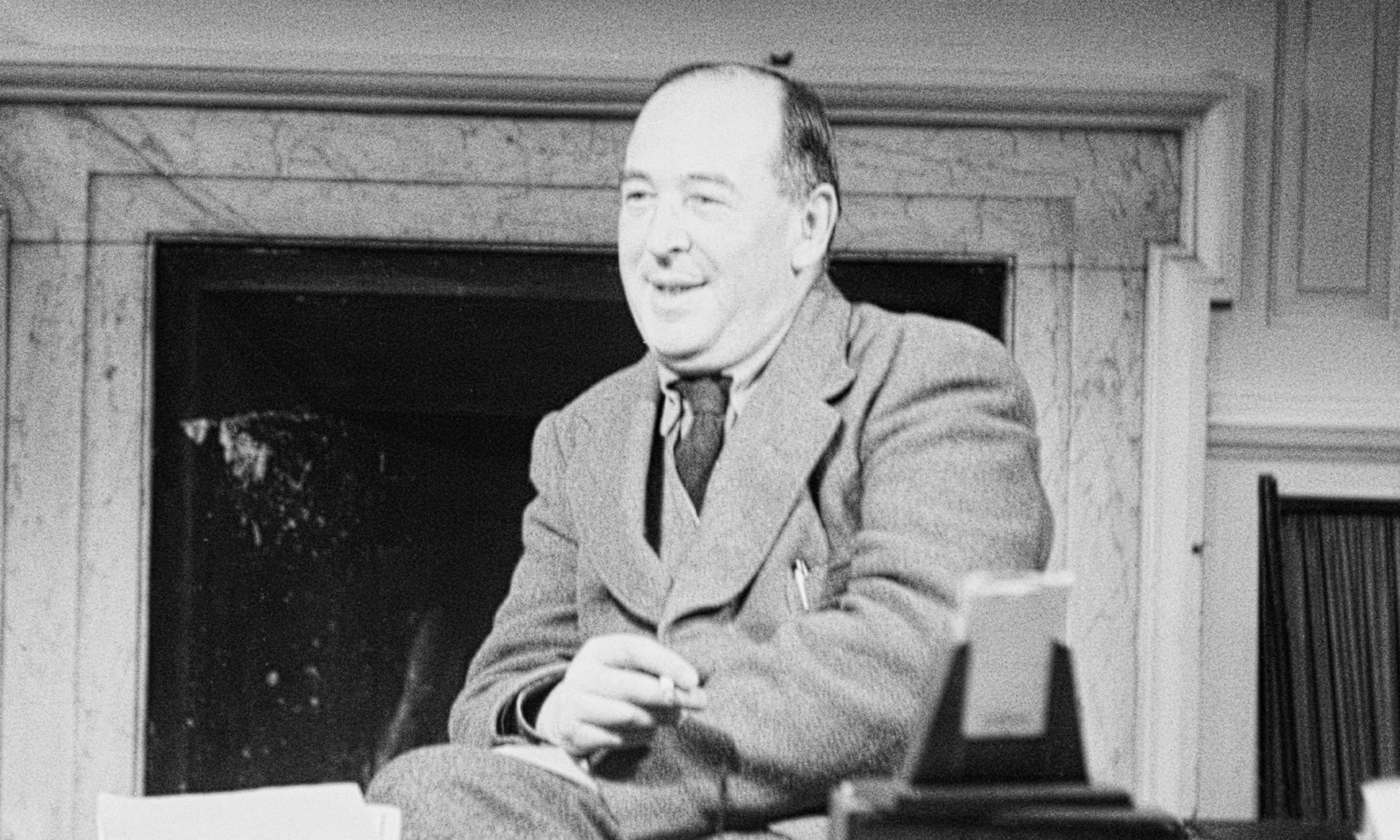
The year 1941, a truly ominous year in the struggle between civilization and barbarism, apparently prompted an obscure Oxford scholar — C. S. Lewis — to think more deeply about the problem of evil in the world, to great literary effect.
There was a lot to think about. Great Britain had survived eight months of a Nazi bombing campaign against London and other strategic cities, but at the cost of 43,000 civilians killed and 1.1 million homes damaged or destroyed. In April, Germany invaded Yugoslavia and Greece, the latest states to be absorbed by Hitler’s blitzkrieg in Europe. In every state controlled by the Nazis, deportations and massacres of Jews became a routine occurrence. In May, Germany invaded the Soviet Union, sending 3.5 million troops across a front stretching 1,800 miles. It was the largest military operation in history, and it caught the murderous communist regime of Joseph Stalin completely off guard. In November, Isoroku Yamamoto, admiral of Japan’s Imperial Navy, issued Top Secret Order No. 1, the plans for the attack on Pearl Harbor. Within a month, Japan was at war with the United States.
Amid the chaos and suffering of the Second World War, Lewis began writing a sequel to his first science-fiction novel, Out of the Silent Planet (1938). Perelandra picks up the story of Elwin Ransom as he travels to Venus (Perelandra), a planet that, in biblical terms, has not experienced a fall from divine grace. Ransom’s mission is to prevent a satanic figure from luring an Eve-like character into a fatal temptation. In a letter to his friend Sister Penelope, dated November 9, 1941, Lewis explained what he was attempting:
I’ve got Ransom to Venus and through his first conversation with the ‘Eve’ of that world, a difficult chapter. . . . I may have embarked on the impossible. This woman has got to combine characteristics which the Fall has put poles apart — she’s got to be in some ways like a Pagan goddess and in other ways like the Blessed Virgin. But if one can get even a fraction of it into words it is worth doing it.
Lewis succeeded beyond his imagination. As James Como argues in Mystical Perelandra: My Lifelong Reading of C. S. Lewis and His Favorite Book, of all Lewis’s books — over 40, in addition to hundreds of essays, poems, lectures, and sermons — no other single work so successfully intertwines his intellectual and imaginative powers, while revealing the breadth and depth of the man himself. Como, professor emeritus of rhetoric and public communication at York College (CUNY) and a leading C. S. Lewis scholar, delivers a profound meditation on the enduring importance of Lewis’s novel: He helps us to recognize our desire for the holy. “The power of Perelandra,” Como writes, “derives from the fact that it offers a convincing portrayal of that Truth for which, knowingly or not, we have always longed.”
Yet Como achieves something more. Drawing on his intimate knowledge of Lewis’s corpus, he reveals the connective tissue between the works, uniquely embodied in the epic narrative and resplendent imagery of Perelandra. Even Lewis devotees may be surprised to learn how some of the key themes of the story — the nature of evil, the idolization of the self, the moral law, the significance of human freedom — also manifest themselves in such works as The Abolition of Man, The Screwtape Letters, The Great Divorce, and The Chronicles of Narnia.
In Lewis’s portrayal of Weston — the mad scientist transformed into “the Un-man” who tries to persuade the Lady to disobey Maleldil (the Creator) — he draws as richly from Milton’s Paradise Lost as from Genesis. The appeal to vanity, the corruption of reason, the invitation to walk “out of this smallness in which you now live, . . . into real life” — all seem horrifyingly authentic. Como, a student of the Western literary canon, would agree with biographer George Sayer’s estimation that “Weston is one of the most powerful and convincing representations of demonic possession in European literature.”
It is in the teeth of this conflict, Como writes, that we witness Ransom’s spiritual growth, “a maturation of character and spirit, undulating certainly, like the waves of the Perelandran sea.” Lewis’s realistic portrayal of Ransom — he doubts himself, struggles with fear, yet engages in mortal combat with the Un-man — appeals to the skeptic as well as the believer. “His courage had to be dredged up, and it was a moral as well as a physical courage; he risked all and endured all on behalf of others, on behalf of a whole world in which he had no palpable stake. . . . Who would not want to be him?”
For Como, this is one of the keynotes of the novel: the individual, spiritual obligation to act, to choose sides in the confrontation between good and evil.
Perelandra shows that we must fight fears both real and imagined, recognize a darkness and enter into combat with it, and then struggle to ascend, for in that ascent is escape from all those concentric worlds of self and culture and the like that would drag us down.
In Perelandra, Ransom’s ascent allows him to experience the overwhelming beauty of an unfallen planet, a vision of the great dance of creation. As Lewis describes it: “A simplicity beyond all comprehension, ancient and young as spring, illimitable, pellucid, drew him with cords of infinite desire into its own stillness.” In this, Como believes, the reader is given a glimpse into Lewis’s personal “mystical vision” of God and eternity, “a voluntary, if oblique, invasion of his own privacy.”
It is remarkable — at least to this reviewer — that Lewis sought to communicate this vision of the holy when so much around him had come under the shadow of a great evil. Nearly the whole world was at war. As he completed his Ransom trilogy, Lewis was taking in child refugees displaced by the Blitz, serving in the Home Guard, and teaching and lecturing young men who would soon be sent into battle. College buildings were converted into hospitals or intelligence units of the government. Windows were blacked out at night and air-raid shelters established.
Thus, not even the “dreaming spires” of Oxford could escape the nightmarish realities of the 20th century, when incomprehensible hatreds and a demonic lust for power instigated a global conflict: the Un-man unleashed.
Here is our debt to Lewis, his act of service in the crucible of war: Like his good friend J. R. R. Tolkien, Lewis deploys his astonishing imagination in the cause of Truth. Through myth — a myth washed in Revelation — he reminds us that the broad road leads to eternal shame, that “to walk out of His will is to walk into nowhere.” He retells an ancient story with a moral purpose: to help us resist the darkness and to love goodness. As Como writes, with palpable gratitude: “He made a path — keep looking, and you will find yours somewhere in his work — he is saying, as the good apostle does, ‘follow me.’”












Comments