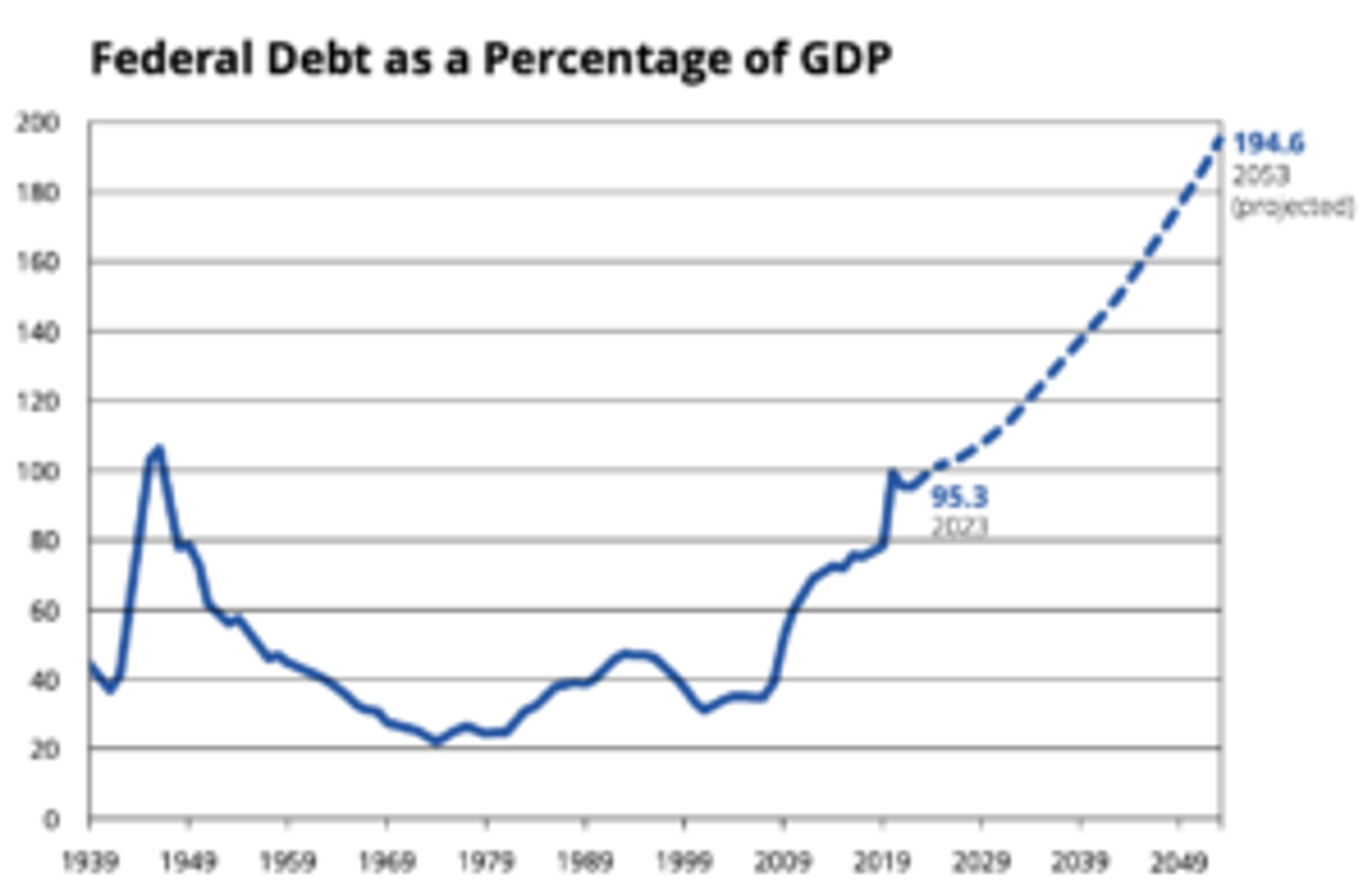
With Fitch’s shocking downgrade of the United States’ credit rating, the question of whether the U.S. will default on its debts in the coming years has become painfully urgent. The nearby chart indicates just how pressing the question is. It shows the debt held by the public relative to gross domestic product from 1939 to 2022 and projects its growth through 2053 using the latest Congressional Budget Office forecast. Today, this measure is almost as high as it was at the end of World War II, and it’s on track to almost double by 2053. To put the 2053 number of 194.6 percent in perspective: It would be roughly 75 percent higher than the peak of Weimar Germany’s indebtedness before it experienced hyperinflation.
But perhaps Weimar Germany was an outlier. Such spikes in debt are common throughout history. The question, of course, is what typically happens next.
Governments have often found themselves with massive amounts of debt after wars or natural disasters. As a practical matter, a government in such a situation has but four options. It can, as Bernie Sanders might recommend, confiscate the property of citizens to repay the debt. Exactly this approach, Aristotle writes, was adopted in his time by the Ephesians, who seized the jewelry of the rich women of Ephesus and used it to retire government debts. The second approach would be to dramatically cut spending, possibly combining this with option one. The third approach is more direct. A government can simply default on its debt by refusing to pay it back or by modifying the terms to extend the repayment period indefinitely. But by far the most common approach has been currency debasement.
To begin a history of currency debasement, one must start with the aptly named Dionysius I of Syracuse. The profligate and ruthless tyrant, who purportedly drank himself to death, employed mercenaries to take command of Syracuse and used them to terrorize his own people and even declare war on Carthage. Mercenaries and wars, of course, can be quite costly, so Dionysius quickly found himself with an unmanageable debt. In response, he laid out the playbook that governments have reliably followed ever since. He ordered, on pain of capital punishment, that all money be turned over to the government. He then reminted the coins and changed the numbers, doubling their value. One drachma was suddenly worth two. With this debased currency, according to a historical account by historian Max Winkler, he “repaid” his debts.
History corroborates the connection between war or crisis and exploding debt. When Rome began the First Punic War, Winkler reports, its coins contained twelve ounces of metal. After the war, Rome reduced the metal content of its currency to two ounces. After the Second Punic War, the metal content was reduced to one ounce. After the Third Punic War, it dropped all the way to half an ounce. Each time, the government repaid its debts, but lenders were left significantly worse off. Rather than engage in outright default, Rome repeated this practice through its history, perhaps because Roman law required that someone who reneged on his debts be disemboweled.
Sovereign default has historically put a heavy burden on the citizenry. But as international capital markets evolved, default or debasement became even more common, as it is often more politically feasible for a politician to cheat foreign investors than to cheat his own citizens. But with this increasing integration of capital markets came an increased sensitivity of the global economy to localized devaluations or defaults.
The worst modern example of this, of course, was the collapse of Weimar Germany, which led to global economic calamity. The fact that the victorious Allies extracted heavy reparations from the Germans is well known. What is perhaps less understood is that the reparations were needed to pay the interest on the massive debts the Allies had incurred during World War I. When the deutschmark dropped to a trillionth of its initial value, and the Germans’ ability to pay reparations evaporated, the entire international financial house of cards collapsed. Suddenly, in 1931, international capital flows seized up, and many sovereigns stopped payment on their debts. According to a fascinating IMF study, this episode came about because of the complex web in which the government finances of virtually every country are interweaved.
This is not to say that outright default is totally uncommon. In a recent historical review, economists Michael Tomz and Mark Wright collected data on 176 sovereign entities since 1820. They found that there had been 248 defaults and that these tended to occur in waves, the most recent of which was just a few decades ago. Given the global explosion of debt following the pandemic, another wave is not unthinkable.
Fine, a skeptic might say, but the U.S. would never default on its debt. It will somehow find a way, as it always has. But the U.S. has defaulted on its debts, or technically on its promises to pay, four times already. The first default happened during the Civil War, when the convertibility of the currency into precious metals was suspended. A similar decoupling of the currency from the promise to deliver precious metal happened as recently as 1971.
Our skeptic might then turn to the U.S. post-war experience. We honored our debt from World War II, and the economy boomed. Perhaps we can just return to the playbook that delivered that miracle?
Perhaps not. A recent study by economists Julien Acalin and Laurence Ball looked at the methods that the U.S. government used to restore balance and found that it relied on three tools and a bit of good fortune. The first tool was our old friend, currency debasement. The government printed money, inflation was higher than expected, and bondholders were paid back with devalued money, just as in Syracuse back in the day. The second tool was something the literature refers to as “financial repression.” The government ordered financial institutions to hold large quantities of U.S. debt while it kept the interest rate close to zero. Thus the runaway expense was controlled, and the fact that low interest rates created little demand for our debt was neutralized. The third tool was austerity. The government recognized that it was in a perilous state, and so it regularly ran surpluses. Finally, the economy helped. Until the 1970s, the economy grew at a rate that was significantly higher than the interest rate. Higher incomes made it easier to retire debt.
Today, our productivity slowdown and ageing population make it unlikely that the economic-growth rate will exceed the interest rate; and financial repression, while an available tool, looks to be a dangerous one in the wake of the failure of Silicon Valley Bank and other banks. Congress could decide to run large surpluses in order to pay back the debt, but neither political party seems willing to propose such a thing, which leaves us with the most commonly relied-upon tool: inflation and consequent currency devaluation.
In other words, we know how this story has to end. Markets do as well. At the start of the previous administration, the price of gold was about $1,200 per ounce. Today it is closing in on $2,000. But gold is illiquid. People would prefer a currency that can be used for everyday transactions but is not exposed to what we might call the “Dionysian risks” associated with government fiat. As a result, alternative, more-liquid stores of wealth have blossomed on the internet. Back at the start of 2017, Bitcoin was trading at $1,000 per coin. Today, it is trading at close to $30,000.
One might consider these quests for dollar alternatives to be some sort of speculative bubble. But a look at the exploding U.S. debt and a careful study of history suggest that investors around the world are engaged in a sensible flight to relative safety.












Comments