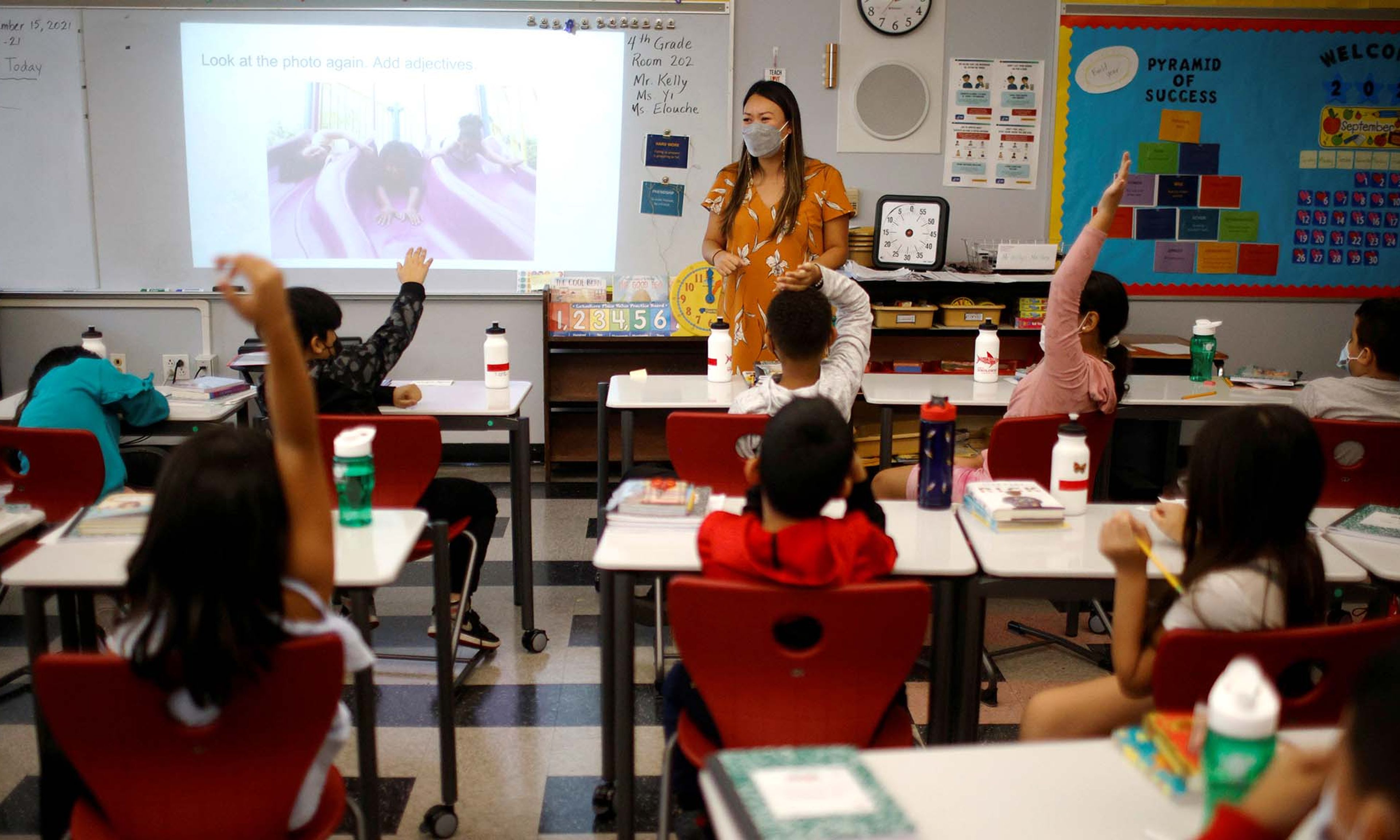
Imagine with me, for a moment, that the year is 2030. You’re the parent of an ambitious middle schooler, and together you are charting out the mix of courses your daughter will take next. It’s summer, but that doesn’t mean she’s on summer break. It doesn’t make a whole lot of sense for an ambitious child — or really any child — to take a ten-week break from learning simply because that’s how it’s always been done.
Instead, she started her morning in a virtual Hindi-immersion course taught by one of the finest dual-language instructors in Mumbai. She not only is learning the language — a course your assigned government school doesn’t offer — but has made friends truly the world over. She hasn’t yet said it, but they’re clearly working on a plan to all meet in person someday, somewhere.
Next, she’ll head to a STEM-focused charter academy nearby for some applied-math coursework. There are no math textbooks; instead, students learn geometry and algebra concepts hands-on as they program an AI-powered robot. You’re hoping today might be the day she trains it to clean up her room, one of the few things in life she does not seem especially interested in.
She’ll hop in a ride-share vehicle with a few classmates after math to head to what was known as the elite private school when you were a kid, the one you wanted to attend but your parents could never dream of being able to afford. Today it’s known simply as a really great school. There she is taking an integrated course on economics, history, and government. Today they’re running a simulation on how tax rates impact new business start-ups.
In the fall, she wants to spend mornings at the school attached to the church you attend, focusing on character development. It’s important to all of you for her to stay close to the values your family holds dear. While there, she’ll work on her writing skills. She’ll be in a classroom, but the teacher won’t be. He’s the author of last year’s must-read teen-fiction sensation. He never would have been interested in teaching writing at just one school, but he was intrigued by a proposal to teach 50 classes simultaneously. There will be a coach in the room to help make sure everyone gets any help she needs, and the author-turned-educator is planning to visit your daughter’s school in person a few weeks into the semester. Your daughter tries to hide it, but she couldn’t be more excited.
The cost to you for all of this? Not one cent. Your state passed an education-savings-account law five years ago. Instead of sending the dollars allocated to your child’s education to a school building you didn’t select, the new law puts them into an education account you control. Your daughter’s love of learning has exploded since then. Sure, there are still mornings when you have to cajole her out of bed, but once she’s up, she’s learning, and there’s no stopping her.
Or perhaps you’re the parent of a high schooler in a rural area in middle America. He goes to what most consider a pretty good regional public school, and for the most part, he would agree. His teachers care, and the classes he can take are fairly engaging.
But they don’t have any of the courses he really wants. His aim is to become an artificial-intelligence and machine-learning engineer. It’s not a common job in his farming community, but he thinks integrating robotics and sensors could really improve crop yields and reduce the amount of water and pesticides required.
He starts his morning on the farm, helping his dad. He’s enrolled in the “Great Books” program at Columbia University and uses the tractor time to listen to the novels. At 9 a.m., he heads to the John Deere factory, where he’s employed in an apprenticeship, working side by side with some of the best thinkers in the AI field. He’s there through lunch and then heads back home and attends a virtual charter school for his core coursework (which also gives him class credit for the apprenticeship). He’s found that the self-paced lessons help him focus better than he did in the classroom; plus, he can work through the material much faster than the classroom pace. Five p.m. is football practice. They’ve shifted to a community-based team rather than a school-based team. Previously there was only one school, and they excluded non-enrolled students. They realized a couple of years ago that that didn’t really make sense. The team has won a lot more games since then.
He, too, does all of this through his education savings account. It doesn’t cost his family anything, which is good on a family farm, where the margins always seem to be tight. Perhaps his newfound engineering and computer-science skills will help improve the family’s fortunes — and everyone else’s in town — before long.
Maybe instead you’re a single parent living in an urban area. You commute to work, and the hours are long. They don’t come close to matching up with the hours your government-assigned school has set. It’s a struggle every day just to make sure someone has eyes on your child from when you both hop on the bus in the morning until the evening, when you can get home.
You’re concerned about academic quality, but you’re especially concerned about safety. The neighborhood seems to be getting worse with each passing year. One day you come across a booth at the YMCA with all sorts of information about school options in the area. You never really had the time to think about sending your child somewhere else; most days you barely have time to think at all. One option catches your eye. It’s a dual-language immersion school, and importantly, it’s open from 7 to 7. They’ve brought several community resources and programs together under one roof to provide a safe, nurturing place for kids like yours to gain new skills and expand their horizons instead of enduring what waits for them on the streets.
You marvel at the novel concept of a school that works around parents’ schedules, not the reverse. But as a result, you assume there must be a cost that’s beyond your means. Much to your surprise, it is covered fully by a tax-credit-funded scholarship program in your state.
You enroll your child on the spot.
This is what education can look like. It’s what it should look like. Innately curious children following their passions, expanding their horizons, and learning from the best of the best. Educators — those trained to teach as well as those who have a lot of knowledge to impart — freed to inspire and engage young minds rather than conform to a system controlled by mandates from on high and measured only by a standardized test.
It’s a stunning contrast to what education in fact looks like today. It’s also a quantum leap from what most of us can imagine education looking like, probably because we’ve never known another way.
Education is the least disrupted industry in America. I’ve made that statement often. People in education still get offended at hearing the word “industry,” but that doesn’t make it any less true.
Education is an industry. It provides a service to the public. It exchanges that service for money, with outposts in every town across the country. Education has vendors, trade shows, whole lines of business set up just to support it, and lobbyists — armies of lobbyists — local, state, and federal lobbyists. Truth be told, there are some classic industries that don’t have all of that.
While the education establishment dislikes being described as an “industry,” what’s more telling is that they don’t quibble with the “least disrupted” part of “least disrupted industry.” They can’t, because they know it’s true. They know education hasn’t evolved the way television has, the way everything else we interact with has.
Horace Mann, who originally called American children “hostages to the cause” of our public-school system, is often called the “father” of that system. In the middle of the 19th century, Mann took a model of education developed in central Europe for the industrial age and brought it to American schools. Student desks aligned in rows. A teacher in front of a blackboard. Learning by rote. Sit down; no talking; eyes up front. Wait for the bell. Move to the next class. And . . . repeat.
American education hasn’t really changed from the basic framework Mann created 175 years ago. Think about that in this context: Horace Mann died nearly two decades before Alexander Graham Bell invented the telephone. The man who designed the education system that is still structurally intact across almost all of the United States never made a telephone call. He likely didn’t even dream of such a thing.
It took a century — 100 years — from Bell’s first call to Mr. Watson before the first cellphone came on the market. And it was three decades later when Steve Jobs held the first iPhone up to the world. In total, 150 years came and went between “father” Horace Mann’s demise and our ability to access information the world over from the palm of our hand. A child entering kindergarten today may very well never see a landline telephone in his or her life, at least not outside of a museum. While that may evoke some nostalgia for those of my generation, it would be hard to argue that the child is worse off because of it.
Public education should mean educating the public, not sending kids to a specific type of school building or school system. Understanding this definition of public education is central to understanding what the future needs to hold. I would argue that any school that educates the public is a public school. And any place or person that educates the public is providing public education. After all, that’s the point of publicly funding education — to have the public be educated.
Even to Horace Mann, the reason parents were to give their children over for mandatory instruction was that he knew that a republic composed of uneducated individuals was unlikely to remain a republic for very long. Washington and Jefferson, along with most of their contemporaries, held similar views.
In fact, the first voucher for education in America wasn’t actually established in 1989 in Wisconsin. The first one was issued much earlier than that — in 1781, to be exact. Thomas Jefferson, while constructing Virginia’s school system, realized that some students would have the capabilities and interest to pursue higher levels of schooling than what their parents would be able to afford and beyond what the public schools of the day offered. So Jefferson proposed a simple solution: The government would cover the cost of their tuition. Jefferson didn’t call it a “voucher,” but that’s precisely what it was.
I have yet to meet any serious person who is opposed to education, or to public education — as defined above. That’s what makes the teachers’-union talking point that I and other reformers are “anti–public education” so maddening. One of the most cited but least sensible criticisms of school choice is that it’s meant to destroy or defund public schools. In a choice system, the only way a traditional public school loses students, and thus funding, is if a family chooses to leave the school. The odds are low that parents would choose to leave a school where their child is learning, growing, and thriving. Parents are going to remove their children from schools that aren’t working for them. If a school isn’t working for enough of the kids assigned to it, that should be a signal to the leadership that changes need to happen. And if it can’t respond accordingly, maybe the school should close! Clearly it isn’t doing its job.
This is what happens with charter and private schools. If not enough families choose them, they close. There’s nothing inherently bad about that. Stores and businesses close every day. New ones open. This healthy dynamic is what continually brings us better restaurants, better grocery stores, better experiences in every other area of life.
The reason public schools don’t close is that we’ve become more attached to the infrastructure than to who is served inside. Defending the system and all of its component parts — its buildings, its traditions, its power, even our nostalgia about our own school experience — has become what matters most. “The system” is the focus of nearly all discussions about K–12 education.
It is worth noting that I’ve never heard it claimed that giving parents more options is bad for Mom and Dad. Or for the child. What you hear is that it’s bad for “the system” — for the school building, the school system, the funding stream. That tells you a lot about where priorities lie.
Let me posit another hypothetical. Imagine we gave every student in America an education savings account with the sum total of the local, state, and federal taxpayer investment that is currently given to the government-assigned school.
What would be the downside?
Kids would still learn. Teachers would still teach. Taxpayers would spend the same amount as they do today.
Of course, I believe — and the research confirms — education would improve. Students would learn more. Teachers would have more autonomy to teach. Taxpayers would get a better return on their investment.
But even if you don’t believe all of that, decades of data prove unequivocally that the present system isn’t working. Consider the consistently failing grades shown on the Nation’s Report Card, or America’s dismal rankings — not even close to the top ten in math, science, and reading — versus our international peers on the Program for International Student Assessment. We have government schools that are consistently producing middling results — even for the “best” students.
So why do we keep trying to “reform” our education system by doing the same thing over and over? Why haven’t we changed our education system to one of education freedom?
As Donald Trump infamously said, though in a different context, “what the hell do you have to lose?”










Comments