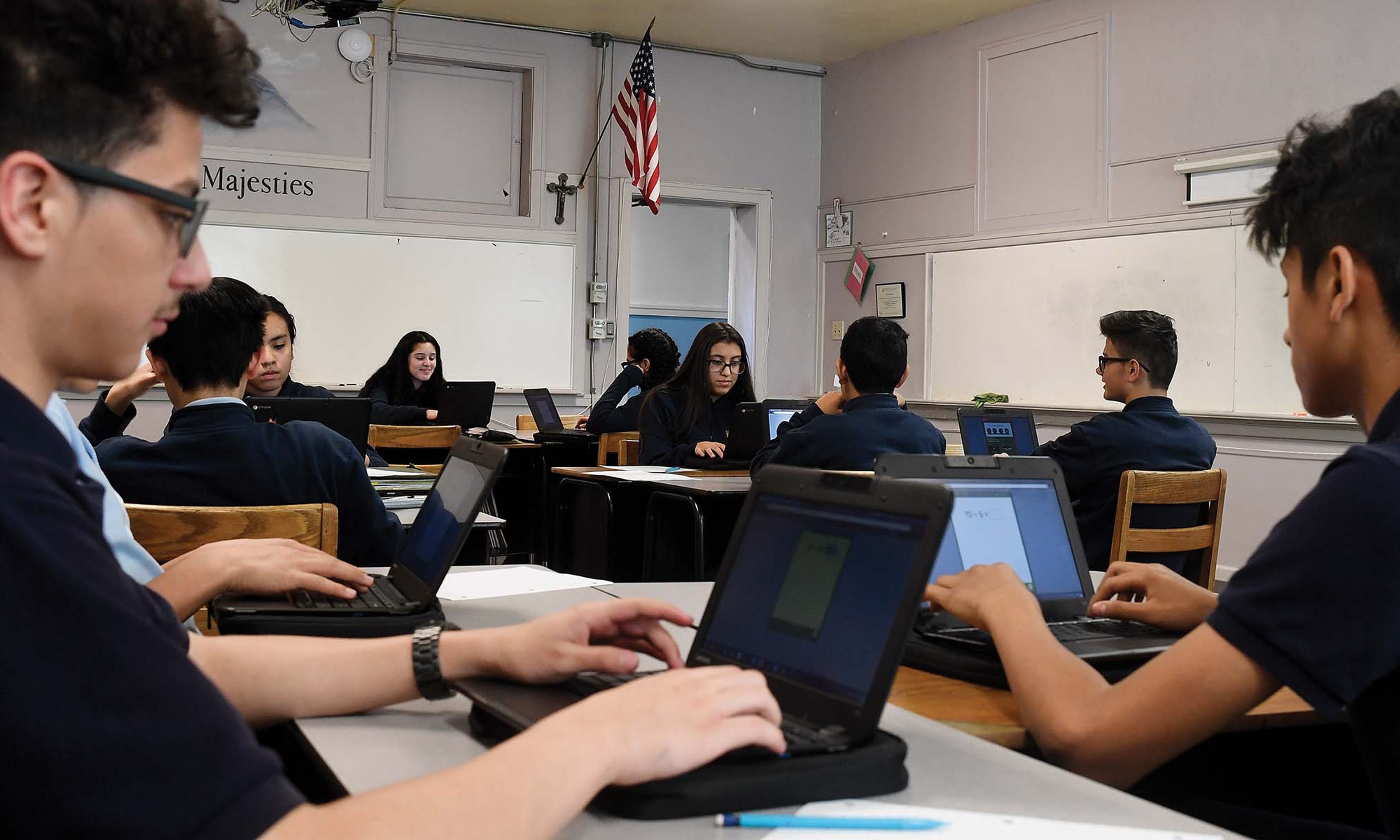
So much has gone wrong in American education the past few years — school closures, rising levels of violence, watered-down curricula, politicized classrooms — that it would be easy to miss one of the biggest educational comeback stories in a generation. After a half century of declining enrollment, America’s Catholic schools are bouncing back. While parents are leading this resurgence, it will take policy-makers to ensure that the flight to quality education lasts.
One reason we often overlook the American Catholic school “system” is that it isn’t much of a system at all. Rather than being led by a central authority, American Catholic schools are a great example of our country’s commitment to local civic institutions. From the dawn of Catholic education in the United States, schools were created by local communities — largely parishes, but also religious orders — for local communities. This agile, community-centered orientation contributed to the sector’s responsiveness and leadership through the Covid-era crisis.
Indeed, in March 2020, Catholic-school leaders had the autonomy and flexibility to assess the local threat and didn’t need to wait for guidance from a sprawling bureaucracy about how to act. As a result, many Catholic schools were among the first to close. Then, in fall 2020, when it had become clear that children were among those least vulnerable to the virus, and when we had more information about how to mitigate “super spreader” events, Catholic schools found a way to reopen while traditional public and charter schools stayed closed. By September 2020, 92 percent of Catholic schools had reopened for in-person or hybrid learning, compared with just 43 percent of traditional public schools and 34 percent of charter schools. These decisions were driven not by a centralized bureaucracy but rather by the community-focused leadership of principals and pastors who saw how much families needed in-person community and learning.
At the same time, the independent, autonomous spirit that allowed for such transformative leadership during Covid has allowed many Catholic schools to resist the latest curriculum fads and stand firm in favor of a rigorous classical and classically inspired education.
Indeed, it’s that principled leadership that is at the core of the most successful Catholic models. For example, the Institute for Catholic Liberal Education has sparked a renaissance in many parish schools by fostering an embrace of a classical curriculum infused with church teaching. Similarly, the network of Chesterton Academies stands as a telling counter-trend to closing schools and declining enrollment. By combining a classical curriculum with “a focus on truth, goodness, and beauty” and formation in virtues and faith, the network has grown from one school in 2008 to 27 today.
What will it take to keep this renaissance growing?
First, Catholic schools need to resist the temptation to compete with public schools by becoming more and more like them. Catholic schools have unique comparative advantages, and parents value mission-driven leadership and real choice. That means individual school and diocesan leaders should not be looking to replicate their public-school “competition” or selling themselves to prospective families by copying what public schools already offer.
Take, for instance, marketing. When Catholic schools face enrollment crises, they frequently look to advertising to attract new recruits. Unfortunately, these marketing efforts too often focus on making Catholic schools resemble any academically rigorous independent school, with nice facilities, smiling students, and little sense of the two millennia of insights into the human condition on which they are built. Similarly, these marketing efforts focus on selling STEM or STEAM (the “A” is for “arts”) programs, or trying to incorporate robotics, engineering, or “maker spaces” (hands-on STEAM learning labs) into the sales pitch, which misses what is driving so many parents to leave public schools right now.
To be sure, these programs can and often do add value, but only if they are established in a way that supports the overall Catholic mission while recognizing the financial limitations that Catholic schools face. A Catholic school cannot outspend a well-funded public school, so simply trying to copy the programming may end up further diluting the brand and undermining the mission.
Second, Catholic-school leaders — at the independent-network, diocesan, and school levels — need to seize the opportunity to rebuild the schools. This will mean that they cannot lament the challenges they face — the financial constraints they operate within, the increased competition they face from charter schools, the lack of access to state and federal funding, and more — as facts that define our destiny. The challenges Catholic schools face are real, and in some places, they present an existential threat. But there is far more within their control than those who benefit from them sometimes acknowledge, and there is much the beneficiaries can do to drive lasting change.
Finally, public officials will have to level the playing field for Catholic education. When you compare the 2021–22 Catholic-school enrollment boost in states that have robust school-choice programs with those that have either no choice programs or limited choice, there is evidence that families are more likely to choose Catholic schools when the cost barrier is removed. For example, in a recent report for the Manhattan Institute, my co-authors and I found that states with robust tax-credit or voucher programs saw more stable enrollment in the first year of the pandemic than states with no choice programs. Even more heartening, the six states that have education savings accounts saw enrollment increases that were almost twice as large (6.3 percent) as in states with no accounts (3.6 percent).
The bottom line: When parents have more control over the money spent on their children’s education, they often use it to opt in to Catholic schools. Parents must demand that state officials recognize religious freedom and enable them to exercise their right to choose schools aligned with their priorities and beneficial to their children and communities.











Comments