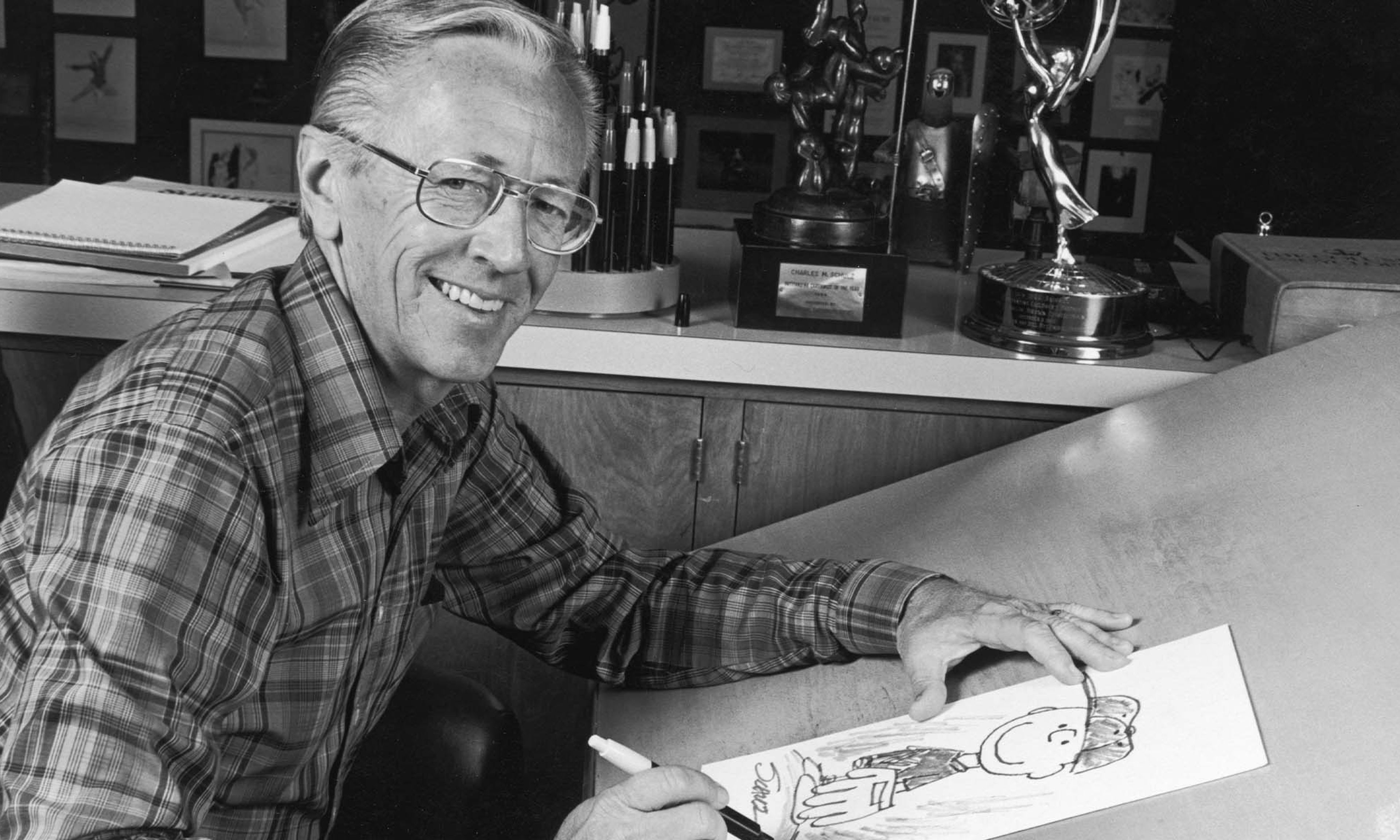
The best way to ensure that great artistry and entertainment are broadly known yet never granted the full respect they are due is to work in an art form associated with children. The past century in American culture has witnessed the work of a number of creative geniuses, such as Walt Disney, Jim Henson, and Chuck Jones, who plied their craft in cartoons and puppetry. This gave their work a reach and resonance others could only dream of, allowing them to inhabit the imaginations of audiences who carried that imprint their entire lives. And yet we tend not to treat them as serious artists.
The same could be said of Charles Monroe Schulz, the Peanuts creator who was born in Minneapolis on November 26, 1922, to a German immigrant and the daughter of Norwegian immigrants, and who died in his sleep on February 12, 2000, the night before his final comic strip ran in the Sunday papers.
A century after his birth and two decades after his death, the Peanuts characters remain beloved American icons. What American doesn’t know Charlie Brown, Snoopy, Linus, or Lucy? The Peanuts Christmas special, made in 1965, remains a holiday tradition. The Peanuts Movie, released in 2015, made a quarter of a billion dollars worldwide. The U.S. Postal Service is honoring the centennial with stamps of the Peanuts characters — but not of Schulz himself, who always insisted that he should be known only through his comics.
Schulz is revered within the cartooning world, which understands his genius and the scale of his accomplishments. But who would discuss Charles Schulz in the same breath with Ernest Hemingway, F. Scott Fitzgerald, George Gershwin, Chuck Berry, Bob Dylan, Steven Spielberg, Martin Scorsese, Meryl Streep, Langston Hughes, Georgia O’Keeffe, or other iconic American artists of the 20th century?
We should. Schulz was the greatest of all American newspaper cartoonists. Sure, you can make the case that Peanuts never quite reached the comedic heights of Gary Larson’s The Far Side or Bill Watterson’s Calvin and Hobbes, or the historic impact of political cartoons such as those of Thomas Nast. But even aside from his humor and his massive commercial success, no other cartoonist can match Schulz’s combination of artistry, longevity, sustained quality, emotional resonance, and influence on the form.
Watterson, who has written that Schulz “blazed the wide trail that most every cartoonist since has tried to follow,” is the first to acknowledge his debt to the melancholy Minnesotan. Schulz expanded the whole idea of what a comic strip could be about, and he did so without ever depicting an adult.
Drawing a daily comic strip really well is an exceptionally demanding art. Cartoonists don’t have the luxury of waiting for inspiration; there has to be a new idea every day. Schulz came up with 17,897 of them over the course of 50 years, laying down his pen only when dying of colon cancer at 77. Stars such as Larson and Watterson burned out and quit much earlier, Larson at age 45, Watterson at 37. Yet Schulz never went through the motions. He sustained his creative prime for three decades, through the social tumult of the Fifties, Sixties, and Seventies. In his later years, he was still introducing new characters, finding new sources of humor and pathos even as he struggled with a shaky hand that made cartooning a chore.
The constraints of space and form in a comic strip are as inflexible as those of a sonnet or a haiku. Even in the fat years for newspaper funny pages — the years of Schulz’s prime — the strip was crammed into a few inches on cheap paper, printed without color, competing for a few moments of the reader’s attention. The more panels the cartoonist uses — Peanuts typically was drawn in four panels for the daily strip, three later in Schulz’s career — the less space there is for words and pictures, and the harder the cartoonist must work to convey characters, a situation, a setup, and a punch line. In this environment, every stroke of the pen must carry meaning, and no word of dialogue can be wasted. Schulz was a master of economy, an expert at packing recognizable emotions into a turn of the lip or a few lines around the eyes.
The cartoonist’s work is then packaged for the adults who buy newspapers, even if the strip is about small children. Even the most popular cartoonist can never assume that the reader has kept up with yesterday’s strip, so if there is an ongoing story of any kind, it needs concise explanation. In one 1953 strip, Charlie Brown fails to impress Patty with a comic drawing and complains, “My humor is too subtle for the average reader.” It was a joke by Schulz on himself.
Unlike cartoonists who turned their characters into a brand to be carried on by others (sometimes under their name), Schulz took great pride that nobody else ever drew a single stroke of Peanuts or wrote a single line of its dialogue. Syracuse University professor Robert Thompson dubbed Peanuts “arguably the longest story ever told by one human being.” This took a toll. As the old saying goes: “If I’d had more time, I would have written a shorter letter.” Schulz slaved over his concise masterpieces with a monomania that ultimately drove away his first wife. Biographer David Michaelis concludes that Schroeder, who plays Beethoven on his toy piano obsessively while ignoring the increasingly shrill romantic overtures of Lucy, is a stand-in for Schulz and his first wife, Joyce. They divorced in 1972. Schulz turned that marital conflict into childhood comedy, beginning in the mid 1950s and peaking in the late 1970s with an extended series of strips following Lucy throwing Schroeder’s piano into the sewer.
Mining his own pain for his art was how Schulz prospered, and to some extent it was how he coped, too. He was the only child of distant parents, and his mother died after a long illness in 1943. Schulz went to war four days later. He saw only desultory combat, arriving well behind the front lines in France in February 1945, but the Army made him a staff sergeant, and for the rest of his life he treasured the fraternity of veterans. The annual Peanuts Veterans Day homage to Stars and Stripes cartoonist Bill Mauldin (only a year older than Schulz himself) was Schulz’s way of honoring those who had a harder war than he did. Snoopy’s adventures as a First World War flying ace, by contrast, invited readers to join Schulz in imaginary heroics.
Schulz returned home to a world booming with children, the sons and daughters of men like himself who had come back hardened by war. More than anyone else in the popular culture of the day, the sensitive and cerebral Schulz grasped something important about childhood: that it is a time not only of play but of anxiety, insecurity, social uncertainty, and the struggle to forge an identity and place in the world. The Peanuts gang knows only unrequited love and endless frustration, except when Snoopy is disappearing into his Walter Mitty fantasy lives. Schulz also understood that portraying these feelings in children would resonate with adults, because so many adults still carried those emotional scars, as he did for his entire life. Peanuts could be clever or wickedly funny at times, but it was the pang of emotional recognition that bound audiences to its characters.
I was privileged to discover Peanuts in the newspapers as a kid in the mid 1970s when Schulz was still at the top of his game, and I collected books of his older comics obsessively. There were many of us, over the decades, who saw ourselves in the smart but uncomfortable and thwarted misfits that populated Peanuts.
Charlie Brown was Schulz’s most obvious alter ego, carrying his first name and being (like Schulz) the proud son of a barber. He is a fan of minor-league ballplayers, the only kind the Twin Cities had before 1961. Schulz’s own favorite ballplayer, fittingly, was Ollie Bejma, a shortstop who played in St. Paul after failing to hold a job on one of the worst teams in the major leagues. Snoopy is modeled on Schulz’s own childhood dog, Spike, after whom he later named Snoopy’s desert-dwelling, Billy Martin–look-alike brother.
Charlie Brown is America’s most famous loser, eternally defeated at baseball, romance, kicking a football, and flying a kite. His own dog neither respects him nor bothers to learn his name. After Lucy scolds him for losing too meekly at checkers, he moans, “I can’t even lose right.” Yet Charlie Brown never gives up hope: He’s always back to kick the football again. Schulz gave his readers permission to be anxious and depressed, but not to ever despair. Linus will always look confidently for the coming of the Great Pumpkin.
The Peanuts kids lived in a mid-century, middle-American world of simple Christian faith, simple patriotism, and classical music, even long after that world was gone. Linus, who in the Christmas special delivers the Nativity story verbatim from the King James Version of the Bible, was an outlet for Schulz’s religious faith, shorn of Schulz’s own adult struggles with doubt. Schulz had a keen eye for the times, though. In a 1954 strip, Shermy congratulates Charlie Brown on his complete set of war comics from the Revolution through the Korean War, and Charlie Brown replies, “The next issue has really got me worried.” Rightly so. Schulz’s strips also dealt with psychiatrists and hippies (hence the name “Woodstock”), occasionally lampooned the merchandising mania that surrounded his own characters, and even introduced a black character, Franklin, in the late 1960s when this was controversial and Schulz had the largest platform of any comic-strip artist in America.
Schulz wrote best from his own experience, so Franklin never became more than a part of the ensemble. But his major female characters were vividly drawn, too. There’s a great sequence in 1974 when Lucy and Peppermint Patty go to get their ears pierced, a rite of girlhood, over the objections of Marcie, who warns that they will get hepatitis and their ears will fall off. It’s the blustering Lucy who makes excuses about needing her ears warmed up, then chickens out and runs home when she hears Peppermint Patty howl in pain. As in so many Peanuts strips, the humor is all in the reader’s familiarity with the characters’ emotional turmoil.
Good grief, America. Charles Schulz deserves your respect.












Comments