Oxford, Ohio
On the trail, Ohio GOP Senate nominee Bernie Moreno likes to tell the story of a recent encounter he had during a campaign stop in Delaware County.
He recalls it again onstage here beside his friend, biotech entrepreneur and former presidential candidate Vivek Ramaswamy, at a Miami University College Republicans event in early October. A man raises his hand, the story goes, and says, “I have a question for you, sonny. If you get it right, you get my vote. You get it wrong? I’m outta here.” The man then takes a receipt out of his pocket and asks how much two large fries and a large strawberry milkshake cost at McDonald’s.
“So I look him back in the eye, and I go, ‘Look, you think because I’m dressed like this that I have fancy meals,’” says the car dealer turned politician. Little did this man know that Moreno’s favorite meal is across the parking lot from the Golden Arches, at Taco Bell. He boasts that he knows the location of every Taco Bell in Ohio, though he doesn’t “like to go to the ones in Springfield.” The college-student crowd goes wild over this casual stereotyping of the Ohio town that’s seen an influx of Haitian migrants. “Delete that from the video!” Moreno jokes as the students guffaw. Finally he repeats the answer he gave to the man who’d asked the question about a McDonald’s meal: “Generally speaking,” the order should cost between 14 and 15 bucks.
“$14.37,” the man responds. “You’ve got my vote.”
The questioner is meant to represent the Middle American everyman Moreno wants lawmakers to think about when crafting legislation: pushing 60, having spent his whole life working blue-collar jobs, but unable to comfortably buy a meal at McDonald’s. Moreno says the emasculation this man feels is “something that he wants to make certain people who represent him in Washington, D.C., understand,” because when he gets home and turns on the news, he sees the big checks lawmakers write to Ukraine, Lebanon, and “house illegals,” and he thinks to himself, “What did I do that makes my government hate me so much?”
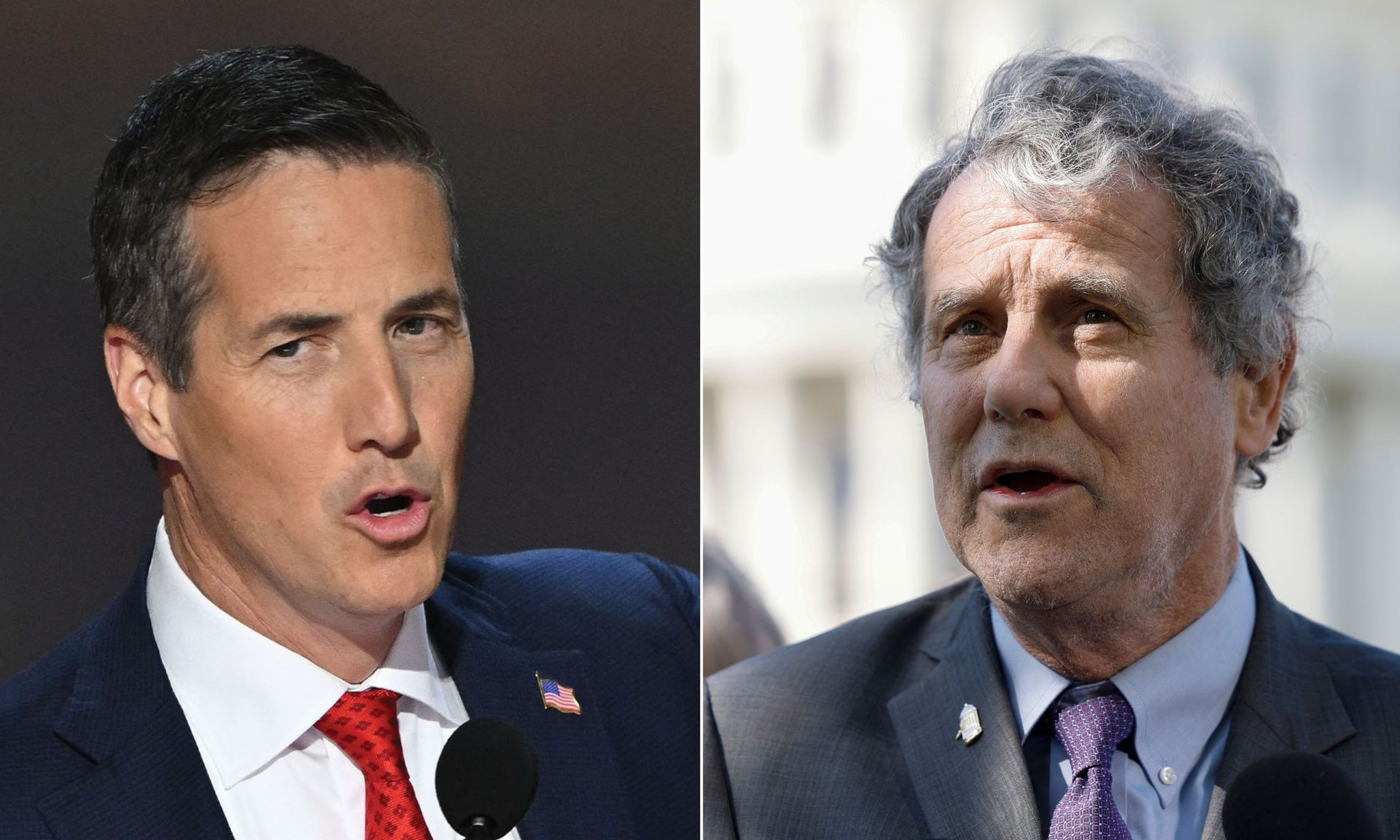
This is something Ohio’s three-term Democratic senator, Sherrod Brown, cannot understand, Moreno says. Brown’s half-century-long career in politics — with stints in the statehouse, as Ohio’s secretary of state, and in Congress — means lobbyists have probably spent decades subsidizing his meals. “He’ll say with his gravelly voice and his ill-combed hair and his ill-fitting suit that somehow, he’s the hero of the working class,” Moreno tells me later. But you can’t be for the working class and support left-leaning policies like student-loan forgiveness and lax immigration enforcement, he says.
He reckons Brown is all talk and is betting that Ohioans will kick a faux-moderate, pretend-populist career politician to the curb in exchange for the real populist deal.
The son of Colombian immigrants, Moreno moved with his family to Florida when he was five. He became a U.S. citizen at 18, attended the University of Michigan, got hitched, and launched a successful car-dealing career in Boston before landing in Cleveland. A father of four adult children, he briefly ran for retiring senator Rob Portman’s seat in 2022 but withdrew from the race before the primary. He won this year’s GOP nomination handily thanks to support from Trump and the state’s junior senator, J. D. Vance.
Brown has an advantage with voters on abortion rights (which Ohioans enshrined in their state constitution last year), and Trump’s eight-point Buckeye State victories in 2016 and 2020 mean he isn’t campaigning here much in 2024. Such factors matter for Moreno in a nail-biter race. With West Virginia a lock for Senate Republicans this cycle and Montana trending their way, too, GOP-aligned groups are spending heavily to tip the scales for Moreno and change the balance of power in Congress. While Brown had a narrow polling lead through the early fall, October surveys suggest the race is now looking like a dead heat.
After the Miami University event, the line for pictures snakes from the stage to the cupcakes on a dessert tray near the back of the room. Moreno poses for some photos, and we head backstage for a quick gaggle with conservative pundit Ben Shapiro. Ramaswamy sees the fuss and decides to join. Donald Trump has long run as an economic populist, but what, I ask, does the buffet of campaign proposals he’s announced in the final stretch — no taxes on tips or overtime pay, temporary 10 percent cap on credit-card interest, blanket tariffs on imports — suggest about the direction of the broader GOP on economic policy?
“The GOP has always been very split over these questions,” says self-identified “free-market guy” Ben Shapiro. Whenever you build a winning coalition, there will be disparate views. But that doesn’t change the GOP’s general “pro-entrepreneurship, pro-innovation, pro-economic dynamism” approach.
In Ramaswamy’s view, “this national-libertarian-versus-national-protectionist divide” will be “the dividing line as we think about the next few years.”
Moreno is excited to join the debate club. “This is a dramatically better conversation in the majority, and if I win, we get the majority,” he says. “In a minority, it’s just a bunch of yelling.”
Later that day, we attend a Lincoln-Reagan Dinner in deep-red Ottawa, where hundreds of Republicans are gathered to hear Shapiro and Moreno speak. In a crowded Knights of Columbus hall, mothers hold cooing babies, and folks stand in line to fill their plates with chicken, beef, biscuits, green beans, potatoes, and brownies. A keyboardist plays some Billy Joel and Bill Withers, and the emcee auctions off local goodies. A woman sings an impassioned version of “The Star-Spangled Banner” a cappella; high-school kids helping staff the event as part of their National Honor Society volunteer quota choke back their laughter.
Moreno takes the stage and urges Putnam County residents to vote early so that everyone can watch in real time on Election Day when Fox News host Bret Baier delivers the good news: “Republicans will control the U.S. Senate because Bernie Moreno has defeated Sherrod Brown!”
In July, Moreno took the mic at the Republican convention to formally nominate his “dear friend,” freshman senator J. D. Vance, as Trump’s running mate. Vance and Moreno are aligned on policy but not “because he’s changed me or I’ve changed him,” Moreno maintains, in a wide-ranging interview inside his campaign SUV following the Putnam County event. “The reason we get along so well is because I know how he thinks, which is the same way I think.”
Their philosophy of governing includes several “obvious” tenets by which to evaluate policy. The first is to ensure that legislation “benefits America” and its people. A policy forcing Americans “to drive an electric car because I think that’s the social, virtuous thing to do does not make your life better,” he says. “What makes your life better is if I give you the ability to have a job with a company that can employ you and pay you well so you can buy whatever damn car you want to buy.”
The second tenet is to ensure that the policies in question grow the middle class. “Every country on earth has wealthy people,” he says. Colombia’s got plenty. “It’s just that they have almost no middle class that’s functional — or that there’s no movement from one class to the other.”
And the third tenet requires lawmakers to “stick with that road map that’s in our Constitution” and understand that “the federal government has very limited duties.”
Like Vance, he breaks from traditional GOP internationalism with his pointed skepticism about Ukraine aid. What does he say to critics who charge him with isolationism? That the choice is “not binary.” He believes in the fundamental “importance of America’s strength and leadership around the world” and thinks retreating from that role is not an option: “Over the last 75 years, American leadership has made the world safer, more secure, more prosperous.” If China steps in, “which is what would happen and what they want,” things would backslide.
His concern is about prioritization. The Marshall Plan “was great” but has “spun out of control.” The problem is that now “we’re funding Gaza, we’re funding Lebanon, we’re funding Yemen, we’re funding Qatar, we’re funding Egypt. Like, whoa, whoa, whoa. When did it become America’s responsibility to pay off other countries?” Put more succinctly: “Why do we give countries that hate us money? They’re going to hate us for free. That seems like a much better bargain.”
“We’ve become the piggy bank of the entire world,” he says, and “the piggy bank’s empty.”
Moreno acknowledges that some people hear him speak and think, “You’re an isolationist.” But he’s frustrated that there does not seem to be an endgame or clear definition of victory in the Ukraine war. If the U.S. defines victory as restoring Ukraine’s 2020 borders plus Crimea, he says, then lawmakers should be honest with the American people. “What is that going to cost?” he asks. “At some point, you’re risking World War III.”
The next morning, I drive 85 miles west of my hotel in Columbus to observe two dozen or so Republicans who are campaigning outside a county courthouse in Sidney against an initiative, largely supported by the Left, to appoint a 15-member nonpartisan redistricting commission. Although there’s some nervousness that Brown will pull off another victory even with Trump on the ballot, everyone here says Moreno represents the best opportunity the Ohio GOP has ever had to defeat Brown. And they’re delighted by Moreno’s neo-protectionism.
“When history gazes back upon this period of time, they’re going to see a party realignment,” says Ohio GOP chairman Alex Triantafilou. Instead of talking about “the benefits of free trade, we’re talking more about how to protect Americans.”
Triantafilou says he’s “never seen” a Brown challenger work so hard and that, historically, populist GOP messaging has paid off as the state has trended redder on the presidential level in recent cycles. Moreno’s blowout primary win against secretary of state Frank LaRose and state senator Matt Dolan in March suggests there’s something to this.
But there are some warning signs from the 2022 midterms, when J. D. Vance, first-time candidate and Moreno’s ideological ally, defeated populist representative Tim Ryan by six points for an open seat while underperforming the old-school Republican incumbent, Governor Mike DeWine, by double digits. And yet Triantafilou remains confident that this is where the “party faithful are telling us we ought to be.” Whether they wish to remain there if new tariffs raise consumer prices, perhaps even at McDonald’s, is another question.











Comments