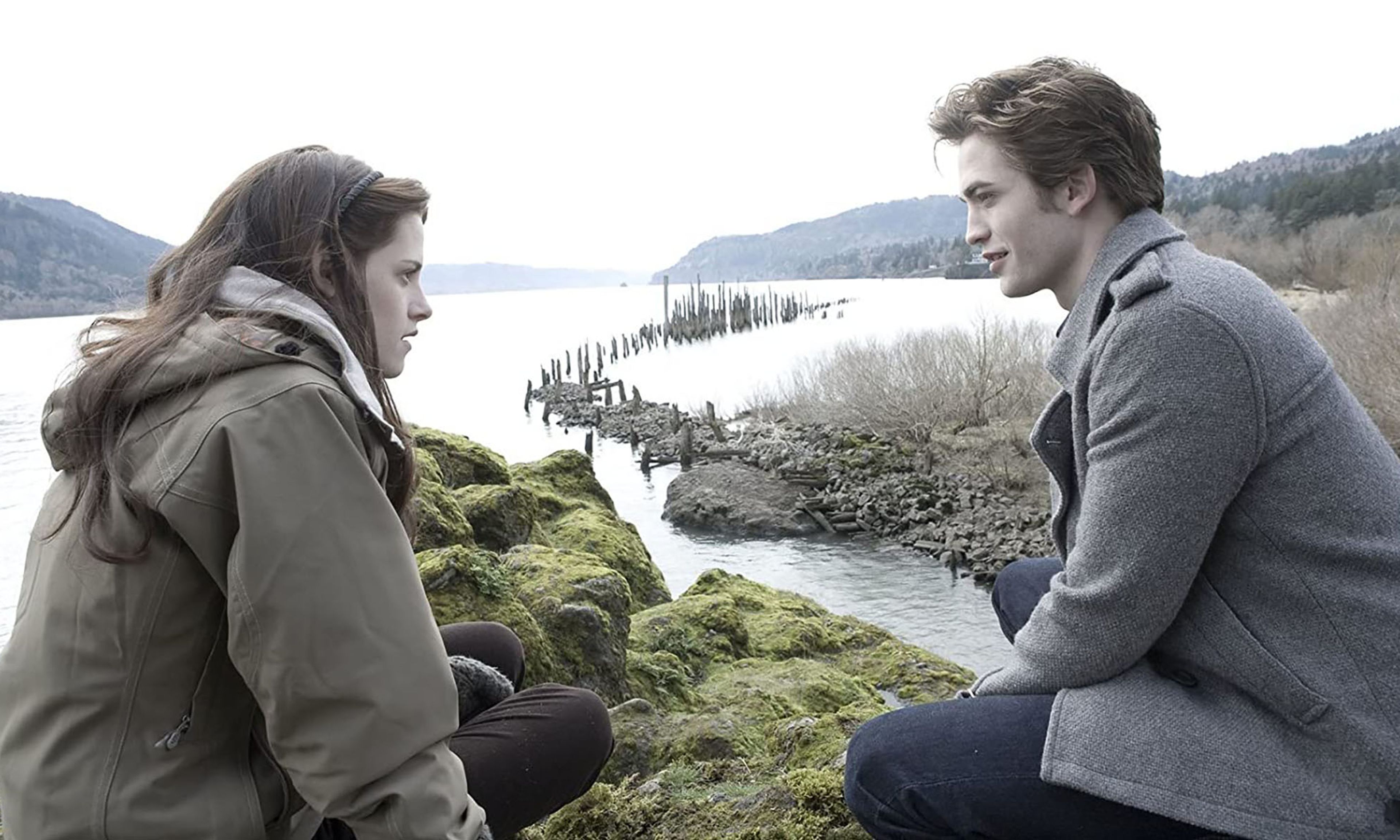
I know what I’m supposed to tell you about the outrageously successful Twilight movies — the second, New Moon, did $140 million in business in its first weekend alone — which sprang from the wildly successful Twilight books, which sprang in turn from the pen of one Stephenie Meyer, a cherubic Mormon mother of three. I’m supposed to say that whatever you think of the overwrought text, the subtext is a cultural conservative’s dream. I’m supposed to talk about how the Twilight saga throws a supernatural cloak over a story that’s explicitly pro-abstinence, pro-romance, pro-monogamy, and pro-marriage. I’m supposed to remark on how it took a series about a high-school girl who falls in love with a vampire to make chastity seem cool again.
I’m supposed to point out that even C. S. Lewis, the master of message-smuggling fantasy, would have never dreamed of repurposing the vampire — a Satanic figure in Bram Stoker, and lately a symbol of transgressive sexuality — as a kind of Christian romantic hero. Yet that’s what the Twilight saga has done with Edward Cullen, a strenuously moral bloodsucker who battles his thirst for human blood like Saint Anthony wrestling with the devil, and regards the possibility of vampiric congress with his beloved Bella as a sin to be resolutely avoided — unless, that is, she agrees to be transformed not only into an immortal, but into his wife as well.
And then I’m supposed to chuckle, just a little, at the anxiety the saga has produced among adults who don’t care for chastity, or Mormons, or young love that ends in early marriage, but find themselves drawn to the vampire romance even so. (From a Washington Post story on liberal feminists’ attempts to justify their affection for the series: “Perhaps [Bella’s] single-minded desire for a relationship is actually a Third Wave feminist expression? Maybe it doesn’t matter that she’s choosing Edward over everything else, as long as it’s her choice? Maybe her wish to become a vampire is really a metaphor for asserting her rights over her own body?”)
Consider all of this said. But now let me say something else: I don’t care for it. Not because both the books and movies are badly written and melodramatic and all the rest of it. A good story covers a multitude of sins, especially on the big screen. No, I don’t care for it because I can’t reconcile myself to rooting for the lovely Bella to end up married to a vampire. Because — well, because he’s a vampire.
I didn’t realize that I harbored this species-ist objection while watching last year’s adaptation of Twilight, the first installment in the saga. Directed by Catherine Hardwicke, the film had an enveloping, fairy-tale aesthetic — rolling fog banks, deep Cascadian forests, deer darting through the mists and ferns — and the frisson that came with knowing more than Bella, for a time at least, about the precise nature of her sunlight-averse love interest.
But New Moon was turned over to the hackish Chris Weitz, last seen butchering Philip Pullman’s The Golden Compass, which means less enveloping mood and more plodding plot this time around. And the more plot there was, the more uncomfortable I felt — and the more time I spent sympathizing with everyone (Edward included, to his credit) who urges Bella to give up the love affair, keep her mortality, and never dally with a vampire again.
Not that Edward isn’t impressively noble, impressively beautiful (he’s played by Robert Pattinson, all cheekbones and ravaged eyes), and impressively conflicted about his species’s way of life. But rooting for him to transform his mortal beloved (embodied by a slightly miscast Kristen Stewart, who’s better suited to playing the hard-to-get cool girl than a passionate romantic) into an immortal bloodsucker still feels a little bit like rooting for a fairy to steal a child and spirit it away to Faerie. Sure, maybe the child will be happy; maybe he’ll turn immortal himself; maybe he’ll become a great lord in the land of Tír na nÓg. But you’re still rooting for the fairy, and against the human race.
Meyer is smart enough to anticipate this reaction, which is why her story includes a mortal (though still magical) rival for our heroine’s affections, the teenage werewolf Jacob (a musclebound Taylor Lautner), whose pursuit of Bella occupies a great deal of New Moon’s running time. I suppose I could just count myself as part of “Team Jacob,” as a subset of the saga’s fans have dubbed themselves, and leave it at that. But the poor lovestruck werewolf is obviously just a hairy foil for the elusive, sharp-toothed Edward, which makes joining his “team” about as much fun as pulling for the Washington Generals to upset the Harlem Globetrotters.
Except that at least the Globetrotters aren’t undead creatures with a taste for human blood. Late in New Moon, Bella and Edward encounter the overlords of the vampire world, the Volturi, and narrowly escape with their lives. As they slip away from the Tuscan basilica where the Volturi make their home, a party of tourists enters, and you hear their helpless screams as the vampires make a meal of them.
It’s one of the movie’s few moments of authentic horror — but, more important, it’s a reminder of what sort of creature we’re romanticizing here. And pro-abstinence messages or no, I’ve had enough. You can call me a bigot, if you like, but I don’t care how carefully Edward Cullen has trained himself to devour deer instead of human beings: I wouldn’t let my daughter anywhere near him. And when the last Twilight movie rolls around, and the fatal bite is taken, I’ll be the guy standing up in the back of the theater, shouting: Leave our women alone, vampire!











Comments