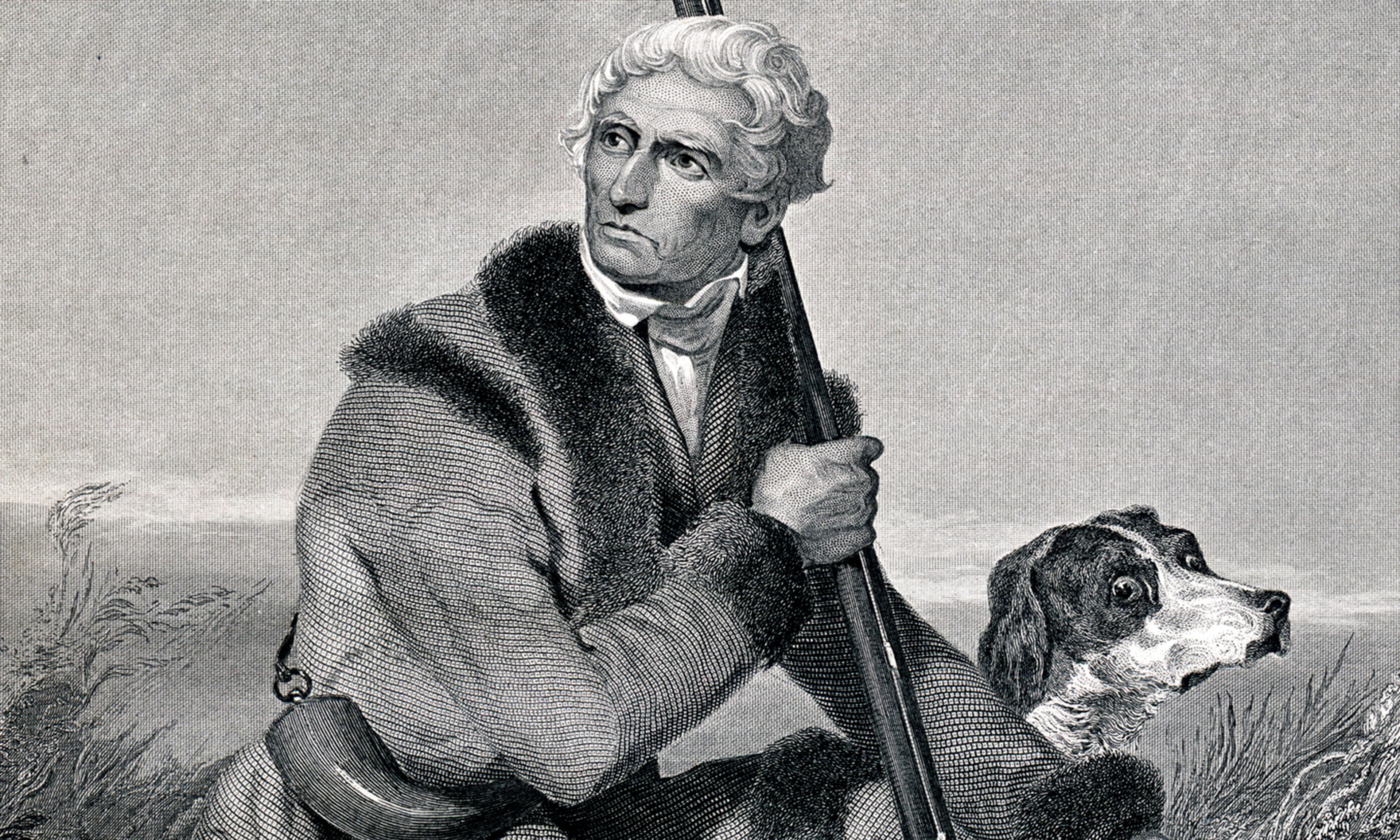
In June 1778, Daniel Boone was being held captive in an Indian village. Sensing that a native attack was brewing against the Kentucky stockade that was his home, he cut loose a pony and, despite the warnings of the wife of the Indian chief imprisoning him that there was no way he’d possibly make it the 160 miles back to Boonesborough, took off.
He rode his pony all night until it collapsed the next day. He proceeded on foot. He jumped into every stream he encountered to throw off pursuers. He crossed the Ohio River naked with a makeshift pontoon for his clothes and gear. He kept walking until he couldn’t anymore. Resting, he was awakened by a fox nibbling at the dead skin on his feet. He lined his moccasins with leaves and kept going. He restocked his rifle with a piece of raw timber and, naturally, took down a buffalo with his first shot.
Four days later, he arrived at Boonesborough completely spent and sank into a chair, the family cat jumping into his lap.
That was Daniel Boone.
He is a legendary American figure whose indelible image — the coonskin-hat-wearing backwoodsman who was the first white man to see Kentucky — is not quite accurate but true enough. Self-conscious about his stature, he favored high-crowned felt hats, not the coonskin of lore. And white explorers had preceded him through the Cumberland Gap.
Yet he was an unbelievably adept outdoorsman, whose courage, marksmanship, and feats of endurance stood out in the settlement of the frontier. He lived a cinematic life of narrow escapes, grievous loss, and fierce battles — a frontiersman in full who was honest and modest, but not to be trifled with.
Boone deserves a place in the nation’s pantheon, even as he is likely to be downgraded. He wasn’t a general or a statesman or a thinker. It is possible to tell the nation’s story without significant reference to him in a way that obviously can’t be done without, say, George Washington or Thomas Jefferson. He doesn’t have any parchment accomplishments to weigh on the other side of the ledger of the things that will be increasingly held against him — namely, encroaching on Indian land and doggedly fighting the natives over it.
Still, he is an exemplar of a backwoods America — venturesome, tough, and stubborn — that made the country what it is today. We may be fascinated by the epic events in Philadelphia circa 1776, but the high politics of the time — and the contention between Britain and its colonists — don’t represent the whole story.
The life of Daniel Boone underlines how the North America of the era was a welter of conflict among and between natives and Europeans. Clashing tribes and the British, French, Spanish, and colonists all competed for advantage, using the tools of diplomacy, trade, strategic outposts, and, often, brutal warfare.
Indeed, there is enough horrific bloodletting in the story of the American frontier to sate even the fevered imagination of a Quentin Tarantino.
All sides engaged in it. The Indians now understandably have a popular image tinged with romance, even though they were unspeakably cruel, racist, vengeful, and as focused on power politics and their self-interest as the other players in North America (only much less powerful).
When Daniel Boone’s eldest son was incapacitated by a shot to the hip and captured by Shawnee Indians on a trip with his father into Kentucky, he begged for mercy. To no avail. His captors ripped out the 16-year-old’s fingernails and toenails before clubbing him to death.
In 1774, a group of white vigilantes enticed the family members of a Mingo warrior known as Logan to a tavern and then slaughtered and mutilated them, including his pregnant sister and her unborn son.
And on and on.
Two books were recently published on Daniel Boone. Blood and Treasure, by Bob Drury and Tom Clavin, tells the Boone story through the prism of the larger struggle for the frontier. It is a substantial and lively book by an accomplished history-writing duo. The Taking of Jemima Boone focuses on the brief kidnapping of Boone’s daughter by Indians, and places much too much weight on an incident that loomed large for the Boone family but in no way “shaped America,” as the subtitle has it (the kidnapping occupies about ten pages in Blood and Treasure).
Boone’s family originally settled in Pennsylvania, before making its way southwest to the Yadkin River in North Carolina. With a penchant and talent for tracking and killing game from a young age, Boone was drawn to the “long hunt.”
Long hunters would venture out into the woods, for a season or for years, and kill a prodigious amount of deer. The hides would bring a pretty penny, if the hunter had the survival skills and luck to make it back. (This is why, by the way, we call a dollar a “buck.”) Boone went on such a hunt as a teenager, and his adult life was characterized by long absences from his family when he was off hunting, scouting, or exploring.
Employed as a wagoneer during General Braddock’s ill-fated foray against Fort Duquesne in the French and Indian war, Boone met a teamster named John Findlay who described a paradise over the mountains that the Shawnee called “Kanta-ke” — “Place of Lush Meadows” or “Land of Tomorrow.” Findlay also told of the Cumberland Gap.
The tales stuck with Boone. More than a decade later, when he encountered Findlay again, they decided to set out for the honeyed land. Once in Kentucky, Boone would hunt and hopefully make enough to retire his debts. Their party found and followed the Warrior’s Path, trod by Indians and buffalo for thousands of years. They made the Cumberland Gap, and, soon enough, Kentucky would be open for significant settlement.
“We passed through a great forest,” Boone later told his biographer, “on which stood myriads of trees, some gay with blossoms, others rich with fruits. Nature here was a series of wonders, and a fund of delight. Here she displayed her ingenuity and industry in a variety of flowers, beautifully colored, elegantly shaped, and charmingly flavored, and we were diverted with innumerable animals presenting themselves perpetually to our view.”
One of many exploitative land deals, this time between the Cherokees and an entity calling itself the Transylvania Company, theoretically secured Kentucky for the colonists. But the British opposed the agreement as a violation of the Royal Proclamation of 1763, setting a western bound to white settlement, and the Shawnee considered it an unforgivable trespassing against their hunting grounds.
Boone got a promise of 2,000 prime acres in return for hacking out a path through the Cumberland Gap. It became known as “Boone’s Trace” and then the “Wilderness Road,” a trail followed by 300,000 settlers over the years.
Boone found a spot where he wanted to erect a fort, although his team of trail-cutters immediately scattered to find their own plots. Boonesborough became a small, struggling community barely hanging on in spartan conditions and buffeted by the winds of war.
Boone’s fame had grown with his various exploits. Whenever something went amiss in the area, settlers came to him for his unmatched backwoods detective work, judgment, and cunning. All came into play when a band of Indians made off with Jemima and two of her friends.
It was best not to be abducted at all — Indians would torture and kill captives or, in a prospect almost as terrifying to whites, forcibly adopt them into their tribes — but if it had to happen, it paid to be the child of Daniel Boone. He led the rescue party. Through his tracking skills and inspired guesswork, the men found the girls, shot dead a few of the kidnappers, and chased off the rest. The tale of the rescue spread far and wide, and inspired James Fenimore Cooper’s The Last of the Mohicans.
By this time, the American Revolution was well under way, and the outposts of settlers in Kentucky had even more to fear from British-allied Indian warriors. Shortly after his escape from his own captivity, the Indian war party that Boone feared showed up at Boonesborough, 300- or 400-strong, accompanied by some British and Canadians, and flying a Union Jack.
After a round of insincere negotiations and trickery on both sides, a weeklong battle ensued, with Boone leading the defense of the fort. The Indians tried to storm it. When that didn’t work, they tried to set it ablaze and tunnel beneath it. Over time, the sniping of the defenders took its toll; Boone shot down a Shawnee warrior who particularly angered the Kentuckians by mockingly displaying his bare bottom after every round he fired. One morning the Indians were gone.
Slowly but surely, the war for the West was won. By 1782, Boone could say of the Indians, “Their connexions were dissolved, their armies scattered, and a future invasion put entirely out of their power.”
The victory over the British, memorialized in the Treaty of Paris, was an inflection point. Drury and Clavin write, “The Crown’s betrayal of the tribes was complete. Great Britain, ignoring its multiple promises to protect Indian sovereignty, ceded to the United States the territory from old Spanish Florida to the Mississippi River to the Canadian border. There were no conditions. The treaty itself did not include a single mention of the indigenous nations that had fought alongside the British.”
Boone had no knack for business and was bedeviled by his debts later in life. A family man, he enjoyed telling his grandchildren tales from the frontier and lived to age 85, undertaking one last long hunt at age 76. A witness recalled that “the old man was still erect in form, strong in limb, and unflinching in spirit.”
Children may hear less of Daniel Boone than they once did; he is a hero who doesn’t fit the rising narrative about America’s history, or fits it only as a villain. Yet, as a characteristic American of a certain time and place whose adventures will always thrill, he’ll be impossible, thankfully, to efface from the national imagination.











Comments