Philadelphia & New York
The first thing you see is the famous flag. The painting hangs at the entrance to the exhibition devoted to Jasper Johns at the Philadelphia Museum of Art. Since the 1950s, when Johns unveiled this secular icon, commentators have thrust their interpretations upon the red, white, and blue image. Is it a statement about Cold War geopolitics? An ironic condemnation of patriotism? A cry for freedom of expression in an era of McCarthyism? A close look reveals an underlayer of newsprint, faintly visible beneath the encaustic that produces a lively texture of visible brushstrokes. The content of these clips is difficult to decipher, though they appear to be a mix of articles and ads. The meaning of the composition is up for grabs.
The 91-year-old artist — regarded by some as America’s greatest living painter — has not said much about his purpose in turning flags into art. An oft-quoted remark divulges little: “One night I dreamed that I painted a large American flag, and the next morning I got up and I went out and bought the materials to begin it. And I did it.”
Johns kept on doing it, too, using the motif of a 48-star American flag to produce a series of works that are the highlight of an exhibition so large that it has taken two museums in two cities to put it on: the art museum in Philadelphia as well as the Whitney Museum of American Art in New York. Featuring nearly 500 objects and running through February 13, 2022, the massive retrospective ranges across seven decades and includes work from as recently as last year. There may never be a better opportunity to see so much of Jasper Johns.
His most important painting of a flag may hang temporarily in Philadelphia, borrowed from its normal dwelling place at the Museum of Modern Art in New York. Yet the Whitney has the best of the rest, in a room that shows the special power of an exhibition to assemble separate works and let their sum become greater than their parts. One wall presents Three Flags (1958), which stacks canvases to produce a striking work in three dimensions. Then there’s Flag on Orange Field (1957), which is pretty much what its title indicates: a flag on the upper half of a bright orange backdrop. Hanging between them is Map (1961), a big and bright companion piece that renders the continental United States with a chaotic overlay of paints that both reinforce and violate borders.
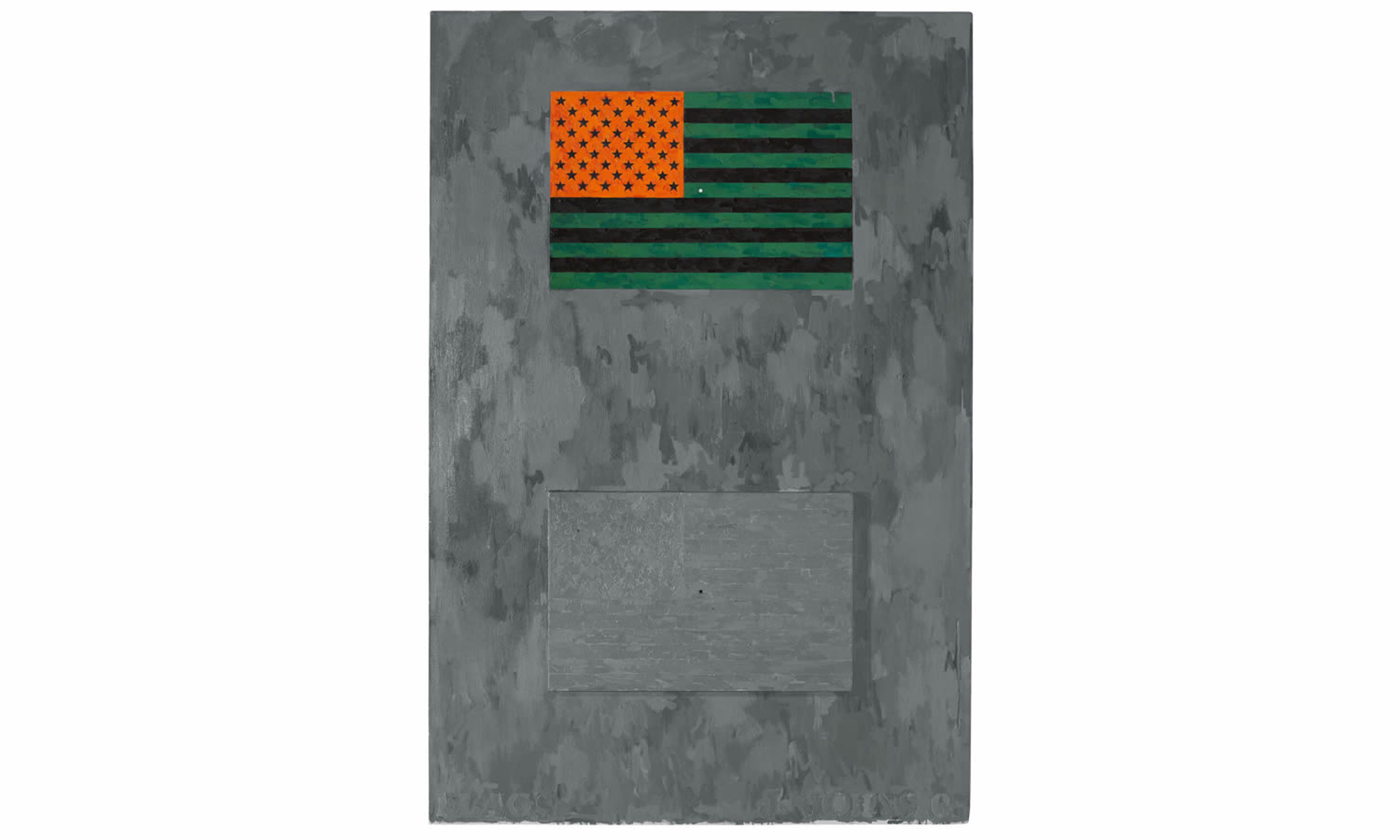
These paintings exude energy and optimism, but those on the opposite wall of the same room tell a different story. Flags (1965) reproduces the national symbol in new colors, trading blue for orange, red for green, and white for black, on a background of cheerless gray. There’s also Map (1962–63) in a sinister black. These depictions are unnerving. On a third wall hangs the enormous White Flag (1955), a bleached-out version of Old Glory. It suggests surrender. In isolation, each of these paintings may have its own message of hope or despair. Put together, they point to something else, such as the need to see the familiar from fresh perspectives.
This is a great theme of Johns’s. “In my work, I have tended to take an action to do something and then to see that it could be done differently and then to try to do it differently,” he once said. “And I’ve simply gone about experimenting with alterations of my ideas rather than settling for any particular idea as being important or useful.” He has taken this approach with targets, smiling skeletons, and paintbrushes in Savarin coffee cans, repeating them in varieties of colors and shades. Occasionally he has played with self-references across paintings and decades. A minor feature of Racing Thoughts (1983), for example, is an optical illusion: a vase whose contours form silhouettes of Queen Elizabeth and Prince Philip. This style of container, called a “Rubin vase,” appears in several more paintings, including one finished four years ago.
Sometimes this works, but often it doesn’t. Like a good portion of the artist’s output, Racing Thoughts is more peculiar than it is beautiful. The same could be said for Painting Bitten by a Man (1961), which is downright ugly. Johns slathered drab gray paint on a small canvas, and then he sank his teeth into it. Rage? Hunger? A stunt? The result is insipid, though it’s weird enough to make for a brief conversational topic. (“Can you believe he chomped his painting? It must have tasted awful!”) In Voice (1964–67), a monotonous gray once again dominates. On the left, Johns smeared the paint with a ruler, like a wiper blade on a windshield, and then attached the ruler to the canvas. On the right, a string suspends a fork and a spoon. The result is odd, unattractive, and — insofar as I can tell — barren of meaning.
If the flags-and-maps room at the Whitney is the highlight of this two-city show, the exhibition in Philadelphia has its own strengths. One of them is a space devoted to numbers, which may be the most persistent subject in the art of Johns. They come in single digits from zero to nine, superimpositions that suggest both order and disorder, and sequences that look like codes. Some are painted in brilliant colors, others in whites and blacks and grays. Together, they are inexplicably engrossing.
Philadelphia also has a series of works called “Usuyuki,” which in Japanese means “light snow.” Rather than relying on objects from our world — “things the mind already knows,” as he once put it — Johns invented his own motif in the form of crosshatchings that are closer in spirit to the abstract expressionism that he commonly is said to have reacted against. They have appeared as elements in his paintings ever since, but they’re best appreciated in the three-panel versions devoted exclusively to these patterns. The finest is a magnificent version from 1982. It belongs to Japan’s Sezon Museum of Modern Art and rarely travels. There’s nothing like seeing it in person, but for those who can’t make the show, the exhibition’s comprehensive catalogue, Jasper Johns: Mind/Mirror, affords a vicarious experience of all the work, plus interpretive essays.
The Usuyuki cross-hatchings adorn promotional posters for the exhibition between the classical columns outside the Philadelphia Museum of Art, at the top of the 72 steps best known for Sylvester Stallone’s upward sprint to the tune of “Gonna Fly Now” in the movie Rocky. Inside, the museum is encyclopedic and extraordinary — one of the best art collections in the country. Visitors see a reminder of this as they exit the Johns show the way they entered, passing that first flag painting. Walking out, they can gaze down a long corridor that stretches for almost the entire length of the museum. In the distance hangs The Large Bathers, a huge painting of nudes by Cézanne that many believe is one of the most significant pieces in the gallery.
Johns once studied it, as curator Carlos Basualdo explains in a video on the museum’s website: “I had the great fortune of looking at it with Jasper, and he said, ‘What are they looking at?’ Then when you focus on that aspect of the work, they seem to be looking at an empty spot. And Jasper found that fascinating.”
The same question could be asked about the fully clothed art buffs who wander the Jasper Johns exhibition, fascinated by its targets and numbers and crosshatchings: What are they eyeballing? It isn’t always clear, and perhaps at the heart of these paintings there’s even an emptiness. For most of my married life, though, I’ve displayed a framed print of Flag in my home, above a living-room fireplace in one house and beside a kitchen table now. I’ve chosen to see the work as a tribute to our cacophonous and commercial republic, but the real reason my wife and I show it is simpler: We just like it.









Comments