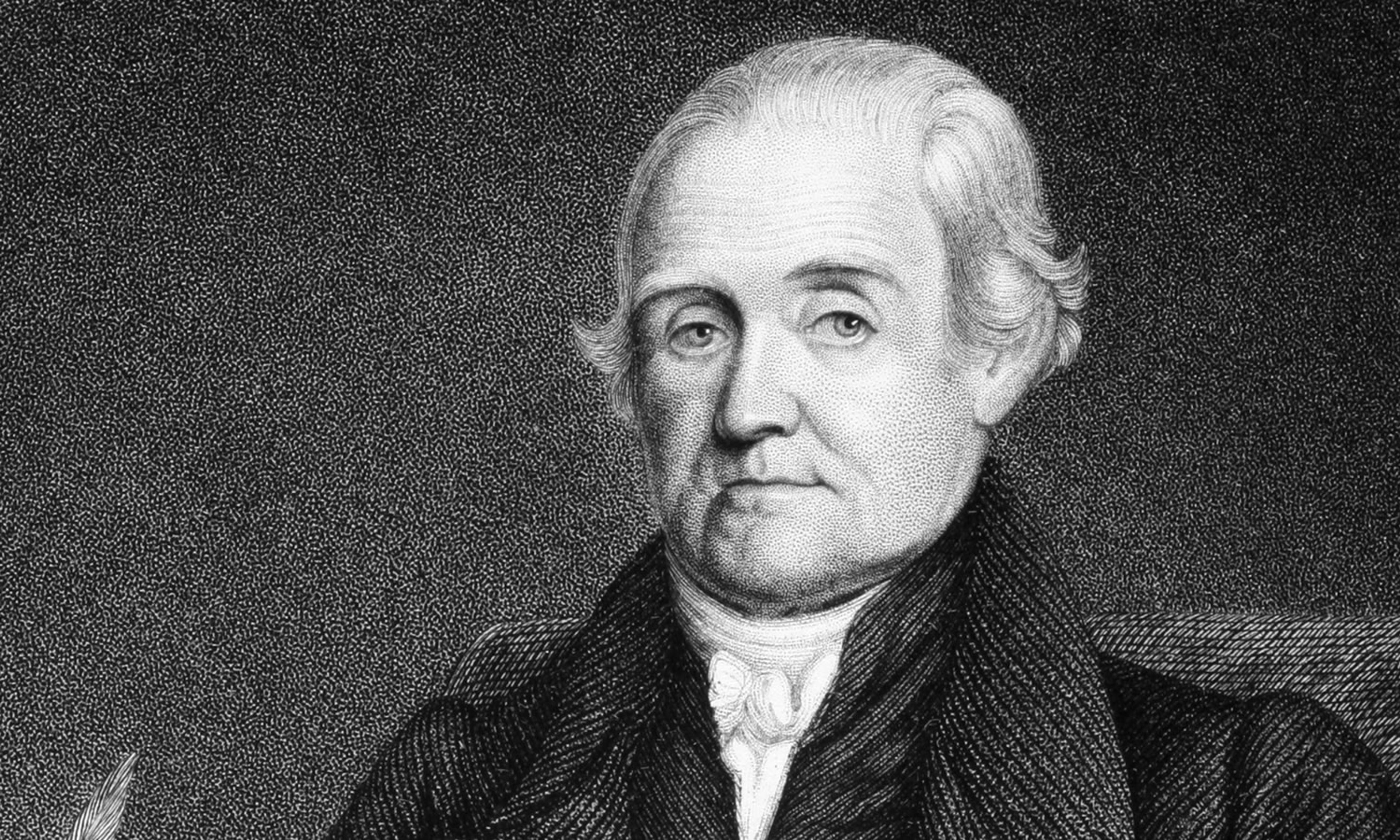
Some time ago, I bought a scrap of paper bearing Noah Webster’s handwriting and signature. As a collector of such things, I have a good little stash. Over the years, I’ve gotten to know Webster’s hand pretty well. Occasionally his words, especially when writing people’s names, can be all but indecipherable.
This note was written in 1841, when Webster was 82 years old. Thirteen years before, he had completed his magnum opus — his monumental two-volume American Dictionary of the English Language. By this point he had a significant array of publications to his name, including dictionaries of various sizes, grammar books, spelling books, anthologies known as “readers,” histories, and collections of his own essays. An early and ardent supporter of the U.S. Constitution, he is sometimes thought of as one of the Founders. In fact, one of the best biographies of the man is Joshua Kendall’s book The Forgotten Founding Father: Noah Webster’s Obsession and the Creation of an American Culture (2010).
But back to this little fragmentary sheet. At the top is “New Haven. March 24 1841.” The salutation looks as if the message might be to a Mr. Mornell or Mormee, or perhaps Burwill, Borrell, or even Bornee.
The message itself is easy to make out: “I wish the foregoing to be inserted in both of your papers, under the Hartford Head, as a communication, rather than as an advertisement. Please to accept the inclosed bill of 3 dollars [$95 in today’s money], & send me two or three copies of your daily papers in which the notice is inserted.”
Webster is asking the newspaper editor to place an item he has enclosed. Given what I know about Webster as a prolific correspondent, I suspected that he was promoting one of his books and disparaging competitors. He often did that sort of thing. The message implies that he wants the piece run as a news item (a “communication”), not as a paid advertisement. Having been a newspaper editor himself, Webster knew that something placed as a news item is more believable than an ad.
This letter has probably passed through the hands of several collectors over the years. Each has probably wondered what it might be about. If you were a researcher in the 20th century, there would be serious impediments to discovering its meaning. You might get in touch with librarians in Hartford to see how many newspapers were being printed nearby in the early 1840s and who the editors were, and then scour the editions from late March 1841. Perhaps you’d have to travel to Hartford to do the scouring yourself. Lots of expense and lots of time — perhaps days.
But we live in quite an era. It’s an excellent time for researchers. After my wife puzzled out the recipient’s name as Boswell, I confirmed on Google Books that in the early 1840s, the editor of the Hartford Courant was John L. Boswell.
Then I logged on to Newspapers.com to search “Noah Webster” in Connecticut newspapers for the last week of March 1841. Voilà! Within seconds, I had the full item in front of me — a photograph of page 2 of the Hartford Courant. Newspapers.com has enabled us to have full-text searchability for more than 20,000 historical newspapers from all over the globe. Not 20,000 issues, but that many different newspaper titles. Even small-town newspapers back to the 1700s are available online. The database allows you to “clip” the piece you want and print it out. Within seconds, you have the equivalent of a photocopy of what you need, but even better: All the bibliographic information is automatically printed beside your clipping.
The piece appeared anonymously on March 26, 1841, just two days after Webster’s letter was written. Here’s how it opened:
Communication
A new edition of Webster’s American Dictionary is now published by the author, in two volumes, large octavo, with many improvements on the former editions, and containing eighty-five thousand words; being from twenty-five to forty thousand more than the English dictionaries now used in the United States. Students who have long wished for an edition of the work, at a less price than the quarto, may now be supplied.
That’s good ad writing: It contains an appeal to patriotism, it supplies an aspiration you might not know you had, and it suggests that you’re sensibly frugal.
There follow eight snippets from British reviews, the first by a clergyman in the Liverpool Mercury: “By far the best English Dictionary, indeed the only one to which appeal can now be made as an authority, is Webster’s, an American Publication.” From the Aberdeen Observer: “This publication will go far to remove the unjust prejudices which prevail in this country against the literature of Americans.” Two others state outright that Webster has wholly eclipsed Samuel Johnson’s great dictionary, despite the many updatings of the latter.
The British recommendations culminate with the claim that Webster’s dictionary is “the nearest approximation to a perfect dictionary of the language which we have ever seen.”
It’s an extraordinary aggregation of effusive praise — and from the British press, no less! The piece then says that “American commendations of this dictionary and of Dr. Webster’s other school books are too numerous to be here inserted.” Undoubtedly true. It declares that a “large proportion of the members of Congress” have recommended the book as a standard work, that colleges and universities have adopted it, and that it’s so riveting that some people “read the two volumes from beginning to end in course.”
What a dictionary. And what an ad.
Few would have suspected that Noah Webster himself had placed the piece. It reads like an ad, but then it’s really just highlights from independent reviews.
But is it really that? I can’t find any evidence that any of those British reviews were ever printed anywhere but in Webster’s own advertisements. Could it be that Webster invented them? More research will be necessary to supply the definitive answer. Watch this space.











Comments