Buried deep in the House-passed “Build Back Better” bill are a set of climate provisions. One section in particular authorizes the Federal Highway Administration (FHA) to award nearly $1 billion in “community climate incentive grants” for state projects that reduce transportation-related emissions. As is usual with such grants, there are strings attached. Authorized funding may not be spent on projects that increase the use of single-occupancy vehicles, and only states that have adopted FHA-approved “carbon reduction strategies” are eligible. Another provision goes further, instructing the FHA to “establish a greenhouse gas performance measure that requires States to set performance targets to reduce greenhouse gas emissions” (emphasis added). Lacking the votes to enact federal climate legislation that would authorize the Environmental Protection Agency to promulgate emission-control regulations, Congress is instead seeking to purchase state cooperation through fiscal largesse.
The BBB’s conditional spending provisions are no anomaly. They are illustrative rather of a new way of governing: bundles of carrots, backed by sticks. Earlier this year Congress told states that received pandemic-related financial relief that they could not cut taxes. The executive branch does this sort of thing too. The Biden administration is telling health-care service providers that they cannot receive Medicare and Medicaid reimbursements unless they require employees to be vaccinated. But lest you think this is only one party’s vice, recall that the Trump administration sought to persuade local jurisdictions to cooperate with its immigration policies by threatening so-called sanctuary cities with a loss of federal criminal-justice grants.
In Purchasing Submission, Columbia University law professor Philip Hamburger seeks to expose and analyze this “transactional mode of control” that is “increasingly . . . displacing” statutes and agency regulations and undermining constitutional governance in hidden ways.
In his prior work, Professor Hamburger has questioned the lawfulness of administrative decrees and the widespread practice of delegating broad rulemaking authority to federal agencies. In Purchasing Submission he expands on these concerns by noting that conditions often are the result of agency decisions, and are therefore not subject to the same political constraints that arise in the legislative process.
“Conditions can function as a mode of regulation that sidesteps the Constitution’s regulatory process,” Hamburger warns. Enacting substantive legislation and promulgating administrative regulations entail long and cumbersome processes, and the resulting measures are readily subject to judicial review. Conditional spending and other incentive-based policy measures are an alternative means to pursue federal policy, comparatively free from legal or political constraints. And that is the problem: “In seeking to regulate through the distribution of privileges, government sidesteps the avenues of power established by the Constitution and thereby threatens both constitutional self-governance and constitutional rights.” Legislative compromises must be ratified in the open; negotiated conditions may be buried in a consent decree or nonpublic agreement.
While conditions are dangerous, Hamburger is quick to concede that “most conditions are entirely lawful and desirable.” If the federal government is providing funding for highways, it is eminently sensible to impose conditions on how the money may be used. There is nothing problematic about a requirement that highway funds actually be used to construct highways, and that funded projects meet desired safety and environmental standards. The federal government may demand that any highways it funds be safe to use and not compromise or conflict with other federal policy goals.
The problems arise when the government adopts more sprawling conditions, or delegates responsibility for articulating and enforcing conditions to administrative agencies. It is one thing for the federal government to say highway funds cannot be used to build projects that will cause a state to violate federal air-quality standards. It is quite another for the federal government to say that any state that receives federal highway funds must adopt a suite of environmental measures that have little, if anything, to do with transportation, let alone highways specifically, or to threaten states with a loss of federal highway money should they fail to adopt new policies that the federal government desires. Current law, however, allows all of this and more.
“Money is power, but not always constitutional power,” Hamburger writes. Control of federal purse strings is the most conspicuous way to purchase submission. Yet this is not all that concerns Hamburger. As he illustrates, there are myriad ways in which the conditional exercise of governmental power constrains freedom or enables governmental actors to evade legal and political constraints.
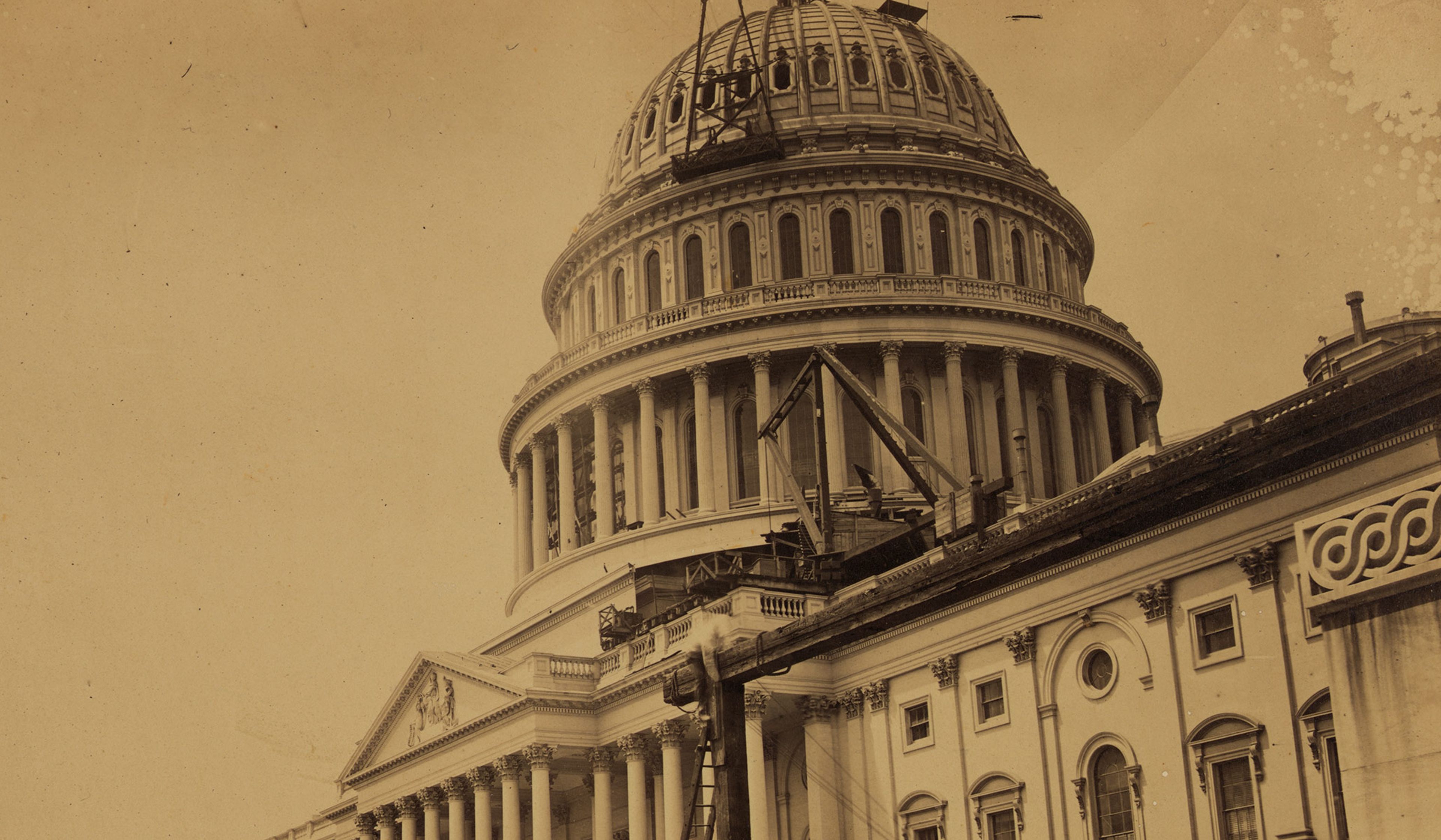
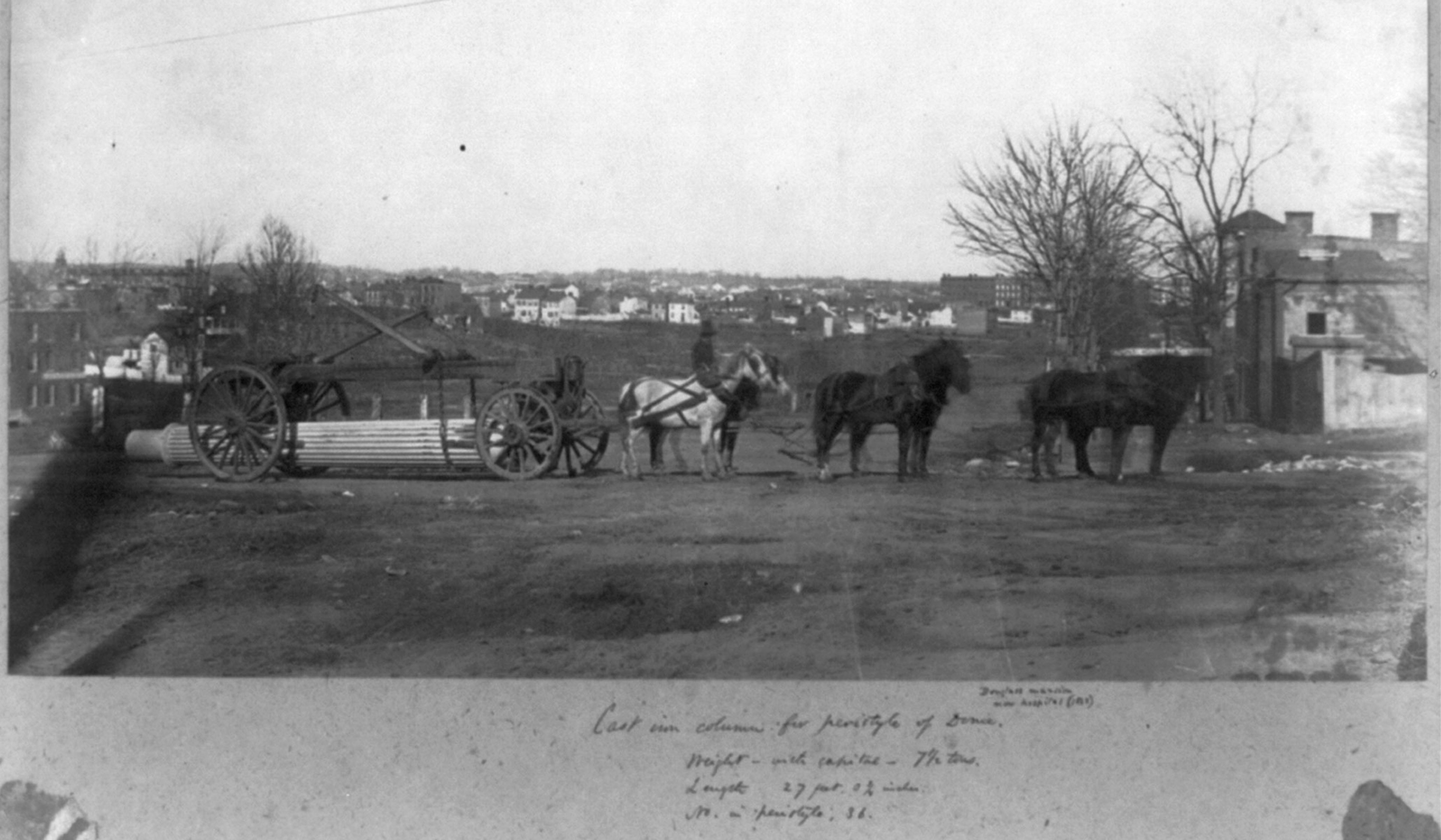
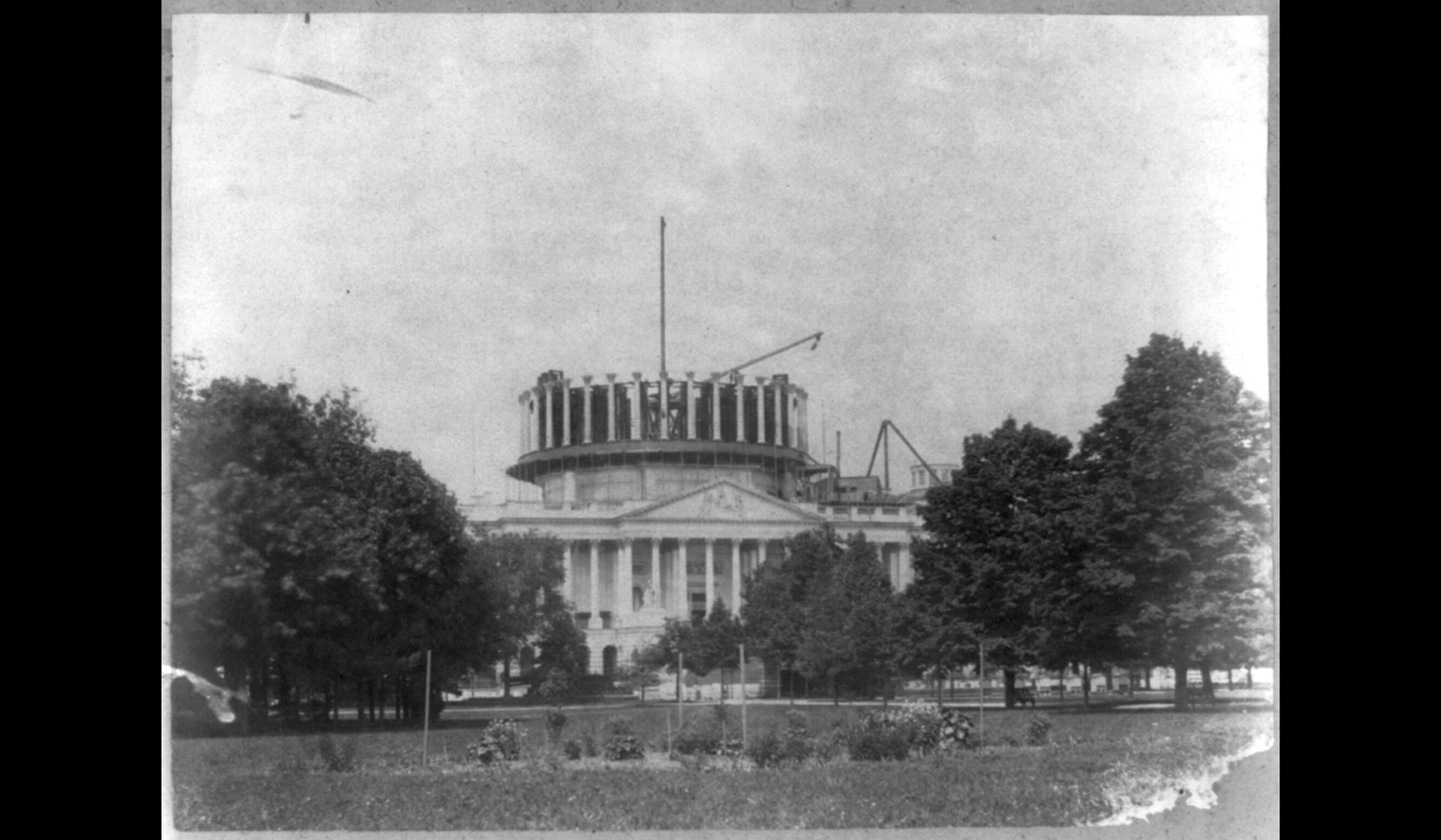


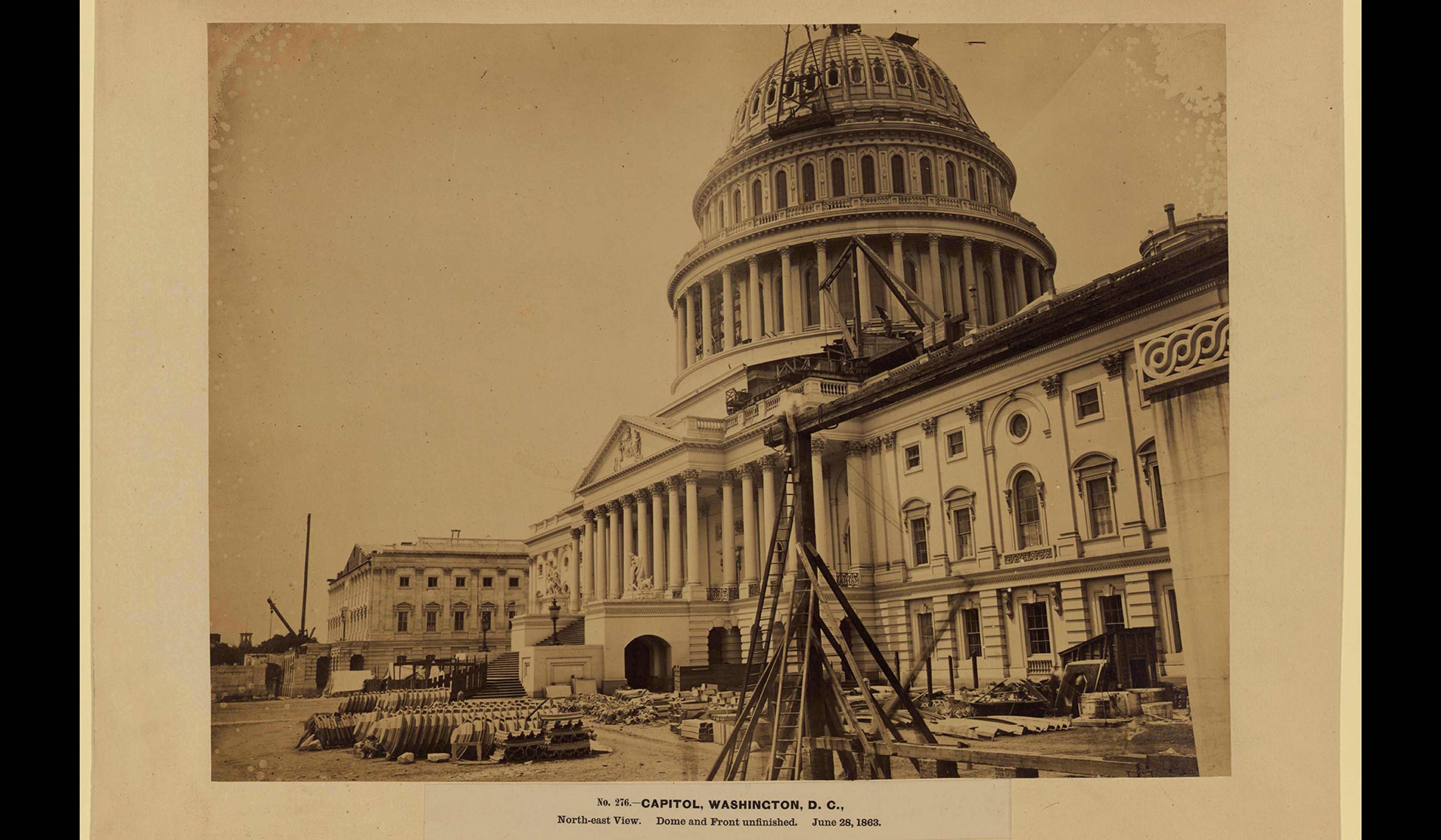
Capitol dome and front unfinished, June 28, 1863.
Library of Congress
Although the details may vary, the underlying dynamic is often the same. Placing a condition on the receipt of federal funds is of a piece with conditions placed on the exercise of coercive force, as occurs in criminal plea bargains and consent decrees. The commonality is that in each case the government is utilizing a conditional threat — the loss of money or exposure to governmental action — to induce submission. And because this approach uses submission to achieve control, it is more difficult to challenge. When the government imposes a new regulation on a private firm, the company can challenge the rule in court. When the government agrees to forswear investigation or prosecution in return for the firm’s promise to engage in government-approved conduct, on the other hand, the government achieves its aim through consent, and there is nothing left for the firm to challenge.
Hamburger identifies a series of questions to ask when evaluating the propriety of specific conditions: Is this condition a means of regulating activity? Is it coercive? Does it subvert constitutional constraints on government power? And so on. The devil is often in the details.
Hamburger raises a particular alarm about “the growing use of conditions to control third parties.” Sometimes this occurs with conditional grants to states, which may induce state or local governments to adopt measures the federal government could never constitutionally impose itself. Unlike the federal government, states are not constrained by limited and enumerated powers, so there is ample incentive to encourage state enlistment in federal causes, such as land-use controls, aimed at reducing greenhouse gases, that might not pass muster if adopted as federal regulation of interstate commerce.
When funding private institutions, such as universities, the government effectively “privatizes” regulatory impositions by inducing funding recipients to impose restrictions on those within their influence or control, such as students or staff. Of particular concern to Hamburger, the specter of lost funding induces private universities to impose restrictions on faculty and students that no level of government could impose directly. Exhibit A here is the requirement that recipients of federal research funds create Institutional Review Boards (IRBs) to review research concerning human subjects.
The impetus for IRB requirements was innocent enough: The federal government wanted to be sure that any research it funds is ethical and not exploitative of human research subjects. Yet IRB requirements soon metastasized from controls on funded projects to requirements governing all research activities at funded institutions. As a consequence, academics whose research is in no way supported by government dollars may nonetheless be subjected to the gauntlet of IRB review and prohibited from conducting, or even publishing, research until it has obtained IRB approval. Any such government restriction on research or publication would immediately run afoul of the First Amendment. Private universities, on the other hand, are not so constrained, even though their imposition of such regulatory constraints is induced by governmental action.
The same dynamic led many universities to create “petty kangaroo courts” for the review of sexual-assault and harassment complaints under Title IX. By its terms, Title IX merely prohibits sex discrimination in educational programs that receive federal funds, but Department of Education bureaucrats interpreted this prohibition broadly and threatened universities with the loss of funding if they did not fall into line. As even temporary suspension of federal funding would be highly disruptive, universities complied, adopting disciplinary and adjudicatory regimes lacking constitutional due process. And because resulting actions were those of the schools, and not the government, they could not be challenged as state action.
Hamburger confesses to “have struggled to wrap [his] mind around” the “entire realm of subterranean governance” facilitated by the conditional disbursement of government power and largesse. At times it shows, as when he has difficulty concretizing a simple operational test through which to distinguish permissible exercises of government discretion from coercive impositions or evasions of legal constraint. Certain formulations of his critique are repeated, almost like a mantra, at the expense of more nuanced explication.
Hamburger is undoubtedly correct that existing legal doctrine on the limits of conditional exercises of governmental power is unsatisfactory. He rightly notes that “judicial decisions on conditions are poorly developed and often simply wrong.” Chief Justice John Roberts’s admonition that government may not make offers tantamount to a “gun to the head” goes only so far. But so too are Hamburger’s prescriptions limited. He identifies a range of factors to consider but does not provide sufficient guidance as to where the lines should be drawn. Nor does he grapple with the range of jurisdictional barriers and constraints that often prevent victims of government conditions from presenting their claims in court. This latter problem could itself be the subject of another book entirely. Perhaps that will be his next work (or so we can hope).
Hamburger’s indictment is powerful and the potential for injustice is plain. He has exposed great potential for wrongdoing, even if not perfectly cataloguing each separate offense. In this sense, the prosecution’s case is not fully complete. Nonetheless, Hamburger has done admirable service excavating and exploring the ways in which purportedly voluntary concessions are a means of extending government power and control. If this book does nothing but enhance our collective vigilance to the danger of purchased submission, it will have performed an essential service.











Comments