• As of this writing, Anne Rice has not risen from her grave. Kind of an off-brand move, really.
• President Biden’s “zero cost” agenda keeps getting more expensive. For months, Democrats from the president on down kept advancing the absurd argument that their multitrillion-dollar social-spending package would be cost-free. Even if all the spending were offset by tax increases, those taxes would be the cost of the law. But the legislation would not meet even Biden’s original “fully paid for” standard. The Congressional Budget Office estimates that the version of the legislation passed by the House would add $160 billion to deficits over the next decade. To get to that number, Democrats relied on the gimmick, which has been blasted by none other than Senator Joe Manchin (D., W.Va.), of allowing a number of key provisions (such as the Obamacare expansion, child-care subsidies, and universal pre-K funding) to expire after a few years. Their hope was that once people became dependent on these and other government programs, those programs would be hard to eliminate — but in the meantime, they could tout a lower CBO score. So Republicans asked the CBO to estimate what would happen if these programs were made permanent. Lo and behold, the CBO found that, were the new programs extended, Build Back Better would add a staggering $3 trillion to deficits over the next decade. White House press secretary Jen Psaki naturally blasted the CBO report as “a fake score about a bill that doesn’t exist.” Excuse us for finding that less than comforting, coming as it does from the woman who pushed the “zero cost” talking point.
• For much of the year, Senate Republicans insisted that since Democrats were making grand plans for taxes and spending on their own, they should also raise the debt limit on their own. The federal government should not default on its debts, Republicans said, but they would not muddy public understanding of which party was necessitating the extra borrowing. The Democrats should use the “reconciliation” process to vote for a debt increase not subject to the filibuster. Democrats balked at that proposal, though. Rather than allowing a default, the parties came to a deal. Essentially, a sufficient number of Republicans agreed to waive a filibuster, and then Democrats raised the debt ceiling by $2.5 trillion. Each side can claim the other blinked, but the upshot is that there will be no default — and voters are unlikely to have great doubts about which party has been spending their money.
• Kamala Harris’s staff may have an even lower opinion of her than the public does, to judge from recent reports. Following a slew of headlines about staffers in her office demoralized by her poor management and political ineptitude, the news came that four senior aides, including her chief spokesperson, would be departing at the end of the year. According to the Washington Post, Harris routinely demeans her subordinates, fails to read briefing materials, and then blames staffers for her failures. Her supporters blame something else: racism and sexism, the two forces supposedly preventing her from achieving the promise of her historic role and causing her to be judged by a double standard. “If she were a man with her management style,” one of her defenders told the Post, “she would have a TV show called ‘The Apprentice.’” Her new communications team might want to rethink that message.
• David Perdue and Brian Kemp are both conservative Republicans who were allied with Donald Trump. But when Georgia voted narrowly for Joe Biden, Governor Kemp followed the law and the truth while Senator Perdue aided Trump’s campaign to deny reality. Perdue is now challenging Kemp’s reelection, with Trump’s support. So far the sole basis of the campaign is that Perdue should be rewarded for his willingness to follow Trump in any folly. Perdue has the free time to make his case because his own reelection as a senator was a casualty of Trump’s election lies: Republican politicians sowed distrust in the vote-counting, so Republican voters stayed home. Stacey Abrams, the Democratic election-denier, says she is running for governor too, and must surely be glad that Perdue and Trump are making her task easier.
• Elizabeth Prelogar, the solicitor general for the Biden administration, told the Supreme Court that the “liberty interest” that the right to abortion protects is the right not “to have a child out in the world.” It is not enough, in other words, for the law to protect a mother from having to raise an unwanted child. It must also protect her from knowing that someone else is raising her. It must protect her, that is, from adoption. Which helps explain the fury that met Justice Amy Coney Barrett in some quarters when she pointed out how changes in adoption law had weakened the case that abortion is needed to avoid the burdens of parenthood. Barrett was assailed for supposedly portraying adoption as a simple and easy solution. She did no such thing. Merely to raise the possibility of adoption is, however, to make an implicit rebuke of abortion — and that is too much for some of its devotees.
• In its decision on the Texas law allowing private lawsuits against abortionists, the Supreme Court got the big thing right. It refused to embrace a newly minted theory that federal courts can issue orders barring state courts from even accepting filings or state judges from hearing cases. That would have been a grave and novel invasion of state legal systems. Disappointingly, Chief Justice John Roberts endorsed the novelty, a bizarre position for a man whose professed judicial minimalism is supposed to protect the institutional integrity and prestige of the courts. The Court also, by an 8–1 vote with only Justice Sonia Sotomayor dissenting, refused even to hear the crackpot suit against the law by Merrick Garland’s Justice Department. We would have preferred to see the Court write an opinion discouraging future efforts similar to Garland’s, but at least the Biden administration’s legal overreaches failed. The enforcement mechanism used by the Texas legislature was born of desperation to evade Roe v. Wade. The Court has available, in Dobbs v. Jackson Women’s Health Organization, a better way: end Roe.
• The D.C. Circuit federal appeals court rejected former president Trump’s claim of executive privilege, by which he has stonewalled the House January 6 committee’s inquiry. It is implausible that a person who is no longer a government official has a confidentiality privilege that belongs to the executive branch — i.e., to the incumbent president. In a rambling Watergate-era decision, however, the Supreme Court opined that former presidents have some quantum of privilege over their presidential papers and communications. It wasn’t enough for Trump to prevail. The court rightly deferred to President Biden’s refusal to invoke the privilege, a government privilege meant to protect such matters as foreign relations, not a personal privilege to frustrate congressional inquiries. The ruling gives the committee the whip hand against recalcitrant Trump officials.
• The ruling from the D.C. Circuit suggests that Mark Meadows, Trump’s last White House chief of staff, is unlikely to be able to avoid testifying before the House committee investigating the January 6 riot. The House voted to hold him in contempt — a rare move motivated by the committee’s need to wrap up its work before the election yields a Republican majority that will surely shut it down. Yet Meadows’s behavior has not really been contemptuous. Documents he already turned over have reportedly helped the committee a great deal — and given it PR ammunition against various Trumpworld figures who texted Meadows in alarm, urging him to urge Trump to tell the rioters to go home, and then spent the subsequent months suggesting that the attack was no big deal and no responsibility of the former president’s. The courts should dismiss the privilege claims expeditiously, at which point Meadows has said he will resume cooperating.
• Inflation lurched upward again, after a period of falling monthly rates. Supply chains are not being rebuilt quickly. While that’s not entirely within the Biden administration’s control, it could be doing a lot more to help, from cutting chassis tariffs to leaning on the unions to allow more automation at ports. Rising levels of spending are also contributing to inflation: Those levels have recovered to their pre-Covid trend, suggesting that the Fed should decelerate its asset purchases — as it is discussing, which puts it ahead of the elected branches of government in addressing the problem.
• In mid November, the number of ships waiting to unload at Los Angeles and Long Beach appeared to be declining. But that wasn’t because the line was getting shorter; it was just more spread out. In the past, ships got assigned their spot in line when they got within 20 miles of the port complex. With so many ships waiting close by, pollution was becoming an issue, so port authorities made a new queuing system in which ships get assigned their spot when they leave their previous port of call. With their spots secured, ships no longer wait near the ports; instead they are waiting all around the world. That’s better for Southern California’s air, but it does nothing to ease the stress on American supply chains. The Marine Exchange of Southern California has since updated its official count, and it shows the truth: There are about 95 ships waiting, more than before. This problem isn’t going away anytime soon.















Container ships wait off the coast of the congested ports of Los Angeles and Long Beach in Long Beach, Calif., September 29, 2021.
Mike Blake/Reuters
• Prime Minister Boris Johnson announced that the Covid Omicron variant had claimed its first fatality in Britain. Portent of doom? The danger of this latest variant, first detected in South Africa, is its rapid spread and, related, its seeming imperviousness to existing vaccines. The silver lining is that those who catch it appear to fare better than those who were stricken with prior variants. An early report from South Africa noted that symptoms in the center of the Omicron wave were “milder than anything we experienced” in previous outbreaks. If that observation holds, Omicron will be a sign of Covid’s diminishing clout, a pattern seen in the influenza pandemic of 1918. A devastating peak, and then regression to the mean as the angel of death molts into an ordinary flu. This is small comfort to the more than 800,000 Americans who have died of Covid so far, and to their families and loved ones.
• After a last-minute change, the final version of the National Defense Authorization Act will not require women to register with the Selective Service. It is a victory for conservatives — and for sanity. Those congressmen in both parties who wished to subject women to any potential draft pursued a blinkered egalitarianism. Few seemed to care much that the measure would weaken the national defense and burden what should be a break-glass-only-in-case-of-emergency government power. Conservatives will have to be vigilant: Next year’s bill will likely see a similar proposal.
• Amazon workers at a Bessemer, Ala., workplace thunderingly rejected unionization: Seventy percent opposed, and fewer than 30 percent supported. The bid to unionize the shop did even worse at the polls than the last Republican to run for governor of California. But along comes the Biden administration to offer the union a do-over. The union contends — and the administration agrees — that the election was invalid because managers at the Amazon facility had the U.S. Postal Service install a mailbox. A mailbox for . . . the mail. And so there will be another election — and, if this one fails, no doubt another one after that, until the union gets its way. This administration is determined that workers will get their rights, whether they like it or not.
• In October, the National School Boards Association (NSBA) sent a letter to the Biden administration characterizing parents who protest radical curricula as “domestic terrorists” and asking for federal intervention to probe and prosecute them. This prompted Attorney General Merrick Garland to mobilize federal law-enforcement agencies to investigate threats against school-board administrators. Since then, 27 state chapters have either downgraded their relationship or severed ties with the headquarters altogether. Eighteen states, Alabama, Arkansas, and Florida being the most recent, have ended their membership, citing repeated grievances with the body. Half of the state groups have condemned in lockstep the NSBA’s encroachment on their local affairs, with a number of them reportedly pitching an alternative organization as a replacement. We wish them every success.
• San Francisco remains beyond parody. In 2014, the San Francisco school district had an embarrassing problem: A great many black and Latino students were failing first-year algebra in eighth grade. And San Francisco hit upon the perfectly progressive policy: forbidding eighth-graders to take first-year algebra. Problem solved! Of course, that created some other problems, such as the fact that students hoping to take enough math to get them through AP calculus before graduating now have to double up and take math courses simultaneously, as Joe Hong reports in CalMatters. After changing its approach to teaching math, San Francisco managed to slightly increase the gap between low-performing students and the district average. Hong also reports that African-American students at O’Connell High School (which has the highest proportion of black students in the district) went from performing poorly on standardized tests — only 6 percent met minimum math standards in 2014–15 — to performing at a level that literally could not get any worse: 0.00 percent of black students met the minimum requirements in 2018–19. It is no surprise that the University of California has now officially abandoned standardized tests as an admissions tool, arguing that the tests are biased against black and Latino students. But it isn’t the tests that are hurting black and Latino students. It is the public schools themselves.
• “We would have been more than happy with just an apology at the end of all that we uncovered,” former Chicago police chief Eddie Johnson says of the Jussie Smollett case, “but for some reason, he just wanted to keep going down this road that he was actually a victim.” That road should end with significant prison time now that Smollett has been convicted on five out of six counts for staging what might be the most famous hate-crime hoax in American history. Smollett’s fake attack generated powerful aromas of the barnyard as soon as he started spinning tall tales in January 2019 about having been jumped by MAGA-heads who for some reason happened to be carrying bleach and a noose in the dark of night during a polar vortex, yet who, after making these fiendish preparations, simply ran away following 30 seconds of low-level combat with their superficially harmed target. Smollett could have been let off with community service had he admitted to staging the whole thing, but in the process of defending himself he committed a serious crime. The criminal-justice system can scarcely remain stable if it shrugs away perjury. Judge James Linn enjoys the power to take into account Smollett’s false testimony when imposing sentence, and for the sake of the truth, society, and Chicago, whose already overtaxed police were forced to expend thousands of hours on a wild-goose chase, he should not hesitate to make an example of Smollett.
• At least we still have our juries. In November and December, the American justice system did itself proud. Beyond convicting Smollett, it declared Kyle Rittenhouse not guilty on all charges and threw the book at the men who murdered Ahmaud Arbery. Figures such as the attorney general of New York, Letitia James, who had proposed in November that “our system needs to be uprooted,” were proven wrong. The progressives’ long march has not yet reached America’s jury pools. Unlike far too many in our media, the jurors in all three recent high-profile criminal cases exhibited an admirable commitment to their role — ignoring the usual partisanship in favor of a narrow focus on the truth. Long may it last.
• A male swimmer at the University of Pennsylvania has made a splash by competing as a woman and smashing female records. As recently as 2019, Lia (formerly Will) Thomas was an average swimmer in the men’s division. But after presenting as transgender, Thomas began competing against women. Thomas now holds the fastest 500-yard female-freestyle time in the country, beating the second-place athlete by 14 seconds, and by more than 38 seconds in the 1,650 freestyle. (Those time differences are an eternity in swimming competitions.) Two of Thomas’s teammates have spoken out anonymously about how unfair this is. One noted that the crowd is unusually silent when Thomas crosses the finish, cheering for the second-place swimmer instead. Another said that the team feels obligated to pretend they are happy for Thomas when they really feel demoralized and frustrated. Apparently, there’s little they can do, since, as one of the swimmers put it, the coach “just really likes winning.” Wokeness is redefining, among other things, good sportsmanship.
• A Wall Street Journal poll found, astonishingly enough, that Hispanic voters are evenly split between the two parties and would favor Biden over Trump by only one point in a hypothetical 2024 rematch. The Journal survey is another indication that Hispanic voters, as disenchanted with economic conditions as the rest of the public and generally not on board with woke racial politics, are swinging right. Trump made big gains among Latinos in 2020 over 2016, and one exit poll had Glenn Youngkin winning the Latino vote in the Virginia gubernatorial race. The trend shows how straight-line thinking about the makeup of political coalitions — e.g., Hispanics are a heavily Democratic voting bloc now and therefore will be forevermore — is usually a mistake. Republicans now have an opening to confound the old conventional wisdom and make what has been presumed to be a party of old white people more markedly multiethnic than it’s been in a long time.
• “Latinx” (pronounced “la-TEA-necks”) is a made-up term that is meant to describe a person of Latin origin without specifying that person’s gender. Since its invention half a dozen years ago, “Latinx” has become virtually universal in higher education, if nowhere else. The idea seems to be that Latinos feel validated when the person addressing them cares enough to describe them with a fake word that sounds like something you pick up at the pharmacy. But is that true? A pair of recent polls, by Pew Research Trust and Politico, elicited strong negative reactions to the neologism among Latinos, with unfavorable reactions outscoring favorable by two to one or more. Why? The reason is simple: “Latinx” is not Spanish. It’s an English monstrosity invented by English-speakers to address a purported problem that exists only in English. In Spanish, the masculine gender can be used to include both male and female; that’s how it’s worked for many centuries — no problemo. So “Latinx” is an awkward solution to a nonexistent problem, though that’s never bothered the language police before (see “Latin@,” the previous solution of choice). Still, if “Latinx” continues to pull worse numbers than Joe Biden, then with any luck it will eventually disappear, and we can again mostly leave “x” to algebra class. Adiós, amigx.
• In 1924, a bronze equestrian statue of Robert E. Lee was erected in Charlottesville, Va. It was removed from its perch in 2017. Now the city council has voted to melt it into ingots to be used in a new work of art. New times call for new heroes, and oftentimes the old heroes deserve retirement (Lee killed more Americans than Yamamoto). But how far should cleansing go? The American Revolution replaced monarchy with republicanism, yet states (such as Virginia) and towns (such as Charlottesville) continue to be named for long-dead sovereigns. Lee should have been stabled elsewhere, as a reminder of the mistaken ideals that led him to rebellion.
• U.S. officials say that Vladimir Putin has not yet decided whether he will push the troops he has recently mobilized on the border with Ukraine into the country, but the Biden administration went into diplomatic overdrive to stave off that scenario. President Biden spoke with Putin and with Ukraine’s Volodymyr Zelensky, as well as with leaders of nations formally aligned with the United States. According to the Associated Press, the administration is thinking of pressuring Ukraine to cede some control over the eastern regions besieged by Russia-backed separatists. The White House would be in a stronger position if it had focused more on deterring Moscow before now. By not sanctioning Putin’s inner circle, not arming the Ukrainians to the teeth with new weapons systems, and not blocking the Nord Stream 2 pipeline, it has neglected to play offense. But it is not too late for some sternness.
• In December, American intelligence reports suggested that the Chinese navy was seeking to establish a permanent base on the Atlantic coast of Africa. For years, Beijing has been working to expand its capability to project power, and it has established a permanent naval presence as far away as the Arabian Sea. A naval base in Equatorial Guinea would be a provocative escalation in the great-power competition between Washington and Beijing. The U.S. should push hard to keep friendly Atlantic nations from hosting the Chinese military. No possible good could come from People’s Liberation Army warships roaming the Atlantic.
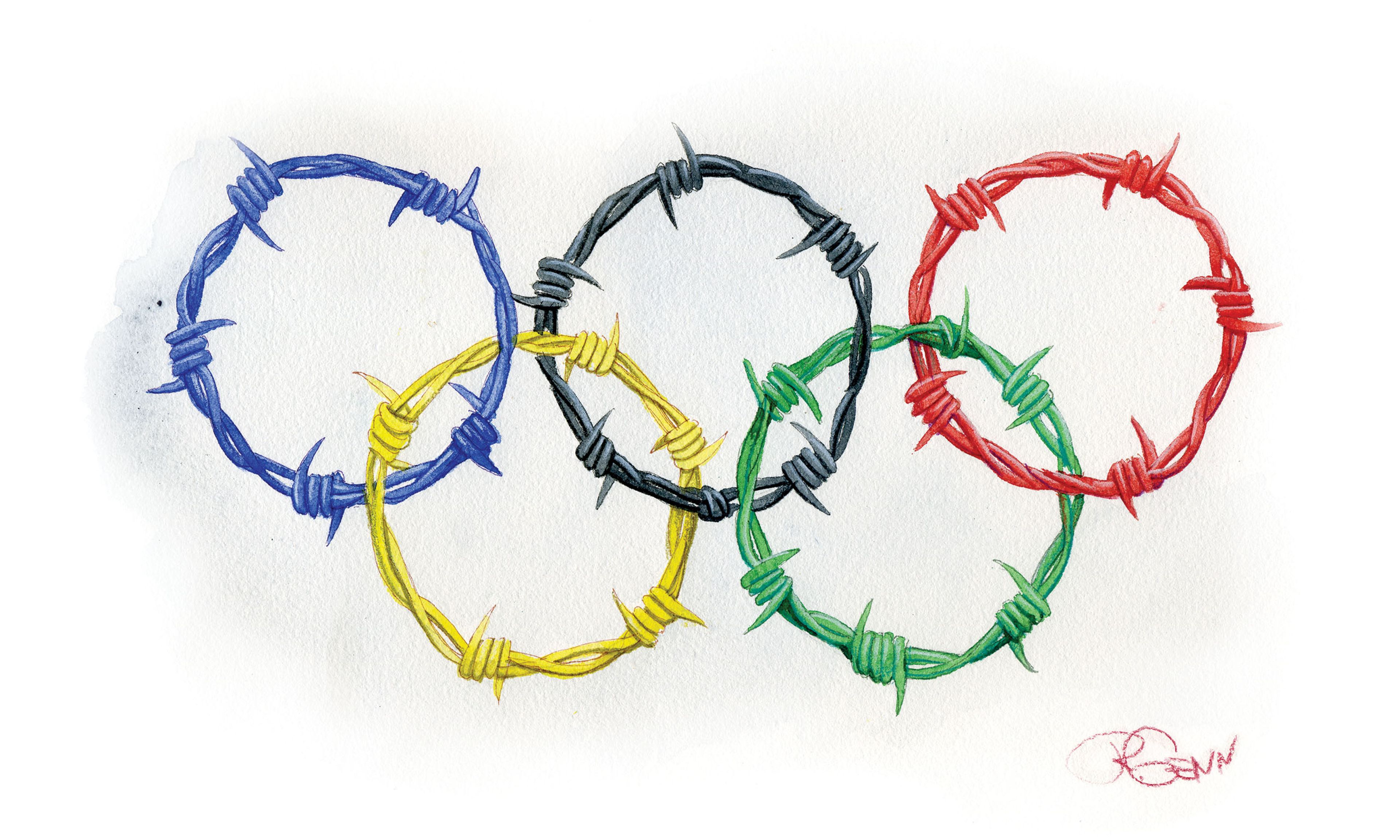
• At press time, four countries — the U.S., Australia, Britain, and Canada — had declared that they would send no diplomats to the Beijing Winter Olympics. Communist China’s oppression of Uyghurs, Tibetans, and Hong Kongers, on top of its workaday oppression of the mass of its people, makes it unfit to host the Games. Not sending diplomats seems like a meager reproof. But the CCP’s reaction — it denounced “ideological biases,” “lies and rumors,” and a “clumsy performance doomed to fail” — shows that even small gestures sting, and hence are worth making.
• Senate Democrats blocked Senator Marco Rubio’s attempt to insert the Uyghur Forced Labor Prevention Act into the annual defense-authorization package. In July, the Senate had unanimously passed the bill, which would severely restrict imports from Xinjiang, but the House still hadn’t put it to a vote. Senate majority leader Chuck Schumer and House speaker Nancy Pelosi hid behind a procedural excuse to block the measure, and the Biden administration slow-walked it as well. But the Democrats seem to be relenting now. The Florida senator was right to drive on, and he should keep it up until the president signs the legislation.
• There had always been a commemoration on June 4 in Hong Kong — a commemoration of the Tiananmen Square Massacre, which was carried out on June 4, 1989. But the authorities no longer permit such a commemoration. A Hong Kong court has just sentenced eight people to prison for trying to commemorate the massacre last year. One of them is Jimmy Lai, the media mogul and entrepreneur. If commemorating the victims of Tiananmen Square is a crime, he said, then “let me suffer the punishment of this crime, so I may share the burden and glory of those young men and women who shed their blood on June 4 to proclaim truth, justice, and goodness.” An example of a man.
• The life of Aung San Suu Kyi has been as turbulent as that of her country, Burma. Her father, Aung San, was also the father of modern Burma. He was assassinated when she was two. For standing up to the military, she was under house arrest for about 15 years. In a democratic opening, she was elected the civilian leader of the country. While in office, she went along with the military, including its persecution of the Rohingya people (a persecution that was very popular among the Burmese at large, sad to say). In November 2020, she and her party were reelected overwhelmingly. The military, not liking the results, staged a coup d’état in February — and has now sentenced Aung San Suu Kyi once again, to two years. Who knows how long the two years will turn out to be? The turbulence of her life — now in its 77th year — continues.
• In October 2018, Saudi agents killed Jamal Khashoggi, a dissident journalist and activist, at the Saudi consulate in Istanbul. U.S. intelligence found that the murder had been ordered by the dictatorship’s crown prince, Mohammed bin Salman. Now the Council of the District of Columbia has passed a bill to rename the street in front of the Saudi embassy “Jamal Khashoggi Way,” in order to highlight the importance of press freedom. That is a bit of symbolism the Saudis deserve.
• France’s National Heritage and Architecture Commission has given the green light to the Archdiocese of Paris’s proposal to modernize Notre-Dame Cathedral. In an exclusive report, the Telegraph warned of plans for gutting the 850-year-old Gothic masterpiece by removing religious statues and confessionals and replacing them with “emotional spaces” and a “discovery tour” with a strong “environmental emphasis.” The justification given by the archdiocese is that these changes would make the cathedral’s religious meaning more accessible, but it’s hard to find any specifically religious meaning, let alone a Catholic one, in the proposal. While the New York Times reported that some of the requests — such as the removal of statues of saints — were denied by the commission, about 100 public figures in France signed an open letter titled “Notre-Dame de Paris: What the fire spared, the diocese wants to destroy.”
• Fans of the successful crowd-funded livestream series The Chosen, about the life of Jesus and his apostles, have been a gift to movie theaters this December. In its first eight days in 1,700 theaters, Christmas with The Chosen: The Messengers debuted at No. 1 and went on to make $11 million. (The series itself has been watched over 322 million times on its associated app alone, and has been translated into 50 different languages.) It has now expanded its originally planned ten-day run, in response to demand. Like The Passion of the Christ before it, The Chosen demonstrates that Christian movies can have high standards of excellence and compete with popular secular movies.
• Robert Dole (“Bob” to everyone) was in many ways an old-fashioned Republican, sometimes very old-fashioned: As Gerald Ford’s running mate in 1976, he spoke of “Democrat wars,” recalling a time before Pearl Harbor. He had his reasons for that: The injuries he suffered in 1945, serving in the 10th Mountain Division in northern Italy, put him in bed for a year and deprived him for 76 years of the use of his right arm. Yet he could also be surprisingly imaginative: tapping Jack Kemp as his running mate in 1996; fusing Kemp’s low-tax gospel with a mildly protectionist and immigration-skeptical stance, prophetic of the party’s future. Throughout his long career, he maintained his sense of humor — dark, but first-rate nonetheless. An admirer of the 37th president, he nevertheless called a photo of Carter, Ford, and Nixon “see no evil, hear no evil, and evil.” One of his last public appearances was to salute the casket of fellow vet and longtime rival George H. W. Bush. He had to use his left arm, but of course he did his duty. Dead at 98, R.I.P.
• For more than 20 years, starting in 2000, Fred Hiatt was the editorial-page editor of the Washington Post. He was particularly strong on issues of freedom, democracy, and human rights. He gave a platform to dissidents. He highlighted cases of political prisoners. He was a scourge of dictatorships, particularly those of China, Cuba, and Iran. And Saudi Arabia. When the Saudis murdered his columnist Jamal Khashoggi, Hiatt was loath to let it go and “move on.” Also, Hiatt was a gentleman, in a business that could use more. He has died at 66, hard to replace. R.I.P.
• Carrying her little sister on her back and trudging with their pregnant mother through the cold, Hyun Sook Han, twelve years old, left home with her family when the Korean War broke out in 1950. They found refuge, but it haunted Han that many neighbors back in Seoul did not. Three of her siblings died in the wartime upheavals and immiseration. In her twenties she studied social work in Seoul, taking an interest in child welfare. She helped Korean families seeking to adopt children orphaned by the war. Collaboration with the Children’s Home Society of Minnesota led to her decision to relocate with her husband and children to the Twin Cities in the 1970s. By the time she retired in 2004, she had facilitated the adoption of more than 13,000 Korean children. As she acknowledged in her memoir, adoption wasn’t always the perfect solution, but consider the alternative. The United States, being a melting pot, was “the best country for international adoption,” she added. An avid fan of the NFL team of her adopted city (go Vikings), she embraced America. A fervent churchgoer, she did justice to the corporal works of mercy. Dead at 83. R.I.P.
• In 1942, Edward Shames, a 21-year-old Virginian, joined the 506th Parachute Infantry Regiment, 101st Airborne Division. Originally a member of I Company, Shames made a combat jump into Normandy on D-Day and within weeks was awarded a battlefield commission. Later, as a platoon commander in the famed Easy Company — which was immortalized in Stephen Ambrose’s book Band of Brothers — he fought in Operation Market Garden and the Battle of the Bulge. Shames ended the war at Hitler’s Eagle’s Nest, where he requisitioned several bottles of cognac labeled “for the Führer’s use only.” The young soldier would later use one of the bottles to toast his eldest son’s bar mitzvah. After his return home, Shames worked at the National Security Agency and served in the U.S. Army Reserve, retiring as a colonel. The last living officer of one of the Second World War’s most famous units, Edward D. Shames, 99, died peacefully at his home in Virginia on December 3. R.I.P.
Hope v. Roe
The Supreme Court heard arguments on December 1 in Dobbs v. Jackson Women’s Health Organization. The case will decide the fate of Mississippi’s ban on abortion after 15 weeks of pregnancy, and perhaps the fate of Roe v. Wade and the life or death of millions of Americans yet to be conceived. A decision is unlikely before the end of June. Veterans of Supreme Court cases past know that it is risky to read the tea leaves from questions at argument, but it is hard to see how things could have gone much better for the pro-life cause. Now we wait to see whether the justices have the fortitude to end 48 years of judicial usurpation and restore the primacy of the Constitution.
The lawyers for the abortion clinic and for the Biden administration insisted on an all-or-nothing outcome, giving the Court no path to upholding the Mississippi law without overruling Roe. Every effort by Chief Justice John Roberts to find some potential compromise standard was rebuffed. That is a risky strategy when the likeliest way to disappoint pro-lifers is to appeal to Court incrementalists’ preference to bend rather than break Roe, but it reflects the calcified, uncompromising extremism of the pro-choice movement.
Nobody seriously defended Roe as a correct reading of the Constitution. Its defenders instead circled the wagons around the institutional importance of adhering to past precedents. Justice Breyer, sounding very much like a man who expected to end up on the losing side, thundered about the Court’s institutional need to avoid revisiting past decisions even if they are seriously erroneous. Justice Sonia Sotomayor suggested, implausibly, that a decision overturning a long-standing precedent could lead the Court to throw out Marbury v. Madison or discard the Second Amendment — even though she herself has already voted to overturn the pivotal Second Amendment case D.C. v. Heller. These same arguments could have been made for keeping the pro-segregation Plessy v. Ferguson decision 58 years later in Brown v. Board of Education.
Mississippi solicitor general Scott Stewart and Justices Samuel Alito and Brett Kavanaugh made the Plessy parallels explicit. In one of the most telling exchanges, Alito forced the solicitor general to concede that it would have been proper to overturn Plessy on the basis that it had been wrongly decided at the time, regardless of whether circumstances had changed in a way that justified throwing out the precedent. The fact that this was a concession speaks volumes about the pro-Roe arguments. So does the fact that Julie Rikelman, the abortion clinic’s lawyer, felt compelled to misrepresent American legal history as well as current European law.
Justice Kavanaugh, regarded as the potential swing vote, stressed how often the Court has jettisoned precedents, and he returned again and again to the theme that getting the Court out of abortion is the “scrupulously neutral,” small-“d” democratic middle ground. Roberts correctly compared Roe to the abortion regimes of China and North Korea and noted that it should be troubling to find ourselves in that company. Justice Amy Coney Barrett, who has given birth to five children and adopted two more, pushed back against the notion that women are forced to raise children, since they have the option of giving up a child for adoption. None of them seemed particularly impressed by the answers to their questions.
A majority of the Court appears to understand that Roe is bad law. What remains to be seen is whether they have the courage to act on that recognition.











Comments