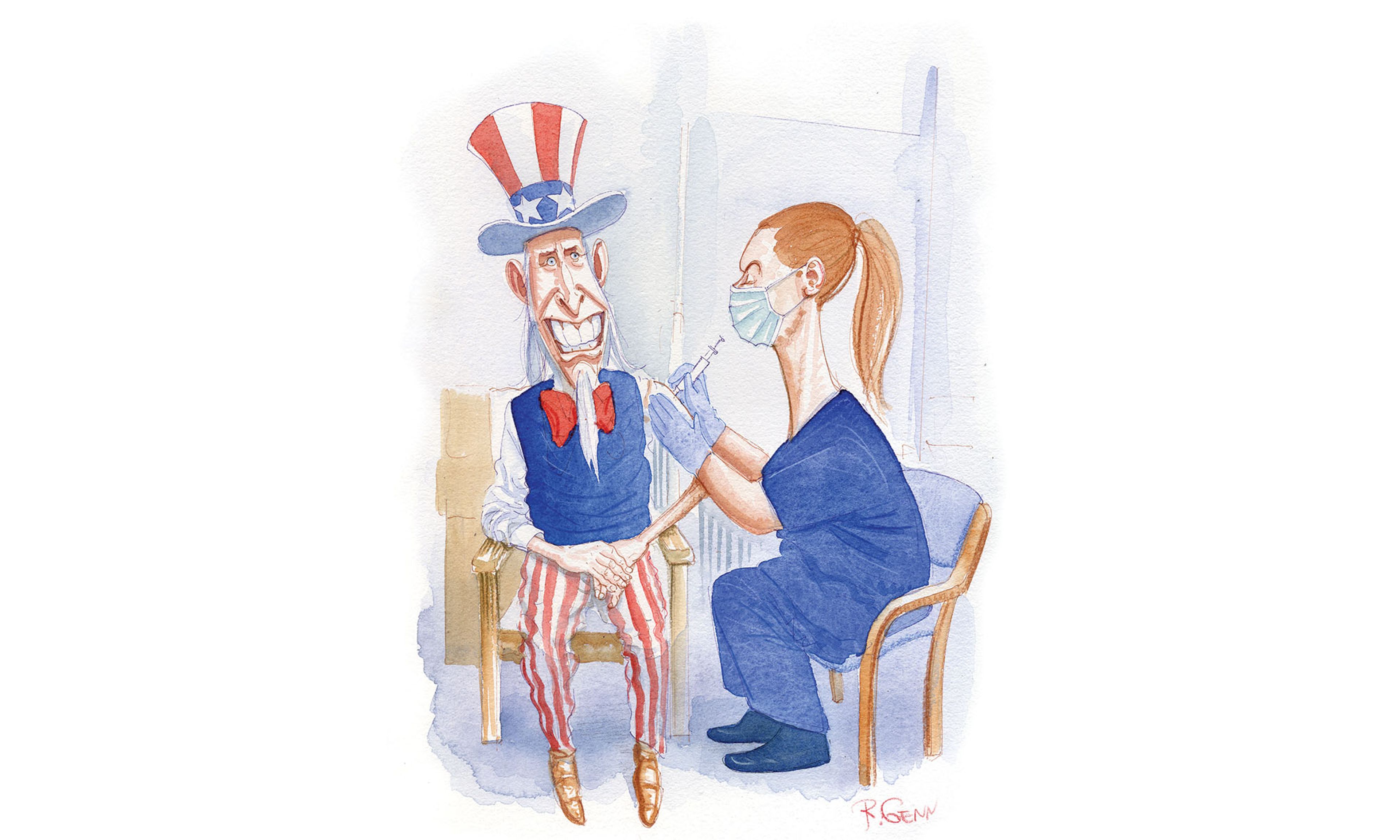
• A former Israeli defense official says Trump knows that aliens exist, but they’ve convinced Trump to keep their existence a secret. We’re not sure which is harder to believe.
• Hunter Biden publicly confirmed that he is under Justice Department investigation. The probe may have been ongoing since 2018, when two of his business partners were convicted in federal court of a $60 million fraud. Biden was not charged then. Weeks prior to the election, it emerged that the now-president-elect’s son was in hot water, not least because of incriminating laptops that were seized pursuant to a grand-jury subpoena. The data added sordid detail to Hunter’s penchant for cashing in on his father’s political influence through business deals with unsavory figures tied to regimes — in China, Russia, and Ukraine — for which his father played point man in the Obama administration. A participant in the China transactions seemed to identify Joe Biden (“the big guy”) as a player and beneficiary. The legacy press and social-media giants conducted themselves abysmally, suppressing the story for fear of hurting Joe Biden’s candidacy. For his part, President Trump hammered his Justice Department for failing to trumpet the investigation for his political advantage. Kudos to Attorney General Bill Barr for protecting and not politicizing the probe, despite tensions with a willful boss that have forced his early exit.
• Historians call the late 1790s, when the first American two-party system was born, the “age of passion”: National partisanship was new and fraught; the example of the French Revolution acted as an accelerant. Things got pretty passionate again just the other day. Georgia secretary of state Brad Raffensperger’s house was surrounded by horn-honking Trump supporters, while his wife received sexually explicit threats (all because he would not undo Georgia’s vote). The Michigan statehouse was closed during the Electoral College count after threats of violence. The Arizona GOP retweeted a fanatical Trumper who declared, “I am willing to give up my life for this fight,” adding, “He is. Are you?” And Michael Flynn, newly pardoned stormy petrel, called on President Trump to invoke “limited martial law” to conduct a national revote. So what did it all amount to? Nothing more, thankfully, than a lot of bluster, ugliness, and futility. The Trump years have had their high points, but the last few weeks have not been among them.
• Most striking of the post-election pro-Trump rallies was the Jericho March in Washington. As Joshua leveled the walls of Jericho, so the marchers — mostly Evangelical Trump fans, with a mix of Catholics and Jews — prayed the “walls of corruption and election fraud” would “fall down” at their behest. The speakers included thinkers (Bonhoeffer biographer Eric Metaxas), crackpots (Flynn), and evil clowns (Alex Jones, the Sandy Hook denier). (Rod Dreher’s reporting, via Twitterstorm, was definitive.) All of them, the good, the bad, and the ugly, were united in the belief that Joe Biden’s victory was a sham and a steal, because Trump is God’s anointed. This fusion of religion and populist politics, not seen since William Jennings Bryan’s Cross of Gold speech in 1896, was, like that earlier upheaval, a rendering unto Caesar the things that are God’s. May the great disappointment of Trump’s defeat cause the best of them prayerfully to rethink.
• President Trump is furious at Brian Kemp and Doug Ducey, the governors of Georgia and Arizona. He wants them to work to overturn the presidential-election results in their states. “Who is a worse governor, @BrianKempGA of Georgia or @dougducey of Arizona???” the president tweeted. “These are two RINO Republicans who fought against me and the Republican Party harder than any Democrat. They allowed states that I won easily to be stolen. Never forget, vote them out of office!” Kemp and Ducey, Trump supporters both, have executed their offices in the face of enormous pressure. Ducey has a special cellphone ring for Trump’s calls: It plays “Hail to the Chief.” Trump called at the very moment that Ducey was signing the certification of Arizona’s election results, in front of TV cameras. The governor removed the phone from his jacket pocket and silenced it. He continued working, and called back later. That was a touch of poetry, and cinema.
• Texas’s lawsuit challenging presidential voting procedures in other states was rightly rejected out of hand by a unanimous Supreme Court. Allen West, the former Florida congressman and current chairman of the Texas Republican Party, responded to the dismissal with a statement concluding, “Perhaps law-abiding states should bond together and form a Union of states that will abide by the constitution.” Loose talk invoking secession over a court decision is reckless and irresponsible, and West backed away after the inevitable controversy. Texans have a fonder cultural memory of secession than most Americans, given that the state won its independence by seceding from Mexico and was spared the scorched earth that characterized the Civil War in much of the rest of the Confederacy. Pro-secession sentiments likewise form a durable undercurrent in California, Alaska, Vermont, and Hawaii. But they are nonetheless an impractical dead end at best, an invitation to violent separatism at worst. The blessings of American union and the diversity of federalism are more valuable than any passing election. Military men such as Colonel West take an oath to protect them. E pluribus unum.
• The pardon power is a royal function, attached to the presidency, our highest executive office, as a check on miscarriages of justice arising from unwise laws or judicial rigidity. The implicit check on it is the president’s concern for his reputation, whether in active politics, retirement, or history’s pages. Whom might President Trump pardon on his way out the door? Edward Snowden, the one-man “cyber Pearl Harbor” (in the words of Ashton Carter, Barack Obama’s last secretary of defense), is the enemy of the intelligence community and the darling of Ron Paul for being so. Those credentials make him a likely beneficiary of Trump’s mercy. The president may also fear that he and his family will be the object of post-presidential prosecution. The pardoning power is plenary and arguably extends to pardoning oneself. Let Trump weigh carefully his use of it. Let him, in short, behave as he never has.
• The Trump administration has carried out several executions in recent weeks, and plans for more before leaving office. Critics say it’s a “rush” of executions. Rush? The latest convict to be executed, Alfred Bourgeois, tortured and murdered his two-year-old daughter back in 2002. While the pace of federal executions has picked up, that’s only because none were conducted between 2003 and 2020. Principled opposition to the death penalty deserves respect. But the law has provided for federal executions for decades. Trump and Bill Barr should not be faulted for implementing it.
• In his November 7 victory speech, Joe Biden said the American people had given him a mandate “to marshal the forces of decency and the forces of fairness” and “to marshal the forces of science and the forces of hope in the great battles of our time.” One month later, Biden ignored that purported mandate by selecting California attorney general Xavier Becerra to serve as secretary of health and human services. Becerra has no experience marshalling the forces of science. He has plenty of experience marshalling the forces of the state to crush religious dissenters, pro-life pregnancy counselors, and independent journalists. That’s bad news for the Little Sisters of the Poor and other Americans who could have their rights trampled upon by the Biden administration’s powerful top health official. The next HHS secretary will need to seamlessly pick up the Trump administration’s efforts to distribute vaccines and persuade enough Americans to take them, but Becerra has no medical background and no experience running a large, complex organization. His notoriety as a rabidly left-wing culture warrior will make it impossible for him to establish credibility with a significant and skeptical swath of the country. In the interest of national unity and bringing the pandemic to a swift end, the Senate would be wise to reject this unqualified nominee — the sooner the better, so Biden may select another HHS secretary who can hit the ground running on January 20.
• Lloyd Austin is an American success story. A retired four-star Army general, he was raised in Thomasville, Ga., went to West Point, and became the first black American to command CENTCOM, i.e., the U.S. Central Command. Austin has now been nominated by Joe Biden to be secretary of defense. According to reports, Biden found Austin’s briefings trustworthy, back in the Obama years. Like Jim Mattis, President Trump’s first SecDef, Austin will have to get a congressional waiver, because the law says you have to have been retired from active duty for seven years before becoming secretary. Like Mattis, Austin has been out just four. Congress might as well waive the law for Austin, as it did for Mattis. But this should not become a habit, and the principle of civilian leadership in the Pentagon is a good one.
• Former 2020 presidential candidate Representative Tulsi Gabbard (D., Hawaii) introduced a bill clarifying that Title IX protections for female athletes are based on sex as opposed to “gender identity.” In other words, the bill would put pressure on schools and colleges to prevent biological men from participating in women’s sports. Similar bills have been introduced by Republicans in the Senate and across state legislatures, but, without support from across the aisle, have not amounted to much. Biden’s Democratic Party has in general swallowed transgender ideology whole, and many progressives cried “transphobia,” but Gabbard’s bill — co-sponsored by Representative Markwayne Mullin (R., Okla.) — offers commonsense, bipartisan resistance to woke extremism.
• Twenty twenty left few of us unscathed, but Minneapolis mayor Jacob Frey has had it particularly rough. After George Floyd was killed, Minneapolis erupted in riots that caused hundreds of millions of dollars in damage, compounding the harm done to the city’s economy by the coronavirus. The ensuing crime wave included a 50 percent increase in homicides, twice as many shootings as occurred in 2019, and more than 4,600 violent crimes, a five-year high. The Minneapolis city council’s reaction to the mayhem was to cut the police department’s budget and trim its stable of uniformed officers by more than a hundred. The 39-year-old Frey — a kind of Jon Ossoff crossed with Beto O’Rourke who has tried to portray himself as a friend of the rioters — had the good sense to threaten to veto any budget bill that took officers off the streets, but the budget was nevertheless cut to the tune of millions of dollars in a compromise signed December 11. With the new year comes the end of his first term and an impending reelection campaign. We recommend the mayor spend his holidays reading about Kerensky and the Gironde.
• In 1971, Nasdaq became the first stock exchange to offer electronic trading. Then it was the first exchange to open a website, and later the first to store data in the cloud. This month, the trailblazing exchange achieved another historic first: It became the only stock exchange to mandate diversity quotas for all listed companies. Businesses hoping to tap funding through Nasdaq will need to have at least one female board member and another who “self-identifies” as an underrepresented minority or LGBTQ: a requirement that three-quarters of companies listed on the exchange would now fail to meet. Nasdaq argues that diversity leads to better financial performance. If that were true, publicly traded companies with too many white male board members would presumably face constant pushback from shareholders. In reality, Nasdaq is following the lead of countless other businesses desperately attempting to shield themselves from the woke mob. In the process, the exchange is distorting capital markets and exacerbating the onerousness of public listing. Sensible companies will take their business elsewhere.
• When last these pages dwelt on the food company Goya, it was caught in one of those pointless, evanescent controversies the modern news cycle generates with abandon. Robert Unanue, its CEO, had said something nice about President Trump at a White House event in July; thereafter, some on the left, such as New York representative Alexandria Ocasio-Cortez, encouraged people to stop buying Goya products (though she now claims otherwise). Donald and Ivanka Trump urged a “buycott” in response to this boycott that supposedly wasn’t. Herewith an update, with some happy news: Unanue claims that Ocasio-Cortez’s efforts have backfired, leading to a 1,000 percent increase in the company’s sales. Unanue even referred to her as Goya’s “employee of the month.” A bit puckish, perhaps, though it is heartening to see a business prosper against a misguided attempt to encourage its failure.
• The Smithsonian, the federal government’s ark of memory, wishes to establish two new museums, focusing on Latinos and women. A bill to begin the process, requiring unanimous consent in the Senate, was blocked by Mike Lee (R., Utah), on the grounds that such museums would “further divide an already divided nation.” Lee was trying to make a point made years ago by historian Arthur Schlesinger Jr. (no right-winger) in The Disuniting of America: We are unum, not plural. Yet the stories of women and Latinos are, as Lee noted, worth telling. Women have left a public mark since Anne Hutchinson and Anne Bradstreet; much of American history, from the Monroe Doctrine through Trump’s border wall, has revolved around the question, What becomes of the Spanish empire? (One answer: A lot of it has moved here.) In an ideal world Senator Lee’s reservations would encourage the museum planners to be thoughtful. Esperemos.
• In an article entitled “The Children of Pornhub,” New York Times columnist Nicholas Kristof recounted the stories of children who were raped or sexually abused and who had videos of their mistreatment uploaded to a popular website for pornography. After the piece was published, Pornhub called it “irresponsible and flagrantly untrue” to suggest that the site hosts videos of child sexual abuse. But within days, the company announced major changes, including increased moderation, a stricter policy for user uploads, and an end to downloading from the site. That didn’t stop credit-card companies Visa and Mastercard from ceasing to allow their cards to be used for payments on Pornhub, following on the heels of a similar decision from PayPal late last year. The latest development: Pornhub appears to have removed millions of videos from the site, more than three-quarters of the content it once hosted. On this occasion, conservatives, and really all decent people, have reason to thank the Times.
• The Supreme Court unanimously ruled in Tanzin v. Tanvir that the Religious Freedom Restoration Act (RFRA) allows plaintiffs to sue government officials in their personal capacities for monetary damages. At issue in this case were three Muslim men who claimed that FBI agents placed them on a no-fly list for refusing to act as informants against their religious communities. The lead plaintiff mentioned that such treatment forced him to “quit his job as a truck driver, in part because he was unable to fly back to New York after completing long-distance, one-way deliveries.” While the men were eventually removed from the no-fly list, the Court made clear that the government cannot escape RFRA requirements by backing down from or modifying policies that clearly violate religious freedom. Moreover, Justice Thomas wrote for the Court, “A damages remedy is not just ‘appropriate’ relief as viewed through the lens of suits against Government employees. It is also the only form of relief that can remedy some RFRA violations.” Let this vigilance continue.
• Key government departments and agencies — including State, Treasury, and Homeland Security — suffered major hacks by a foreign actor or actors. All indicators point to the Kremlin. The leadership of our cybersecurity efforts has, unfortunately, just been thinned. President Trump fired Chris Krebs, who was in charge of cybersecurity, after Krebs said that the elections on November 3 had been secure. Other senior officials resigned in the wake of that firing. A priority for the next administration will be cybersecurity, or should be. And both parties should take the maneuverings of the Kremlin with dead seriousness.
• Axios reported that a Chinese spy targeted up-and-coming politicians, including California congressman Eric Swalwell. Her name is Christine Fang, and she was active in the United States for four years, ending in 2015. Much of her activity was concentrated on the West Coast, where she cultivated a rapport with Swalwell, then an ambitious city councilman, meeting him at campaign events. Her activities spanned the country, and she attended conferences for local mayors that allowed her to have sexual relationships with two Midwestern officials. The FBI began a counterintelligence probe into her activities, and she fled the country in 2015. For all her efforts, intelligence officials said that Fang didn’t get access to any classified information. It’s still a cautionary tale about the sophistication with which Beijing approaches espionage, targeting local politicians before they win election to federal office. Swalwell may have been an innocent, if gullible, victim in this matter. Best for the time being to keep him away from, er, foreign relations.
• Jimmy Lai is probably the most famous person in Hong Kong. He is an entrepreneur, a media magnate, and a democracy advocate. If he is “touchable,” anyone is touchable. The authorities have now arrested him — “national security,” you know — and denied him bail. Night is falling on Hong Kong with alarming speed. On November 23, Jimmy Lai sent out a message by Twitter. “Let us not be afraid and fight on!” he said. The greater the danger, he continued, the easier to arouse the world’s attention. How important is such attention? “The world’s attention is our saving grace.”
• It was a jarring presidential tweet: “Morocco recognized the United States in 1777. It is thus fitting we recognize their sovereignty over the Western Sahara.” Just a few minutes earlier, Trump had announced that Israel and Morocco would normalize ties, the fourth agreement of the recent Abraham Accords. The administration’s remarkable work has set the region on a path to peace that was previously unthinkable. But with the latest agreement some are crying foul, alleging that the deal sells out the Sahrawi people who call the Western Sahara home. They have some noteworthy Washington advocates in Senator Jim Inhofe (whose falling out with the president over a defense bill was the proximate event leading to the agreement) and John Bolton, who in an op-ed savaged the recognition of Moroccan sovereignty for its potential to destabilize an already fragile region. He asks whether it was actually necessary to give up the territory to get normalization, since Israel and Morocco have longstanding, unofficial ties. As a whole, these normalization agreements are a historic opportunity for peace. Still, it’s legitimate to ask whether each particular one is worth the bargain.
• As a second, heavy wave of COVID-19 sweeps over Europe, Sweden’s government is winding down its experiment with herd immunity and moving toward public-health restrictions similar to those adopted by neighboring countries months ago. COVID death rates in Sweden have been high from the beginning and conspicuously higher than those elsewhere in Scandinavia and in Germany. Hospitalizations and deaths in Sweden have risen sharply since late autumn, leading Prime Minister Stefan Löfven to call on citizens to cancel all nonessential meetings and limit gatherings to no more than eight people. Entertainment venues have closed, but Swedish law prevents the government from enforcing many of its recommendations. Polls show that public opinion is still split on restrictions but trending toward support for them. Some scientists and medical personnel worry that Stockholm’s rethinking of its pandemic policy may be too little, too late. Optimists once held up Sweden’s hands-off approach as a model for others to follow. What they need to follow now is Sweden’s current example: Look with clear eyes at the growing severity of the health crisis and adjust accordingly.
• England’s high court ruled to effectively ban puberty-blocking drugs for gender-confused minors. The case was brought by Keira Bell, a 23-year-old woman who began to medically transition at 16 but after completing the process changed her mind. The mother of an autistic teenage girl joined Bell in the case against the Gender Identity Development Service (GIDS) clinic at the Tavistock Hospital in London. The clinic, which is Britain’s largest gender-identity service, has seen huge spikes in the number of children and young people being referred for puberty blockers, as well as a disproportionate number of girls, and has come under heavy scrutiny after whistleblowers alerted the press to “woefully substandard” care. Bell, who comes from a difficult family background, has lost her speaking voice, breasts, and fertility as a result of transgender ideology. As she stood on the steps of the court she expressed hopes that the ruling will stop gender clinicians from “playing God with our bodies.”
• Joseph Epstein, essayist par excellence and occasional contributor to NR, wrote an article for the Wall Street Journal in which he advised incoming first lady Jill Biden not to call herself “doctor” (she holds an Ed.D. — doctorate of education — from the University of Delaware), the term being reserved in common parlance for medical doctors. The reaction was sulfuric, as Epstein was denounced for assailing hard-working scholars, women, and those who are both. People should be called what they wish to be called (within limits). But there is something a tad pompous about parading one’s academic credentials in the ordinary intercourse of life. Germans do it, but America is not Germany. Epstein expressed himself with a tart tongue. If that is the worst Jill Biden has to endure as FLOTUS, she will have an unusually happy tenure.
• The coronavirus has killed more than 300,000 Americans. Countless businesses have been shut down. One of them is the 21 Club, known most often as “21,” the legendary restaurant in New York City. It opened as a speakeasy in 1922. The great and the good dined there — also the bad. In mid December, the owners issued a statement: “In light of the ongoing global crisis and anticipated extended recovery period for the hospitality industry, it has become clear that it will not be feasible to reopen this business in its current form for the foreseeable future.” Possibly, 21 will be revived. In any case, there will be new restaurants, new lore — new life.
• “O! Be some other name,” said baseball commissioner Rob Manfred to the Cleveland Indians, joining a chorus of public opinion. “What’s in a name?” The Cleveland front office listened. “Okay,” they answered in a public statement issued earlier this month. They will keep their name for now, they say, but have decided to start looking for a new one. Precedent was set by the NFL franchise formerly known as the Washington Redskins, who ditched their name last year and have yet to come up with an alternative. (At least the Indians have avoided the awkwardness of calling themselves the Cleveland Baseball Team for an interim.) Future generations may find it odd that in North America we celebrate teams identified with northern European ethnicities — Celtics, Vikings — but consider it distasteful to name anything after American Indians. Meanwhile, Clevelanders are full of suggestions for the new name of their beloved Tribe. A leading contender, sources tell us, is “the Tribe,” the club’s longtime nickname and possibly acceptable to reformers and traditionalists alike.
• The victorious candidate in the recent election for councillor in Namibia’s Ompundja constituency was a man named “Adolf Hitler Uunona.” What is now Namibia was once a German colony, and Teutonic surnames remain common there. So “Adolf” we can understand. But why the jarring middle name? The only thing we can think of is that in Namibia’s neighborhood, Winston Churchill is even more unpopular.
• On December 13, George P. Shultz celebrated his hundredth birthday. For us, it is an occasion to celebrate him. He has had a useful career, and a multifaceted one. Economist, academic, and business exec. Labor secretary, budget director, Treasury secretary. Secretary of state. We should not leave out “Marine,” during World War II. With President Reagan and others, Shultz handled the last chapter of the Cold War expertly. He stands for the values of freedom and democracy when those values need all the support they can get. May this country be blessed with George Shultzes in the next hundred years.
• First, a few stats: In her 29-year career at National Review, Galina Veygman set records in an untold number of categories, having signed over 100,000 checks on the organization’s behalf and processed 685 consecutive payrolls (once from a hospital bed). Numbers are her friend, we would say, but we won’t, because we can hear her now: “They are not my friend! They’re numbers.” As our accounting manager, she elucidated for hundreds of employees, one on one, various mysteries of health-insurance plans and federal, state, and local taxes. She had a flair for slicing through administrative knots and was not shy about voicing affectionate impatience with colleagues who had other gifts but lacked common sense. Always a lively interlocutor, combining strong opinions with impeccable good manners, she also dresses smartly and in general brings energy to the scene — if this were baseball, you would say she has clubhouse presence. A young editor and Russianist owes her for spending time practicing conversation with him in her native language. Спасибо вам. She soon leaves our masthead, to retire from NR — “to spend more time with grandkids,” she writes, “and to do something different with my life.” Godspeed, Galina. Ad multos annos.
• When historians wonder what exactly it was that made the United States a superpower in the 20th century, they should consider the life of Chuck Yeager. Born to farmers in West Virginia in 1923, Yeager joined the Army straight out of high school and worked as an airplane mechanic — the man who would go on to be the most revered pilot in the armed forces was excluded from pilot training because he was an enlisted man and lacked the required educational credentials. World War II changed the requirement and gave him a chance to fly, and Yeager executed 61 combat missions. On one occasion, he shot down five German fighters on the same day; on another, he was shot down over Nazi-occupied France and escaped to Spain, carrying a wounded comrade. Army rules prohibited those who had had contact with the Resistance from returning to Europe, but Yeager protested all the way up the chain of command until Dwight Eisenhower changed the policy and sent him back to fight. After the war, Yeager was a fearless experimental pilot, famously the first to break the sound barrier. He would later be the first man to go 2.5 times the speed of sound, and suffered serious injuries after an emergency bailout from a flight that took him to the edge of space. Having enlisted as a private, he retired with the rank of brigadier general. And all that danger hardly touched him: He was famous for his low-key, easygoing manner, and died at age 97. R.I.P.










Captain Charles E. “Chuck” Yeager in front of the Bell X-1, 1947.
USAF
• Walter Williams’s career as a libertarian public intellectual began in an unusual way: He was court-martialed. After being drafted in 1959, Williams, a self-styled radical raised in a Philadelphia housing project, waged a “one-man battle against Jim Crow from inside the army,” as Damon Root put it in Reason magazine. He represented himself in the proceedings, was acquitted, and then was promptly sent to Korea before he could make any more trouble. But he never stopped making trouble. At the conclusion of his service, he sent a question to his commander-in-chief, John Kennedy: “Should Negroes be relieved of their service obligation or continue defending and dying for empty promises of freedom and equality? Or should we demand human rights as our Founding Fathers did at the risk of being called extremists?” He studied economics in college, and his radical’s attraction to figures such as Malcolm X was tempered by his sensible aversion to socialism and his regard for the ideals of the American founding. He took a doctorate in economics at UCLA, where he met Thomas Sowell, then a visiting professor. After teaching at Los Angeles City College and Cal State Los Angeles, Williams returned to Philadelphia as a professor at Temple University. He was a profound student of the classical-liberal tradition, which brought him to the Hoover Institution, and later to a position as chairman of the economics department at George Mason University. The world was his classroom: He wrote a syndicated column and was as at home filling in for Rush Limbaugh as he was behind the lectern. He died suddenly at the age of 84 after teaching a class. R.I.P.
• How the Cold War was told could depend on where it was watched from. For those peering out from the perspective of an archipelago of rainy islands that had lost its grip over much of the world, and, for that matter, from the perspective of a social class that was losing its grip over that same archipelago, there was no greater narrator than David Cornwell, better known to generations of readers as John le Carré. It is a commonplace that le Carré transcended the limits of the “spy” novel (in an appreciation, the New York Times’ Sarah Lyall noted how WFB had observed that “The Little Drummer Girl is about spies, as Madame Bovary is about adultery or Crime and Punishment about crime”). Nevertheless, it says something that le Carré’s one attempt to break cleanly from that genre — The Naïve and Sentimental Lover — is generally judged to have been a failure. It says something, too, that, despite some fine later novels, le Carré’s greatest work was written while the Cold War drifted on, seemingly without any hope of a victory for a West that, for all its imperfections, he recognized was the better side (complaints that le Carré had succumbed to the temptations of moral equivalence were overdone). The product of a chaotic upbringing — a vanished mother, a conman father — he replaced lost illusion with the embrace of disillusion that gives his writing so much of its strength. But when Eastern Europe came in from the cold, so in a way did he. Disillusion was replaced by causes: bad big pharma, good big Europe. The quality of his work came down a notch, but from what a peak. He died, at 89, a grand old man, somewhat enigmatic right to the end, the perfect chronicler for the perfect, and imperfect, spy. R.I.P.
All Hat, No Evidence
The “big one,” as President Trump called it, got nowhere.
He touted a Texas filing with the Supreme Court seeking to invalidate the presidential election in four battleground states won by Joe Biden. Texas alleged that election procedures in those states violated the Constitution, and resulting irregularities impermissibly diluted the votes of Texans.
The justices dismissed the case 7–2. In keeping with their longstanding view that the Court has to hear such cases within its original jurisdiction — i.e., when a case is brought directly to the Supreme Court by a state suing another state — Justices Thomas and Alito thought that it should take up the case regardless of the merits (they stipulated that they would not grant the remedy sought by Texas).
The court found that Texas has no standing to challenge the election procedures in Pennsylvania, Wisconsin, Michigan, and Georgia, having suffered no direct, tangible injury from them. Besides, it would have been a grotesque violation of federalism (not to mention democracy) for the Supreme Court, at the behest of one state, a month after the election, to reverse the duly certified election results of four other states.
It is dispiriting that a suit seeking to reverse the outcome of a national election on the flimsiest grounds won the support of 19 other Republican states and more than 100 House Republicans.
Trump and his allies complained that the Supreme Court didn’t address the merits of the Texas suit, even though there was almost nothing there. The filing rehearsed arguments that had been extensively litigated and rejected in other courts. Texas, for instance, made much of the Pennsylvania secretary of state’s issuing guidance allowing counties to give voters the opportunity to “cure” faulty absentee ballots, and the Pennsylvania supreme court’s permitting late-arriving absentee ballots to count, but there is no reason to believe either of these jerry-rigged measures involved enough votes to call into question Biden’s 80,000-vote margin in the state.
Tellingly, shortly after the Supreme Court order, a federal district judge granted the Trump campaign standing and evaluated its lawsuit in Wisconsin on the merits. The Trump-nominated judge rejected the campaign’s contention that Wisconsin had violated the Constitution by promulgating election procedures not passed by the state legislature, instead finding that they were reasonable statutory constructions. One of the changes, involving officials’ correcting faulty witness addresses on absentee ballots, actually dates from prior to the 2016 election. None of this, the judge ruled, came anywhere close to justifying tossing out Wisconsin’s election.
Having failed in the courts, Trump turned his attention to challenging Biden electors on January 6 in Congress. This would require Congress to vote to reject lawful Biden electors and accept self-appointed Trump electors, something that is not going to happen. After the Electoral College met on December 14, Senate majority leader Mitch McConnell congratulated President-elect Joe Biden and declared it time to move on, a sentiment echoed by many of his Republican colleagues.
Trump has exhausted every legitimate means, and quite a few illegitimate ones, to challenge and overturn the election. It’s past time for him to stand down.
An End in Sight
One last terrible wave of COVID is cresting just as vaccines start to be distributed.
The vaccines are a great triumph for private enterprise, aided by intelligent government policy, and specifically for the Trump administration’s “warp speed” initiative. Reflexive critics of the president said, when he promised their quick deployment, that it would be well into next year before we had vaccines. They were, thankfully, wrong. We should couple the distribution of the vaccine with federal support for increased production of antibody treatments, as recommended by former Food and Drug Administration commissioner Scott Gottlieb.
For a while, though, vaccinations and the number of deaths will rise in tandem. Vigilance is still needed, including the wearing of masks in close indoor quarters.
Calls for such preventative measures have been undermined by the absurd, and frequently hypocritical, overreach of too many government officials. For a while, Los Angeles shut down outdoor playgrounds. In much of the country, public schools have been kept closed even as evidence has mounted that they could be safely reopened and that a lot of children are falling badly behind. The press, too, has lost credibility, framing too much coverage of the pandemic in partisan terms. (You would never guess from the focus on Florida that it currently ranks 20th among states in per capita COVID deaths even with its disproportionately elderly population.)
Some of this is annoying, some of it maddening. None of it is a reason to forget to wash our hands. The cost of the virus, in lives and dollars, is going to keep rising for several hard weeks ahead.











Comments