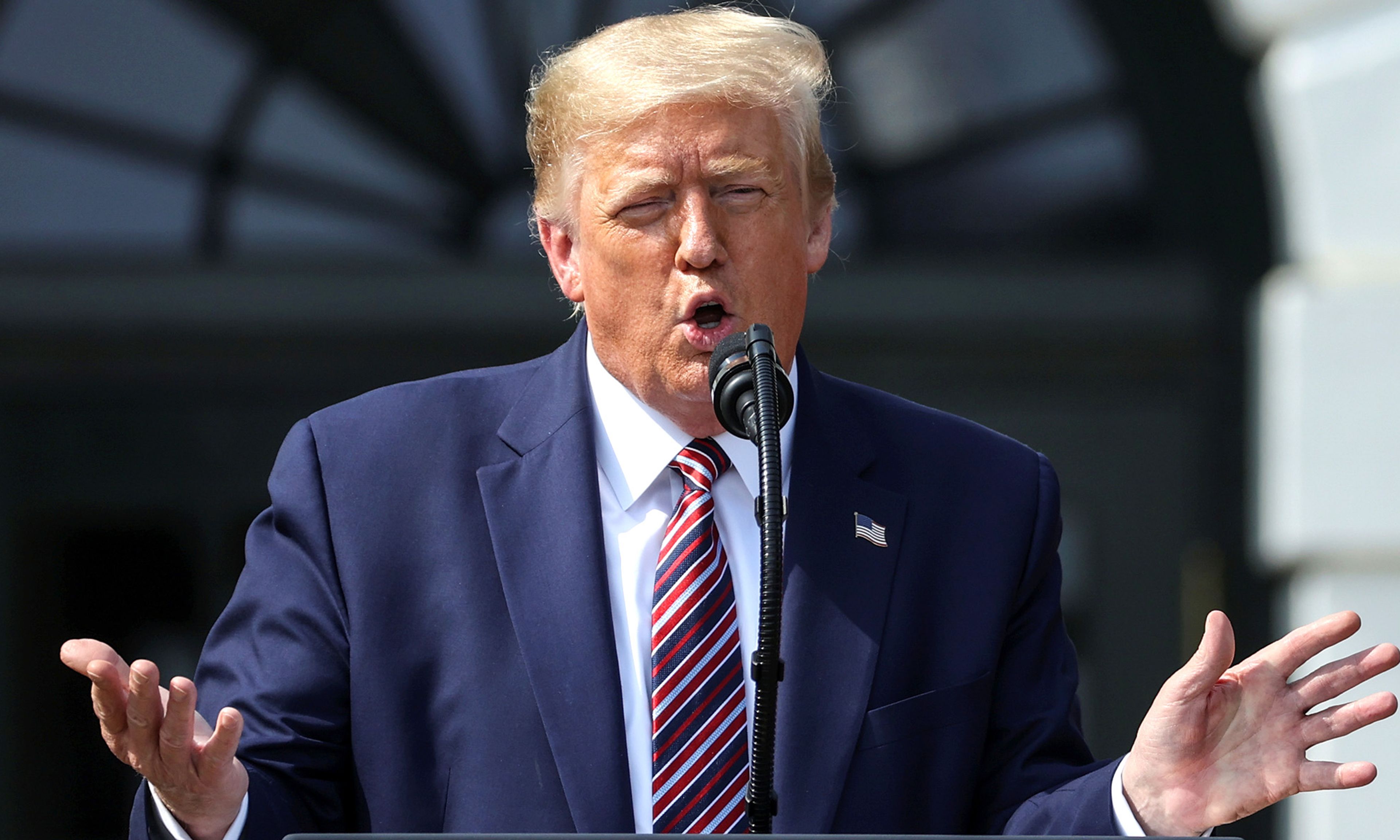
Many changes have been inflicted on the Right by the ascendancy of Donald Trump, including a substantial altering of its posture on economic issues. Where this blend of economic nationalism and conservative populism has been tried, it has been found wanting — at least if you take the goal of working-class populism to be the bettering of opportunities and outcomes for the working class. And there is every reason to believe that more of this approach in the future will lead to the same disappointing outcomes.
This is not to say that every instance of President Trump’s economic policy disappointed. But it is notable that Trump’s successes were deviations from his brand of nationalism-populism. Indeed, the two major economic-policy accomplishments of the Trump years were standard conservative economic fare: needed reform of the corporate tax code — including a lowering of the statutory corporate-tax rate from 35 to 21 percent and the allowing of businesses to immediately write off the full cost of qualified new investments — and a less onerous regulatory regime than existed during the Obama presidency.
It is perhaps superfluous to argue that Trumpian economic nationalism and populism did not help the working class, given that, for many of its manifestations, a forecast of success would have been entirely unreasonable to begin with. Using the bully pulpit to browbeat and publicly shame companies — Foxconn, Harley-Davidson — into investing in the United States rather than overseas was never going to do much for their workers over the long term, much less for the working class as a whole. In a free society, businesses make long-run decisions based on real-world factors, not on the president’s thumping his chest and howling “America first.”
The trade war with China — the most substantial and developed policy manifestation of Trumpian economic nat-pop — is a different story. Many were quick to point out that increasing tariffs on imports from China would increase the prices U.S. consumers pay at grocery and retail stores. But even if so, might this not prove to be an example of diffuse costs and concentrated benefits? Domestic manufacturing workers might be helped quite a bit if government protected their industry from competition from imported goods.
A December 2021 working paper by economists Aaron Flaaen and Justin Pierce did find that the protection provided by the Trump tariffs on imports from China and other nations boosted manufacturing employment. They estimated that if an industry were to shift from relatively light exposure (at the 25th percentile) to tariffs to relatively heavy exposure (at the 75th percentile), the effect of additional import protection would boost employment by 0.4 percent.
But the story doesn’t end there, because tariffs don’t function only to protect domestic industries from foreign competition. They also increase the cost of intermediate goods used by U.S. firms in their own production of final goods for sale to consumers. These higher costs hurt manufacturing employment in U.S. firms that export abroad or that sell their products here at home. Flaaen and Pierce estimate that this aspect of the Trump tariffs reduced manufacturing employment by 2 percent.
Finally, other countries don’t just sit on their hands and allow the United States to reduce their competitiveness. Instead, they retaliate. Retaliatory tariffs imposed on U.S. exports reduced manufacturing employment by 1.1 percent.
All told, the trade war reduced U.S. employment in manufacturing by 2.7 percent relative to what it likely would have been in the absence of the trade war, mostly through slower job creation. Flaaen and Pierce also found that counties with more exposure to the tariffs had elevated unemployment rates, suggesting that manufacturing workers who lost their jobs were not quickly hired into other industries.
Along with hurting manufacturing workers, the trade war increased overall consumer prices and clouded the policy outlook, leading to a pause of business investment. In fact, the trade war worked against the Trump administration’s laudable corporate-tax reduction, dampening investment with one hand while encouraging it with the other. Now and in the future, when some argue that we don’t need to keep the 2017 corporate-tax cuts in place because the cuts didn’t spur business-investment spending, we can thank Trump’s trade war.
It is nonetheless the case that Trump’s blend of economic pessimism, conservative populism, and economic nationalism has staying power. To one degree or another, various conservative intellectuals — such as American Compass founder Oren Cass and writers for the journal American Affairs — and 2024 GOP presidential aspirants — most notably, Senators Marco Rubio and Josh Hawley — are attempting to pick up the baton and fashion a policy agenda guided in part by their understanding of Trump’s 2016 success.
Whatever the politics, the economics will be detrimental for American workers.
Few of the major policy goals of Trump’s successors can be expected to help the working class any more than his jawboning of corporations did. Breaking up large technology companies, going after pharmaceutical companies, and imposing taxes on financial transactions aren’t about helping workers. They’re about expressing grievance against a social class on behalf of workers — what you might call “grievance-onomics.”
Protecting manufacturing workers from imports does have a certain logic to it. But the effects of trade restrictions on the price of intermediate goods and producer prices would be the same as they were with Trump’s trade war. The same goes with the threat of retaliation. There is every reason to believe that additional trade restrictions would hurt manufacturing workers, to say nothing of workers in general, consumers, and the broader economy.
The eagerness to continue offering the domestic manufacturing industry protection from imports is one manifestation of a longing on the right for industrial policy. Long derided by free-market conservatives, industrial policy also will not help the working class or the nation as a whole and should be avoided. The standard questions about industrial policy are worth asking: Why should we expect the government to do a good job picking winners and losers? Why should we think the government will do a better job allocating scarce resources across industries and businesses than the market will? If the government is involved in microeconomic intervention — say, supporting domestic semiconductor or pharmaceutical manufacturers — then how will it avoid slipping into cronyism and corruption?
“We don’t make things here anymore,” lamented Senator Hawley in a 2019 speech. This isn’t true. (The senator implicitly acknowledged as much when he went on to say, “At least, not the kinds of things a normal person without a fancy degree can build with his hands” — which sounded more like grievance-onomics than economics.) If anything, manufacturing output was on an upward trend after it took a hit in the 2008 global financial crisis, and it has recovered nicely from the pandemic.
What is true is that the number of manufacturing workers has been declining for four decades. What is also true is that manufacturing’s share of overall employment has been declining for eight decades. Eight decades — it is hard to blame that decline on China’s rise, the neoliberalism of the 1980s, the rise of high finance, globalization, or any other of the factors to which purveyors of grievance-onomics point. This is not to deny that these factors may have contributed to some degree, but the driving force behind this change has been technological advance, which has increased manufacturing-sector productivity.
Economic nationalist-populists might have cultural or aesthetic reasons for preferring an America in which workers make “the kinds of things a normal person without a fancy degree can build with his hands,” but unless their industrial policy is to turn back the clock on technology and heavily discourage use of the equipment, software, and know-how that have increased manufacturing productivity, they won’t get what they desire.
And why would we want them to? For the U.S. to turn back the clock would not be in any group’s economic interest. Nostalgia is a kind of wrath, and those who are led to support reindustrialization because of it have found a solution in search of a problem.
It is also a problem of its own. Over the long run, heavy use of industrial policy would reduce investment, lower productivity, reduce wages, and, through lower income and fewer opportunities, harm the very workers its proponents want to help. Ultimately, industrial policy is bad for the working class.
Senator Rubio’s approach to industrial policy is more nuanced and thoughtful than that of the typical nat-pop conservative, though ultimately off base. In a speech last May, he called for a “targeted industrial policy.” In addition to being concerned about deindustrialization and manufacturing jobs’ moving overseas, Rubio is worried about China.
Some of Rubio’s worries are well placed. There is no doubt that China has stolen the intellectual property of trading partners, but there are better solutions to this than the United States’ attempting to micromanage domestic industry.
Concerned, partly for national-security reasons, about China’s role in making medicines and in mining and producing rare earth minerals, Rubio would like to see pharmaceutical and semiconductor manufacturing return to the U.S. He argues that what is in the nation’s economic interest is not always in its best interest overall.
One need not be in favor of central planning to sympathize with Rubio’s China worries. But arguing that the U.S. should not rely on Chinese production of critical medicines and weapons-system components is quite a distance from arguing that that production should relocate to Ohio and Michigan — and that the federal government should pressure that relocation through aggressive subsidies and heavy-handed regulation. Why shouldn’t that production move to Vietnam or Mexico?
Conservative nat-pops want to substantially curtail immigration. Reasonable people can disagree on the right number of green cards for the U.S. to issue in any given year. But this debate is taking place while two things are true: The U.S. has the lowest level of immigration in decades, and U.S. businesses are desperate for workers.
An overheated labor market may be good for some workers in the near term, though it is contributing to consumer-price inflation that is eating into — and for many workers overwhelming — nominal-wage gains. It is also going to spur businesses to adopt worker-replacing technology at an even faster pace. By reducing the size of the workforce through additional immigration restrictions, nat-pops would be strengthening the very force they want to weaken.
Beyond these obvious problems, economic nationalism-populism and grievance-onomics threaten workers in insidious ways.
For one thing, this way of thinking belittles the importance of economic growth. Mr. Cass goes so far as to dismiss both economic growth and income redistribution as ways of fighting material poverty and of increasing opportunity. He mocks this approach to economic policy — growing the economy and using the fruits of growth to help workers — as “economic piety.” (It is confusing, and perhaps telling, that one of his signature policy goals is a massive wage subsidy, a textbook example of the “economic piety” he criticizes.) He is not alone in downplaying the importance of growth.
Suffice it to say that over long periods of time, seemingly small changes in the economy’s rate of growth translate into massive upswings in opportunity for the working class. Over the short run, there is no better jobs program than a hot economy that finds employers chasing workers. Industrial policy and trade wars are a threat to long-run growth and to the long-term welfare of workers. Growth in recent decades has been lower than it had been in the decades following the Second World War. What is needed in the face of slower growth is faster growth, not policies — like those advanced by nat-pops — that would compound the problem. Social conservatives should champion economic growth as well: A strong economy and the healthy labor markets that come with it allow people to provide for their families.
Another of the visible manifestations of Trumpian economic populism was in immigration policy. The optimal amount and composition of immigration to the United States can be debated, but nat-pops — intellectuals, pundits, elected leaders — often go further, demonizing immigrants. Trump himself is as guilty as anyone, but he is far from alone. Hanging a “no immigrants need apply” sign on the Statue of Liberty diminishes America’s status as the preferred destination for a great many of the world’s most talented, ambitious, risk-tolerant, and hardworking people. They start businesses at a higher rate than native-born workers, and new businesses hire a disproportionate share of workers.
The broader Trumpian populism that is gripping so much of the Right — and of which economic nationalism and grievance-onomics are a part — threatens longer-term social stability by dividing the nation along racial, ethnic, and religious lines. Populism’s threat to longer-term economic prosperity is a threat to the longer-term well-being of workers.
Grievance-onomics indulges a narrative that workers are victims who don’t have agency and are players in a “game” that is “rigged” against them. This is analytically false — e.g., the link between worker productivity and compensation is empirically strong. More than that, it is a terrible message to send to workers. If workers come to think of themselves as victims who can’t get ahead, then why will they try to get ahead? Apostles of grievance-onomics risk creating among workers the very problems of economic stagnation and immobility that they falsely claim beset us.
Yes, the economic pessimism of conservative nat-pops is misplaced. Income inequality has been stagnant or falling for over a decade. Inflation-adjusted wages for typical workers have grown by around one-third over the past three decades. Most adults today have a higher household income than their parents enjoyed at similar ages. The middle of the labor market has not been permanently hollowed out. The American dream is not dead.
Though Trump’s blend of pessimism, populism, and nationalism has failed, his focus on workers points in a helpful direction. The challenge for conservatives is to craft a policy agenda for workers that will be actually effective rather than merely cathartic.
The working class faces many economic challenges. The best solution to those challenges is neither libertarianism, with a stronger dose of “free-market fundamentalism,” nor the type of industrial policy or class warfare offered by conservative nat-pops. Instead, workers need a growth-and-participation agenda. Grow the economy and use some of the surplus to create on-ramps of opportunity for all, helping more people to participate more fully in economic life and to enjoy the dignity and fulfillment that come from work.












Comments