• Nothing says bringing back the America of earlier generations like a sex scandal involving a Kennedy.
• Socialist Zohran Mamdani, running on the Democratic line, handily beat former Governor Andrew Cuomo and media personality Curtis Sliwa to be the next mayor of New York City. Young gentrifiers dismayed by high rents joined the perennial left to make the win. Progressives hailed the result as springtime for socialism, and indeed Mamdani gave a victory speech name-checking the long-ago collectivist Eugene V. Debs and pledging to soak the rich. He would need the cooperation of the state legislature and Governor Kathy Hochul to do that. The governor, up for reelection next year, had pledged not to raise taxes but, fearing pressure from an energized left wing, looks ready to buckle. Mamdani’s calls for free buses and a rent freeze require the approval of independent authorities, but all by himself he can end charter schools for the children of ambitious parents and hog-tie the police department. A determined enemy of Israel, he will be tempted to foreign-policy grandstanding whenever domestic mischief stalls. Gotham has probably had worse mayors — Fernando Wood wanted to sit out the Civil War; Harry Truman sent William O’Dwyer to Mexico as ambassador to thwart a corruption investigation. But Mamdani will do for now.
• It was hard to find any bright spot for Republicans in a near-comprehensive wipeout in November’s local elections. This shouldn’t be overinterpreted, since in the normal course of things Republicans are hard-pressed to win statewide in Virginia and New Jersey — especially in off-year elections when the GOP holds power in Washington, D.C. — and they have no chance in New York City. But it shouldn’t be ignored, either. Abigail Spanberger’s margin was large enough to pull Democratic attorney general candidate Jay Jones over the top, despite his history of fantasizing about political violence in texts that were revealed by NR’s own Audrey Fahlberg. It’s true that President Trump wasn’t formally on the ballot, which was his explanation for why the elections went poorly. But Democrats worked ceaselessly to link every Republican to the president, and Trump’s approval rating in Virginia and New Jersey, in the low 40s, matched the vote share of the GOP’s gubernatorial candidates. These are bad signs for next year’s congressional midterms.
• The longest government shutdown in history ended, and it somehow managed to be even more pointless than usual. Chuck Schumer and Senate Democrats talked themselves into believing that they could strong-arm Republicans into passing a permanent extension of the “enhanced premium tax credits” for purchasing health insurance on the exchanges set up under Obamacare. Extending the credits for the next ten years would cost almost half a trillion dollars. After government workers either stayed home or worked without pay for almost six weeks — and airports grew increasingly snarled as air traffic controllers started calling in sick — seven Democratic senators and Angus King (I., Maine) relented in exchange for a promise of a vote on the tax credits. If the point of the shutdown was to convince the Democratic grass roots that Schumer is a tough guy who can go toe-to-toe with President Trump and Republicans, it backfired. The party activists are angrier than ever, convinced that either Schumer couldn’t control his caucus or that he secretly assented to their voting to reopen the government. Polling indicates that Democrats believe that their leaders compromised too much and that Republicans won the shutdown fight. Schumer often looks miserable; these days he has good reason to be.
• As part of the reopening agreement, Democrats abandoned the demand that Republicans expand Obamacare. Instead, the agreement does no more than promise a vote on extending the Covid-era subsidies for purchasing insurance on Obamacare’s exchanges that are set to expire at the end of the year. The flip side of this result is that Democrats will now be able to bring the issue of rising health insurance premiums into the midterm elections. Obamacare is a national insurance scheme that functions by imposing a raft of regulations on insurance policies and then forcing young and healthy enrollees to pay more for coverage to offset the cost of covering older and sicker enrollees. In other words, it drives up the cost of premiums by design. The subsidies are an example of the government trying to chase costs that are rising because of regulations passed by the exact same government. The fact that Republicans have failed to explain this — and that, over the more than 15 years since the passage of Obamacare, they have failed to rally around an alternative and have surrendered the issue of affordability to Democrats — is an own goal by the GOP. The United States spends roughly $5 trillion per year on health care at all levels, which is more than one in six dollars in the economy. They may not like to talk about it, but Republicans need to realize that the health-care issue isn’t going away — and they need to find their voice.
• To live is to maneuver, said Whittaker Chambers. But even the clear-eyed Cold Warrior might have been shocked by this one: Trump executed an abrupt about-face on the Epstein files. After excoriating everyone who wanted to vote to release them, and intensely lobbying recalcitrant members of Congress, he decided to bolt in the other direction to get in front of the parade. A vote to release the files passed the House with only one nay vote. Not that this is necessarily a good thing. We’d prefer maximal transparency, overseen by the relevant judges in the various ongoing Epstein-related cases, rather than a willy-nilly, politicized push to violate every standard practice in the hopes of nailing Trump or exposing some vast criminal conspiracy. The Epstein emails released so far are what one might expect given what we know so far: They are embarrassing regarding Trump’s relationship with Epstein but contain no smoking gun regarding any misconduct by the president. Where there’s smoke . . . there’s sometimes just smoke.
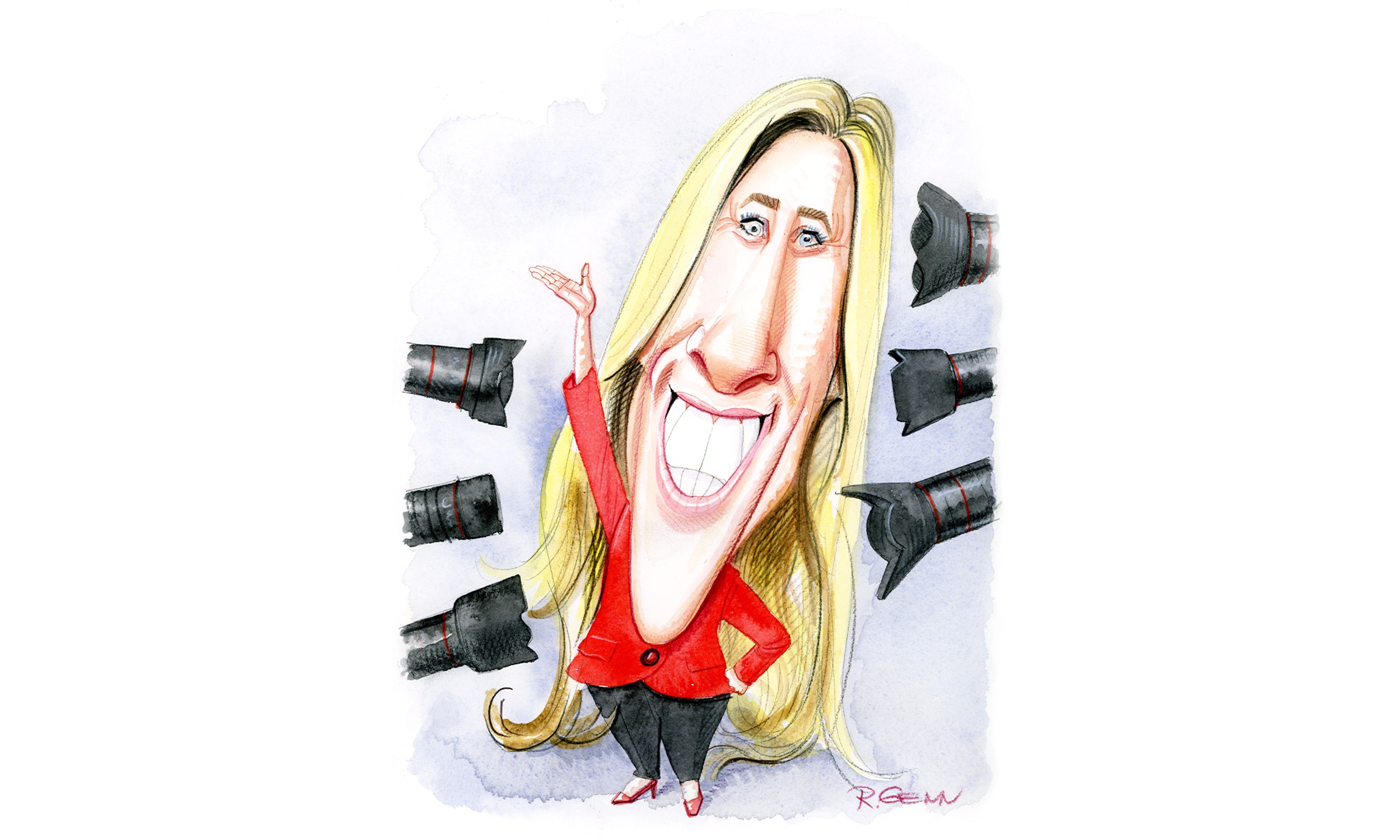
• Representative Marjorie Taylor Greene (R., Ga.) has been perhaps the most unlikely beneficiary of strange new respect in the history of D.C. In recent weeks, she has gone from a conspiracy theorist disdained by the legacy media to a conspiracy theorist given a respectful hearing by the legacy media, based on her criticisms of her fellow Republicans and her feud with Trump. The proximate cause of the breakup was MTG’s support for the House vote to release the Epstein files. She is winning at least a tactical victory on this issue. But Greene, true to form, believes that there has been a nefarious cover-up to protect pedophiles, with, of course, Israeli involvement. More broadly, Greene is a Tucker Carlson–style isolationist who believes that Trump has betrayed MAGA and working Americans by being so engaged around the world. Greene has complained that Trump has called her a “traitor,” arguing that it puts her life at risk. It was indeed wrong of Trump to say this — it’s untrue, and it’s unworthy of his office — but MTG hasn’t found fault in Trump’s lobbing such rhetorical grenades in the past. What do they say about being able to dish it out but not take it? Given how these intra-MAGA feuds with Trump often work, a reconciliation could come at some point. That won’t change the fact that Greene is a conspiracist with a naïve and dangerous view of the world.
• For 52 years, the Heritage Foundation has been a pillar of serious conservative action and thought in Washington, D.C. It has analyzed policy and advised incoming Republican presidents, including Donald Trump in his second term. But Heritage Foundation President Kevin Roberts has now dealt his organization and its reputation a severe blow. It began with two online yakking heads, Nick Fuentes and Tucker Carlson. Fuentes is a proud racist and pro-Nazi: he has called Vice President JD Vance a “race traitor who married a jeet” (a slur referring to Vance’s wife, Usha) and Hitler “very cool.” Carlson, the former Fox News host who is on his own downward path (see James Kirchick’s article “Tucker Carlson’s Dark Turn” in the September 2025 issue of NR), gave Fuentes a two-hour interview with barely any pushback. (When Fuentes remarked that he also liked Stalin, for instance, Carlson said he would “circle back to that,” but never did.) A chorus of conservative criticism ensued, when in jumped Roberts, explaining in a four-minute video posted on X that while antisemitism is bad, a “venomous coalition” was attacking Carlson, whom he described as Heritage’s “close friend.” Roberts’s subsequent efforts to explain his intervention have been poor. After trying to blame his own utterances on his chief of staff, who was dismissed, he told an all-hands meeting at Heritage, “I made a mistake, and I let you down, and I let down this institution, and I’m sorry, period, full stop.” But Roberts still stood by Carlson and rejected internal calls to remove the video. What will the conservative movement and the GOP be after Trump steps down? Will MAGA include fascist cosplay and conspiratorial lunacy? (Post-Fuentes, Carlson had another long interview, promoting the idea of “chemtrails.”) Unfortunately, the last couple of weeks suggest that Heritage hasn’t yet decided where it wants to come down in these debates.
• The Supreme Court heard arguments in two cases challenging Trump’s “emergency” tariffs, which were imposed under the International Emergency Economic Powers Act of 1977 (IEEPA). Solicitor General John Sauer faced some deservedly hard questions. The Court should rule that the congressional power to tax — the very core of the Article I power of the legislature — cannot be delegated without clear and unambiguous statutory language and identifiable limiting principles. IEEPA has nothing of the sort. It never mentions tariffs, taxes, or any synonym for them. No other president has argued that IEEPA authorizes tariffs. The most that IEEPA says is that the president may “regulate” the “importation or exportation” of foreign goods during a non-wartime emergency by means of “licenses.” Sauer conceded that presidents have no inherent power to impose tariffs. He also admitted to Justice Ketanji Brown Jackson that, under Trump’s theory, if a future Democratic president declared a global climate emergency, this could unlock sweeping powers that could not be reviewed by the courts. The prospect of that sort of governance should be enough to horrify the justices. They returned again and again to the core question: Is a tariff different from other trade sanctions (such as an embargo or an import quota) because it is a tax? Given the centrality of taxation to the powers of Congress, the answer should be easy.
• No bad idea is ever truly dead. Among the rules of our governance that are not written in the Constitution, few are more crucial to preventing mischief than the Senate’s legislative filibuster. A bare majority can tax and spend, but the consent of senators representing at least three-fifths of the states is needed to make new, potentially permanent federal laws. While this can frustrate conservatives and thwart needed reforms, it far more often curbs brief, ill-considered enthusiasms such as Joe Biden’s plans to remake American election law and spend $6.5 trillion. It also leaves space for states to govern themselves. That’s why Senate Republicans, and now-departed Democratic institutionalists such as Kyrsten Sinema and Joe Manchin, have long defended the legislative filibuster. Now, Trump is renewing his call to junk it — which he began doing while trying to end the government shutdown. Given how little major legislation the GOP has ready to enact on a majority basis, this would amount to selling our patrimony for a mess of pottage. It would allow progressives to accomplish their long-cherished goal without paying a political price for their radicalism. Thankfully, Senate Majority Leader John Thune and most of his caucus have resisted this siren song.
• The Republican-led House Oversight Committee released a report on former President Joe Biden’s use of autopen signatures on the many pardons and commutations he handed out during his term, and particularly near its end. Many of these were scandalous enough taken on their own terms, but what made them particularly outrageous was the suspicion that the bulk of these acts were the work of Biden’s staff, not of the senescent president himself. One might reasonably understand how Biden found the time to preemptively pardon his family members, breaking frequent promises never to do so, but it was harder to believe that he was setting aside personal time to commute the sentences of people like Maryland’s thrice-murdering “Black Widow” killer. The House report confirms what voters long suspected: Biden’s inner circle hid the extent of his mental decline from the American people and, after he dropped out of the race, used his autopen as part of their campaign to set a new record for presidential clemency.
• Trump has too often abused the power of clemency, but his pardoning of dozens of his 2020 campaign advisers and supporters complicit in “fake electors” schemes is less objectionable than portrayed. Reports describing these as “prospective” pardons because the recipients haven’t been federally charged are misleading. The allegations have been around for five years (meaning the federal statute of limitations is about to expire), and Democratic prosecutors filed charges in several states. Federally, only Trump was ever charged with fake-electors allegations (in Jack Smith’s January 6 case, which was doomed by the Supreme Court’s immunity ruling and Trump’s 2024 electoral victory). That’s because the allegations are weak. The electors themselves understood their standing as alternative Trump slates (in states won by Biden) as a contingency in the event the election results were overturned. Top Trump advisers did use the existence of ersatz slates to support their claim that Biden’s electoral votes were invalid, but that’s better understood as pushing a bogus legal theory than perpetrating an actionable fraud. The pardons thus excuse no federal crimes that were ever likely to be charged, and they have no effect on state charges (those cases seem to be collapsing of their own weight). That said, the pardons continue Trump’s condemnable obsession with portraying Biden’s 2020 victory as a fraud.
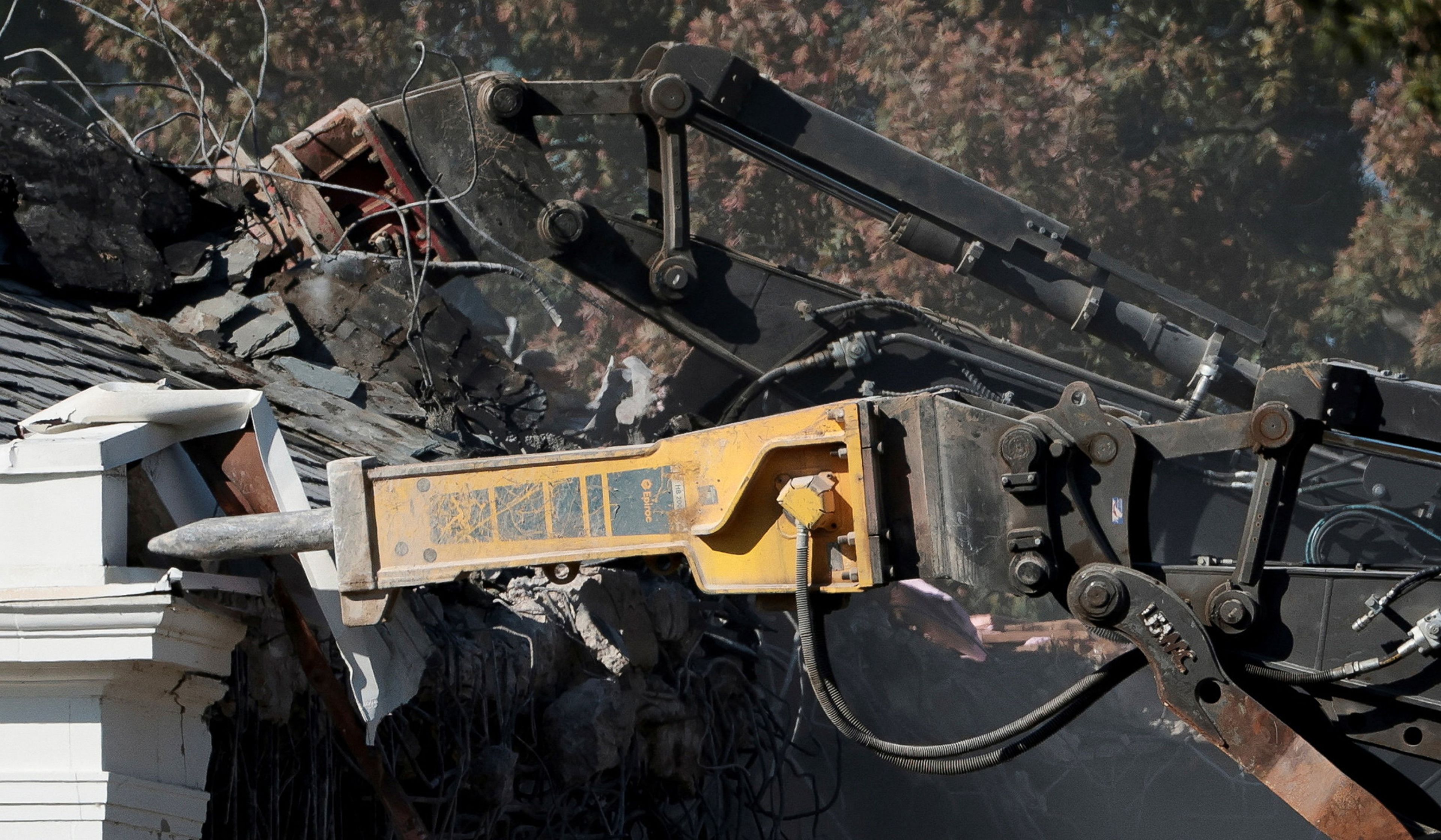
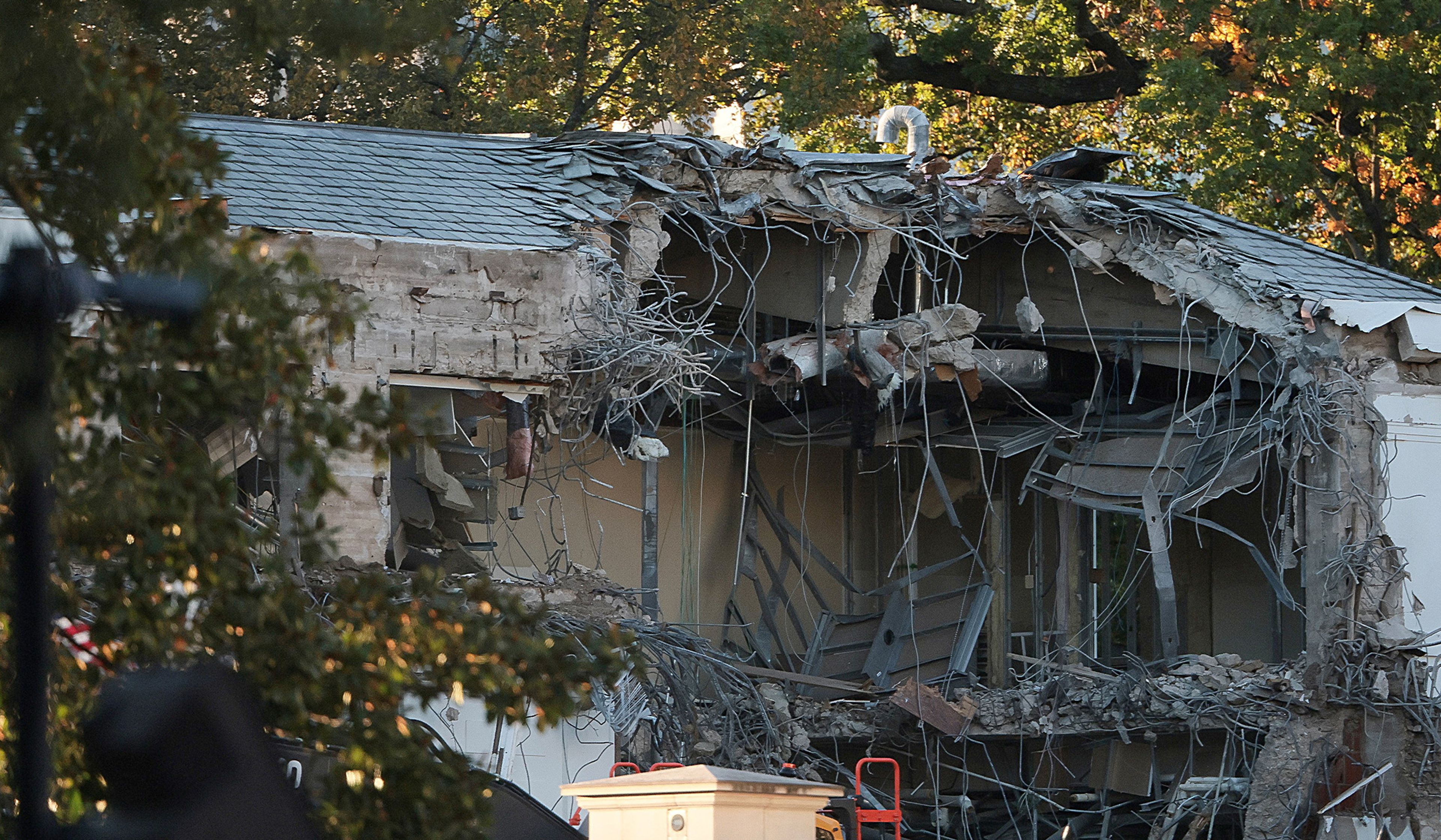
• In late October, Trump began demolishing the White House East Wing to replace it with a $250 million ballroom. But judging by the morose and hysterical rhetoric that has emanated from the Democratic Party and its ideological allies in response, one might have thought that Trump had announced his intention to send a squadron of B-2 bombers across the Potomac to completely level Washington, D.C. California Governor Gavin Newsom complained that Trump is “literally destroying the White House,” while Hillary Clinton groaned, “It’s not his house. It’s your house. And he’s destroying it.” Of all the reasons to criticize Trump, however, this must count as the silliest. The president is simply replacing a handful of 1940s-era office buildings with a ballroom. As a general matter, there is nothing intrinsically wrong with a president’s making changes to the White House. Over the years, presidents of both parties and of all leadership styles have done precisely that, and in no cases have these changes implied incipient fascism, betrayed an inappropriate sense of permanent ownership, or justified tears and outrage from political critics. Certainly, one may quibble with Trump’s often gaudy design preferences. But, objectively, the White House lacks sufficiently robust entertainment spaces, and the addition of a new facility will clearly help to alleviate that problem. The justification for this is so obvious that the idea was first proposed by President Benjamin Harrison — back in 1891. Altering a modern part of the executive branch’s headquarters is not akin to “destroying” the White House. Good grief, people. Pull yourselves together.
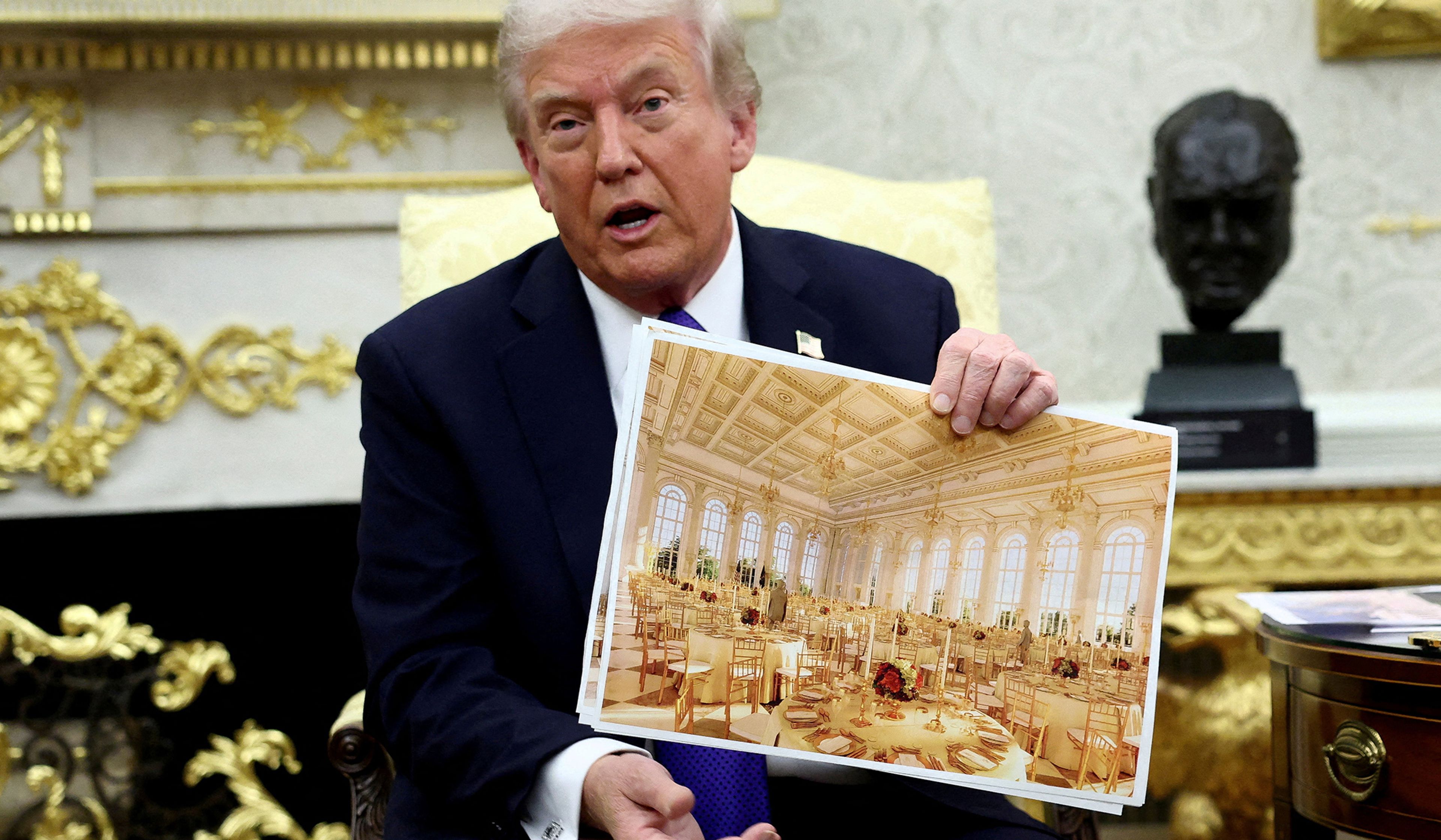
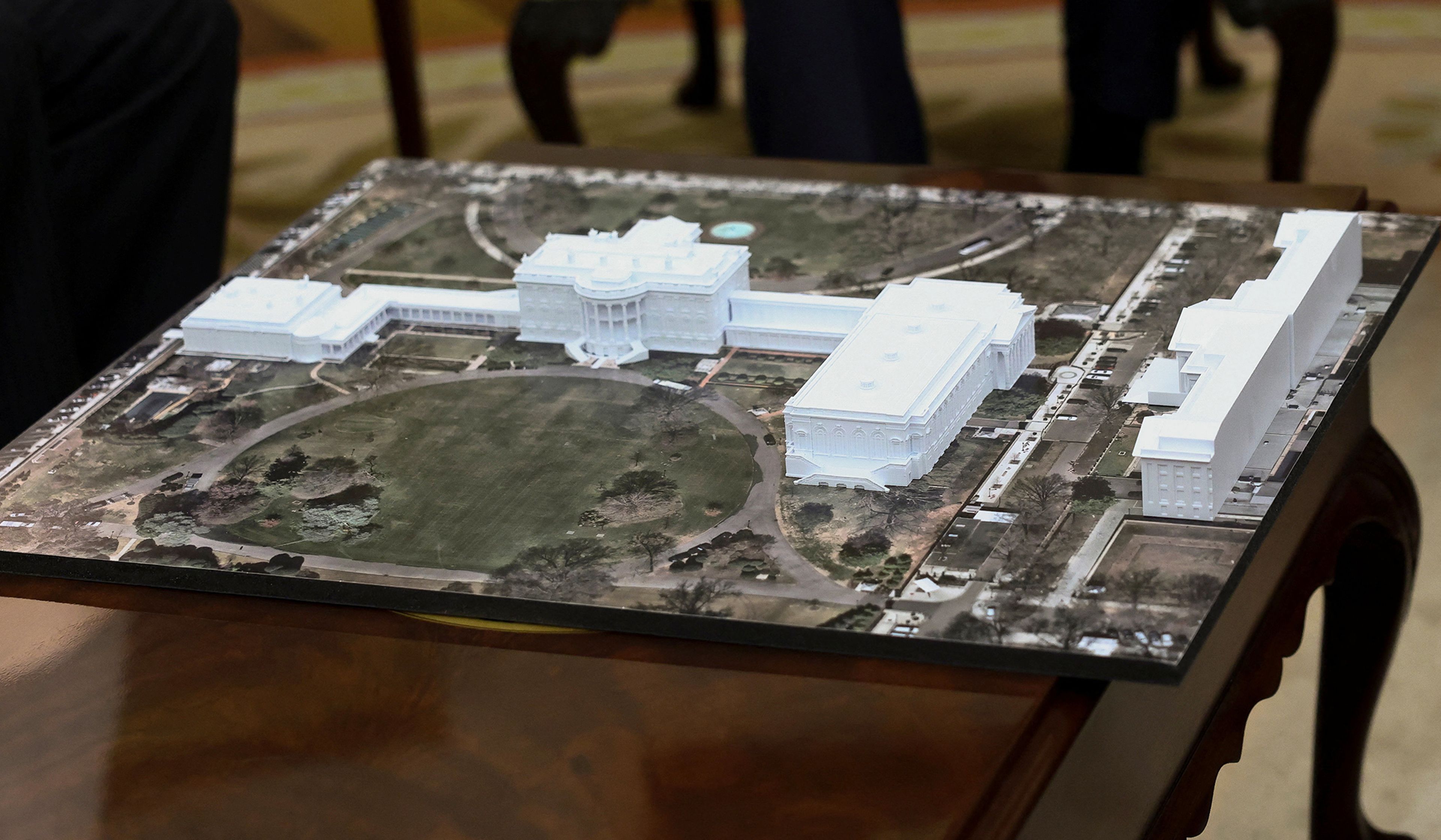
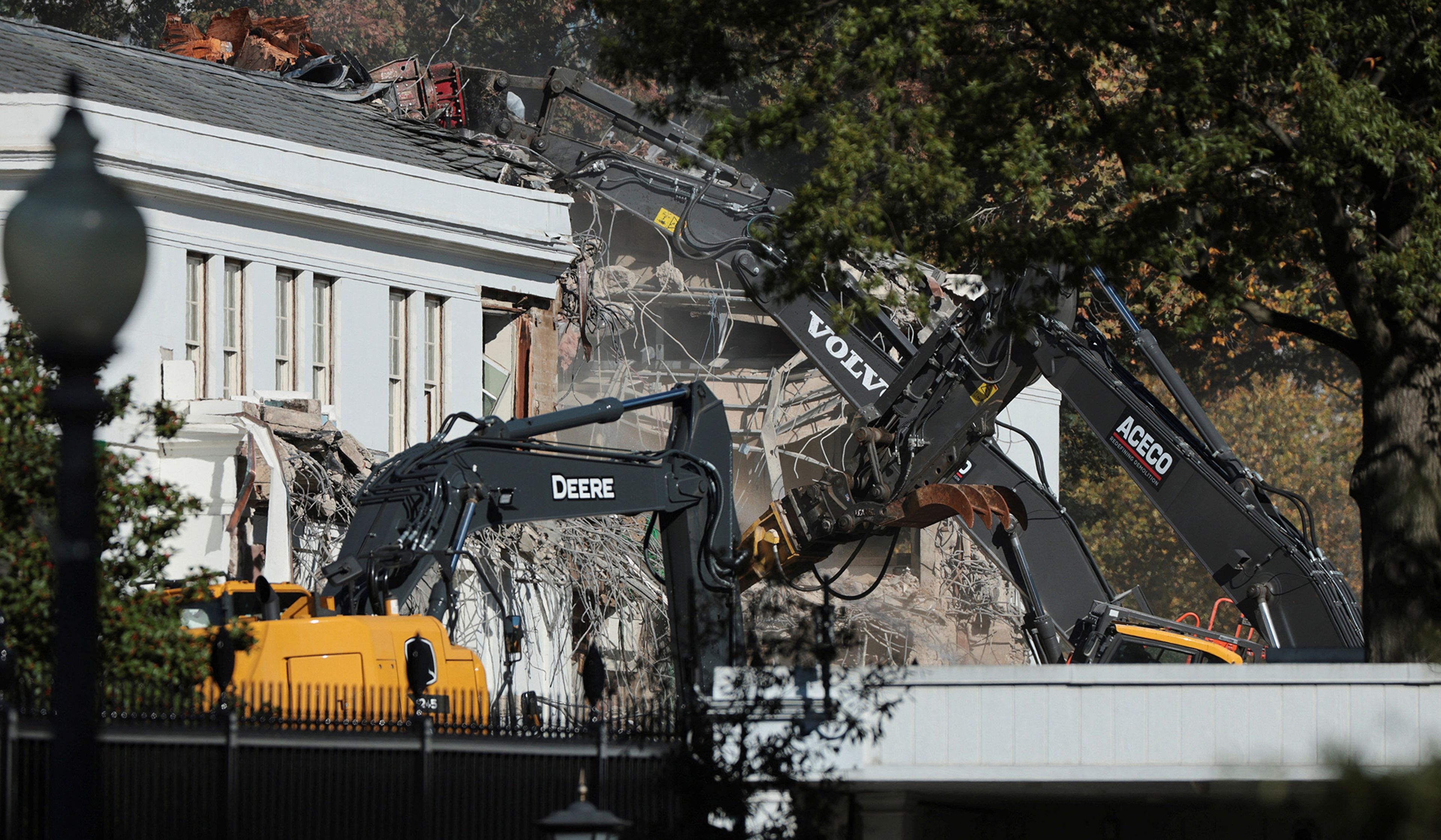





President Donald Trump holds an image of a rendering of the new White House ballroom to be built in the Oval Office of the White House in Washington, D.C., October 22, 2025.
Kevin Lamarque/Reuters
• Connecticut Democrat Chris Murphy has spent the twelve years he has served in the U.S. Senate establishing himself as one of the upper chamber’s more partisan agitators — quite a feat given the stiff competition in that space. The senator recently launched a political action committee, and he’s taking conspicuous meetings with Democratic influencers in early presidential primary states, indicating his intention to translate that record into a bid for the White House. During a recent New Hampshire town hall, Murphy defaulted to the laziest appeal in politics: flattery. The only problem with the Democratic Party, he averred, is that it’s just too “addicted to incremental change.” It’s not that Democrats’ ideas are unattractive to most voters. Rather, “the ideas we have aren’t big enough.” In an attempt to establish himself as the progressive’s progressive, Murphy proposed a slate of radical revisions to the social contract. But his unctuous solicitation only restates the problem afflicting Democrats. The American system of government is, by design, resistant to radical change in the absence of overwhelming consensus. The American Constitution constrains ambition. If Murphy finds those constraints too limiting, that’s his problem, not his party’s — and certainly not America’s.
• For the first time in twelve years, the United States Conference of Catholic Bishops overwhelmingly approved a pastoral “Special Message,” in which the bishops took issue with the Trump administration’s immigration enforcement efforts. As is often the case, the bishops apply sound moral judgments but through the lens of highly contestable assessments of practical reality. They are right to warn against “dehumanizing rhetoric and violence, whether directed at immigrants or law enforcement” and to urge “the fundamental dignity of all persons, including immigrants.” They properly acknowledge that “nations have a responsibility to regulate their borders and establish a just and orderly immigration system,” without which migrants face “trafficking and other forms of exploitation” — a heartening recognition that there is moral weight on the pro-enforcement side, too. And they are right that the ends of security and human dignity need not be irreconcilable. While the bishops call for a “meaningful reform of our nation’s immigration laws and procedures,” however, they advocate certain measures that we typically oppose. It is always important to be reminded that immigrants deserve humane treatment, but we need immigration laws that protect our nation’s sovereignty and advance its interests.
• American forces have now killed more than 80 people on the high seas around South and Central America, and Trump continues to insist that he does not need congressional authorization for military strikes against suspected narcotics-trafficking boats. After first informing lawmakers that our military is in an armed conflict against “non-state actors” (a backpedal from their original claims tying the cartels to Nicolás Maduro’s Venezuelan regime), Trump officials now say that the drone attacks do not really amount to “hostilities.” That is to avoid the 1973 War Powers Resolution mandate that U.S. forces must be withdrawn unless Congress approves the operation within 60 days. Relying on the dubious precedent of former President Barack Obama’s unauthorized 2011 strikes against Libya, Trump officials argue that the drug couriers are not in a position to fire back, so U.S. forces are not truly in harm’s way. But this only elucidates the lack of an armed conflict that would justify lethal force. The administration also cites a right of collective defense, but the other countries implicated object to the U.S. attacks. Republicans, meanwhile, block legislation that would require the White House to submit any further military action against Venezuela to congressional authorization. Doing so, Senate Republicans are mollifying Trump at the expense of their own constitutional prerogatives.
• The current president of Syria, Ahmed al-Sharaa, is probably the only world leader who has spent time incarcerated at a U.S. military prison camp. Under the nom de guerre Abu Mohammad al-Jolani, Sharaa traveled to Iraq in 2003 and joined al-Qaeda; he was later captured and held at Camp Bucca. In 2011, at the start of the Syrian civil war, he formed the Nusra Front as an affiliate of the Islamic State. But Sharaa had a falling-out with Abu Bakr al-Baghdadi in 2013, and the al-Nusra Front split off. Until late December, the U.S. government was willing to pay $10 million for information about Sharaa’s location, because he was on the “specially designated global terrorist” list. By 2024, Sharaa and his coalition, Hay’at Tahrir al-Sham, had toppled Bashar al-Assad’s regime. Since Trump took office, he’s been surprisingly warm and friendly to the Syrian president. After meeting Sharaa in Saudi Arabia in May, Trump described him to reporters on Air Force One as a “young, attractive guy, tough guy.” On November 12, the New York Times delivered a scoop that affirmed what some in the Middle East had suspected for a while. Sharaa’s actions have quietly been more pro-American and anti-ISIS than many had realized: “The Syrian leader has been discreetly cooperating with the U.S.-led coalition against ISIS and Al Qaeda since he took control of a slice of rebel-held territory in northwestern Syria in 2016.” This may not make Sharaa our man in Damascus, but it helps explain why the U.S. government wants to maintain its relationship with the man and the government he now leads.
• “Anti-Christian persecution,” Régis Debray said, “falls squarely into the political blind spot of the West; the victims are ‘too Christian’ to excite the Left, and ‘too foreign’ to excite the Right.” So it is commendable that Trump has been speaking out in favor of persecuted Nigerian Christians. In 2025 alone, 7,000 Christians in Nigeria have been killed, and an equal number have been kidnapped. Appropriately, Trump announced Nigeria’s redesignation as a “country of particular concern” under the International Religious Freedom Act. Trump’s celebrity has also allowed him to reach beyond the bounds of the normal Republican coalition. Rapper Nicki Minaj, for example, has decided to work with U.N. Ambassador Mike Waltz to draw more attention to the plight of persecuted Christians in Nigeria. However, Trump has gone beyond drawing attention to this issue to saber-rattling: “We’re going to do things to Nigeria that Nigeria’s not gonna be happy about.” It would be one thing to expand weapons sales, share intelligence, and offer training to counter Boko Haram and Islamist militants. But the prospects of major U.S. intervention in this situation are grim. Our military resources are already stretched thin in more important theaters. It’s not remotely the time to undertake serious military operations in a country more divided and ten times larger than Iraq.
• The remains of the last two American-Israeli hostages — whose bodies were abducted into Gaza after they were both killed in battle against Hamas terrorists on October 7, 2023 — were returned to Israel after two years. Omer Neutra, the child of Israeli immigrants, was born and raised on Long Island, N.Y. After high school, he decided to put off going to college so that he could serve in the Israel Defense Forces’ “lone soldier” program, which attracts young Jews from around the world who wish to devote a year or two of their lives in support of the Jewish state. A tank platoon commander, Omer was 21 when he was killed. At his funeral, Omer’s father said that he had “an American open heart with a warm Israeli soul.” Itay Chen, the child of an American father and Israeli mother, grew up in Israel and visited family in New York regularly. He wasn’t supposed to be on duty on October 7 but had traded weekends with another soldier so he could attend his younger brother’s bar mitzvah the next week. He was 19. For the Neutra and Chen families, the agony of not being able to bury their beloved boys is over. May the memory of Omer and of Itay be a blessing.
• More than a decade ago, the climate scientist Michael Mann wrote us a threatening letter demanding that we take down a blog post by Mark Steyn about Mann’s sketchy research. We let him know we would never take down the post, since it was First Amendment–protected speech, and a lawsuit against us would inevitably fail. Sure enough, Mann has finally dropped any claims against us after wasting God knows how much money from his (presumed) financial backers, and Steyn’s post on how Mann’s famous hockey stick graph is intellectually bogus and wrong is still available on our website for your reading pleasure. Shamefully, Mann got judgments against Steyn and Rand Simberg (who had elsewhere posted a critique of Mann that Steyn quoted) from a friendly D.C. jury. A series of legal reverses for Mann since then, though, suggest that this purported victory will wash away under scrutiny from more objective authorities. In short, Mann boasted that he would destroy us, and we are still here, alive and thriving, while he is slinking away in humiliation.
• Bill Gates has finally recognized an inconvenient truth: The Paris Agreement target of confining the increase in the global temperature since 1850 to 1.5°C by 2050 is unachievable, and the likely increase of between 2° and 3°C by 2100 (a much lower level, incidentally, than earlier forecasts) does not represent an existential threat. Gates’s change of mind may be belated, but it is welcome and may be helpful. Gates will focus even more on helping our species adapt — and adaptation is one of our greatest skills — to a changing climate. And he will continue working to improve the lot of the world’s poorest, who have sometimes found that efforts to combat climate change can be more damaging than climate change itself. We hope that governments will discard millenarian dread and replace their pursuit of the net-zero will-o’-the-wisp in favor of something more realistic.
• Climate change neuroses that were formerly confined to the fringes of academia have, however, burrowed their way into His Majesty’s government. The United Kingdom Health Security Agency released a report earlier this month identifying anxiety about climate change as a significant driver of mental health problems among young people. These climate-change-driven disorders have become so ubiquitous as to warrant their own nomenclature: “eco-anxiety, a term used to describe the distress and worry caused by the threat of climate change, and solastalgia, which refers to the distress experienced as a result of environmental change.” Rather than counseling politicians and activists to tone down their apocalyptic rhetoric, the report casts climate alarmism as a reasonable response to real-world conditions. The report’s authors also consider it “adaptive and rational” that young people are increasingly choosing not to have children. As a fix for these newly defined afflictions, the British bureaucrats recommend yoga and the establishment of so-called climate cafés, where maladjusted young people can gather to reinforce each other’s paranoid delusions.
• Britain’s Labour government has proposed a slate of restrictive reforms to the country’s immigration and asylum system that has won rare, if mixed, praise from the right and has outraged the Labour Party’s progressive base. According to the “Danish model” changes announced by Home Secretary Shabana Mahmood, refugees will have their asylum status periodically reevaluated and will have their status revoked if it’s deemed safe to return to their home countries. Refugees will also be required to wait 20 years rather than five to apply for permanent residency in Britain, and other reforms will be introduced to limit the level of legal migration, cut welfare to those remaining in Britain illegally, speed up asylum appeals, and ban nationals of countries who refuse to accept deportations from obtaining British visas. It remains to be seen whether the Labour government can hold firm against what is shaping up to be a mutiny from the party’s left.
• British MP Jeremy Corbyn has been a part of U.K. politics for over half a century now, representing the furthest-left faction of the Labour Party in his urban London constituency since 1983. Once he was but a crankish curiosity, until the various omnishambles of British politics unexpectedly elevated him via protest vote to Labour’s leadership in 2015. He was toppled five years later, and in 2024 the party finally expelled him. Why defenestrate a former party leader? Because Corbyn’s particular brand of leftism has above all else been based on a British Marxist strain of anti-Zionism, and he has said all manner of unfortunate things as he mingles with London’s most infamous Islamists and antisemites. (He now sits in Parliament as an independent member.) But his Islamist activist constituents apparently feel that he is not antisemitic enough. According to the New Statesman, Corbyn is under serial attack every time he appears in public — and is being denounced as a Zionist. Why? Because he believes in a two-state solution to the Israeli-Palestinian conflict. But the zeitgeist on the left — specifically among London-based Muslim immigrants — has moved on since October 7, and their demand has escalated to a one-state solution: the abolition of Israel altogether. Corbyn, of all people, is no longer anti-Zionist enough for U.K. anti-Zionists. One can only grimly chuckle.
• Richard “Dick” Cheney joined Richard Nixon’s administration while still in his 20s. When George H. W. Bush became president, Cheney was tapped as secretary of defense. He became a household name in 1991, during the successful campaign to drive Saddam Hussein out of Kuwait in the Persian Gulf War. To his fans and detractors, Cheney will be most known for his role in the immediate aftermath of the September 11 attacks. On that fateful day, as George W. Bush zigzagged back from Florida on Air Force One, Cheney took charge from a bunker underneath the White House, having been given the authority to order the shooting down of civilian aircraft that posed a threat, though it never came to that. For the remainder of the Bush administration, Cheney was a key architect of the strategy for combating terrorism that successfully weakened al-Qaeda and prevented another large-scale attack but also included the launching of wars in Afghanistan and Iraq. Both wars enjoyed popular support at the outset but gained critics as they dragged on and the costs in American lives and treasure swelled. As Republican voters came to sour on the legacy of the Iraq War and moved to embrace Donald Trump, Cheney fell out of favor with the party. In 2024, he endorsed Kamala Harris. Cheney lived a full life, serving the country for decades, and his legacy will be long debated. Dead at 84. R.I.P.
• David Pryce-Jones led a remarkable 20th-century life. His father was an English author and Liberal Party politician, his mother a member of a French Jewish banking dynasty. His parents married in Vienna. In 1940, four-year-old David and his nanny were plucked from Normandy by a relative-in-law, who happened to be a Spanish diplomat. Pryce-Jones went to Eton and Magdalen College, Oxford, and served in the Coldstream Guards postwar. He wrote novels and poetry. His nonfiction tackled notable persons, from Joseph Roth to the Duke of Windsor, and knotty subjects, from the Mitford sisters to Arab clan culture. He once played tennis with a topless Greta Garbo (who has not?). Come the Nineties we were lucky enough to add him to the roster at NR. On 9/11, he called the office from England to state the clear hard truth that America was under attack, and to wish us well. His pieces for us showed clear prose, a clear head, and knowledge of just about everything. He has died at 89. Our condolences to his wife, Clarissa, and to his children, grandchildren, and great-grandchildren. R.I.P.
The Economy
Cutting Costs
“Affordability” was the watchword of every Democrat, left and further left, who won in the November elections. Never mind that their party recently presided over the largest rise in prices in four decades, or that their policies — on energy and health care especially — still raise them. The Republicans have national power, and President Trump has governed as though high prices had nothing to do with why he was elected. Worse, he has insisted that his policies have already conquered inflation and lowered prices across the board — which Americans can see for themselves is out of touch.
Some of his policies have contributed to the problem. He has leaned on the Federal Reserve to loosen monetary policy even though inflation has continued to run persistently above its target of 2 percent a year. His tariffs have raised the prices of many products, directly and indirectly, since they apply to many U.S. companies’ supplies.

In recent days, the administration has announced that it will lower tariffs on some products, such as coffee, that have few U.S. producers and raise no strategic concerns. The move raises the question of why it imposed those tariffs in the first place. The promise is that the reductions will lower prices, although the administration has insisted for months that tariffs do not raise prices. Still, it’s a step in the right direction. It ought to be followed up — especially by easing the pressure on the Fed.
Republicans also ought to be able to explain how many areas of American life would see lower costs and prices with the application of free-market and federalist ideas. Housing construction has been stymied by regulation, especially in blue enclaves. Republicans should publicize the problem and perhaps look at tying to progress on this front the federal aid that is supposed to spur opportunity in states and localities. (Unworthy of consideration is federal support for a 50-year mortgage, which would save homeowners little money up front and cost them in the long term; Trump floated it but seems to have quickly and wisely abandoned it.) Higher education needs more competition. Health insurance markets would benefit from the legalization of cheap, renewable catastrophic coverage.
There’s a lot Republicans can do for the good of the economy, and some of it might even make November 2026 go better for them.
A Note to Our Readers
In response to popular demand, with this issue we introduce a larger typeface. We hope you’ll find reading the magazine easier on the eyes.
The Stat
$2.66 trillion — federal individual income tax collections in fiscal year 2025, according to the Congressional Budget Office.
Fiscal year 2025 wrapped up on September 30, and the Congressional Budget Office released the numbers for the year. Despite refrains from the left about how Republican tax cuts have gutted federal revenue, individual income tax collections rose by 9 percent year over year. More significantly, they also rose as a share of the economy, from 8.4 percent of GDP in 2024 to 8.8 percent of GDP in 2025. Both of those numbers are above the 50-year average of 8 percent of GDP in revenue from individual income taxes. This means that, despite the 2017 Tax Cuts and Jobs Act, which cut rates across the board, and a move by Congress this year that made those lower rates permanent, individual income tax collections are still higher than normal. Spending is much higher than normal (23.1 percent of GDP in 2025 versus the 21.2 percent 50-year average), so the deficit remains large. But it simply isn’t true that GOP income tax cuts have wrecked the government’s ability to raise revenue. Total federal revenue in 2025 was 17.3 percent of GDP, up from 2024’s 17 percent and exactly the same as the 50-year average.
by Dominic Pino











Comments