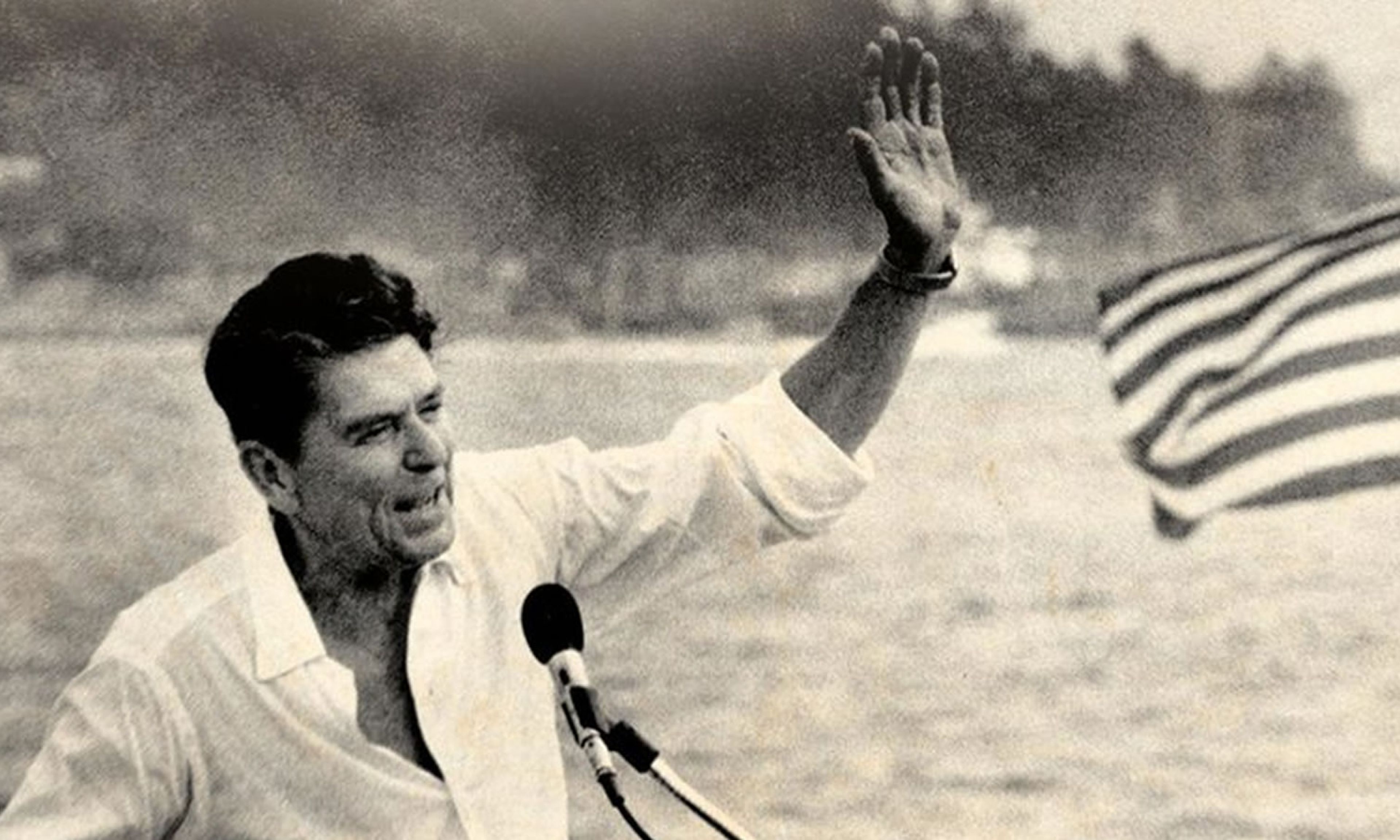
Ronald Reagan’s 1980 campaign for the presidency was historic in numerous ways. Not only did Reagan inaugurate a new era of conservative governance, he was the only candidate in the 20th century to defeat an incumbent of the opposing party who had served just one term in office, and he did it by making major inroads into typically Democratic territory — winning working-class voters, white ethnics, and Catholics, all of whom became known as the “Reagan Democrats.” Republicans have followed this Reagan template for 30 years — with great success in 1988, 1994, 2000, and 2004. When the GOP finally recaptures the presidency, it’s an easy bet that the victorious Republican candidate will owe a great debt to Ronald Reagan and the campaign of 1980.
Craig Shirley has offered a comprehensive account of Reagan’s triumphant march to Washington. Rendezvous with Destiny is a follow-up to his well-received account of Reagan’s failed quest for the presidency in 1976. Shirley takes the reader on a step-by-step journey from Reagan’s defeat at the 1976 Republican convention to his landslide victory over Jimmy Carter.
It sometimes feels as though no detail has been spared. In the first half of the book, the reader is treated to an extensive discussion of the gripping primary battles on both the Republican and the Democratic sides. The Republican clash between Reagan and George H. W. Bush receives most of the attention, but Shirley is careful to keep the reader apprised of developments in the clash between Carter and Sen. Edward Kennedy. He approaches the often bitter general-election campaign with the same exacting care. Along the way come fascinating insider perspectives of the historic moments in the campaign: the Nashua Telegraph debate between Reagan and Bush, in which the Gipper famously shouted, “I’m paying for this microphone, Mr. Green!”; the ever-present question of whether Gerald Ford would enter the race; the last-minute decision to go with George H. W. Bush as running mate; “debate-gate,” or the issue of Carter’s stolen debate books; and the late-breaking swing of the electorate to Reagan.
This is consequential history at every step, as the events of that cycle set the course for the Republican party for the next 30 years. Shirley recognizes the importance of the proceedings he catalogues, and accordingly he leaves no stone unturned. At 600 pages of narrative, plus almost 90 pages of notes, Rendezvous with Destiny gives every impression that its account is thorough and authoritative, that this is the book on the 1980 campaign. Shirley’s research included over 150 insider interviews that span the political divides of that election. It’s no small feat that this book is based on direct accounts from a diverse group that includes George H. W. Bush, Jimmy Carter, Dick Cheney, Walter Mondale, Michael Reagan, and many more. The result is a work that goes beyond the bland details and self-serving quotations of more typical accounts. Shirley obviously persuaded many of his diverse subjects to speak candidly, which makes this a first-rate work of insider history. His book reads like Bob Woodward at his very best: a probing, insightful, behind-the-scenes examination of events that had profound implications for the trajectory of American politics.
Shirley is admittedly a Reagan supporter, and while the narrative is not written explicitly from this perspective, it is clearly sympathetic. This makes for especially interesting reading in the first half, which is probably the strongest part of the work. There, Reagan is in the midst of an internecine war in the Republican party. Reagan was ultimately successful in uniting the rival groups within the GOP under the conservative banner. Yet campaigning amidst the cold, snow-covered hills of the Granite State in January 1980, Reagan was not yet the Reagan so many of us remember fondly today. He was instead the most prominent representative of a faction in a diverse party still struggling to find a voice in the wake of the Watergate scandal. In many respects, this was the time and place of the battle for the heart of the modern-day Republican party. Shirley is clearly rooting for Reagan during these events, just as any conservative reader no doubt would today; but what is fascinating is that so often one finds Shirley (and oneself) rooting against the Bush family, which would become the heir to the conservative dynasty Reagan initiated. Indeed, the significance of Reagan’s victory is particularly striking when one considers that the presidency of George W. Bush essentially united the partisans of two of Reagan’s opponents — George H. W. Bush and Gerald Ford — under the banner of Reaganite conservatism.
The only significant problem with the book is that Shirley occasionally misses the forest for the trees: If one did not know already that the campaign of 1980 was so consequential, it would be hard to glean this fact fully from the book. The larger impact of events is left relatively unexplored. This might be an inevitable consequence of providing such detail, but it could also be a result of Shirley’s decision to organize his material chronologically. If he had arranged it thematically, he might have had a greater opportunity to offer his reflections; given his vast knowledge of the subject, that would have been of great interest. Thematic organization might also have ameliorated the problem of occasionally rough transitions; the book has a habit of jumping from one event to another without developing a connection between them.
This absence of the larger picture is felt most acutely in the book’s first half. President Carter comes across clearly here — as in many other accounts — as out of his depth, not capable of executing his duties well, and certainly not able to inspire confidence in the American people. While the election of 1980 was a late-breaking one, in retrospect the result does not seem to be nearly as big a surprise as it did at the time. Viewed in historical context, perhaps Reagan’s most extraordinary feat in that cycle was his victory over the powerful moderates in his own party, which caused an important realignment within the GOP. Yet Shirley does not dedicate a great deal of space to reflecting on how this happened. His dedication is primarily to cataloguing every event that made it happen. After 600 pages, this absence of historical analysis leaves one wanting more.
But these are quibbles. Shirley has accomplished a great feat of scholarship and research, and it could not have come at a better time, as many conservatives are beginning to feel “déjà vu all over again.” The current political climate is highly reminiscent of that of the late 1970s: On one hand, we have a president with an amazingly thin résumé, whose appeal to the electorate was based instead on his superior moral qualities, but who has since raised concerns that he might not be up to the job. On the other hand, we have a GOP divided into factions, squabbling with itself over minor issues, often to the point that dyspeptic Republicans seem most intent on undermining the party’s broader goals.
These historical similarities add special value to Shirley’s work. It should give conservatives and Republicans hope that victory is possible, despite the GOP’s current problems. It should also provide a template to evaluate the Republican contenders for the presidential nomination. Conservatives should keep an open mind about the nomination: After all, many conservative heroes and leaders were not Reagan men in 1980.
Rendezvous with Destiny is an important, timely book that conservatives, Reagan admirers, and students of electoral politics will cherish and enjoy for years. Credit is due to Shirley for a monumental accomplishment.












Comments