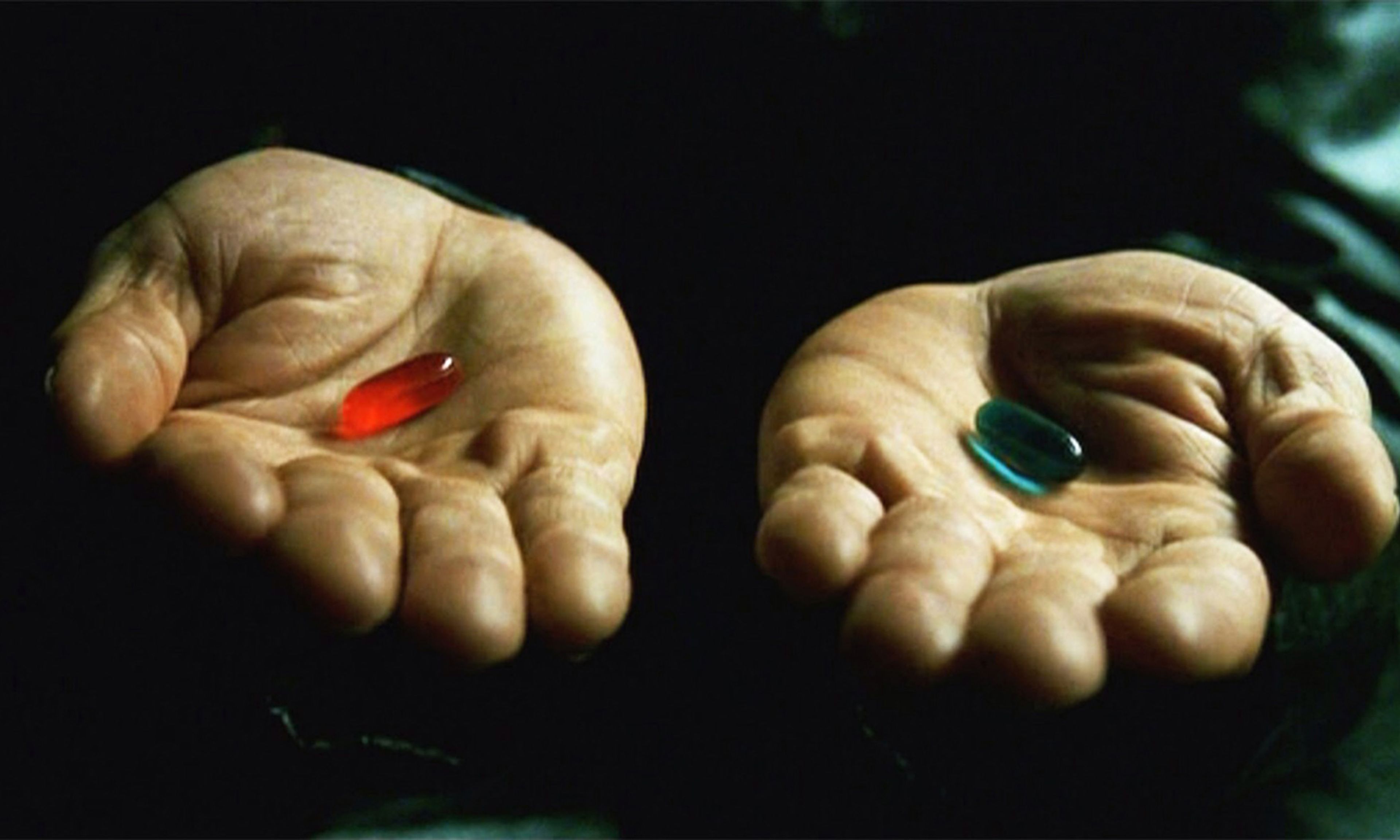
In the 1999 film The Matrix, the protagonist, offered a blue pill that would allow him to continue living as before and a red pill that would show him “how deep the rabbit hole goes,” famously chooses the latter and learns that he lives in an elaborate simulation. The derivative term “red-pilling” has since entered the lexicon, first by way of the early-2010s “manosphere” — an Internet subculture dedicated to pick-up artistry and men’s-rights advocacy in which to be red-pilled was to understand that women leverage their sexual power to secure things they are biologically conditioned to want — and then via political message boards where users spoke of becoming red-pilled on the demographic future of the West or the attack on the USS Liberty. Now ubiquitous, the term is right-wing-speak both for the acceptance of forbidden truths and for the adoption of an intellectual posture that makes one open to receiving them.
But the idea that people don’t understand things-in-themselves isn’t exactly new, much less exclusive to the political Right. And while Kant didn’t exactly say that we could apprehend the noumenal world but for the work of nefarious authorities who keep it out of the reach of their subjects, a lot of people across the political spectrum believe it. The problem for left-liberals is that “wokeness,” their version of red-pilling, has been pilloried to great effect. As a meme, it feels self-serious and lacks the transgressive appeal of its counterpart. So it would be tempting for, say, a left-liberal writer who is uncommonly familiar with the genealogy of the online Right to reconstrue the notion of “red-pilling” in terms his tribe would understand. And it is tempting to read Red Pill, the sixth novel from British-Indian writer Hari Kunzru, in which a British-Indian narrator confronts the inhuman world of the alt-right as it reaches its apogee of influence, as just such a reclamation project by just such a writer.
Most of the book consists of the narrator recounting the story of his professional and psychological breakdown. A writer and middling academic living in Brooklyn, he is unfulfilled, so he says a temporary goodbye to his wife and kid to take a fellowship at the fictional Deuter Center for Social and Cultural Research in the Berlin suburb of Wannsee. It turns out that he prefers to write in private and the Deuter Center has a culture of radical transparency, so he can’t get any work done. Instead, he spends most of his time wandering around Wannsee: here the building where the Final Solution was rubber-stamped, there a gravestone of the 18th-century writer Heinrich von Kleist.
The first quarter of the book is filled with literary allusions but lacks momentum (though a series of disputes at Deuter Center dinners with a pompous neuroscientist named “Edgar” — an eliminative materialist who denies the reality of consciousness and disparages anyone, including the narrator, who thinks subjective experiences can be real and meaningful — are especially funny). Things pick up once the narrator starts watching TV. He chooses a police serial called “Blue Lives,” which resembles Shawn Ryan’s The Shield, in its stark depiction of violence, and Nic Pizzolatto’s True Detective in that its characters deliver pretentious but compelling diatribes to the camera. One character repeats a truncated quote from the French reactionary Joseph de Maistre: “The whole earth, perpetually steeped in blood, is nothing but a vast altar on which all living things must be sacrificed without end, without restraint, without pause, until the consummation of things.”
“The sense of transgression, of having done something wrong, was very powerful,” the narrator says, wondering whether the show is propaganda, an attempt to insinuate fascism into the mainstream. Its head writer, an American named “Anton,” is transgressive too. When the narrator meets him by chance at a party, he asks about the Maistre quote. Anton demurs. The encounter turns hostile when Anton invites the narrator out for kebabs with friends, only for Anton to mock him and express a “preference” that Germany be “without kebab,” that Europe be without people who aren’t ethnically European. Shaken, the narrator musters a weak rejoinder, calls Anton a racist, and leaves. “I suppose I’d wanted to provoke some kind of confrontation with him. . . . Instead I’d been blindsided, caught off balance,” he says, aware that he lost the exchange and disturbed that a racist such as Anton could be so insouciant, confident, and smart. Are there more people like him?
Like others who discovered in 2016 that millions of their countrymen hold views they find irredeemable, the narrator becomes convinced that “there is an existential risk to losing this debate.” He decides to abandon his work at the Deuter Center and to follow Anton across Europe, dropping into an Internet rabbit hole and becoming increasingly paranoid. His fear of being watched seems unjustified; more justified is his feeling threatened by the momentum of Anton’s political project and by his own failure to articulate precisely what he finds objectionable about it — at least without sounding, to borrow another right-wing locution, “cringe.” (When he accosts Anton at a conference in France: “I know what you’re doing. I came to tell you that you’re on the wrong side.” “The wrong side of what?” “History.” “Jesus, for this you flew to Paris? Cultural Marxism has filled your brain with worms.”) Liberal pieties about the universal dignity of human beings don’t seem to stand a chance against Anton and his legions of online compatriots.
Eventually the narrator loses his mind. He watches more Blue Lives and stops calling his wife. He spends days reading posts on Blue Lives–adjacent message boards claiming that immigrants to Europe have an ingrained kinship bias and are congenitally unable to participate in neutral political institutions. He finds an Internet meme of himself impotently challenging Anton and wonders whether Anton made it. He thinks he’s tracked Anton to a remote Scottish isle, makes his way there, wanders around, looks out from a cliff, and has an epiphany “that the truth of existence lay in a sort of ceaseless impersonal violence.” He passes out and is arrested for trespassing, hospitalized for several months, diagnosed with a mental illness, prescribed antipsychotics, and eventually sent back to his family in Brooklyn . . . where, as the book ends, he hosts a party for the 2016 election, watches Trump win, and attempts to reassure his wife.
When the narrator first returns home, his family and friends clearly find him insane. When Trump wins the election, he gains a measure of vindication: “My madness . . . is about to become everyone’s madness.” It is tempting to stop here and identify the book’s red pill as a tendentious lesson about the need for good-hearted people to understand the true nature of the American Right: It’s Antons all the way down. The narrator was red-pilled early, and now everyone is about to be.
Like his narrator, Kunzru knew about the alt-right and its associated subcultures before most people did (having by his admission browsed 4chan since 2006, back when it was an apolitical cesspool). Like his narrator, Kunzru may have had encounters with far-right intellectuals (having received an M.A. in philosophy from the University of Warwick at the time when an energetic, eccentric philosopher named Nick Land, who later became a founding father of the neoreactionary movement, was on the faculty). Like his narrator, Kunzru felt on November 8, 2016, a “stunned incomprehension” at the “intrusion” that the mingling of the alt-right and the real world represented (as he has written in The New York Review of Books). And if the upshot of the book is a straightforward rebuke of the Right, Kunzru is guilty of exactly the sort of pious, impotent riposte that the narrator delivers repeatedly to Anton.
But he may not be that oblivious. Halfway in, the book takes a hard turn into a 33-page interlude that is entirely unrelated to the plot but suggests a more nuanced interpretation. Just before he meets Anton, the narrator has coffee with the Deuter Center maid, a woman named “Monika” who relates her life story. Monika lived in the German Democratic Republic and, after leaving home to join a punk scene, was recruited by the Stasi to be an informant. It went against her will and better judgment, but she didn’t have a choice. Forced to inform against her friends, she considered telling them, then tried to spare them by feeding disinformation to her superiors; but “how was she to tell the story without inviting suspicion?” Eventually, her apartment was raided, her roommates and bandmates discovered her betrayal, and she was left friendless and alone, a casualty of the truism that there can be no pre-political relations in a totalitarian society.
An inhuman political ideology, the novel seems to be saying, can induce a terrible and all-consuming paranoia. Malicious actors turn both the narrator and Monika into agents of their own undoing, creating an atmosphere of pervasive suspicion that leaves them alone and despairing. They can’t confide in others, worried it would only make people more suspicious of them.
The consequences of paranoia can be immensely destructive, causing people to cut off loved ones, retreat inward, and indulge their irrational feelings. This is true for societies undergoing a collective paranoia, too. If there is a proposition in Red Pill that, once accepted, will help the reader more accurately perceive the world, it is the narrator’s post-election realization that he can trust other people, his admonishment that “we must remember that we do not exist alone.” Would that more people were red-pilled by that recognition.












Comments