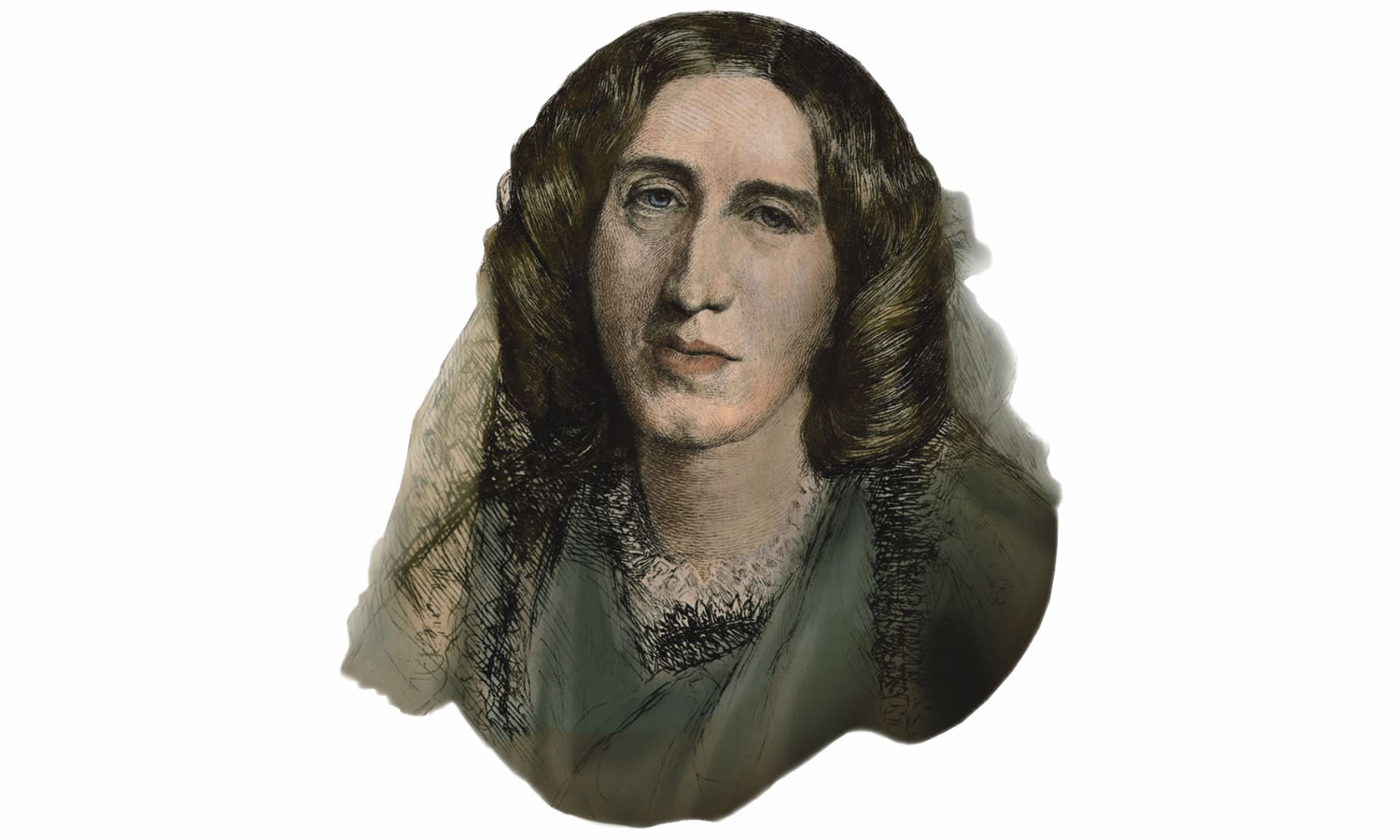
As some dismal signs of American women’s condition — the creeped-out smile squeezed between a governor’s hands, my ex-professional neighbor loping around an Amazon warehouse, the Asian women slain in Georgia — keep flashing at me, I wonder what George Eliot (1819–1880) would have thought of it all.
Eliot was born with the name Mary Anne Evans, and with off-putting looks and a restless, powerful brain. Studying on the side as a young woman (she was becoming one of the last true polymaths), she kept house for and nursed her widowed father, who forced her to attend church on the principle that a daughter had to show the neighborhood a submissive conformity.
Like another great female intellectual, Virginia Woolf, she allied herself with men of the avant-garde once she was free to, but both in time recoiled from the wolfishness and condescension prevailing in such circles. It was the straitlaced Blackwood publishing firm that championed Eliot’s fiction from the start. They gave her excellent terms, did not pressure her to soften depictions (of domestic abuse, for example) that shocked them, and were quietly accepting after they discovered that “George Eliot,” first billed as a shy clergyman, was a scandalous woman.
They seem to have recognized an integrity that inhered in her scandalous behavior itself. She lived with the married George Lewes for 24 years, until his death, insisting that she was “Mrs. Lewes.” She took the full force of the societal horror, unable as she was to explain with discretion that she was not breaking Lewes’s home but helping hold it together. Agnes Lewes, the lawful wife, had taken a long-term lover. Had Lewes divorced her (a rare, costly, very public option), she would have lost her home and three surviving children. The “wronged” and “abandoned” wife took cynical advantage of him by having four more children with her cavalier, who appears to have paid little or nothing toward their maintenance or hers, while she ran up large debts for which Lewes was held responsible.
As the price of her union with Lewes, Eliot worked like mad as a journalist to fund the home she never saw; later, as a successful novelist, she was the effective provider for everyone (including her own impoverished blood relatives neglected by the male heirs); she also opened her heart and door to Lewes’s offspring. Restrictions around the unsanctioned pairing were mainly hers to bear. She stayed home while Lewes went to gatherings at which she would have been unwelcome; and she did not rail when her own close friends and family shunned her. Lewes cherished her writing, acted as her agent, and read and studied and traveled with her as she struggled against overwork, migraines, and other ailments; but he did not pitch in to run houses as they grew larger and more challenging; and his own poor health was a great drain on her time and emotions. She was often miserable, but she embraced all difficulties as her own responsibility.
In this, she took after her rigid father. He had risen to prosperity as an ultra-respectable manager of aristocrats’ property, and her own ethics partook of handshake deals, a reputation for getting the job done, and zeal to be useful within the system as it was. She agreed with her father’s code of honor, that having a home meant paying all its debts, but she claimed that for women there was extra, in fact limitless obligation, derived from the uniquely female “function of love in the largest sense, to mitigate the harshness of all fatalities.”
She was accordingly leery of social reforms in favor of women. Her politics instead enshrined hierarchy, a society in which servants would obey without backchat and cater to their masters’ frail digestion; in which laborers, tradespeople, everyday professionals, and household drudges would muddle along sacrificially and not question the existing division of goods. All this had made for the stability that redeemed her girlhood, and it now upheld the sturdy tower in which (in an eccentric apartment near the top) her adult choices were survivable.
She herself was extraordinary, brilliant and tough enough to sustain ties that other rebels would have destroyed, spreading chaos and suffering. Her literal conservatism comports with the kindness, gentleness, and thoughtfulness almost everywhere exhibited by the mature Eliot. She did not want women getting into trouble on her example. Especially when fans were female, she tended to deflect their ardors and their requests for public support in specific causes by applying to both herself and them rather conventional, rather abstract language about duty. It was a sidelong defense of the prerequisite for a woman’s leadership: She can’t bring the structure down and have anything left to lead.
Hence what are seen as the great clashes of her fiction and politics with her life are really no such thing. Her habitual treatment of her individualistic, striving heroines is stern. Most are humbled and silenced; nearly all who survive to find long-term purpose and qualified satisfaction do so in the background of a man; almost every one who achieves independence finds it rather bleak. It is in a sense the traditional community — at least in the novels that are provincial, set in the era of Eliot’s childhood, and about outwardly ordinary people — that is the real, triumphant protagonist; her masterpiece has a title that suggests averageness and regimentation, “Middlemarch.”
But what she slips into these plots and backgrounds is momentous. Though Eliot is nostalgic, she is anything but sentimental. This is fiction without satisfying moral conclusions; it is tragic rather than homiletic. At its emotional center is Maggie Tulliver of The Mill on the Floss. She is not an ethereal Dickensian waif, but a shatteringly convincing human being stunted in her development, gifted but born into the wrong family in the wrong neighborhood in the wrong century — all of these just accommodating enough to frustrate her, and she takes it in believable ways.
She is impulsive, sometimes a show-off, sometimes cruel; she “forgets” to feed her brother’s pet rabbits while he is away, far from her clinging attentions, getting the classical schooling she envies. She withdraws, as a child, to torture a doll. In her teens, only Thomas à Kempis’s Imitation of Christ can bring her into a sort of solidarity with her family’s sufferings — but like her authorial creator, in trying to stamp out her ego she maims her potential for humor, joy, and balanced judgment and falls into a priggishness exhausting to maintain. Maggie turns back at the last minute from eloping with her loving friend’s fiancé and drowns in a flood shortly afterwards. She has the saddest, and the most common, tragic flaw: There is simply no room in her world for herself.
The visceral honesty of Eliot’s life and fiction is thus more challenging and fuller of potential for constructive change than any lifestyle stunt or tub-thumping tract. In stretching painfully to address what seemed to be the logical implications of the realities at hand, she raised in others questions she was unwilling to confront: Was it truly the individual woman’s duty to shore up all the neglected breaches in the community’s welfare? Would men, if put to the test, smoke cigars and watch the deluge pour in? Doesn’t dread of that come from outsize female self-regard, a womanly savior complex?
In practical terms, it’s impossible to assess how much the novels militated against the suppression of women; but a general look backwards is telling. Generation after generation has fixed on Maggie Tulliver’s plight, much as we have fixed on Virginia Woolf’s fable of Shakespeare’s doomed sister. Eliot has been called, in spite of all she didn’t say, “the voice of a century” — or, more likely, this was because of what she implied: that half of the species would inevitably increase its participation, but that this wasn’t going to be easy, as its bonds with so much that was so oppressive were not disposable; and hardly any women would ever have this one’s steam-engine design and iron durability, so as to vindicate a brand-new kind of existence.
Maybe all this is only a start for present-day consideration, but it’s a start with sturdy grounding — especially by comparison. Almost the whole bellowing barnyard of male Victorian intellectuals is now justly ignored on the topic of women. How, after all, is “genius” practically instructive as to the most basic of human relationships if its bearer, like Ruskin, can’t consummate his marriage? All the greatest male Victorian poets and novelists are still celebrated for their engaging artistry, but who in her right mind would take seriously their obsessive opinions on what female humankind is naturally like or ought to be like, and what this means for human well-being? Most 19th-century male authors who managed to keep a home together did so from sheer force of privilege and despite prodigious fecklessness or mighty Ring cycles of solipsism, which only their own fictional heroines would have simpered at. George Eliot both tells and shows us something more real, and better worth discussing.












Comments