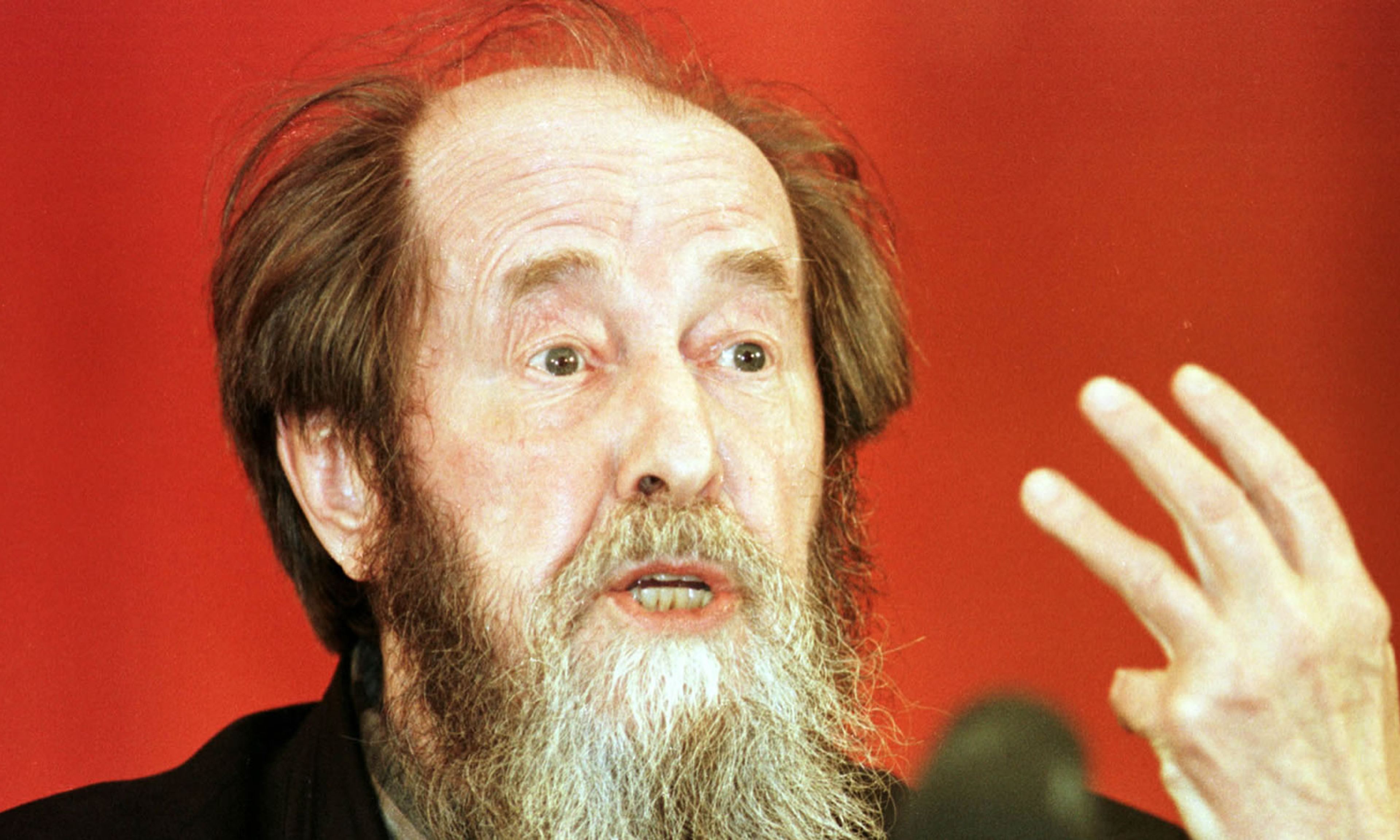
In June 1978, the Russian novelist, dissident, and exile Aleksandr Solzhenitsyn delivered the commencement address at Harvard University. The day was one of heavy rain. The stormy weather proved mild, however, in comparison with the words the author had for the young American elites and their families who crowded the Yard to hear him.
Some years earlier, Solzhenitsyn had been welcomed to the United States as a hero, a witness to the tyranny of communism, and a refugee who found freedom in the West. While he accepted the refuge, Solzhenitsyn was unimpressed by the spirit of Western freedom. Private persons, lawyers and judges, and the media, he said, were all exploiting the doctrine of “individual rights” at the expense of the integrity of society and culture and, above all, at the expense of the spirit.
Modern Westerners nourished themselves on a crude “mass” culture rather than on any substantive vision of the dignity and religious drama of human life. Were he asked whether his countrymen should accept the West as a model, Solzhenitsyn would answer, “No.” The Russian soul had been purified and deepened under the suffering and tyranny of Soviet communism. The freedom of the West had, in contrast, bred a civilization of superficial antinomians, of flabby souls, whose political liberties had proven little more than a license for decadence.
How did the Western media respond to this bracing chastisement? As Sohrab Ahmari writes in his new book, The Unbroken Thread, “the reviews, as they say, were bad.”
Ahmari can hardly expect a better reception for his own book: one written in Solzhenitsyn’s spirit; one published at a time when the symptoms Solzhenitsyn diagnosed are widespread and patent; one that holds Solzhenitsyn up as an exemplar of freedom rightly understood. And yet it is also a book written in a spirit of hope that Solzhenitsyn dared not entertain. Ahmari writes not to denounce a society but to help his young son, Maximilian, find a sure footing in the world. The book as a whole is framed as a father’s meditation on the questions his young son will need answered if he is to grow into a flourishing adult.
Ahmari is, on his own description, a “radically assimilated immigrant.” As he wrote in his gripping spiritual memoir From Fire, by Water (2019), he was born into the repressive Islamic regime of the Iranian mullahs. His secularized family looked upon American mass culture as an oasis of freedom amid the narrow tyranny of their everyday lives. This view culminated in Ahmari’s immigration to the United States, with his mother, when he was twelve.
In the years that followed, Ahmari passed through stages of maturation familiar in the modern West. He came to despise the false appearance of freedom on offer in American culture and, in his undergraduate years, became a “cultural Marxist” of sorts, critiquing every feature of our society as failing to deliver the authentic liberation he had intuited while watching Baywatch in Tehran.
As he left his undergraduate cynicism behind, he grew into a deracinated meritocrat, a “member of the global creative class, free to move anywhere, work anywhere, party anywhere.” A talented opinion writer for the Wall Street Journal, Ahmari relished a life of upward mobility and cosmopolitan hopscotch, until something in his soul tugged him in the direction of the Catholic Church.
His conversion occurred at just that moment when the informal post–World War II concordat that made Catholicism, and Christianity in general, part of the civil religion and moral backbone of American liberal democracy had been broken. Where once American society, business, and government encouraged religion as a moral ballast, in our times those same institutions have concluded that democracy is better served going it alone. Ahmari did not hesitate to take sides. He proclaimed himself an advocate of authority and tradition, the spiritual authority of the pope and the tradition of the Catholic Church in particular.
He found himself an opponent of modern “liberalism.” As Ahmari sees it, liberalism means permissive individualism, an ever more zealous extension of state protections for deviant behaviors, and an increasing appetite not only to ignore the traditional religious foundations that once made liberalism functional but to exclude the religious from public life and persecute them in private life. Liberalism defends procedural goods but rejects all “substantive ideals,” he claims in the opening of The Unbroken Thread.
The post-war concordat had acknowledged as much: Christian culture would provide the substantive account of morality, while democracy would provide the procedures of just and legitimate government. And yet, such a broad claim risks becoming an ahistorical abstraction. There never was a time when “liberalism” existed as a regime in complete isolation from a deeper and richer cultural foundation — not even now. The advanced liberalism of the European Union depends on deep, tangled roots far older than itself, and the same may be said of American democracy. The problem is that, now, our elites and mass culture aim to dissolve those roots.
Ahmari might have delivered a sweeping broadside or given us a work of abstract theory, defining and defending tradition per se, the Catholic tradition in particular, or any of the species of “traditionalism” that have emerged over the last two centuries since the days of Edmund Burke and Joseph de Maistre. But that is not the kind of book he has written. He does not dwell in the ether of abstraction but concerns himself rather with the specific substantial bits of wisdom to be found, here and there, in what he calls “the tradition.”
In twelve chapters, each devoted to answering one of a set of moral questions, Ahmari explores some particular wisdom that he would have his young son understand and accept. For his purposes, “tradition” simply means any moral practice or way of seeing the world that predates — and is threatened by — the vacuous worldview of contemporary liberalism.
As he considers such questions as “Is God reasonable?”; “Does God need politics?”; “Should you think for yourself?”; and “Is sex a private matter?” he enters them entirely by way of storytelling. I confess to having a personal interest in such a procedure. Some years ago, I argued in a rather long, abstruse, and abstract book that stories are foundational to human reason. While human beings can think productively by way of abstraction, they cannot do so in isolation from storytelling. Conversely, storytelling is a kind of philosophical argument that cooperates with abstract reason to help us arrive at the truth.
In answering a question about the Sabbath rest — “Why would God want you to take a day off?” — Ahmari turns to the life of the great Jewish theologian Abraham Joshua Heschel. Forced into exile by the Nazi Holocaust, Heschel came to live in the United States. There, he was dismayed by the secularism of American Jewry and by the injustice of American racial discrimination. He marched with Martin Luther King Jr. in the pursuit of justice. If justice is an activity, one might ask, is not all rest and leisure a failure to pursue justice? No, Heschel answered. The Sabbath foreshadows the peace of God. Leisure, contemplation, and above all prayer are foundational to justice and to any other good of the active life. To be just toward our fellow men, we must first rest in peace with God.
Ahmari tells us of Victor and Edith Turner, the great British anthropologists who journeyed to Africa and studied the necessity of religious ritual for all true community. They converted to Catholicism in consequence. He tells the life stories of Augustine, Confucius, Andrea Dworkin, Seneca, Howard Thurman, and others.
To question the “liberal” dogma to “think for oneself,” he turns to John Henry Newman. Newman’s life was itself a wrangling with liberalism, which Newman called the “anti-dogmatic principle.” He gradually discovered that the individual “conscience” makes absolute demands on us, but the conscience is nothing other than the apprehension of and assent to a universal law. Our consciences must first, therefore, be properly formed by authority to know the universal, if they are to perform their irreducible function. In asking about the purpose of freedom, Ahmari naturally turns to Solzhenitsyn, the story of whose Harvard address he recounts.
In every chapter, Ahmari shows us incarnate ideas, the lives of men and women who testify to one truth or another. Sometimes a little more abstraction might be called for. In asking about the compatibility of reason and God, for instance, Ahmari wisely recounts the life of Thomas Aquinas. But then, when the moment comes to tell us how Aquinas showed faith and reason’s harmony, Ahmari punts and recommends we read a (very good) book by Edward Feser.
The virtues of The Unbroken Thread far outweigh the limitations. His chapter on the body as an “image of moral responsibility,” with its tale of the philosopher Hans Jonas’s discovery of the “gnosticism” of Martin Heidegger, is the perfect union of story and reflection.
Ahmari provides us — and his son — with examples of lives well lived, lives that affirm the necessity, vitality, and authority of particular claims of traditional wisdom. His hostility to liberalism is not hard to find; the questions he explores are in themselves defiant of the false modesty, agnosticism, and relativism that saturate our “liberal” age. And yet even those who reject Ahmari’s categories and conclusions will still admire and be edified by the stories he has to tell.












Comments