For decades, tax cuts have been at the center of the conservative economic agenda. But some on the right want to deprioritize them in favor of other economic goals. Senators Marco Rubio, Josh Hawley, J. D. Vance, and others talk of the need for a new Republican economic agenda focused on things such as industrial policy or social policy. The Trump administration sought to increase tariffs, and conservative defenders of protectionism are being more vocal.
Tax cuts in particular seem to irk some right-wing commentators. In May 2020, writing for the American Conservative, Michael Cuenco bemoaned the Tax Cuts and Jobs Act (TCJA), the 2017 tax-cut law that Donald Trump signed, and called for a “reformulation of fiscal policy along populist economic nationalist lines.” He wrote, “The reformist right should ask: is there any way to stand athwart the supply-side swamp yelling Stop?”
Gladden Pappin, in the spring 2023 issue of American Affairs, wrote, “There is no reason to think that doubling down on standard ‘conservative’ issues like tax cuts . . . would help the Republican Party get to 51 percent in the states where it needs to.”
In June, the public-policy organization American Compass released a “handbook for conservative policymakers” on economics. It says the “agenda of tax cuts, deregulation, and free trade” was “a disaster for the nation.” Its 112 pages do not contain an overall income-tax plan. That’s in keeping with an article that executive director Oren Cass wrote in 2020 encouraging conservative politicians to reject the no-tax-increase pledge of Grover Norquist, president of Americans for Tax Reform, and adopt a new vow: “I will not talk about taxes until 2030.”
In the three years since Cass wrote that article, Republicans at the state level have been talking nonstop about cutting taxes. And they’ve been succeeding: The U.S. is in the middle of a tax-cut revolution.
“The past three years have seen the largest wave of state-tax cuts in the modern era, certainly since income taxes were created over a century ago at the state level,” says Jared Walczak, vice president of state projects at the Tax Foundation. “We have seen more than half of the states with income taxes cut their top rates. We’ve seen trimming of rates in other taxes, including 13 states with corporate-income-tax cuts, a couple of states with sales-tax cuts, and trimming other taxes as well.”
Though the idea hasn’t caught on at the federal level, state-level Republicans are “bringing Steve Forbes’s vision for a flat tax into reality,” says Jonathan Williams, chief economist and vice president for policy at the American Legislative Exchange Council (ALEC). Five states — Iowa, Mississippi, Georgia, Arizona, and Idaho — have passed laws to implement a flat tax in the past two years. Arizona’s flat rate is only 2.5 percent.
Currently, seven states do not tax individual income at all (Alaska, Florida, Nevada, South Dakota, Tennessee, Texas, and Wyoming). Washington formerly did not tax income but has recently added a tax on high earners’ capital gains. New Hampshire taxes only interest and dividends, but that is set to be phased out under current law, so there will be eight income-tax-free states soon.
More states want to join. After signing a bill that reduced rates and the number of brackets while zeroing out the bottom bracket, North Dakota governor Doug Burgum said the legislation “moves us further down the path toward becoming a zero-income-tax state.” At the Cato Institute in February, Iowa governor Kim Reynolds said she wants to abolish her state’s income tax. For multiple budget sessions, Mississippi governor Tate Reeves has called for abolishing his state’s income tax. An attempt to do so this year did not pass the legislature, but Mississippi adopted a flat tax with a rate reduction instead.
Walczak says that Mississippi lawmakers were wise to be more gradual and that states have done well rejecting maximalist impulses. “Some proposals have overreached, but lawmakers have either defeated those proposals or substantially curtailed them before enacting them,” he says.
The TCJA made a lot of these cuts possible. At the federal level, it broadened the tax base (the amount of income subject to taxation) and reduced rates. States’ revenue laws mostly follow the federal definitions for the tax base, but they set their own rates. Since the base got bigger post-TCJA, the same rate leads to higher revenue.
This happened before, on a smaller scale, when Ronald Reagan signed tax cuts in the Eighties. “In the aftermath of the Tax Reform Act of 1986, we saw 14 states cut individual-income-tax rates, and these generally were not tax relief from a pre-TRA86 baseline,” Walczak says. “They were simply adjustments to account for the broader base.”
The TCJA also expanded the tax base for states through its corporate-tax reforms by making the U.S. tax code more internationally competitive. “Since the TCJA’s enactment, we haven’t seen any more corporate inversions,” says Walczak, referring to the practice of headquartering a U.S. company overseas to avoid the formerly uncompetitive American corporate tax. “At the federal level, the old worldwide system still captured a fair share of that foreign activity, but states could rarely reach it. The TCJA helped onshore some of that economic activity, bringing it back into the United States, so states have more of an opportunity to tax it.”
The TCJA also capped the state-and-local tax (SALT) deduction, so high-income earners and some middle-income earners in high-tax states now feel more of the burden of their states’ policies. That, combined with the spread of remote work, has increased competition between states on taxes, driving rates down to attract new residents.
Williams points to interstate competition as a driver of reforms: “Legislators are increasingly realizing that this is a critical juncture for their states: Do we want to be more like Florida and Texas and states that are growing, or do we want to be more like big-spending states like California and New York?”
The Supreme Court’s 2018 decision in South Dakota v. Wayfair has also boosted state revenues. The decision clarified the laws covering sales taxes on online purchases. Online purchases were never exempt from sales tax; it seemed that way sometimes only because the law had not caught up with technology. States updated their laws after the decision and have seen increased sales-tax revenue as a result.
These are all long-run policy changes that have positively affected states’ budgetary baselines. The reason for the tax-cut revolution is not the one-time infusion of cash from the federal government during the pandemic. States are not using a fiscal sugar rush as an excuse to cut taxes. They have experienced record growth in their own tax collections; the extra money from Washington was just gravy.
The growth in tax collections is not simply a product of inflation, either. “After adjusting for inflation, state tax collections were 9.3 percent higher in 2022 than they were in 2017, even though 17 states had lower top income tax rates in 2022 than they did in 2017, to say nothing of cuts to corporate income taxes and other state taxes,” Walczak wrote in a February article.
The Fiscal Survey of States, a semiannual summary from the National Association of State Budget Officers (NASBO), noted that states have paired this increase in revenue with a record increase in spending. It could be the case that states are getting ahead of themselves, but so far they have mostly been responsible. The tax cuts have been based on budgetary projections that don’t rely on federal dollars, and states are not giving their whole surpluses back in tax cuts.
The NASBO report also notes that the balances in state rainy-day funds have seen record growth and are expected to increase again this year. States are not allowed to deficit-spend like the federal government, so they put aside money in rainy-day funds to make up for potential shortfalls. Balances at the end of the 2022 fiscal year totaled $134.5 billion, which is equal to 12.4 percent of total state expenditures. Ten years ago, that number was only 6 percent.
With all that money sloshing around, states faced a choice. They could spend it all by growing government, or they could give it back to the taxpayers. Republicans nationwide have been setting up their states for fiscal success and giving the excess back to the taxpayers. Of the states with unified Republican government that have an income tax, only Alabama has not passed a rate cut in the past two years.
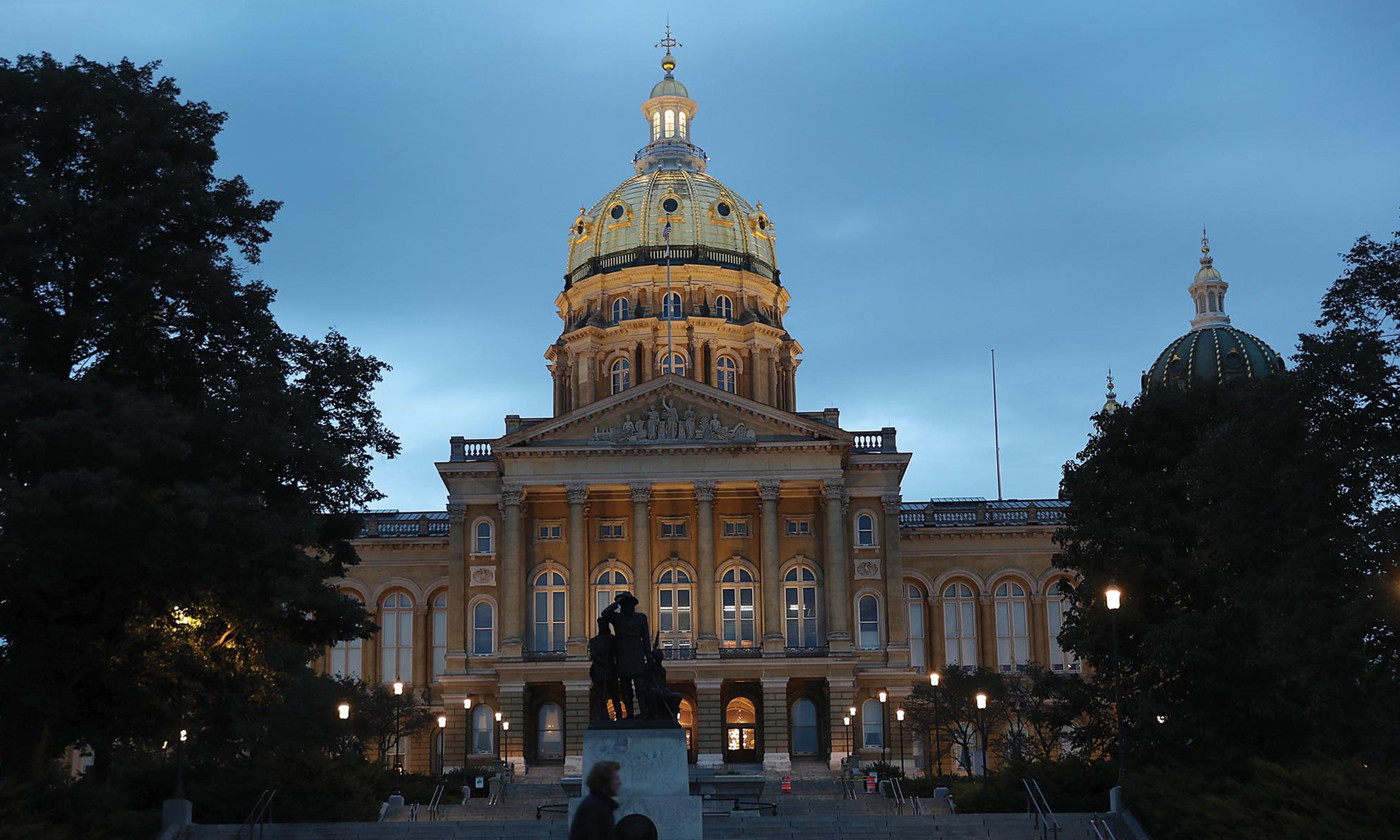
Iowa led the way. The state is replacing its nine-bracket progressive income tax, which included a top rate of 8.53 percent, with a flat tax. This year, there are four brackets with a top rate of 6 percent, and one bracket will be eliminated each year, coincident with rate reductions, until 2026, when everyone will pay a flat rate of just 3.9 percent. Iowa is cutting the corporate-tax rate to 5.5 percent, subject to revenue triggers. And it has already exempted retirement income from taxation.
Iowa house speaker pro tempore John Wills did not expect to become a politician. He was politically active in Dickinson County, in the northwestern part of the state, when the 89-year-old “matriarch” of Republican politics there told him he would run for the state house. Wills initially refused, he says, but “over the course of another month, that stewed in my mind, and one time on Fox News they were talking about something, and my wife and I, at almost the same time, said, ‘Why doesn’t somebody do something about that?’ And boom, here I am.”
First elected in 2014, Wills, 57, has risen through the ranks, and in addition to being a leader of Iowa house Republicans, he is a board member of ALEC. Working with ALEC alumna Kim Reynolds in the governor’s office, Wills helped lead the charge for Iowa’s tax reform.
There are two things midwestern Republican politicians say they want to avoid. First, they want to avoid unfavorable comparisons to Illinois. On literally anything. As of 2021, Iowa had higher income-tax rates than Illinois, which Wills says served as a wake-up call that reform was necessary.
The second thing they want to avoid is any comparison to the so-called Kansas experiment. In 2012, then-governor Sam Brownback signed into law huge tax cuts that he said would boost economic activity and raise revenue, and the cuts were initially praised by supply-siders. Kansas experienced weak growth and budgetary shortfalls instead, and the Republican stronghold elected a Democratic governor, Laura Kelly, in 2018 and 2022.
“We were looking at being very cautious, and being very conservative, I guess you could say, in our approach, so that if at any point the revenues weren’t coming in as projected, we could back it off,” Wills says. That’s why the cuts are designed to step up over several years.
Another thing that has improved in the conservative movement since 2012 is the quality of economic modeling. As John J. Miller wrote in National Review (May 29), the Buckeye Institute, a free-market group from Ohio, began developing STELA, a computer model for the economic effects of tax policies, in 2014. That model has now been used in other states, including Iowa, to help policy-makers predict the effects of tax cuts more accurately.
Iowa Republicans were still shell-shocked by the Kansas experiment, and Wills says they needed to be educated on the real reasons why Kansas’s reforms failed. “We told them not to listen to the rhetoric and the media, who are going to tell you, ‘What happened in Kansas is that they lowered taxes, and that’s what caused all the problems.’ Well, no, in truth what happened is that they lowered taxes too much, and then they increased spending, and those two dynamics together just don’t work.”
“We’re only spending 88 percent of our projected new revenue this year, and we’ve been right around 80 or 90 percent in the last few years,” Wills adds. “We’ve slowed the growth of our spending.” After more than five consecutive years of increasing balances, Iowa’s rainy-day fund is at $895 million, according to the NASBO report, compared with a state budget of about $8.5 billion.
Wills does not think Iowa overshot; in fact, he sees room for more cuts in the future. “This is the first year where senior citizens’ retirement income is not taxed, and our revenue projections are coming in over what we expected them to. So we’re over-collecting taxes still,” he says. “By 2029, we’ll be $9 billion in the black, so we’ll basically have over one year’s entire revenue in our savings, and we can’t have that. It’s not the state’s job to be a bank.”
A few Democrats in moderate districts voted for the reforms, but Democrats overall have rejected them, Wills says. “They keep saying, ‘This is the state taxpayers’ money, and we need to spend this money in an appropriate manner so that taxpayers have all the policies that they want,’ and we absolutely are. We’re doing that already without spending excess money.” The voters seem to agree. Iowa Republicans control 64 of 100 house seats and 34 of 50 senate seats, and they picked up seats last year after passing the tax cuts.
Williams, of ALEC, disagreed with the argument that tax cuts should no longer be a primary part of the conservative economic agenda. “I think it shows how out of touch the people who make that argument are with what’s going on at the conservative grassroots level across the country,” he says. “You may have some of the groupthink going sour on tax cuts, but the overwhelming evidence is the majority of conservative state legislatures are moving in the exact opposite direction. Working in the states now for 20 years, as we’ve seen the factions clearly develop in the Republican Party and in the conservative world at large, I don’t think I’ve seen this kind of unity over an issue like we’ve seen around tax cuts in the last several years.”
Of the argument for downplaying tax cuts, Wills says, “I think that’s kind of — to put it bluntly, that’s kind of bull. Right now, I think Americans as a whole are overtaxed. I think it’s stifling growth. You can have all the industrial policy, all the pro-growth policies you want, but if you’re stifling the average citizen and causing them to not have the freedom to spend their money as they wish, you’re just slowing down the growth that you so desperately want. I think it’s backwards thinking.”












Comments